
Planetary Science
APEX (Advanced Photovoltaic & Electronic Experiment) successfully tested a wide array of advanced photovoltaic and electronic components in a harsh radiation environment, provided significant data to support improved designs for future space systems. During operation, APEX's highly elliptical orbit allowed the investigation of space plasma effects on high-voltage operation (current leakage at positive voltages and arcing at negative voltages) in the perigee region, plus the investigation of space radiation effects (decreased array power output from passage through the inner radiation belt) in the apogee region.
Orbital Attempt
#3,917
OSC Mission
#8
Pad Launch
#5
Location Launch
#7
Designator
1994-046
Aug 3, 1994, 2:38 PM
1 update
Total Launches
51
Total Landings
0
Coordinates
34.9056, -117.8836
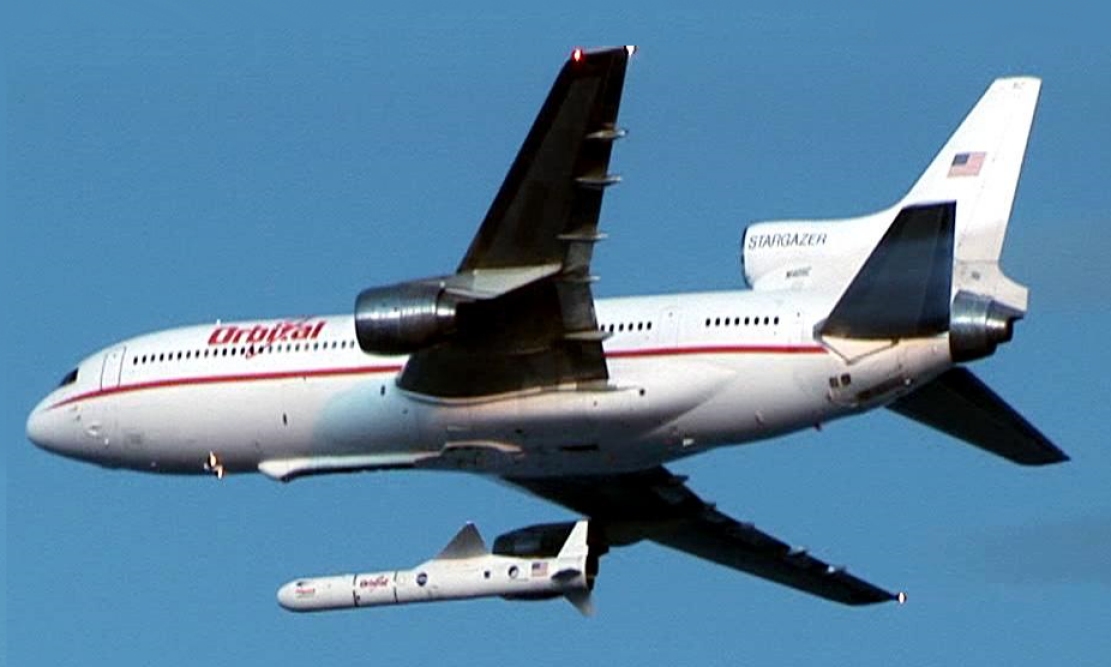
The Pegasus is an air-launched rocket developed by Orbital Sciences Corporation (now part of Northrop Grumman Innovation Systems). Capable of carrying small payloads of up to 443 kilograms (977 lb) into low Earth orbit, the vehicle consists of three solid propellant stages and an optional monopropellant fourth stage. Pegasus is released from its carrier aircraft at approximately 40,000 ft (12,000 m), and its first stage has a wing and a tail to provide lift and attitude control while in the atmosphere.
Length
16.9 m
Diameter
1.27 m
Launch Mass
18 t
Thrust
580 kN
LEO Capacity
443 kg
GTO Capacity
0 kg
Launch Cost
$40M
Reusable
No
Maiden Flight
1990
Fastest Turnaround
2mo 14d
Total Launches
4
Successful
4
Failed
0
Consecutive Success
4
Maiden flight: Apr 5, 1990