Government/Top Secret
Note: Payload identity and Cosmos series numbering not confirmed. The Strela (Russian: Стрела) are Soviet, then Russian, military space telecommunication satellites, in use since 1964. These satellites operate as mailboxes ("store-and-forward"): they remember the received messages and then resend them after the scheduled time, or by a command from the Earth. They can serve for up to five years. The satellites are used for transmission of encrypted messages and images. The operational constellation consists of 12 satellites in two orbital planes, spaced 90° apart. The spacecraft had a cylindrical body with a gravity-gradient boom, which was extended on-orbit to provide passive attitude stabilization. On-board storage was 12 Mbits of data, with a transmission rate of 2.4 kbit/s. The first three satellites were launched in 1964 by a Cosmos launcher. After one year of service, new and improved satellites were launched, called Strela-2. In 1970, these satellites were modernized, and became the Strela-1M and Strela-2M satellites. From 1985, these satellites will be gradually replaced by Strela-3, and then by Strela-3M from 2005. A civilian version of these satellites was created, called Goniets. Initially they were launched in groups of six on Tsyklon; when the launcher was retired, they were only launched by two on Cosmos, before Rokot was put into service and allowed the sending of triplets of Strela satellites.
Orbital Attempt
#7,129
VKS Mission
#152
Pad Launch
#11
Location Launch
#1,679
Designator
2025-273
Nov 25, 2025, 1:42 PM
Minute
1 update
1:00 PM
Window Open
2:35 PM
Window Close
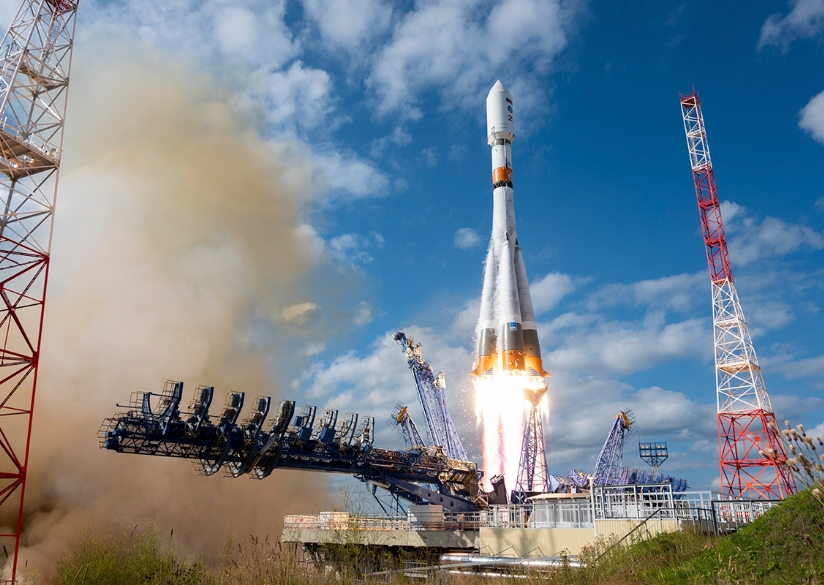
Plesetsk Cosmodrome is a Russian spaceport located in Mirny, Arkhangelsk Oblast, about 800 km north of Moscow and approximately 200 km south of Arkhangelsk. Originally developed as an ICBM site for the R-7 missile, it also served for numerous satellite launches using the R-7 and other rockets. Its high latitude makes it useful only for certain types of launches, especially the Molniya orbits, so for much of the site's history it functioned as a secondary location, with most orbital launches taking place from Baikonur, in the Kazakh SSR. With the end of the Soviet Union, Baikonur became a foreign territory, and Kazakhstan charged $115 million usage fees annually. Consequently, Plesetsk has seen considerably more activity since the 2000s.
Timezone
Europe/Moscow
Local Launch Time
Nov 25, 2025, 4:42 PM
Total Launches
1,686
Total Landings
0
Coordinates
62.9256, 40.5778