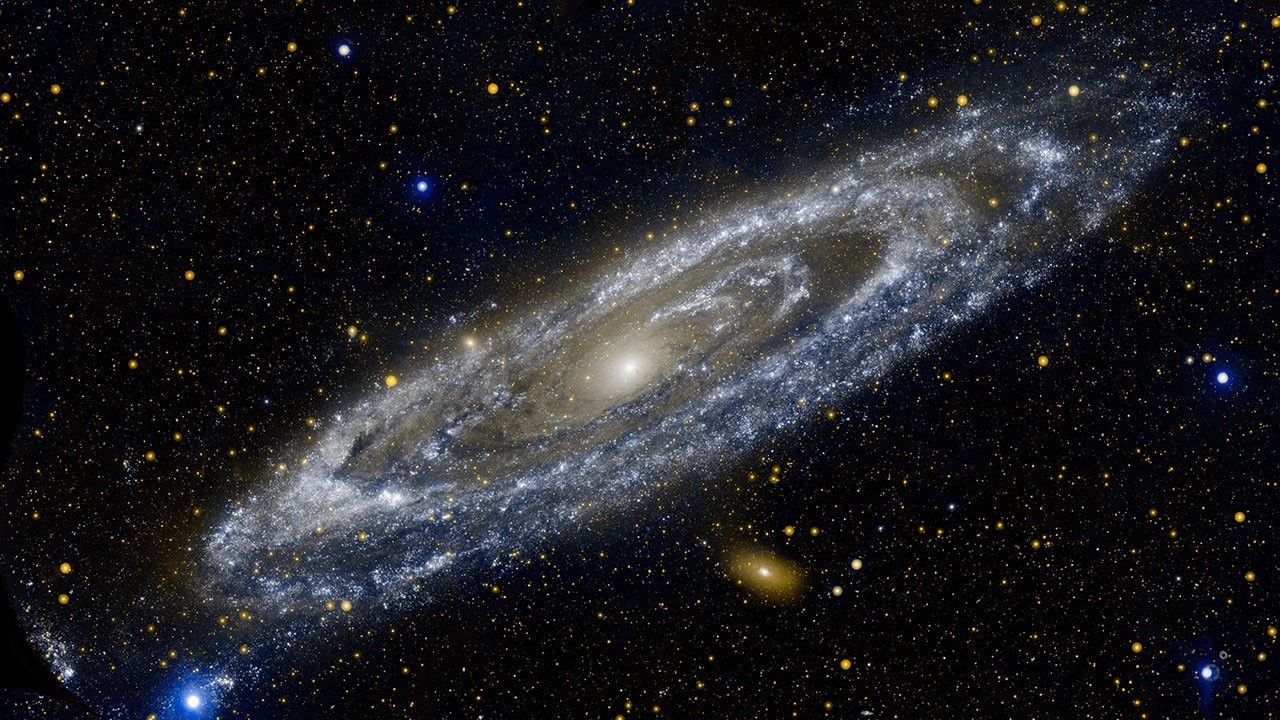
Andromeda Galaxy
The nearest major galaxy to the Milky Way — a trillion-star barred spiral 2.5 million light-years away whose future collision with our own galaxy is no longer a certainty.
The Andromeda Galaxy
The Andromeda Galaxy — catalogued as Messier 31 (M31) and NGC 224 — is a massive barred spiral galaxy located approximately 2.5 million light-years from Earth. It is the nearest large galaxy to the Milky Way, the most massive member of the Local Group of galaxies, and the largest galaxy visible to the naked eye from Earth's surface. On a dark, moonless night it appears as a faint, elongated smudge in the constellation Andromeda, spanning an angular width roughly six times that of the full Moon — a deceptively modest appearance for a system containing an estimated one trillion stars.
Andromeda's sheer proximity makes it an exceptional laboratory for galactic astronomy. Unlike any other large spiral galaxy, its individual stars can be resolved and studied in detail, allowing astronomers to reconstruct its full star-formation history, map its stellar populations, and trace the evidence of ancient mergers with smaller galaxies. The Hubble Space Telescope has devoted more than 1,000 of its precious orbiting hours to Andromeda alone, and in January 2025 released the largest photomosaic ever assembled of the galaxy, built from more than 600 individual snapshots collected over more than a decade.
For centuries Andromeda was thought to be a cloud of gas inside our own galaxy. It was Edwin Hubble's identification of pulsating Cepheid variable stars within it in 1923–1924 that proved it to be a separate, enormously distant "island universe" — a discovery that instantly expanded humanity's picture of the cosmos by orders of magnitude. Today Andromeda is also central to one of the most dramatic long-range predictions in astrophysics: the eventual collision and merger of the two largest galaxies in the Local Group. But even that outcome, long presented as inevitable, has recently been called into question.
From Ancient Sky to Space Telescope
- 964 CEAl-Sufi's 'small cloud'
Persian astronomer ʿAbd al-Rahman al-Sufi describes a 'small cloud' in the constellation Andromeda in his Book of Fixed Stars — the earliest known written record of the object now called the Andromeda Galaxy.
- Aug 3, 1764Messier observes the nebula
French comet-hunter Charles Messier carefully observes the Andromeda object while searching for comets. He notes it as a permanent, non-cometary fuzzy patch and includes it in his catalogue of objects that could be confused with comets.
- 1771 / 1781Listed as M31 in the Messier catalogue
Andromeda is published as Messier 31 (M31) — the 'Great Andromeda Nebula' — in Messier's catalogue of nebulae and star clusters. It is still assumed to be a gaseous cloud within the Milky Way.
- 1899First deep photographic image
Welsh-born astronomer Isaac Roberts obtains a celebrated deep photograph of the 'Great Andromeda Nebula,' clearly revealing its spiral structure. The image attracts wide attention, but the object is still widely regarded as a nebula inside our own galaxy.
- 1912–1913Leavitt's Cepheid period–luminosity relation
Henrietta Swan Leavitt at Harvard publishes the period–luminosity relation for Cepheid variable stars, showing that a Cepheid's pulsation period reveals its true luminosity. This turns Cepheids into reliable 'standard candles' for measuring cosmic distances — the key tool that will soon settle the debate about Andromeda's nature.
- 1910s – early 1920sThe 'Great Debate'
Astronomers argue fiercely over whether spiral nebulae like Andromeda are 'island universes' — independent galaxies far beyond the Milky Way — or merely gas clouds within our own galaxy. The question remains unresolved until Hubble's measurements.
- 1923–1924Hubble resolves Cepheids in Andromeda
Using the 100-inch Hooker telescope at Mount Wilson, Edwin Hubble identifies individual stars and Cepheid variable stars on photographic plates of the Andromeda 'nebula.' Applying Leavitt's relation, he estimates Andromeda's distance at several hundred thousand to around 1 million light-years — far beyond the extent of any plausible Milky Way.
- 1924–1925Andromeda confirmed as a separate galaxy
Hubble presents his distance results, demonstrating that Andromeda lies entirely outside the Milky Way. The 'Great Debate' is resolved: Andromeda is an independent galaxy — an island universe comparable to our own. This single result transforms cosmology.
- 1929Hubble's Law and the expanding universe
Building on his extragalactic distance scale — calibrated partly through Andromeda — and Vesto Slipher's redshift data, Hubble publishes the velocity–distance relation for galaxies, providing the observational foundation for an expanding universe.
- Late 20th centuryDistance refined to ~2.5 million light-years
Improved calibration methods — revised Cepheid scales, the tip of the red giant branch, and eclipsing binary stars — refine Andromeda's distance to approximately 2.48–2.5 million light-years (~780 kiloparsecs), roughly 25 Milky Way diameters away.
- ~2010sPHAT: Panchromatic Hubble Andromeda Treasury
The PHAT program uses Hubble's Advanced Camera for Surveys and Wide Field Camera 3 to mosaic the northern half of Andromeda across wavelengths from near-ultraviolet to near-infrared, resolving tens of millions of individual stars and providing an unprecedented stellar map of the galaxy.
- 2020sPHAST: Panchromatic Hubble Andromeda Southern Treasury
The companion PHAST program images the southern half of Andromeda, adding approximately 100 million resolved stars. Together, PHAT and PHAST required more than 1,000 Hubble orbits spanning over a decade.
- January 2025Largest-ever Andromeda photomosaic released
NASA and ESA release the largest photomosaic ever assembled of the Andromeda Galaxy, built from more than 600 Hubble snapshots collected over more than a decade. The mosaic resolves the glow of roughly 200 million stars and is intended to help astronomers reconstruct Andromeda's history of mergers with smaller galaxies.
Physical characteristics
Andromeda is classified as a barred spiral galaxy, morphological type SA(s)b in the de Vaucouleurs–Sandage system. While visible-light images show a classic spiral appearance, infrared observations from the 2MASS and Spitzer surveys reveal a box-shaped central bulge — the signature of a central bar — confirming Andromeda as a barred spiral structurally similar to the Milky Way. The galaxy is inclined roughly 77° to our line of sight, making it appear nearly, but not quite, edge-on from Earth.
The stellar disk and surrounding halo extend to a diameter of approximately 200,000–260,000 light-years, depending on how the galaxy's boundary is defined. This makes Andromeda physically larger in extent than the Milky Way, even though its total mass — including dark matter — is broadly comparable, estimated at roughly 1–3 trillion solar masses. At its distance of about 2.5 million light-years, Andromeda subtends an angular width on the sky roughly six times that of the full Moon, though only the brightest inner regions are visible to the unaided eye.
The outer disk is not flat but shows a pronounced S-shaped warp, most likely caused by gravitational interactions with its companion galaxies, particularly M32 and M110. Rectified images of the disk reveal two continuous trailing spiral arms separated by at least 13,000 light-years, traced inward to within approximately 1,600 light-years of the nucleus. The astronomer Walter Baade famously described the chains of ionized hydrogen (H II) regions strung along these arms as 'beads on a string.' Infrared observations have further shown that much of Andromeda's gas and dust is arranged in overlapping rings, the most prominent being a structure at roughly 32,000 light-years from the center, nicknamed the 'ring of fire.' A smaller inner ring is interpreted as the debris of an encounter with the companion galaxy M32 more than 200 million years ago.
At the heart of Andromeda sits a double nucleus — a dense central star cluster surrounding the true core — and an embedded supermassive black hole designated M31*. The surrounding dark matter halo has an estimated mass of roughly 1.5 × 10¹² solar masses and extends approximately 1 million light-years from the galaxy's center. Andromeda also possesses a massive halo of hot gas whose mass is estimated at roughly half the mass of all the galaxy's stars.
Satellite galaxies and globular clusters
Andromeda presides over a rich entourage of smaller galaxies. Surveys such as the Pan-Andromeda Archaeological Survey (PAndAS), conducted with the Canada-France-Hawaii Telescope, have identified several dozen dwarf satellite galaxies orbiting M31, broadly comparable in number to the Milky Way's own satellite population. The two most prominent companions are M32 (NGC 221), a compact dwarf elliptical galaxy visible superimposed on Andromeda's southern disk, and M110 (NGC 205), a larger dwarf elliptical with visible tidal features. Both are strongly implicated in disturbing Andromeda's spiral structure and warping its outer disk.
A striking finding from PAndAS in 2013 revealed that 15 of Andromeda's dwarf satellites are arranged in an enormous, extremely thin plane about 1 million light-years in diameter but only roughly 30,000 light-years thick. The probability of this arrangement arising by chance was estimated at just 0.13%. Radial velocity measurements showed that 13 of these 15 satellites share coherent rotation about M31, a result statistically significant at 99.998% confidence. Such a thin, co-rotating plane of satellites is difficult to reproduce in standard cosmological simulations and remains an active subject of galaxy-formation research.
Andromeda's globular cluster system is the largest in the Local Group, comprising approximately 460 known clusters — roughly three times as many as orbit the Milky Way. The most massive of these is Mayall II (also called G1, or Globular One), which has greater luminosity than any other known globular cluster in the Local Group. The globular clusters are distributed through Andromeda's halo and inner regions; several are bright enough to be detected with moderate amateur telescopes as faint, compact points of light projected against the galaxy's disk.
What Andromeda has revealed
Edwin Hubble's 1923–1924 identification of Cepheid variable stars in Andromeda placed it far beyond any plausible boundary of the Milky Way, instantly establishing that the cosmos contains billions of independent galaxies. This is one of the most consequential observational results in the history of astronomy.
Infrared observations by ESA's Infrared Space Observatory and NASA's Spitzer Space Telescope revealed that Andromeda's gas and dust are structured into several overlapping rings. The dominant ring, at roughly 32,000 light-years from the center, is an active site of star formation and was likely triggered by a collision with the companion galaxy M32 more than 200 million years ago.
PAndAS survey data published in 2013 showed that 15 of Andromeda's dwarf satellites lie in a single thin plane and orbit M31 in the same direction. The statistical significance of this coherent structure — 99.998% confidence — makes it one of the sharpest challenges to standard predictions of satellite galaxy distributions.
A major Hubble Treasury Program using more than 1,000 Hubble orbits to study Andromeda's dwarf galaxy ecosystem found that Andromeda's satellites are more diverse than the Milky Way's. Evidence suggests many of Andromeda's dwarf companions retained gas and continued forming stars longer after falling into Andromeda's gravitational sphere of influence.
Research published in Nature Astronomy in 2025, based on 100,000 Monte Carlo simulations using updated Hubble and Gaia measurements and incorporating the gravitational influence of the Large Magellanic Cloud and Triangulum Galaxy, found that there is only about a 50% chance that the Milky Way and Andromeda merge within the next 10 billion years — overturning the long-held view that a head-on collision in roughly 4–5 billion years was essentially certain.
The combined PHAT and PHAST Hubble surveys, completed over more than a decade and released as the largest-ever Andromeda photomosaic in January 2025, resolved the individual light of roughly 200 million stars in Andromeda's disk — enabling direct measurement of stellar ages and chemical compositions across the galaxy's full extent.
The predicted collision with the Milky Way
For decades, one of the most dramatic predictions in astrophysics held that the Andromeda Galaxy and the Milky Way are on a collision course. Because Andromeda is approaching the Milky Way at roughly 110–120 km/s along the line of sight, Hubble Space Telescope–based orbital models published around 2012 predicted that the two galaxies would experience a first close passage — their disks plowing through each other — in approximately 3.75–4 billion years, with subsequent passes leading to a final coalescence into a single large, elliptical-like galaxy (popularly dubbed 'Milkomeda') within roughly 6–7 billion years. This scenario was widely presented by NASA and ESA as essentially certain, assuming Andromeda's sideways, or tangential, motion was very small.
That picture has now been substantially revised. A study published in Nature Astronomy in 2025 — led by Till Sawala and colleagues, based on a preprint first posted in 2024 — combined updated proper-motion measurements from both the Hubble Space Telescope and ESA's Gaia satellite and accounted for the gravitational influence of the Large Magellanic Cloud and the Triangulum Galaxy (M33). The team ran 100,000 Monte Carlo simulations of the Local Group's future evolution. The results are striking: there is only approximately a 50% probability that the Milky Way and Andromeda merge at all within the next 10 billion years. In the roughly half of simulations where no merger occurs within that timeframe, the two galaxies either pass each other at separations of hundreds of thousands of light-years or settle into wide, slowly decaying orbits in which dynamical friction is too weak to bring them together within 10 billion years.
When a merger does occur in the simulations, the typical timescale is considerably longer than the older estimates: the median merger time is approximately 7.6–8 billion years from now, depending on the exact separation threshold used to define coalescence. And the classic early scenario — a head-on collision in only 4–5 billion years — is found to have only about a 2% probability. ESA/Hubble's 2025 press release summarized the situation plainly: there is now only a '50–50 chance' of a collision within the next 10 billion years, and the previously cited figure of roughly 4.5 billion years is no longer regarded as near-certain. The older NASA/ESA visualizations depicting a guaranteed galactic train wreck thus represent a plausible but now low-probability, early-merger subset of a much wider range of possible futures.
Frequently Asked Questions
Sources
- Andromeda Galaxy | Description, Location, Distance, & Facts — Britannica
- Messier 31 (The Andromeda Galaxy) — NASA Science / Hubble
- Andromeda Galaxy: Facts about our closest galactic neighbor — Space.com
- The Andromeda Galaxy: All you need to know — EarthSky
- Andromeda Galaxy (M31): A star that changed the universe — Astrography
- NASA's Hubble Traces Hidden History of Andromeda Galaxy — NASA Science
- Andromeda Galaxy — Wikipedia
- The Curious Case of Andromeda's Satellites — Astrobites
- No certainty of a Milky Way–Andromeda collision — Nature Astronomy (2025)
- [2408.00064] Apocalypse When? No Certainty of a Milky Way–Andromeda Collision — arXiv
- Hubble casts doubt on certainty of galactic collision — ESA/Hubble
- Crash of the Titans: Milky Way & Andromeda Collision — NASA SVS
- NASA's Hubble Provides a Bird's-eye View of the Andromeda Galaxy's Ecosystem — UC Davis Letters & Science