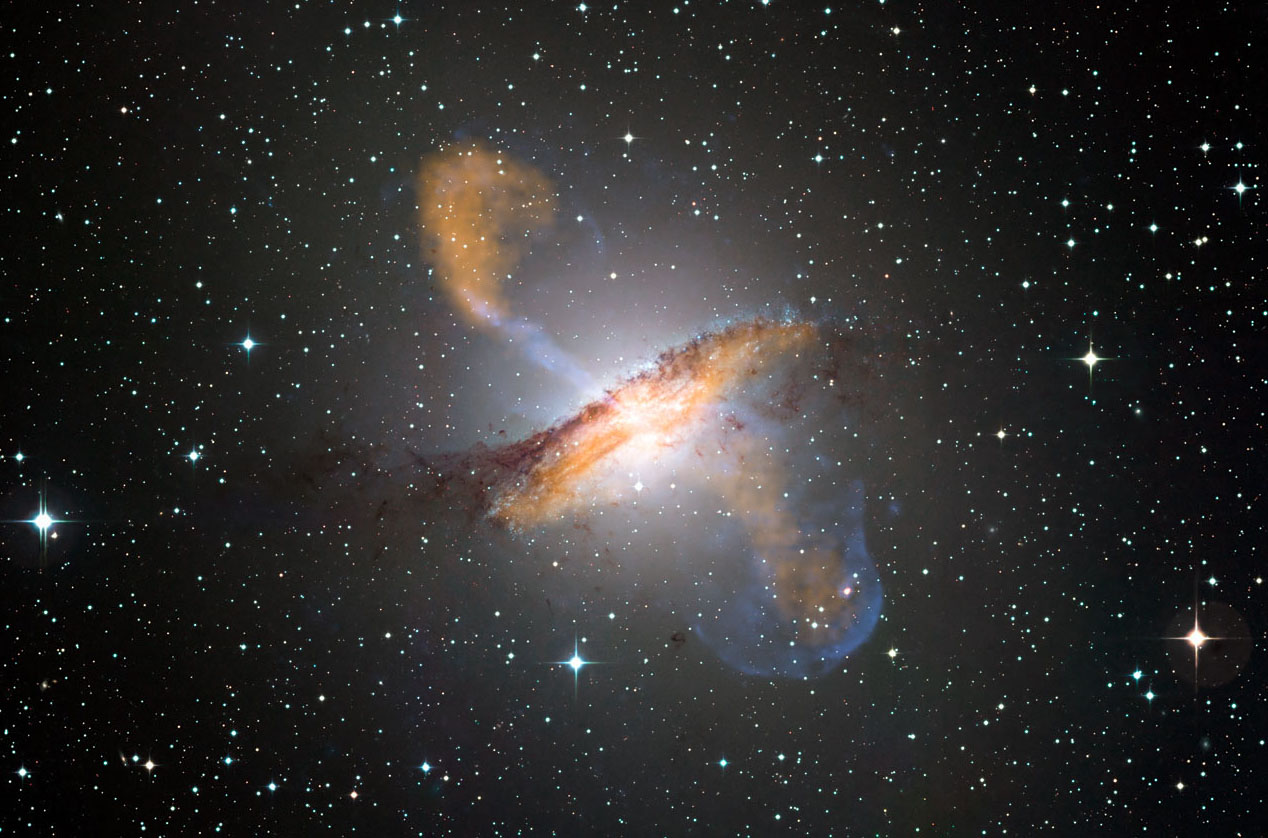
Centaurus A
The nearest active radio galaxy — a colossal merger remnant with a supermassive black hole and jets stretching over a million light-years.
Centaurus A — The Nearest Radio Galaxy
Centaurus A — also catalogued as NGC 5128 and Caldwell 77 — is the nearest prominent active radio galaxy to Earth, situated roughly 12 million light-years away in the southern constellation Centaurus. It occupies a unique position in modern astrophysics: close enough to be studied in extraordinary detail across the entire electromagnetic spectrum, yet energetic enough to exhibit nearly every phenomenon associated with the most powerful galaxies in the universe. From its colossal radio lobes spanning over a million light-years to its supermassive black hole caught in the act of launching relativistic jets, Centaurus A has served for decades as a cornerstone laboratory for understanding active galactic nuclei, galaxy mergers, and the physics of relativistic jets.
Morphologically, the galaxy presents a striking contradiction. Its bright, rounded stellar body resembles a classical giant elliptical galaxy — dominated by billions of old, red stars — yet its core is bisected by a broad, dark, warped dust lane laced with young blue stars and active star-forming regions. This peculiar duality is the signature of a dramatic cosmic collision: Centaurus A is widely understood to be the remnant of a major merger between a large early-type galaxy and a gas-rich disk galaxy, with the final coalescence completed roughly 2 billion years ago. The merger deposited fresh gas and dust into the heart of what was once a quiescent elliptical, reigniting star formation and feeding the central supermassive black hole.
With an apparent visual magnitude of about 7, Centaurus A falls just below naked-eye visibility but is easily resolved through binoculars or a small telescope from the southern hemisphere, revealing its distinctive dust lane against the glow of the stellar bulge. In professional observations spanning radio, infrared, optical, X-ray, and gamma-ray wavelengths, it displays virtually every hallmark of a powerful active galactic nucleus — variability, a compact radio core only about 10 light-days across, a one-sided relativistic jet, and extended radio lobes that dwarf the optical galaxy by orders of magnitude.
From Peculiar Nebula to AGN Paradigm
- 4 Aug 1826Discovery by James Dunlop
Scottish-Australian astronomer James Dunlop observes NGC 5128 from Parramatta Observatory, New South Wales, cataloguing it as entry No. 482 in his southern nebulae survey. He notes a peculiar, bisected appearance but has no framework to interpret it.
- 1847–1849John Herschel's detailed description
John Herschel publishes an account in Outlines of Astronomy, noting two elliptical nebulous halves separated by a broad, dark band with a faint light streak at its centre — an accurate description of the dust lane that would intrigue astronomers for over a century.
- 1948Radio astronomy comes of age
John Bolton and colleagues, using a sea-cliff radio interferometer at Dover Heights, Sydney, detect discrete radio sources in the sky, among the earliest ever identified by the new discipline of radio astronomy.
- 1949Identification as a powerful radio source
John G. Bolton, Bruce Slee, and Gordon Stanley publish a landmark paper identifying Centaurus A as a bright radio source and associating it with the optical object NGC 5128 — one of the first extragalactic radio sources to be localized. The designation 'Centaurus A' is coined because it is the brightest radio source in the constellation.
- 1954Merger interpretation proposed
Walter Baade and Rudolph Minkowski, working at Palomar Observatory, confirm that NGC 5128 is an external galaxy and propose that its peculiar morphology results from a collision and merger between a giant elliptical and a smaller spiral galaxy.
- 1970First X-ray detection
Centaurus A is detected in X-rays for the first time using a sounding rocket, establishing it as a multi-wavelength emitter and hinting at the energetic processes near its nucleus.
- 1974–1976Gamma-ray detection
Balloon-borne instruments detect gamma-ray emission (33 keV–12.25 MeV) from Centaurus A, most likely originating in the nuclear region, placing it among the first radio galaxies detected at such high energies.
- 1975Optical jet discovered
Victor Blanco, using a telescope at Cerro Tololo Inter-American Observatory (CTIO), detects a faint optical jet extending from the nucleus, along with blue stellar objects in the jet region.
- 1979X-ray jet discovered
Ethan Schreier, using the Einstein X-ray Observatory (HEAO-2), discovers an X-ray jet from Centaurus A's nucleus. Coordinated VLA observations by Eric Feigelson and Jack Burns identify the corresponding radio jet, establishing the multi-wavelength jet structure.
- 1997VLBA resolves the radio core
Kenneth Kellermann, Anton Zensus, and Marshall Cohen use the Very Long Baseline Array to resolve Centaurus A's radio core to a size of only about 10 light-days — then the smallest known extragalactic radio source. Day-scale variability is observed, and the central mass is inferred to be around 100 million solar masses.
- Jul 2021Event Horizon Telescope images the jet base
The EHT Collaboration publishes the first high-resolution image of Centaurus A's jet-launching region in Nature Astronomy (Janssen et al.), based on 2017 observations at 1.3 mm with 25-microarcsecond angular resolution. The image reveals an edge-brightened jet structure and pinpoints the likely position of the central black hole.
Physical Structure and Morphology
Centaurus A's optical appearance is immediately striking even in modest telescopes: a bright elliptical glow, roughly 58,000 light-years in diameter, cleaved across its middle by a wide, dark, warped dust lane. This dust lane is not a simple band of obscuring material — it is a complex structure hosting over a hundred identified star-forming regions, young blue stars, and warm dust clouds that radiate strongly in the infrared. The juxtaposition of old red stars in the bulge and vigorous young star formation in the dust lane is a direct consequence of the galaxy's merger history, with infalling gas compressed during the collision triggering a burst of new stellar birth.
The galaxy's overall morphology is classified as a peculiar elliptical — designated E0 or S0 pec — reflecting its mixed character. The dominant stellar body follows a smooth, de Vaucouleurs-like brightness profile typical of elliptical galaxies, but the prominent dust lane, shells of stars visible in the outer halo, and the extended stellar streams betray the imprint of a major merger. Infrared observations, which pierce through the optically thick dust lane, reveal the hot gas and accretion structures at the very core that are completely hidden in visible light. The central region also contains a tilted disk of hot gas roughly 130 light-years across, encircling the black hole and likely feeding a smaller inner accretion disk that drives the AGN.
Well beyond the optical galaxy, Centaurus A is enveloped by enormous radio-emitting lobes. The inner jet and counter-jet structure spans approximately 40,000 light-years from end to end in the radio and X-ray bands, while the full extent of the giant outer radio lobes stretches over 1 million light-years — dwarfing the visible galaxy by a factor of roughly twenty. These lobes are filled with relativistic electrons spiralling in magnetic fields, radiating across the radio, X-ray, and gamma-ray bands and making Centaurus A one of the brightest radio sources in the entire sky.
The Supermassive Black Hole and Active Nucleus
At the heart of Centaurus A lurks a supermassive black hole with a mass estimated at approximately 55 to 100 million solar masses — with modern high-resolution measurements favouring values in that range, and ESO studies citing approximately 100 million solar masses. For comparison, the Milky Way's central black hole, Sagittarius A*, has a mass of about 4 million solar masses, making Centaurus A's black hole substantially more massive. Despite this, the black hole's event-horizon angular size as seen from Earth remains too small to be imaged directly by the current Event Horizon Telescope array operating at 1.3 millimetres — only the jet-launching region can be resolved.
The central engine is identified as a radio-loud active galactic nucleus. In visible light, the dusty lane almost completely obscures the nuclear region, but infrared, radio, and X-ray observations reveal a compact, variable source only about 10 light-days across at radio wavelengths — an extraordinarily small region given the energy it produces. The nucleus displays variability across its entire spectrum, from radio frequencies through X-rays and into gamma-rays, consistent with ongoing accretion of gas onto the black hole. This accretion powers relativistic jets that carry enormous amounts of energy outward from the nucleus into the surrounding intergalactic medium.
Centaurus A is often described as the nearest BL Lac-type object — a class of AGN characterised by a nearly featureless, highly variable spectrum dominated by jet emission. Its proximity makes it one of the best-studied objects of its kind. The combination of a bright, resolved structure and manageable distance means that phenomena normally inferred indirectly in more distant AGN can be observed directly in Centaurus A, including the proper motion of jet components, the geometry of the jet-launching region, and the interaction between the jet and the surrounding interstellar medium.
The Relativistic Jet
The jets of Centaurus A are among the most intensively studied in any galaxy. On the smallest scales resolved by Very Long Baseline Interferometry, component speeds of 0.1–0.3 times the speed of light are measured. At distances of roughly half a kiloparsec from the nucleus, apparent component speeds up to 0.8 c imply an intrinsic jet speed of approximately 0.63 c, given the jet's inclination to the line of sight. Fluid modelling of the kiloparsec-scale X-ray jet — traced from 0.25 to nearly 6 kiloparsecs — finds an initial intrinsic velocity of about 0.67 c declining modestly to about 0.52 c at the jet tip, as the jet entrains ambient material and decelerates. This behaviour is characteristic of Fanaroff-Riley Class I (FR I) radio galaxies, where jets decelerate through mass loading rather than terminating abruptly in a bright hotspot.
The approaching northeast jet is traced continuously in X-ray images to a projected distance of about 4.5 kiloparsecs from the nucleus, where it blends into the inner radio lobe. The receding southwest jet is much fainter, a consequence of relativistic beaming: the approaching jet's emission is boosted in our direction while the receding jet is suppressed. In the innermost region imaged by the Event Horizon Telescope, the jet-to-counter-jet brightness ratio exceeds 5, consistent with intrinsic speeds of 0.3–0.5 c at inclinations of roughly 20 degrees in the jet collimation zone. Chandra X-ray observations show a bright, continuous northeast jet and only faint, knotty emission on the southwest side, confirming this beaming asymmetry.
Centaurus A is detected across the full high-energy spectrum. Fermi-LAT observations reveal gigaelectronvolt gamma-ray emission from both the central region and the extended radio lobes, where relativistic electrons scatter cosmic microwave background photons to high energies via inverse Compton processes. Very-high-energy gamma-ray emission above 1 TeV has also been detected at greater than 5-sigma significance, placing Centaurus A alongside M87 as one of only a handful of radio galaxies confirmed as TeV emitters. This broad-spectrum emission — from metre-wavelength radio through TeV gamma-rays — makes Centaurus A one of the most complete laboratories for non-thermal astrophysics available.
Stellar Populations and Merger History
Centaurus A's stellar populations tell a detailed story of two distinct episodes of galaxy assembly. Deep Hubble Space Telescope imaging of the halo, tens of kiloparsecs from the nucleus, shows that roughly 70–80 percent of the halo stars formed in a short, intense burst approximately 12 billion years ago — placing this initial formation episode in the early universe, contemporaneous with the formation of most giant elliptical galaxies. These stars are predominantly red giant branch stars with metallicities higher than those typical of Local Group halos, indicating early, dissipative collapse of a massive gas reservoir.
Superimposed on this ancient population is a younger component comprising roughly 20–30 percent of halo stars, with ages of 2–4 billion years. This intermediate-age population is the smoking gun of the recent major merger. Hydrodynamical simulations tailored specifically to Centaurus A reproduce the galaxy's kinematics, light profile, inner gas-and-dust disc, extended halo, and stellar shells when they incorporate a merger between two disk galaxies of similar mass (mass ratio no greater than 1.5:1, with 20–40 percent gas fractions), with a first close passage about 5 billion years ago and a final coalescence approximately 2 billion years ago. The merger drove gas into the centre, triggering the ongoing starburst and feeding the black hole, while tidal forces redistributed stars into the shells and elongated halo seen in deep optical imaging.
The globular cluster system mirrors this two-phase history. Centaurus A hosts approximately 1,550 globular clusters, with a bimodal metallicity distribution: metal-poor clusters dominate the outer halo while metal-rich clusters are more centrally concentrated, a pattern characteristic of merger-built ellipticals. Several inner clusters have colours and brightnesses consistent with intermediate ages of roughly 2 billion years — aligning with the youngest field stars and the timing of the final coalescence. The mean metallicity of the globular cluster system is higher than that of the Milky Way's system, consistent with formation in a more massive, rapidly enriching progenitor.
What Centaurus A Has Taught Astronomers
When Bolton, Slee, and Stanley identified Centaurus A with NGC 5128 in 1949, it became one of the first radio sources ever traced to an external galaxy, establishing that galaxies could be powerful emitters of non-thermal radiation and founding the field of extragalactic radio astronomy.
Baade and Minkowski's 1954 interpretation of Centaurus A as a merger product — later confirmed by hydrodynamical simulations — was among the earliest and most influential arguments that galaxy collisions produce the peculiar morphologies and enhanced nuclear activity seen in many observed galaxies.
From VLBI sub-parsec observations through Chandra kiloparsec-scale X-ray imaging to the giant radio lobes spanning over a million light-years, Centaurus A's jet is the most completely mapped relativistic outflow in any galaxy, allowing fluid models to trace its deceleration from ~0.67 c to ~0.52 c across the observable region.
Detection of TeV gamma-ray emission from Centaurus A, at greater than 5-sigma significance, established it alongside M87 as one of very few radio galaxies confirmed as sources of very-high-energy gamma-rays, constraining particle acceleration mechanisms in AGN jets and lobes.
The 2021 EHT image of Centaurus A's jet base — the first at 25-microarcsecond resolution — revealed pronounced edge-brightening (the jet's outer edges are brighter than its centre), a morphology not reproduced by standard jet models and now a driver of new theoretical work on jet launching and collimation.
HST colour-magnitude diagrams of the halo and hydrodynamical merger simulations together demonstrated that giant ellipticals like Centaurus A are built in two stages: an ancient (∼12 Gyr) initial formation and a recent (∼2 Gyr ago) major merger, reshaping understanding of elliptical galaxy evolution.
The 2021 Event Horizon Telescope Result
On 19 July 2021, the Event Horizon Telescope Collaboration published the first resolved image of the jet-launching region in Centaurus A, appearing in Nature Astronomy (Janssen et al., 2021; DOI: 10.1038/s41550-021-01417-w). The observations were conducted on 10 April 2017 during a 6-hour track, with 105 minutes on-source, using the global EHT array of eight stations operating at 1.3 millimetres (230 GHz). The resulting angular resolution of 25 microarcseconds was approximately 16 times sharper than any previous radio image of Centaurus A at comparable wavelengths.
The image revealed the innermost structure of the jet on scales reaching down to fractions of a light-day — equivalent to a few hundred gravitational radii of the black hole, whose mass is used in the analysis at approximately 55 million solar masses. The jet shows clear one-sidedness, with a jet-to-counter-jet brightness ratio exceeding 5, consistent with relativistic beaming. Most strikingly, the jet displays pronounced edge-brightening: the outer limbs of the jet are significantly brighter than the interior. This morphology, which challenges standard jet models and is reminiscent of structures seen in M87's jet, points toward jet launching and collimation mechanisms that concentrate the emitting plasma and magnetic fields preferentially along the jet boundary rather than uniformly through its cross-section.
Because the black hole mass in Centaurus A is considerably lower than in M87 — where the EHT famously resolved the photon ring — the event-horizon-scale structure in Centaurus A remains too small to be imaged by the current Earth-sized array at 1.3 millimetres. Imaging the shadow directly would require shorter observing wavelengths and, ultimately, a space-VLBI extension of the EHT. In the meantime, the 2021 result's pinpointing of the black hole's likely position and the revelations about jet collimation geometry have already opened new avenues for theoretical modelling. The calibrated Centaurus A data from the 2017 observations were made publicly available on the same date as the publication. No new Centaurus A EHT observing campaigns or analyses had been released publicly by the end of 2024, with subsequent major EHT results focusing on Sagittarius A* and updated M87* reconstructions.
Frequently Asked Questions
Sources
- Black Holes: Centaurus A — ViewSpace
- Galaxy Centaurus A — NASA Science (Hubble)
- Radio galaxy Centaurus A — ESO.org
- Dusty Elliptical Galaxy Centaurus A — Spitzer/Caltech
- Photo Album: Centaurus A — Chandra X-ray Observatory
- Key events in the observational history of Centaurus A — extragalactic.info
- Centaurus A — Wikipedia
- A Deeper Look at Centaurus A — ESO.org
- Caldwell 77 — NASA Science (Hubble)
- Event Horizon Telescope observations of the jet launching and collimation zone in Centaurus A — Nature Astronomy (Janssen et al., 2021)
- EHT Pinpoints Dark Heart of the Nearest Radio Galaxy — Event Horizon Telescope
- Event Horizon Telescope Pinpoints Heart of the Nearest Radio Galaxy — University of Arizona
- Zoom into the dark heart of Centaurus A — Max-Planck-Gesellschaft
- EHT Data Products — Event Horizon Telescope
- A recent major merger tale for the closest giant elliptical galaxy — MNRAS (2020)
- Centaurus A — NGC 5128 (F.P. Israel review) — NASA/IPAC NED
- One Thousand Wonderful Stars Discovered in Centaurus A — ESO
- 1D fluid model of the Centaurus A jet — MNRAS (Oxford Academic)
- Centaurus A: the Inside Story — NASA Science (Hubble)
- Centaurus A — Britannica