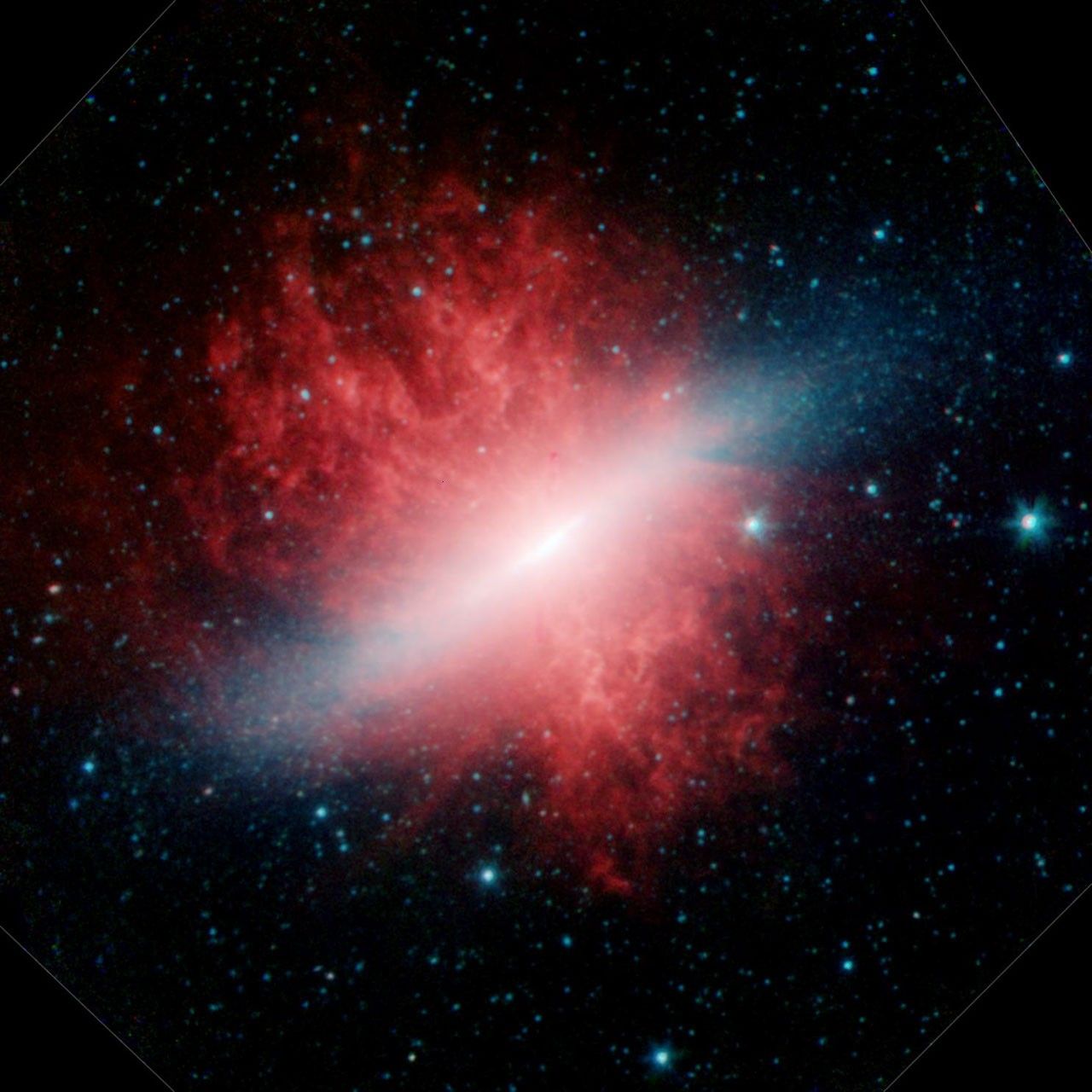
Cigar Galaxy
A nearby starburst galaxy forming stars ten times faster than the Milky Way — and blasting them out into intergalactic space.
Cigar Galaxy (Messier 82)
Messier 82, universally known as the Cigar Galaxy, is one of the most intensely studied galaxies in the night sky. Located approximately 12 million light-years away in the constellation Ursa Major, it is a prototypical starburst galaxy — a system in which star formation is proceeding at a rate roughly ten times that of the Milky Way, concentrated almost entirely within its compact, turbulent core.
The galaxy's distinctive elongated silhouette — from which its popular name derives — is the result of its nearly edge-on orientation as seen from Earth. That geometry also makes visible one of the most dramatic features of any nearby galaxy: a vast bipolar superwind of hot gas and dust that erupts perpendicular to the disk, driven by the furious pace of star birth and stellar death in the nucleus. Filaments of glowing hydrogen extend tens of thousands of light-years above and below the galactic plane, while a magnetised "highway" carries metals, dust, and magnetic flux from the starburst core into intergalactic space.
M82's starburst was ignited — and continues to be sustained — by a gravitational encounter with its giant neighbour M81 (Bode's Galaxy), roughly 600 million years ago. That tidal interaction funnelled gas inward, triggered the formation of more than a hundred massive young star clusters, and distorted M82's structure into the turbulent, irregular system visible today. In 2014, M82 was also the host of SN 2014J, the closest well-observed Type Ia supernova in at least four decades, discovered by chance during a university teaching session in London. Since 2024, the James Webb Space Telescope has pierced the galaxy's dust-obscured core in unprecedented detail, revealing new structure in its star clusters, wind filaments, and ejected clouds of organic molecules.
Discovery and Cataloguing
The Cigar Galaxy entered the historical record on a single observing night in 1774, when German astronomer Johann Elert Bode turned his telescope toward Ursa Major and noticed two faint "nebulous patches" separated by about three-quarters of a degree. One — now known as M81, or Bode's Galaxy — was relatively bright and oval; the other was elongated and very pale. That second smudge was M82. Neither was understood at the time as anything other than a distant, unresolved nebula; the concept of galaxies as island universes lay more than a century in the future.
In 1779, French astronomer Pierre Méchain independently rediscovered both objects and reported them to Charles Messier, the renowned comet-hunter who compiled his famous catalogue of objects that might be mistaken for comets. Messier incorporated them, and M82 became the 82nd entry in the Messier Catalogue — a listing that would eventually make it one of the most-observed deep-sky objects among amateur astronomers worldwide. The galaxy is also catalogued as NGC 3034 in the New General Catalogue.
With an apparent magnitude of approximately 8.4 and apparent dimensions of 11.2 by 4.3 arcminutes, M82 is detectable with binoculars from a dark site and is a showpiece object in small telescopes, which reveal its characteristic elongated shape and a faint hint of the central dust lane. Its angular size and brightness make it one of the finest irregular galaxies accessible to amateur observers in the northern hemisphere.
Physical Characteristics
M82 lies at a distance of approximately 12 million light-years from Earth, placing it among the nearest galaxies with an active starburst. Its physical diameter is roughly 38,000 light-years — considerably smaller than the Milky Way — but the intensity of activity compressed into that volume far exceeds anything in our own galaxy. M82 is classified as an irregular galaxy (type I0) by most authorities, though some descriptions characterise it more broadly as a peculiar or disrupted spiral, reflecting the difficulty of assigning a clean morphological type to a galaxy so severely disturbed by tidal forces.
The galaxy is oriented nearly edge-on from Earth, which is both a cosmetic blessing — producing the striking cigar silhouette — and an observational challenge, since the dense dust lanes that criss-cross the disk absorb most of the visible light from the nucleus. At optical wavelengths, the core is almost entirely hidden. Infrared and radio observations have been essential to understanding what lies within. The James Webb Space Telescope's near-infrared cameras, deployed in 2024 and 2025, have provided the clearest views yet of the stellar populations and molecular structures buried inside the starburst region.
The galaxy belongs to the M81 Group, a loose association of galaxies that includes its dominant neighbour M81 and the irregular NGC 3077, all bound together by gravity at distances of roughly 11 to 12 million light-years from the Milky Way. Within this group, M82 stands out as the most actively star-forming system, a condition directly linked to its gravitational history with M81.
The M81 Interaction and the Starburst
The furious pace of star formation in M82 is not intrinsic to the galaxy — it was induced by a gravitational encounter with M81. The two galaxies are separated by only about 150,000 light-years (comparable to the diameter of the Milky Way itself), and their histories are deeply intertwined. Hubble Space Telescope observations concluded that the last close tidal encounter between M82 and M81 occurred approximately 600 million years ago and lasted around 100 million years. Before that event, M82 was not a particularly active star-forming galaxy.
During and after the encounter, M81's gravitational tidal field distorted M82's structure profoundly. Large-scale gravitational torques and enhanced collisions between clouds of interstellar gas funnelled material inward toward M82's nucleus, dramatically increasing the density of gas available to form stars. The result was a concentrated burst of star formation — a starburst — in the galaxy's central region. Hubble observations subsequently found more than 100 young, compact super star clusters in M82's core, each containing roughly 100,000 stars: direct products of that tidally triggered episode.
The interaction also left an extensive legacy of tidal debris. Streams and filaments of neutral hydrogen gas stretch roughly 10 kiloparsecs (about 32,600 light-years) along M82's minor axis, and the halo contains young and intermediate-age stars that were either displaced by the encounter or formed in the outflowing gas. Studies of the M81 group show that the gravitational interplay involved all three major members — M81, M82, and NGC 3077 — redistributing gas among them and shaping their evolutionary histories over hundreds of millions of years.
Today, star formation in M82's core proceeds at a rate roughly ten times that of the entire Milky Way, concentrated within a region far smaller than our galaxy's disk. This intense activity is self-sustaining in the short term — massive stars form, evolve rapidly, and explode as supernovae, whose combined energy drives the galaxy's spectacular superwind — but it is ultimately a finite episode. The fuel supply is limited, and M82 is gradually exhausting the dense gas reservoir that the M81 encounter delivered to its nucleus.
The Galactic Superwind
One of M82's most visually arresting features is its bipolar superwind: a powerful outflow of hot gas, plasma, and dust that erupts perpendicular to the galactic disk, forming plumes visible in hydrogen-alpha emission extending far into the halo. The wind is powered by the collective energy of thousands of massive stars and supernovae in the starburst core, whose ultraviolet radiation, stellar winds, and explosion shockwaves combine to drive material out of the nucleus at high velocity. The superwind carries an estimated 50 to 60 million solar masses of gas and dust into intergalactic space, enriching the surrounding medium with heavy elements forged in the starburst.
Research using NASA's Stratospheric Observatory for Infrared Astronomy (SOFIA) and its HAWC+ far-infrared polarimeter has revealed that the superwind is intimately coupled to M82's large-scale magnetic field. Polarised thermal emission from dust shows that at the base of the outflow, the magnetic field is dragged into a configuration largely perpendicular to the disk — aligned with the bipolar wind — and remains coherent over approximately 2,000 light-years (around 600 parsecs) above and below the galactic plane. This provided the first direct observational proof that a galactic superwind can drag a galaxy's magnetic field into the halo.
A modified Davis–Chandrasekhar–Fermi analysis of the SOFIA/HAWC+ polarimetry yields an average magnetic field strength in the central starburst region of approximately 0.77 ± 0.45 milligauss — comparable to the thermal and turbulent gas pressure (the turbulent plasma beta is estimated at β′ ≈ 0.56 ± 0.23), indicating that the magnetic field is dynamically significant and not merely a passive tracer of gas motions.
Work by López-Rodríguez and colleagues, applying a solar-heliophysics-style potential field extrapolation technique to M82, traced the three-dimensional structure of the outflow's magnetic field from the disk into the far halo. They found that turbulent kinetic and magnetic energies are in close equipartition at approximately 2 kiloparsecs (measured) and approximately 7 kiloparsecs (extrapolated) above the plane, and that the field lines are predominantly open — extending into the circumgalactic and intergalactic medium rather than looping back to the disk. This configuration was described as a "magnetic highway": a direct channel through which metals, dust, and magnetic flux are transported from the starburst nucleus into intergalactic space, potentially magnetising the medium between galaxies.
SOFIA work also identified a two-component structure in M82's magnetic field: a large-scale component associated with the ordered galactic outflow, and a small-scale turbulent component generated in a bow-shock-like region where the outflow collides with surrounding gas. Researchers interpreted this as the first detection of magnetic energy from a bow shock in a galactic outflow. Independent submillimetre polarimetry from the James Clerk Maxwell Telescope broadly supports this picture, finding one magnetic component tied to the disk and a second vertical, wind-aligned component in the outflow.
What M82 Has Taught Astronomers
M82 is one of the closest and best-observed starburst galaxies, forming stars at roughly ten times the Milky Way's rate in a compact nucleus. It has become the benchmark for understanding how intense star formation proceeds and how it is triggered by tidal interactions.
Hubble observations established that M82's starburst was triggered by a close gravitational encounter with M81 approximately 600 million years ago. The tidal interaction produced more than 100 super star clusters, each containing roughly 100,000 stars, demonstrating how galaxy collisions ignite star formation.
M82's bipolar superwind carries an estimated 50–60 million solar masses of gas and dust enriched with heavy elements into intergalactic space. The galaxy showed that starburst-driven outflows are a major mechanism for distributing metals and energy across the cosmic web.
SOFIA/HAWC+ polarimetry demonstrated for the first time that a galactic superwind can drag a galaxy's magnetic field into the halo, forming open field lines that extend into intergalactic space. M82's "magnetic highway" provides observational proof that starbursts can magnetise the intergalactic medium.
The serendipitous discovery of Type Ia supernova SN 2014J in M82 in January 2014 gave astronomers the closest well-observed Type Ia event in at least four decades, enabling unprecedented multi-wavelength study of explosion physics, dust properties, and the progenitor question.
In 2024–2025, JWST's NIRCam resolved individual young star clusters in M82's dust-obscured core and discovered fine filamentary structures traced by polycyclic aromatic hydrocarbons (PAHs) in the galactic wind, including individual clouds just 16–49 light-years across entrained in the outflow.
SN 2014J — The Closest Type Ia Supernova in Decades
On the evening of 21 January 2014, astronomer Steve Fossey of University College London and four undergraduate students — Ben Cooke, Guy Pollack, Matthew Wilde, and Thomas Wright — were conducting a routine training session at the University of London Observatory in Mill Hill, north London. Exploiting a brief break in cloud cover, they pointed a 0.35-metre (14-inch) teaching telescope at M82. Within minutes they noticed a new, bright point of light in the galaxy's disk that had not been visible in recent archival images.
A comparison with a second telescope ruled out an instrumental artefact. The team reported the discovery to the International Astronomical Union's Central Bureau for Astronomical Telegrams, which confirmed them as first discoverers. The object was designated SN 2014J — the tenth supernova reported in 2014. Spectroscopic observations obtained shortly afterward using the Dual Imaging Spectrograph on the ARC 3.5-metre telescope at Apache Point Observatory classified it as a Type Ia supernova, based on the characteristic silicon absorption features and expansion velocities of approximately 20,000 kilometres per second in the outer ejecta.
Pre-discovery archival data revealed that the supernova had already been visible in images taken as early as 15 January 2014, six days before the formal discovery. Detailed modelling of the early light curve constrained the explosion date to approximately 14.75 January 2014 UT. The supernova reached B-band maximum brightness on 1 February 2014, with an absolute magnitude of approximately −19.19 after correction for the substantial dust extinction within M82's disk. In apparent brightness it reached about magnitude 10.5 — visible in binoculars and accessible to small amateur telescopes.
At a distance of approximately 11.5 ± 0.8 million light-years (3.5 ± 0.3 megaparsecs), SN 2014J is the closest well-observed Type Ia supernova for at least four decades, rivalling SN 1972E when distance uncertainties are taken into account. This proximity made it an extraordinary scientific opportunity, and follow-up observations poured in from facilities across the electromagnetic spectrum — gamma-ray, X-ray, ultraviolet, optical, infrared, and radio — including the Hubble Space Telescope, the Chandra X-ray Observatory, and numerous ground-based observatories. Photometric analysis classified it as a "middle-class" or normal-luminosity Type Ia, making it useful as a calibrator for the cosmic distance ladder and as a testbed for models of explosion physics and interstellar dust.
James Webb Space Telescope Observations (2024–2025)
Since its commissioning, the James Webb Space Telescope has made M82 a priority target, and the results released in 2024 and 2025 represent the most detailed infrared views of the Cigar Galaxy ever obtained. JWST's near-infrared camera (NIRCam) is capable of penetrating the dense dust that has historically obscured M82's nucleus at visible wavelengths, enabling a direct census of the star clusters embedded in the starburst zone.
In 2024, a team led by Alberto Bolatto of the University of Maryland published results from JWST NIRCam imaging of M82's central starburst region. The images resolved dense concentrations of young star clusters and individual point sources within the dusty core that had been inaccessible to previous observatories. At slightly longer near-infrared wavelengths, the data revealed clumpy tendrils of emission extending above and below the galactic plane — the galactic wind traced by emission from polycyclic aromatic hydrocarbons (PAHs), small carbon-rich dust molecules. The study, published in The Astrophysical Journal (Bolatto et al. 2024, arXiv:2401.16648), reported fine filamentary PAH structures in the outflow that were entirely unknown from earlier Hubble or Spitzer observations.
A second, broader NIRCam dataset was released by ESA/Webb as a Picture of the Month on 30 June 2025. This image combined six NIRCam filters at wavelengths of 1.4, 1.64, 2.12, 2.5, 3.35, and 3.6 micrometres — probing emission from ionised iron, molecular hydrogen, methane, and PAHs simultaneously — and covered a wider field than the 2024 core-focused image. The 2025 data captured the light of billions of stars across M82's centre, unobscured by dust, alongside the glow of organic molecules spread across the broader starburst region. Researchers used the PAH emission to identify individual plumes extending out of the disk. Each plume is approximately 160 light-years wide; within each plume JWST resolved multiple individual clouds only 16 to 49 light-years across, demonstrating the small-scale clumpiness of material carried outward by the starburst wind. These clouds appear to be entrained in the outflow and actively being transported away from the galactic disk.
Forthcoming JWST spectroscopic data, not yet fully published as of 2024, are expected to yield ages for individual star clusters across M82's starburst region, potentially constructing a detailed timeline of the different phases of star formation triggered by the M81 encounter. The team working on M82 has also been awarded additional JWST time to observe ten galaxies with large-scale galactic winds, using M82 as the template case for understanding how starbursts drive outflows.
Cigar Galaxy — Key Dates
- 1774Discovery by Johann Elert Bode
German astronomer Bode observes two faint elongated nebulae in Ursa Major. The second, described as very pale and elongated, is M82. The objects are not yet recognised as galaxies.
- 1779Méchain's independent rediscovery
French observer Pierre Méchain independently locates both objects and reports them to Charles Messier, who enters M82 as the 82nd entry in his catalogue of comet-like nebulae.
- Early 1780sEntry in the Messier Catalogue
M82 appears in the expanded Messier Catalogue, securing its place as one of the most-observed deep-sky objects. It is also later catalogued as NGC 3034.
- ~20th centuryRecognition as a starburst galaxy
Radio, infrared, and X-ray observations reveal that M82's nucleus is forming stars at an extraordinary rate and driving a powerful bipolar outflow of hot gas and dust — defining it as a prototypical starburst galaxy.
- 1990s–2000sHubble observations — star clusters and tidal history
Hubble Space Telescope imaging resolves more than 100 massive young star clusters in M82's core and establishes that the last close tidal encounter with M81 occurred approximately 600 million years ago.
- 2001Magnetic field in the nucleus detected
Submillimetre polarimetry reveals an organised magnetic field around M82's starburst nucleus and a giant magnetic bubble in the halo, providing early evidence that the superwind interacts with the galaxy's magnetic field.
- 21 Jan 2014Discovery of SN 2014J
Steve Fossey and four undergraduates at the University of London Observatory discover a new point source in M82 during a teaching session. Classified as a Type Ia supernova, SN 2014J becomes the closest well-observed Type Ia event in at least four decades.
- 1 Feb 2014SN 2014J reaches maximum brightness
The supernova reaches B-band maximum at apparent magnitude ~10.5, visible in binoculars, with an absolute magnitude of approximately −19.19 after dust correction. Multi-wavelength follow-up campaigns begin in earnest.
- 2021Magnetic highway confirmed by SOFIA
López-Rodríguez et al. use SOFIA/HAWC+ far-infrared polarimetry and solar-field extrapolation to map M82's magnetic field into the halo, confirming open field lines extending into intergalactic space and identifying a "magnetic highway" for metals and dust.
- 2024JWST NIRCam resolves M82's starburst core
A team led by Alberto Bolatto (University of Maryland) publishes the first detailed JWST NIRCam study of M82's central region, revealing individual star clusters in the dust-obscured nucleus and previously unknown PAH filaments tracing the galactic wind.
- 30 Jun 2025JWST wider-field NIRCam image released
ESA/Webb releases a broader NIRCam view combining six filters, capturing PAH plumes ~160 light-years wide and resolving individual clouds of 16–49 light-years entrained in the starburst outflow.
Frequently Asked Questions
Sources
- Messier 82 (The Cigar Galaxy) — NASA Science / Hubble Messier Catalog
- The smouldering heart of a celestial cigar — ESA/Hubble
- Cigar Galaxy — eSky / Glyph Web
- M82, the Cigar Galaxy — The Planetary Society
- Hubble Spies Huge Clusters of Stars Formed by Ancient Encounter — NASA Science
- Magnetic Highway: Channeling the M82 Superwind — SOFIA/IRSA
- Galactic Wind Provides Clues to Evolution of Galaxies — NASA JPL
- Magnetic "Highway" Channels Materials out of Cigar Galaxy — USRA Newsroom
- The Magnetic Field in the Galactic Outflow of M82 — Harvard CfA
- Submillimetre observations of the two-component magnetic field in M82 — University of Galway Research
- SN 2014J at M82 — I. A middle-class Type Ia supernova by all measures — MNRAS
- SN 2014J — Wikipedia
- Supernova 2014J in M82 — SEDS Messier Database
- Closest, brightest supernova in decades is also a little weird — UC Berkeley News
- NASA's James Webb Space Telescope Captures Images of Galaxy M82's Glowing Core — UMD CMNS
- A starburst shines in infrared (JWST Picture of the Month, June 2025) — ESA/Webb
- Webb Observes Hidden Depths of Messier 82 — Sci.News
- Messier 82 — Wikipedia