Crux
The smallest constellation in the sky — and the most recognised in the Southern Hemisphere.
Crux — The Southern Cross
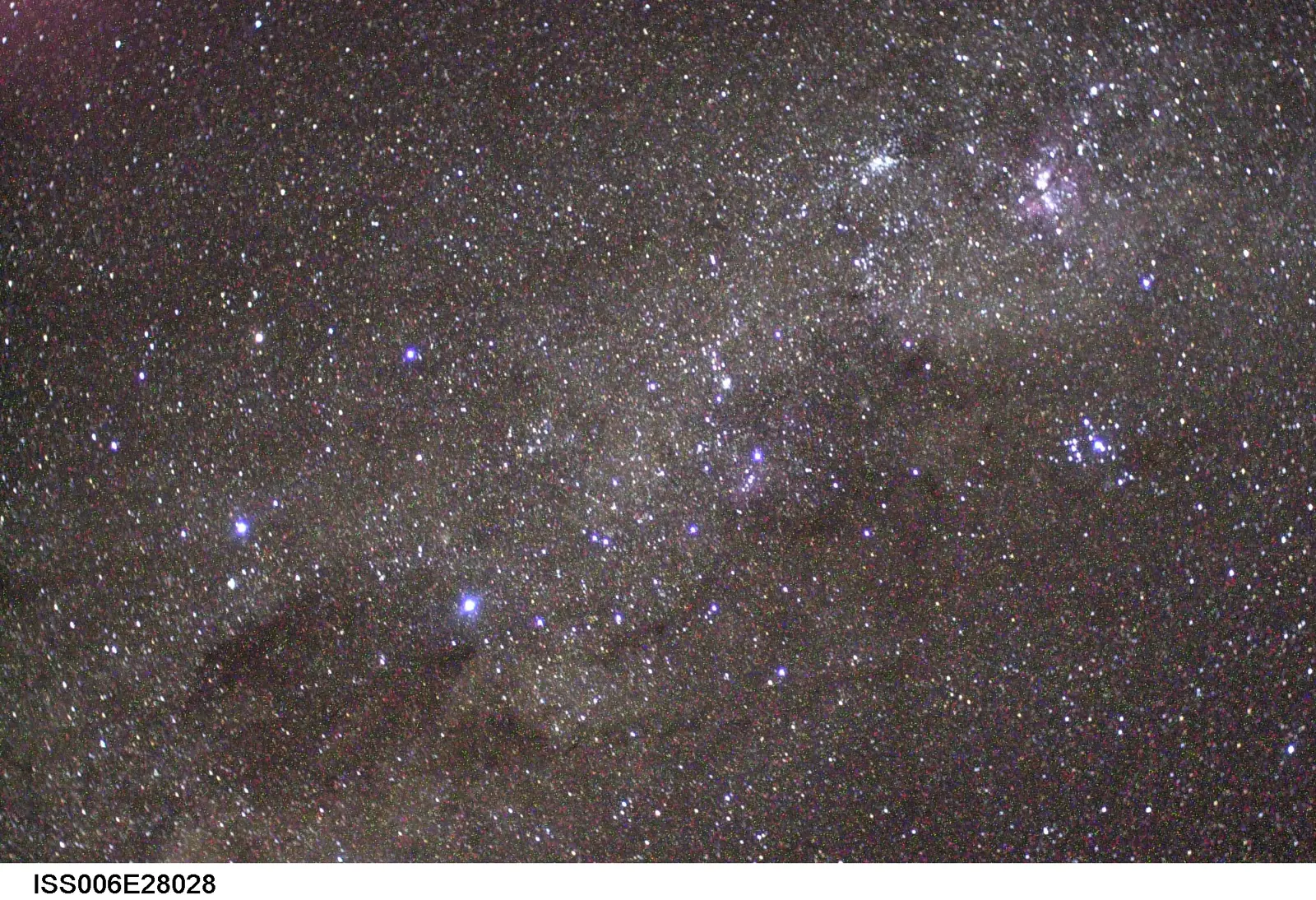
Crux is the smallest constellation in the sky by area, yet it is arguably the most recognisable star pattern in the Southern Hemisphere. Its four principal stars — Acrux, Mimosa, Gacrux, and Imai — form a compact cross shape, all brighter than apparent magnitude +2.8, making the pattern unmistakeable even from sites with moderate light pollution. A fifth star, Ginan (Epsilon Crucis), completes the Southern Cross asterism as depicted on several national flags.
The constellation lies on a particularly rich section of the southern Milky Way, bordered by Centaurus to the north and west and Musca to the south. Within its modest boundaries sit two of the southern sky's showpiece objects: the Jewel Box (NGC 4755), one of the youngest and most colourful open clusters in the galaxy, and the Coalsack Nebula, the most prominent dark nebula visible to the unaided eye.
Because it is circumpolar from most of the Southern Hemisphere, Crux has served for centuries as a navigational reference, its long axis pointing reliably toward the south celestial pole. It carries deep cultural meaning across Indigenous Australian, Māori, Inca, and Pacific Islander traditions, and its stars appear on the flags of Australia, New Zealand, Brazil, Papua New Guinea, and Samoa.
History and discovery
The stars of Crux were known to ancient Greek astronomers, who folded them into the neighbouring constellation Centaurus rather than treating them as a separate figure. Because of the slow wobble of Earth's axis called precession, by around 400 CE the Southern Cross had sunk below the horizon as seen from the Mediterranean, and it faded from European astronomical consciousness for more than a millennium.
European rediscovery came with the great age of exploration. In the 15th and 16th centuries, navigators including Alvise Cadamosto, João Faras, and Amerigo Vespucci encountered and described the bright southern cross-shaped pattern as their ships pushed deeper into the Southern Hemisphere. These accounts reintroduced the Southern Cross to European cartography.
The formal separation of Crux from Centaurus as its own constellation is associated with the Dutch cartographer Petrus Plancius, who distinguished it around 1613. The German astronomer Jakob Bartsch published this arrangement in 1624, and the French astronomer Augustin Royer further codified it in 1679. Today the International Astronomical Union recognises Crux as one of the 88 official constellations, occupying a compact region of the southern sky.
Mythology and cultural significance
Unlike most constellations derived from the Greco-Roman tradition, Crux carries no major Greek myth of its own — the Greeks subsumed its stars into Centaurus. Its richest traditions come instead from the Indigenous and Pacific cultures of the Southern Hemisphere, where the constellation has been observed continuously across generations.
For the Inca of South America, the Southern Cross was central to an elaborate sky-mapping system centred on the concept of Chakana, a stepped cross motif that was one of the most important symbols in Andean cosmology. The Māori of New Zealand called it Te Punga, meaning "the anchor," reflecting its practical role as a fixed navigational reference in the night sky.
In various Aboriginal Australian traditions, the Southern Cross and the nearby Coalsack Nebula are interpreted as part of the head of the "emu in the sky" — a dark-constellation figure traced not by stars but by the dark dust lanes of the Milky Way. Other Pacific traditions interpret Crux as a stingray, a footprint, or part of a celestial canoe narrative. Across all of these cultures, the circumpolar steadiness of the Southern Cross gave it significance as a fixed point around which the night sky revolves.
The constellation's cultural importance in the modern era is perhaps most visible in national symbolism. The Southern Cross appears on the flags of five sovereign nations: Australia, New Zealand, Brazil, Papua New Guinea, and Samoa. Australia's flag, first adopted federally in 1901, shows five stars of Crux (including the faint Epsilon Crucis) and is said to incorporate Australia's oldest national symbol — Southern Cross imagery appeared on Australian flags as early as 1823 and prominently on the Eureka Stockade flag of 1854. New Zealand's flag, with its four-star Crux adopted in 1869, and Papua New Guinea's flag (1971) likewise showcase the asterism. Brazil's flag, adopted on 19 November 1889, incorporates 27 stars representing its states, among them the stars of Crux, which also feature in the national anthem. Samoa's flag, finalised on 24 February 1949, displays five white stars of the Southern Cross on a blue field. Sub-national use extends further, to territories such as Christmas Island and the Argentine province of Tierra del Fuego.
The main stars of Crux
All four stars that define the Cross shape are bright, hot, and relatively nearby — yet they are not a physically related group. Three (Acrux, Mimosa, and Imai) are massive blue-white B-type stars that were probably born in the same star-forming region, while Gacrux is an unrelated red giant lying far closer to Earth. A fifth star, Ginan (Epsilon Crucis), is an orange giant that appears on several national flags as part of the Southern Cross asterism.
Acrux (Alpha Crucis), the brightest star in Crux at apparent magnitude +0.77, is a multiple-star system located about 321 light-years from Earth. Its two principal components are both hot B-type stars: Acrux A has a mass of roughly 17.8 solar masses, a radius of about 7.8 solar radii, a surface temperature near 24,000 K, and a luminosity approximately 25,000 times that of the Sun. Acrux B is somewhat less extreme at about 5.5 solar masses, 5.4 solar radii, 28,000 K, and 16,000 solar luminosities. The two main components are separated by about 430 AU. As massive early-type OB stars, they are very young on cosmic timescales.
Mimosa (Beta Crucis), also known as Becrux, shines at magnitude +1.25 from a distance of about 280 light-years. It is a blue-white B-type giant or subgiant with a mass near 16 solar masses, a radius of about 8.4 solar radii, and a luminosity roughly 34,000 times the Sun's — making it intrinsically the most luminous of the four Cross stars. Its age has been estimated at 8 to 11 million years. Mimosa is classified as a binary star.
Gacrux (Gamma Crucis) is the outlier of the group. At only 88.6 light-years from Earth it is the nearest of the four main stars — and the nearest M-class red giant to the Solar System. It glows at magnitude +1.64, its cool surface giving it a distinctly reddish hue compared with the blue-white trio of the other bright Cross stars. Gacrux has a mass of about 1.5 solar masses, a radius roughly 8.4 times the Sun's, and a luminosity around 820 solar luminosities. At such a modest mass it has been nuclear-burning for billions of years, far longer than its hotter neighbours.
Imai (Delta Crucis) is the faintest of the four defining stars of the Cross at magnitude +2.79. It is a blue-white B-type subgiant with a mass of about 8.9 solar masses, a radius near 8.0 solar radii, a surface temperature around 22,570 K, and a luminosity approximately 10,000 times that of the Sun. Imai is a notably fast rotator, with a projected equatorial velocity of roughly 210 km/s. Like Acrux and Mimosa, it is a very young massive star.
Ginan (Epsilon Crucis) is an orange giant located about 230 light-years away, shining at magnitude +3.58. It is the faintest of the five Southern Cross stars depicted on national flags, and is evolving away from the main sequence. With a mass of about 1.52 solar masses and a radius roughly 28.4 times the Sun's, it is physically larger than any of its Cross companions, despite appearing dimmer due to its cooler surface temperature. Like Gacrux, it is inferred to be billions of years old.
Deep-sky objects
Despite its small area, Crux hosts two of the most celebrated deep-sky objects in the southern sky: the Jewel Box open cluster and the Coalsack Nebula. Both are visible without optical aid under dark skies and have been known since the age of sail.
The Jewel Box (NGC 4755), also called the Kappa Crucis Cluster, is among the youngest and most visually striking open clusters anywhere in the Milky Way. It lies about 6,400 to 6,500 light-years from Earth and shines at an overall apparent magnitude of around +4.2, making it just visible to the naked eye as a fuzzy point roughly one degree from Mimosa. Telescopically it resolves into a glittering assembly of more than 100 stars dominated by hot blue giants, punctuated by a prominent red supergiant that creates a vivid colour contrast — the jewel-box effect that gave the cluster its name. At an estimated age of only about 10 million years, it is one of the youngest open clusters known, its stars barely having settled onto the main sequence. The name Kappa Crucis derives from the star Kappa Crucis (around magnitude +5.9) embedded within it.
The Coalsack Nebula is a large, nearby dark nebula that occupies the south-eastern corner of Crux and spills into the adjacent constellations Musca and Centaurus. At a distance of roughly 500 to 600 light-years, it is one of the closest dark nebulae to Earth and, measuring about 5° by 7° across, it is the most prominent dark nebula visible to the unaided eye. It appears as a conspicuous inky void set against the luminous star clouds of the Milky Way — a region where dense interstellar dust blocks the light of background stars. Southern Hemisphere observers have long noted its striking appearance; in many Aboriginal Australian traditions the Coalsack forms the head of the "emu in the sky," a dark-constellation figure defined by dust lanes rather than stars.
A third catalogued object within Crux's IAU boundary is NGC 4609 (also catalogued as Collinder 263 and Caldwell 98), a fainter open star cluster projected close to the Coalsack region and associated on the sky with the variable star BZ Crucis. It is often swept up in the same wide-field view as the Jewel Box and the dark nebula. Because Crux lies on such a rich stretch of the southern Milky Way, it also serves as a convenient starting point for locating nearby showpieces in Carina and Centaurus, including the Carina Nebula (NGC 3372) and the massive OB-association complex known as the Dragonfish Nebula.
Celestial navigation
One of Crux's most enduring practical uses is as a pointer to the south celestial pole — the point in the sky around which all southern stars appear to rotate, located in the otherwise unremarkable constellation Octans. Unlike the Northern Hemisphere, which has the bright star Polaris sitting very close to the north celestial pole, the south celestial pole has no bright star nearby, making an indirect method necessary.
The standard technique uses the long axis of the Cross. The observer identifies the two stars that define this axis — Gacrux at the top and Acrux at the foot — and extends an imaginary line from Gacrux through Acrux, continuing beyond Acrux by approximately four to four-and-a-half times the length of the Cross. That point marks the south celestial pole. Dropping a vertical line from that point straight down to the horizon gives due south.
A complementary method uses the two bright Pointer Stars in Centaurus — Alpha Centauri and Beta Centauri, which lie just outside Crux's boundary — to confirm the direction. A line drawn between the Pointer Stars, extended until it intersects the long-axis projection of the Cross, also locates the south celestial pole. Navigators often use both methods together for a cross-check. Because Crux is circumpolar from most of the Southern Hemisphere, this technique works on any clear night throughout the year for observers south of roughly 25° north latitude.
Crux through the ages
- ~400 CELost to European observers
Precession of Earth's axis gradually lowers the Southern Cross below the Mediterranean horizon. Stars previously catalogued within Centaurus by Greek astronomers become invisible from Europe.
- c. 15th–16th centuryEuropean rediscovery
Navigators including Alvise Cadamosto, João Faras, and Amerigo Vespucci observe and describe the Southern Cross during Atlantic and southern ocean voyages, reintroducing it to European astronomy.
- 1613Plancius separates Crux from Centaurus
Dutch cartographer Petrus Plancius distinguishes Crux as a standalone constellation, separating it from the larger Centaurus.
- 1624Bartsch publishes the arrangement
German astronomer Jakob Bartsch publishes the separation of Crux from Centaurus, spreading the new classification to a wider European audience.
- 1679Royer formalises Crux
French astronomer Augustin Royer codifies Crux as an independent constellation in his star atlas, cementing its separate status in the Western astronomical tradition.
- 1823Southern Cross on Australian flags
The Southern Cross appears on Australian flags, marking the beginning of its use as a national symbol more than seven decades before Australian federation.
- 1854Eureka Stockade flag
The Southern Cross is displayed prominently on the Eureka Stockade flag during the Ballarat miners' rebellion in Victoria, Australia — one of the most iconic uses of the symbol in Australian history.
- 1889Brazil adopts Southern Cross on national flag
Brazil's flag, adopted on 19 November 1889 following the proclamation of the republic, incorporates the stars of Crux among 27 stars representing its states.
- 1901Australian flag adopted federally
Australia federates and adopts a national flag showing five stars of Crux plus the Commonwealth Star. The design is standardised in 1903.
- 1930sIAU formalises constellation boundaries
The International Astronomical Union standardises the boundaries of all 88 constellations, including Crux, giving it its current official, precisely defined region of the sky.
- 1949Samoa adopts flag with Southern Cross
Samoa's flag, finalised on 24 February 1949 and confirmed at independence in 1962, displays five white stars of the Southern Cross.
- 1971Papua New Guinea flag adopted
Papua New Guinea's national flag, adopted in 1971, includes five stars of Crux on a black triangle alongside a Bird of Paradise.
What makes Crux remarkable
Crux occupies less sky area than any of the other 87 IAU constellations, yet its compactness and the brightness of its four main stars make it one of the easiest patterns to identify in the entire sky.
At only 88.6 light-years, Gacrux (Gamma Crucis) is the nearest known M-class giant to Earth — meaning the closest red giant star to the Sun resides within the Southern Cross.
The brightest star in Crux, Acrux, is a multiple-star system. Its two main blue-white components are separated by roughly 430 AU, and the system harbours at least one additional companion.
At an estimated age of only around 10 million years, the Jewel Box (NGC 4755) is among the youngest open clusters in the Milky Way. Its brilliant blue stars and contrasting red supergiant have made it a benchmark for stellar evolution studies.
The Coalsack Nebula, overlapping Crux's south-eastern corner, is considered the most conspicuous dark nebula in the sky. Visible to the naked eye as a dark void in the Milky Way, it was woven into Aboriginal Australian sky lore as the head of the celestial emu — a figure defined entirely by darkness rather than starlight.
No other constellation appears on more sovereign national flags than Crux. Its stars fly on the flags of Australia, New Zealand, Brazil, Papua New Guinea, and Samoa, and on sub-national flags from Christmas Island to Argentine Tierra del Fuego.
For roughly a thousand years — from around 400 CE until the age of exploration — the Southern Cross was effectively invisible from Europe due to precession, creating a gap in northern astronomical tradition that was only bridged when southern-ocean navigators rediscovered it in the 15th and 16th centuries.
Frequently asked questions
Sources
- Crux - Constellation Guide (freestarcharts.com)
- Crux - Wikipedia
- Crux Constellation: The Ultimate Guide - Label Stars
- Acrux: The Brightest Star in the Southern Cross - Universe Space Tech
- Meet Crux, the constellation of the Southern Cross - EarthSky
- The Southern Cross is your guide to due south - EarthSky
- Crux | Astronomy and Astrophysics | Research Starters - EBSCO
- Crux Constellation — Constellation Guide
- Navigating the stars: the stories behind the Southern Cross - ESO
- The Crux Constellation: Mythology, Stars and Facts - Star Name Registry
- Crux Constellation - Facts & Features - ThePlanets.org
- Southern Cross: Crux constellation, stars and mythology - Space.com
- The Night Sky: Crux - A Distinctive Cross in the Southern Sky - Cicerone
- Crux and Coalsack - AstroPixels
- Southern Cross - National Museum of Australia
- Stars and Constellations on Flags - National Space Centre
- The Southern Cross - Astro Navigation Demystified