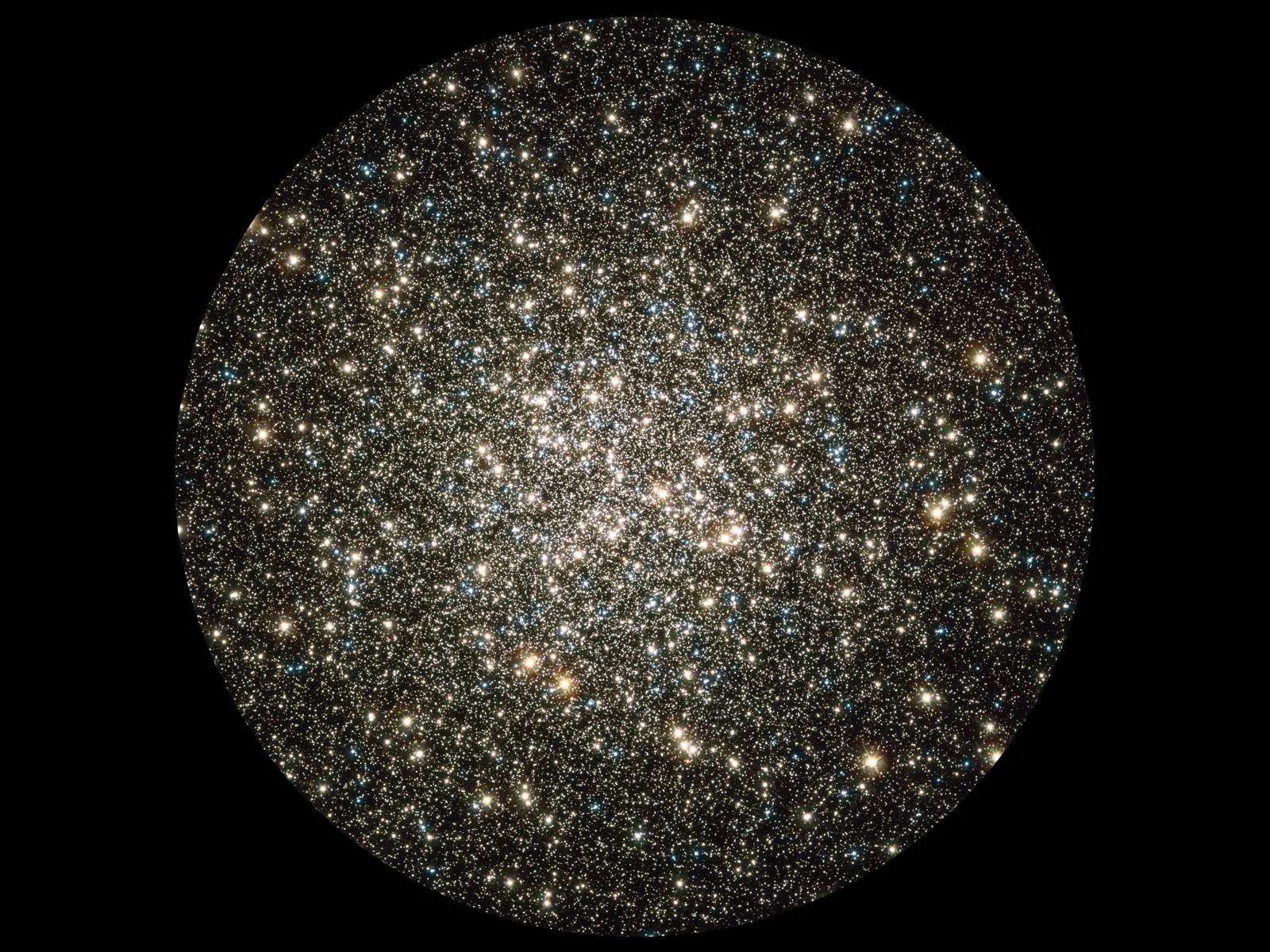
Hercules Cluster
The Great Globular Cluster in Hercules — a sphere of hundreds of thousands of ancient stars, 25,000 light-years away, and the target of humanity's first deliberate message to the stars.
Hercules Cluster (M13 / NGC 6205)
Messier 13 — also designated NGC 6205 and popularly known as the Great Hercules Cluster or simply the Hercules Cluster — is one of the largest and brightest globular star clusters visible from the Northern Hemisphere. It lies approximately 25,000 light-years from Earth in the constellation Hercules, and contains several hundred thousand ancient, metal-poor stars packed into a sphere roughly 145 to 165 light-years across. With an apparent magnitude of about 5.8, it sits just at the threshold of naked-eye visibility under dark, moonless skies, and resolves into a stunning swarm of individual stars through even a modest telescope.
The cluster belongs to the Milky Way's halo population — one of roughly 150 globular clusters known to orbit the Galaxy on highly inclined, extended paths that repeatedly cross the Galactic plane. Its stars formed together very early in the Universe's history, roughly 11.65 billion years ago, long before most of the heavy elements we associate with planets and life had been forged in stellar interiors. As a result, its stars are highly metal-poor, with iron abundances only about 4–5% of the Sun's, and their evolved states — red giants, horizontal-branch stars, and blue stragglers — have made M13 a benchmark object for stellar evolution and Galactic archaeology.
Beyond its scientific importance, M13 holds a unique place in the history of humanity's outreach to the cosmos: in November 1974, the Arecibo radio telescope beamed the most powerful deliberate radio signal ever sent from Earth directly toward M13, encoding a binary portrait of life, chemistry, and civilization. That message will not reach the cluster for roughly another 24,950 years.
Discovery and study
- 1714Halley's discovery
Edmond Halley becomes the first recorded observer of M13, noting it as a faint spot visible to the naked eye under dark skies: "This is but a little Patch, but it shews it self to the naked Eye, when the Sky is serene and the Moon absent."
- 1 June 1764Messier catalogues M13
Charles Messier independently observes the cluster and adds it as entry No. 13 in his catalogue of nebulous objects. He describes it as a "round and brilliant nebula with a brighter center" and concludes it contains no stars, since his telescope could not resolve individual members.
- Late 18th centuryHerschel resolves the cluster
William Herschel observes M13 with his larger telescopes and resolves it into a true globular star cluster, distinguishing it from a diffuse nebula.
- Early 20th centuryShapley maps the globular system
Harlow Shapley uses RR Lyrae variable stars in globular clusters — including clusters like M13 — as standard candles to map the three-dimensional distribution of globulars, revealing the Milky Way's true scale and the Sun's off-centre position.
- 16 November 1974Arecibo message transmitted toward M13
During a ceremony marking major upgrades to the Arecibo Observatory, a 1,679-bit binary message is beamed at M13 for approximately 169 seconds — the most powerful deliberate radio signal ever sent from Earth, with an effective isotropic radiated power equivalent to roughly 20 trillion watts.
- 1999–2006Hubble images the core
NASA/ESA's Hubble Space Telescope images M13's dense core in visible and infrared light using the Advanced Camera for Surveys, enabling precise colour–magnitude diagrams, identification of blue stragglers, and studies of mass segregation in the cluster's crowded interior.
Physical characteristics
M13 is classified as a concentration class V globular cluster, indicating intermediate central condensation — neither the most loosely structured nor the most core-collapsed of globulars. At a distance of approximately 25,000 light-years, it subtends about 20 arcminutes on the sky, yielding a physical diameter in the range of 145 to 165 light-years. The cluster's total mass lies between roughly 500,000 and 600,000 times that of the Sun, distributed among several hundred thousand stars — estimates vary from about 300,000 to possibly 500,000 members, with at least 100,000 well-confirmed by photometric surveys.
Stellar density within M13 rises dramatically toward the core. In the central region, the density reaches approximately 100 times that of the solar neighbourhood, and some estimates for the very inner core cite as many as 100 stars packed into a cube just three light-years on a side — roughly 500 times the local stellar density. At such concentrations, stars occasionally interact gravitationally and even physically collide, making the core a natural laboratory for studying stellar dynamics and the products of close encounters.
The cluster's stars are almost exclusively old, low-mass Population II objects with a metallicity of [Fe/H] ≈ −1.33 dex — meaning their iron content is only about 4 to 5 percent of the Sun's. This reflects formation very early in the Milky Way's history, before generations of massive stars had enriched the interstellar medium with the heavier elements produced by nuclear burning and supernova explosions. The most luminous members visible today are red giants and horizontal-branch stars, since all higher-mass stars exhausted their fuel billions of years ago. A main-sequence turnoff near about 0.8 solar masses, consistent with an age of approximately 11.65 billion years, anchors the colour–magnitude diagram alongside a steep, well-populated red-giant branch and an extended horizontal branch that reaches to bluer colours — a hallmark of metal-poor globulars.
Among M13's most scientifically interesting objects are its blue straggler stars, of which approximately 15 have been identified. These appear bluer and more luminous than the cluster's main-sequence turnoff, superficially resembling younger, more massive stars despite belonging to the same ancient population. Their formation is thought to involve stellar mergers or mass transfer between binary stars in the dense core environment, and their spatial distribution provides evidence for which of these mechanisms dominates. Hubble observations of the core have been particularly important in cataloguing these objects.
Observers with sufficiently large telescopes and good seeing conditions also report a distinctive Y-shaped or "propeller" dark feature near the cluster's bright core. This is not caused by gas or dust but by the irregular distribution of bright stars across the densely packed centre — a subtle asymmetry in the arrangement of the most luminous giants that creates apparent dark lanes at high magnification.
The 1974 Arecibo message
On 16 November 1974, the Arecibo Observatory in Puerto Rico — then home to the world's largest radio telescope, a 305-metre fixed spherical dish set into a natural sinkhole — transmitted a single, one-time binary radio message toward M13. The transmission was a deliberate demonstration of human interstellar messaging capability rather than a practical communication attempt, staged as part of a ceremony marking major upgrades to the telescope.
The message was encoded in 1,679 binary digits, a number chosen because 1,679 = 73 × 23, the product of two prime numbers. This mathematical structure was intended to hint to any hypothetical recipient that the bits should be arranged as a 73-row by 23-column two-dimensional grid to reveal a pictorial message. Sent at a carrier frequency of 2,380 MHz and a bit rate of 10 bits per second, the transmission lasted approximately 169 seconds — just under three minutes.
When decoded, the 73 × 23 grid encodes: the numbers 1 through 10 in binary; the atomic numbers of hydrogen, carbon, nitrogen, oxygen, and phosphorus (the key elements of terrestrial biochemistry); the chemical formulae of DNA nucleotides; a diagram of the DNA double helix; a stick-figure outline of a human being with encoded values for average height and the 1974 human population; a diagram of the Solar System showing the Sun and nine planets with Earth displaced to indicate the sender's home world; and a schematic of the Arecibo dish itself, with its diameter encoded numerically.
The transmitter's one megawatt of power, concentrated by the enormous dish into an extremely narrow beam, yielded an effective isotropic radiated power equivalent to roughly 20 trillion watts — at the time the most powerful deliberate radio signal ever beamed into space. M13 was selected as the target primarily because it happened to be near the zenith above Arecibo during the ceremony: the fixed dish could not be fully steered, so the cluster's position in the sky that day was the decisive factor rather than any assessment of its habitability.
At M13's distance of roughly 25,000 light-years, the message will take approximately 25,000 years to arrive — meaning a round-trip communication time of about 50,000 years. The signal's leading edge was, as of 2026, only about 51 light-years from Earth, a tiny fraction of the journey. When the signal eventually reaches M13 (around the year 26,974 CE), the cluster will have shifted on its orbit around the Galaxy, though calculations indicate its proper motion is small enough relative to the beam width that the signal should still intersect the cluster. Because M13 contains hundreds of thousands of stars in a relatively compact volume, any civilisation orbiting one of those stars would receive the same brief transmission simultaneously — a consideration that made the dense globular an appealing symbolic target.
What M13 has taught astronomers
At 11.65 billion years old and with iron abundances only 4–5% of the Sun's, M13's stars formed in the first few billion years of the Milky Way's existence, before successive generations of supernovae had substantially enriched the interstellar medium. Studying its stellar populations directly probes conditions in the very early Galaxy.
The identification of approximately 15 blue straggler stars in M13's core — objects that appear younger and hotter than they should given the cluster's age — provided early evidence that stellar mergers and binary mass transfer can rejuvenate stars in dense environments. Hubble imaging of the core has been central to cataloguing these exotic objects.
Pulsating RR Lyrae stars on M13's horizontal branch behave as standard candles: their pulsation periods correlate with intrinsic luminosity. Studies of such variables in globular clusters, pioneered by Harlow Shapley in the early 20th century, revealed the Milky Way's true scale and demonstrated that the Sun is far from the Galactic centre.
Core stellar densities roughly 100 times that of the solar neighbourhood — high enough for occasional stellar collisions — make M13 a natural laboratory for N-body simulations and dynamical modelling of dense stellar systems, helping constrain mass profiles, relaxation timescales, and the accumulation of compact remnants such as neutron stars and white dwarfs.
Studies connected with M13 and similar clusters suggest that planets are very rare in the dense environments of globular clusters. High stellar density (leading to disruptive gravitational encounters), intense radiation fields, and the very low metallicity of the stars (meaning fewer heavy elements available to build rocky planets) all contribute to an inhospitable planet-forming environment.
Observing the Hercules Cluster
M13 is among the finest deep-sky objects available to Northern Hemisphere observers, accessible from spring through early autumn and rewarding instruments of virtually every size. It culminates highest in the sky during the summer months, when the constellation Hercules rides well overhead at nightfall for observers at mid-northern latitudes. From latitudes north of about 36°N, the cluster is technically circumpolar — it never fully sets — though it is best observed when well above the horizon.
Finding M13 begins with locating Hercules itself, which lies roughly one-third of the way across the sky from the brilliant star Vega (in Lyra) toward Arcturus (in Boötes). Four moderately bright stars in Hercules form the distinctive "Keystone" asterism — a lopsided quadrilateral representing the hero's torso. M13 lies on the Keystone's western edge, approximately 2.5 degrees south of the star Eta Herculis and about two-thirds of the way along the line from Zeta Herculis to Eta Herculis. In a wide-field binocular view both Eta Herculis and M13 typically fit within the same field.
Under truly dark, moonless skies — the conditions Edmond Halley specified when he first noted the cluster in 1714 — M13 is just detectable with the unaided eye as a faint, fuzzy point of light, though averted vision is usually needed. Binoculars reveal it immediately as a bright, clearly non-stellar patch. A 100 mm (4-inch) telescope begins to resolve the outer halo into individual star points, while instruments of 200 mm (8 inches) and larger show a rich, resolved cluster across its full extent. At magnifications of 200× or more under steady seeing, experienced observers may discern the subtle dark "propeller" pattern — three apparent lanes cutting across the core's bright centre, created by the irregular distribution of the brightest giant stars rather than by any foreground obscuration.
Frequently asked questions
Sources
- Messier 13: Hercules Globular Cluster — Messier-Objects.com
- Messier 13 - M13 - Great Hercules Globular — AstroPixels
- M13 - NGC 6205 - Milwaukee Astronomical Society
- How to Find and Observe the Great Hercules Globular Cluster (M13) — Love the Night Sky
- Messier 13 — SEDS Messier Catalog
- Messier 13 — Wikipedia
- Messier 13 (The Hercules Cluster) — NASA Science / Hubble
- The crowded heart of the Hercules globular cluster — ESA/Hubble
- Messier 13 (NGC 6205) Hercules Cluster — Go-Astronomy.com
- Meet M13, the Great Globular Cluster in Hercules — EarthSky
- The Great Cluster of Hercules — Vanderbilt Dyer Observatory
- Nov. 16, 1974: Arecibo sends a message — Astronomy Magazine
- Arecibo — SETI Institute
- Find the Keystone in Hercules, and the Hercules Cluster M13 — EarthSky