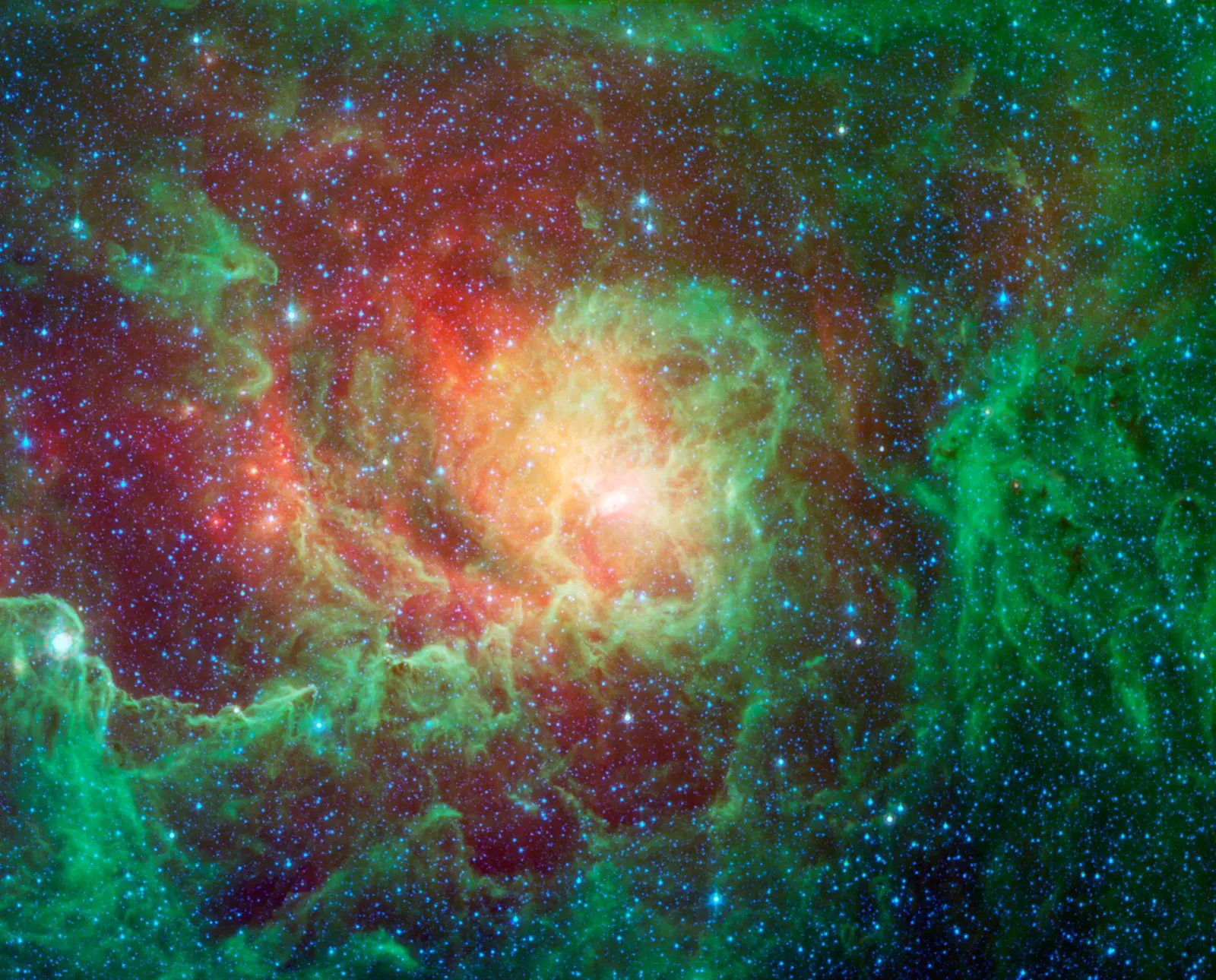
Lagoon Nebula
A glowing stellar nursery 4,000–5,200 light-years away in Sagittarius — one of the few emission nebulae visible to the naked eye, and one of the Milky Way's most active star-forming regions.
The Lagoon Nebula
The Lagoon Nebula — catalogued as Messier 8 (M8) and NGC 6523 — is a giant emission nebula and active star-forming region lying in the constellation Sagittarius, in the direction of the Milky Way's core. It sits roughly 4,000 to 5,200 light-years from Earth and stretches across approximately 110 × 50 light-years of space, making it one of the largest and brightest H II regions visible from our planet. With an apparent magnitude of about 6.0, it sits right at the threshold of naked-eye visibility, appearing as a faint hazy patch under dark, transparent skies and revealing rich detail through binoculars or any small telescope.
The nebula is a vast cloud of ionized hydrogen gas, glowing because the intense ultraviolet radiation from a population of massive, hot young stars embedded within it strips electrons from hydrogen atoms. When those electrons recombine, they emit light — most prominently in the deep red of hydrogen-alpha emission, which gives the nebula its vivid color in long-exposure photographs. The nebula is not a single uniform cloud: it is a turbulent, sculpted landscape of bright emission regions, dark dust lanes, dense globules, and spectacular pillar-like structures all shaped by the relentless winds and radiation of the newborn stars within.
At its heart sits a compact, intensely bright sub-region called the Hourglass Nebula, dominated by the powerful O-type star Herschel 36, alongside the sprawling young open cluster NGC 6530, which contains several thousand stars formed from the same molecular cloud. Together, these components make the Lagoon Nebula one of the best-studied stellar nurseries in the sky and one of the closest laboratories for understanding how stars — including perhaps stars like our own Sun — are born.
Physical characteristics
The Lagoon Nebula is classified as a giant H II region — a large volume of interstellar gas dominated by ionized hydrogen. Its apparent angular dimensions on the sky span roughly 90 × 40 arcminutes, equivalent to about three times the width of the full Moon in its longer dimension. At its adopted distance of approximately 5,200 light-years (as used in NASA's Hubble Messier catalog), this translates to a physical extent of about 110 × 50 light-years. Some catalogs quote a distance closer to 4,100 light-years (as in Spitzer data), reflecting the range of measurement techniques applied to different targets within the complex — the embedded stellar cluster and the surrounding gas do not always yield identical distance estimates.
The nebula is dominated by ionized hydrogen gas, but also contains dust, molecules, and traces of heavier elements. Its glowing appearance arises from photoionization: the ultraviolet radiation emitted by massive young stars within the complex has enough energy to knock electrons free from hydrogen atoms throughout the surrounding cloud. As the free electrons recombine with protons, they cascade through energy levels and release photons, producing the bright emission that gives H II regions their characteristic red glow in photographs. Visually, through an eyepiece, the nebula appears gray-green because the human eye's dim-light (scotopic) vision does not perceive color well at low light levels, and the dominant emission line falls in the red, where the eye is least sensitive.
Within its boundaries the nebula is far from uniform. Dark dust lanes and intricate filaments divide the glowing gas into distinct lobes and cavities. Several Bok globules — dense, cold, opaque clumps of gas and dust that can collapse to form stars — are catalogued inside the nebula, including those designated Barnard 88, Barnard 89, and Barnard 296. These small dark clouds stand out as silhouettes against the brighter emission behind them. Funnel-shaped and tornado-like dust columns sculpted by radiation and stellar winds are visible in high-resolution imagery, particularly in the central Hourglass region.
The Hourglass Nebula and Herschel 36
Near the center of M8 lies a compact, dramatically bright emission region known as the Hourglass Nebula — a name bestowed by the astronomer John Herschel and not to be confused with the Engraved Hourglass Nebula, an unrelated planetary nebula in the southern constellation Musca. The Hourglass is the most active and compact star-forming core within the larger Lagoon complex, packed with very young massive stars and embedded protostars.
The dominant force shaping the Hourglass is Herschel 36, a hot O-type star of extraordinary luminosity. Its intense ultraviolet radiation ionizes the surrounding gas so thoroughly that the Hourglass blazes in emission lines, and its powerful stellar wind drives photo-evaporation of nearby dense clouds, carving the funnel-like cavities visible in Hubble imagery. Each of the tornado-like funnel structures seen in Hubble's detailed maps is approximately 0.5 light-years long — enormous by terrestrial standards, yet a small fraction of the nebula's full extent. Hubble narrowband imaging of the Hourglass encodes different ionic species in color: oxygen appears blue, hydrogen green, and sulfur red, highlighting zones of different temperature and ionization state within the turbulent cavity.
In 2006, observations identified four Herbig-Haro objects within the inner Hourglass region. Herbig-Haro objects are small patches of nebulosity produced when jets of gas ejected by very young, still-forming stars slam into the surrounding interstellar medium at high velocity, creating shocks that glow at optical wavelengths. Their presence inside the Hourglass provides direct observational evidence that star formation is actively occurring there right now — not merely in the recent past. These jets trace protostars still in the process of accreting material from their surrounding envelopes, making the Hourglass one of the most vivid active star-formation environments accessible to Hubble's cameras.
NGC 6530: a stellar nursery in miniature
Embedded within the gas and dust of the Lagoon Nebula is the young open cluster NGC 6530, a collection of several thousand stars that formed from the same molecular cloud now surrounding them. Hubble analyses have placed the cluster at approximately 4,350 light-years, consistent with its physical association with M8's gas. With an age of only about 1 to 3 million years, NGC 6530 is among the youngest open clusters known — its stars have barely had time to disperse the cocoon of gas in which they were born.
The cluster's massive, hot O- and B-type members are the primary source of the ultraviolet radiation that ionizes the surrounding nebula, maintaining the Lagoon's glow. In Hubble imagery, portions of NGC 6530 appear embedded in what looks like a roiling wall of smoke — clouds of gas and dust with embedded stars caught in various stages of formation. The interplay between the cluster's radiation and the remaining molecular cloud is actively shaping what survives of the surrounding gas and what new generation of stars might yet be triggered.
Hubble targeted NGC 6530 using the Advanced Camera for Surveys and the Wide Field Planetary Camera 2 in a search for proplyds — protoplanetary disks that become visible as bright, ionized rims when they are close enough to a massive star to be photo-evaporated. The vast majority of confirmed proplyds have been found in the Orion Nebula, the nearest major star-forming region. In the Lagoon, the search found that if proplyds are present, they are rarer and less conspicuous than in Orion, likely because the geometry and radiation field strengths differ. Nonetheless, infrared surveys have identified a significant population of young stellar objects with infrared excesses indicative of circumstellar disks, with disk fractions typical of a 1-to-3-million-year-old region — though disk survival rates appear lower near the most massive OB stars, consistent with external photo-evaporation stripping disks in the harshest ultraviolet environments.
Discovery and Study of the Lagoon Nebula
- Before 1654Hodierna's first record
Giovanni Battista Hodierna, an Italian court astronomer working in Sicily, records the nebula in his catalog of nebulous stars — the earliest known observation of M8.
- c. 1680Flamsteed notes a nebula
English Astronomer Royal John Flamsteed independently observes the object and catalogues it as Flamsteed 2446. His catalog was published posthumously in 1725.
- 1746De Chéseaux catalogs a cluster
Swiss astronomer Philippe Loys de Chéseaux records the object but classifies it as a cluster, not recognizing the surrounding nebula.
- 1747Le Gentil describes the nebula
French astronomer Guillaume Le Gentil observes and clearly describes both the nebula and its associated cluster. Many later popular accounts incorrectly identify Le Gentil as the discoverer, overlooking Hodierna.
- 1751–1752Lacaille's southern catalog
Nicolas-Louis de Lacaille, observing from the Cape of Good Hope, includes the Lagoon Nebula as Lacaille III.14 in his southern sky catalog.
- 23 May 1764Messier enters it as M8
Charles Messier, the French comet-hunter, observes the nebula and enters it as the eighth object in his famous catalog of non-cometary fuzzy objects — the origin of its modern designation Messier 8.
- 19th centuryHerschel names the Hourglass
John Herschel names the compact bright inner region of the nebula the Hourglass Nebula, a designation still in use today.
- 2006Herbig-Haro objects discovered in the Hourglass
Observations identify four Herbig-Haro objects within the inner Hourglass region, providing direct evidence of active ongoing star formation and protostellar jets.
- 18 Apr 2018Hubble 28th anniversary image
NASA and ESA release a large, high-resolution Wide Field Camera 3 image of part of the Lagoon Nebula to mark Hubble's 28th anniversary. The image, taken between 12 and 18 February 2018, covers a region about 4 light-years across within the turbulent central star-forming zone.
Hubble Space Telescope observations
The Lagoon Nebula has been imaged multiple times by the Hubble Space Telescope using several of its instrument generations, producing some of the most detailed views of any star-forming region in the sky. Hubble's sharp optics — free from atmospheric blurring — allow individual structures only a fraction of a light-year across to be resolved at the nebula's distance of thousands of light-years.
An early Hubble close-up using the Advanced Camera for Surveys (ACS) captured a region about 3 light-years wide, revealing the turbulent, knotted structure of the ionized gas in unprecedented detail. A separate set of ACS and Wide Field Planetary Camera 2 (WFPC2) observations targeted the embedded cluster NGC 6530 in a science program searching for proplyds. In 2015, ESA/Hubble released an updated WFPC2 optical and near-infrared view (heic1517a) centered on the nebula's turbulent star-forming heart, showing intense winds from hot stars, churning funnels of gas, and dark dust against the glowing background. The field of view of that image spans approximately 2.1 × 2.8 arcminutes.
The most celebrated recent Hubble image of the Lagoon was released on 19 April 2018 to mark the telescope's 28th anniversary. Taken with Wide Field Camera 3 (WFC3) between 12 and 18 February 2018, this large high-resolution mosaic (ESA catalog ID heic1808a) captures a turbulent region about 4 light-years across within the nebula's core. The filters used include the [O III] line at 502 nm, hydrogen-alpha at 656 nm, and a broadband filter around 547 nm, producing the striking color rendition. The full nebula spans about 55 light-years wide by 20 light-years tall in the Hubble field coverage, though the anniversary image represents only a portion of this. ESA and NASA also released accompanying video productions, including a 'Swimming across the Lagoon Nebula' zoom sequence based on this dataset. A narrowband Hubble image of the Hourglass region maps oxygen emission in blue, hydrogen in green, and sulfur in red, revealing zones of distinct ionization and temperature within that compact cavity.
As of the latest available information, no dedicated public images of the Lagoon Nebula from the James Webb Space Telescope (JWST) have been released. JWST's more sensitive infrared cameras would be capable of penetrating the dust obscuring the nebula's star-forming cores in ways even Hubble cannot, and outreach materials have referenced the Lagoon as a type of region JWST is well suited to study — but no M8-specific JWST image release has been announced.
Recent research
The Lagoon Nebula and its embedded cluster NGC 6530 continue to attract research attention as one of the nearest and best-resolved massive star-forming complexes in the Galaxy. Work from roughly 2020 onward has been substantially reshaped by the availability of precise astrometry from the European Space Agency's Gaia mission, which has allowed astronomers to measure the proper motions and distances of individual cluster members with unprecedented accuracy.
Gaia data releases have converged on a distance to NGC 6530 of approximately 1.3 to 1.4 kiloparsecs — equivalent to about 4,200 to 4,600 light-years — consistent with the 4,000-to-5,000-light-year range quoted in NASA and ESA summaries. Beyond distance, Gaia proper motions have allowed researchers to cleanly separate true cluster members from unrelated foreground and background stars, revealing that NGC 6530 has an elongated sub-structure broadly aligned with the parent molecular cloud. The data also suggest the cluster is in mild expansion, with sub-groups moving apart, implying it may gradually dissolve into the Galactic field over tens of millions of years — a fate common to most young open clusters.
Color-magnitude diagrams built from optical and near-infrared photometry, combined with spectroscopic indicators of youth such as hydrogen-alpha emission and the lithium absorption line at 6708 Å, show that the dominant stellar population has ages of 1 to 3 million years, with the youngest stars concentrated toward the Hourglass and central regions and slightly older populations dispersed toward the cluster outskirts. This age gradient is interpreted as evidence of sequential or triggered star formation: earlier generations of massive stars likely compressed nearby molecular gas through their winds and expanding H II region, initiating new bursts of collapse. Millimeter-wavelength observations of carbon monoxide and other molecular lines trace the large-scale molecular cloud surrounding the ionized cavity and show velocity gradients consistent with the H II region expanding and compressing gas at its rim.
Chandra X-ray Observatory observations have detected hundreds of X-ray-bright pre-main-sequence stars in NGC 6530, confirming strong magnetic activity typical of very young low-mass stars. Studies combining X-ray data with infrared photometry find that the initial mass function of the cluster is broadly consistent with standard forms (similar to those seen in the solar neighborhood), with no strong evidence for an unusual excess or deficit of either high-mass or sub-stellar objects relative to other nearby star-forming regions, though uncertainties at the lowest masses remain large. Disk fractions inferred from infrared excess emission are typical for a 1-to-3-million-year-old region, but appear reduced near the most massive OB stars, consistent with external photo-evaporation eroding circumstellar disks in the most intense ultraviolet environments.
Key Findings from the Lagoon Nebula
At apparent magnitude ~6.0, the Lagoon Nebula is one of only two major star-forming emission nebulae visible to the naked eye from northern latitudes, the other being the Orion Nebula. It is the brightest H II region in the northern and equatorial sky after Orion.
The identification of four Herbig-Haro objects inside the Hourglass Nebula in 2006 provided direct evidence that stars are being born in the Lagoon right now — jets from protostars still accreting material are slamming into surrounding gas and creating shock-lit filaments.
The O-type star Herschel 36 dominates the Hourglass sub-region, ionizing the surrounding gas and driving photo-evaporation that carves tornado-like funnel structures each roughly 0.5 light-years long — vivid proof of how a single massive star can reshape its local environment.
Hubble searches for protoplanetary disks (proplyds) in NGC 6530 found that such objects appear rarer and less conspicuous than in the Orion Nebula, suggesting that the radiation environment and geometry of M8 are less favorable for illuminating disk edges — an insight into how environment shapes early planetary system evolution.
Age gradients from optical spectroscopy and Gaia astrometry show that the youngest stars cluster near the Hourglass while slightly older populations spread toward the cluster outskirts, supporting a model in which successive generations of star formation have been triggered by the expanding H II region compressing nearby molecular gas.
Gaia proper motions have revealed that NGC 6530 is elongated along the parent molecular cloud, is in mild expansion, and may gradually dissolve over tens of millions of years — providing a direct window into how young clusters disperse into the Galactic field.
Frequently Asked Questions
Sources
- Messier 8 (The Lagoon Nebula) — NASA Science / Hubble Messier Catalog
- Into the Depths of the Lagoon Nebula — Spitzer / Caltech
- Lagoon Nebula — Wikipedia
- Messier 8 (M8) — The Lagoon Nebula — Universe Today
- Messier 8 (NGC 6523) Lagoon Nebula — Go Astronomy
- Wallow a While in the Lagoon Nebula — Sky & Telescope
- Hubble's Lagoon — NASA Science
- New Hubble view of the Lagoon Nebula (heic1517a) — ESA/Hubble
- Hubble's 28th birthday picture: The Lagoon Nebula (heic1808a) — ESA/Hubble
- Swimming across the Lagoon Nebula — ESA/Hubble
- Zooming in on the Lagoon Nebula — ESA/Hubble
- Lagoon Nebula — Britannica
- Lagoon Nebula — McDonald Observatory
- Lagoon Nebula Facts — ThePlanets.org