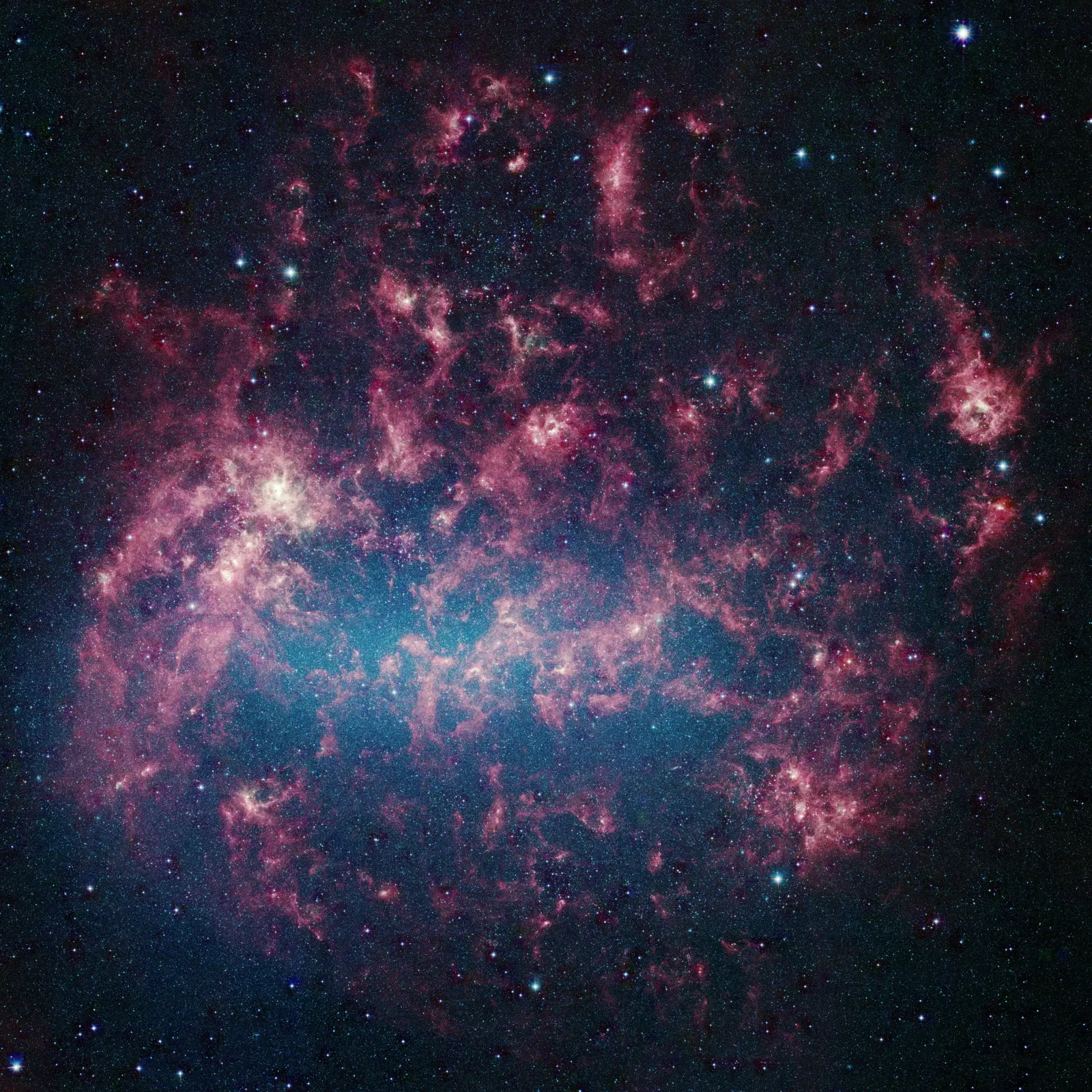
Large Magellanic Cloud
The Milky Way's largest satellite galaxy — a stellar nursery, supernova laboratory, and window into the early universe, visible to the naked eye from the Southern Hemisphere.
Large Magellanic Cloud
The Large Magellanic Cloud (LMC) is a dwarf irregular satellite galaxy of the Milky Way, located approximately 49.6 kiloparsecs — equivalent to about 160,000–162,000 light-years — from Earth. Easily visible to the naked eye as a hazy patch in the southern sky, it is one of the closest neighboring galaxies to the Milky Way and the largest of the Milky Way's known satellite galaxies that is still actively forming stars and rich in gas.
Spanning roughly 32,500 light-years in diameter, the LMC contains a prominent off-center stellar bar, glowing nebulae, abundant young stars, and one of the most energetic star-forming regions in the entire Local Group: the Tarantula Nebula (30 Doradus). Its star formation rate density is approximately five times that of the Milky Way. The galaxy is classed as a Magellanic spiral — a barred dwarf spiral whose outer structure has been severely disrupted by tidal interactions with the Small Magellanic Cloud (SMC) and the Milky Way itself.
The LMC has been known to southern peoples since prehistory and has attracted scientific study for centuries. In the modern era it gained worldwide recognition in 1987 when a stellar explosion — Supernova 1987A — lit up the galaxy, becoming the first naked-eye supernova since 1604 and the most comprehensively studied stellar death in history. More recently, the James Webb Space Telescope has used the LMC as a laboratory for studying star formation and prebiotic chemistry under conditions that mirror those of the early universe.
Discovery and naming
The LMC has been visible to inhabitants of the southern hemisphere since time immemorial. Rock art and petroglyphs in Chile are among the earliest preserved representations of the Clouds, though no written records from Greco-Roman antiquity survive — understandably, since classical Mediterranean astronomers worked at latitudes where the LMC barely clears the horizon.
It has sometimes been claimed that the Persian astronomer ʿAbd al-Raḥmān al-Ṣūfī mentioned the LMC in his Book of Fixed Stars (c. 964 CE), referring to it as al-Bakr ('the White Ox'). Modern scholarship regards this identification as unconfirmed: al-Ṣūfī notes certain stars south of Canopus that he explicitly states he never personally observed, and there is no clear description of a diffuse nebular object corresponding to the LMC. Most historians of astronomy do not credit him with a secure first record.
The earliest securely identifiable written observation comes from the Florentine explorer Amerigo Vespucci. In a 1502 letter known as Mundus Novus, he described seeing 'three Canopi — two very bright, the third dark and unlike the others.' Historians identify the two bright objects as the Large and Small Magellanic Clouds and the dark one as the Coalsack Nebula near the Southern Cross. Around 1515, the Italian explorer Andrea Corsali provided one of the first detailed descriptions and drawings of the two Clouds near the south celestial pole, noting that they 'rise and set in circular motion' around a star offset about 11° from the pole.
During Ferdinand Magellan's circumnavigation of 1519–1522, his chronicler Antonio Pigafetta described the southern polar sky as containing 'many stars congregated together, which are like two nebulae, a little separated from each other, and a little dark in the middle.' Through Pigafetta's widely read account, the Clouds became firmly embedded in European navigational knowledge. The objects were long called Nubecula Major and Nubecula Minor ('greater' and 'lesser little cloud') in formal astronomical usage. By the early 1700s, sailors and writers were already referring to them informally as the 'Magellanic Clouds,' and in 1847 John Frederick William Herschel became the first to use the term in a scientific publication.
Structure and internal anatomy
The LMC is classified as a Magellanic spiral — a barred dwarf spiral galaxy whose outer arms have been heavily disrupted by gravitational interactions. Its most prominent internal feature is a stellar bar with a radius of approximately 2.13 kpc (about 6,900 light-years) and a position angle of roughly 121°. This bar is geometrically off-center relative to the outer disk, a signature of past tidal distortion. Its eastern and western ends lie closer to the Milky Way than the middle, indicating a measurable warp.
Kinematic studies using carbon stars reveal that the LMC's disk is both thick and flared. Hubble Space Telescope proper-motion measurements have determined a disk rotation period of approximately 250 million years. Theoretical modeling shows that tidal torques from the Milky Way twist stellar orbits out of the original disk plane, progressively thickening the disk and building up a spheroidal component of stars that were once disk members — a process directly supported by observations of the LMC's flared outer disk.
The LMC hosts an extraordinary population of stellar objects: roughly 60 globular clusters, more than 700 open clusters, glowing emission nebulae, and large reservoirs of neutral hydrogen gas. Star formation proceeds across the galaxy at a rate density approximately five times that of the Milky Way, fed by abundant molecular gas and sustained by the gravitational stirring of ongoing interactions.
Orbit, interactions, and fate
For most of the 20th century astronomers assumed the Magellanic Clouds were long-term, tightly bound satellites of the Milky Way. Precise proper-motion measurements with the Hubble Space Telescope upended this picture by revealing that the LMC and SMC move at velocities that are possibly too high for a long-lived, low-energy bound orbit in standard Milky Way mass models. Current interpretations hold that the Clouds are either on their first passage around the Milky Way or on a very long, eccentric orbit with only a small number of past pericenters. N-body and observational studies suggest the LMC first approached the Milky Way approximately 2.2 billion years ago.
The LMC and SMC share a common envelope of neutral hydrogen, indicating a long mutual gravitational bond. A gaseous Magellanic Bridge connects the two galaxies, evidencing ongoing tidal interaction. Extending further across the sky is the Magellanic Stream — a vast trail of neutral hydrogen gas spanning more than half a million light-years. Once attributed to repeated tidal stripping by the Milky Way, the Stream is now understood to arise primarily from the mutual tidal and ram-pressure interaction between the LMC and SMC themselves, consistent with a first-infall scenario in which there has not been sufficient time for repeated strong encounters with the Galaxy.
Because of its relatively large dark-matter halo — modeled at roughly 10¹¹ solar masses, or about 1% of the Milky Way's mass — the LMC measurably perturbs the Milky Way's own dark-matter and stellar halo. High-resolution N-body simulations identify two main effects: a dark-matter wake, consisting of overdensities in the Milky Way halo trailing the LMC's orbit; and a reflex motion of the Milky Way's center of mass in response to the LMC, which alters the apparent orbits of satellites, stellar streams, and halo stars. These perturbations must now be accounted for when interpreting six-dimensional phase-space data from surveys such as Gaia.
Recent observations show that the LMC has just completed its closest approach to the Milky Way, and this passage has stripped or blown away much of the galaxy's roughly spherical gas halo, demonstrating how efficiently the Milky Way's circumgalactic medium removes gas from infalling satellites. Dark Energy Survey and Gaia data also reveal that the LMC brought its own group of companion dwarf galaxies into the Milky Way halo: at least six currently observed ultra-faint dwarfs have positions and velocities consistent with being former LMC satellites. Simulations predict dozens more associated with the Magellanic group, pointing to a group-infall event rather than a single isolated arrival. Dynamical friction acting on the LMC's massive halo will eventually bring it into a full merger with the Milky Way in approximately 2.4 billion years.
The Tarantula Nebula: the Local Group's greatest stellar nursery
The most spectacular feature of the LMC is the Tarantula Nebula, also catalogued as 30 Doradus. It is the largest and most active star-forming region in the Local Group of galaxies, spanning more than 1,000 light-years across — some estimates place its full extent at between roughly 650 and 1,860 light-years depending on how its boundary is defined. Were the Tarantula Nebula positioned at the distance of the Orion Nebula, it would cast visible shadows on Earth.
At its heart lies NGC 2070, a giant H II region powered by the dense young star cluster R136. Chandra X-ray Observatory observations of the central bright cluster identified at least 11 extremely massive stars, each only about 2 million years old — newborns by stellar standards. These luminous giants pour out intense ultraviolet radiation and fast stellar winds that ionize surrounding gas, carve cavities in molecular clouds, and trigger additional rounds of star formation across the nebula. The Tarantula Nebula has sustained multiple strong episodes of star formation over millions of years, making it a benchmark for studying starbursts, massive-star feedback, and supernova remnant physics in extreme environments.
Supernova 1987A: the century's defining stellar explosion
On 23 February 1987, neutrinos and light from a stellar explosion in the LMC reached Earth — the first naked-eye supernova since Johannes Kepler observed SN 1604 in the Milky Way. Visual discovery was reported on 24 February 1987 from Las Campanas Observatory by Ian Shelton and Oscar Duhalde, with an independent report by Albert Jones in New Zealand. The supernova lies approximately 51.4 kpc (about 168,000 light-years) from Earth.
Spectroscopy quickly classified it as a Type II (core-collapse) supernova. Early spectra obtained at ESO showed broad Balmer hydrogen features with blue-shifted absorption and red-shifted emission, indicating an expanding shell moving at approximately 17,400 km/s. Infrared spectra obtained on 1 March 1987 from ESO's 1-metre telescope were the first infrared spectra ever taken of a supernova, recording numerous hydrogen and helium lines and a photospheric temperature of roughly 6,000 K by early March.
The progenitor star was swiftly identified in pre-explosion images as Sanduleak −69° 202, a 12th-magnitude blue supergiant. This was the first unambiguous identification of a core-collapse supernova's progenitor from archival observations, and it challenged prevailing stellar-evolution models, which had predicted that most Type II supernovae arise from red supergiants rather than hotter, more compact blue ones.
Crucially, on 23 February 1987 at approximately 07:36 UT — hours before the optical brightening — the Kamiokande II water Cherenkov detector in Japan recorded 12 neutrinos arriving within about 13 seconds. Additional events were detected by the IMB and Baksan underground detectors. This burst matched theoretical predictions that core collapse releases more than 10⁵³ erg predominantly in neutrinos, providing the first direct experimental confirmation of the neutrino-driven mechanism for massive-star core collapse.
SN 1987A also furnished the first direct observational test that the long-duration optical light curve of a core-collapse supernova is powered by radioactive decay, primarily ⁵⁶Ni → ⁵⁶Co → ⁵⁶Fe. Gamma-ray line emission from radioactive nuclei in the ejecta was detected, directly confirming this mechanism for the first time in any supernova.
Hubble Space Telescope imaging beginning in August 1990 revealed the supernova's circumstellar environment in unprecedented detail: a triple-ring structure consisting of a bright inner ring and two fainter outer rings, tracing gas shed by the progenitor star tens of thousands of years before the explosion. Long-baseline monitoring allowed the first direct measurement of ejecta and ring expansion in a young extragalactic supernova. As the blast wave reached the dense inner ring, Chandra X-ray Observatory monitoring from 1999 through 2013 tracked an expanding ring of X-ray emission that steadily brightened and then, in the early 2010s, began to slow and soften — consistent with the shock moving beyond the densest ring material into lower-density surroundings.
ALMA submillimeter observations revealed a cold dust mass of approximately 0.5 solar masses in the ejecta, establishing that core-collapse supernovae can be major cosmic dust producers — with implications for dust budgets in galaxies throughout cosmic history. Searches for the compact remnant (neutron star) were long unsuccessful. In 2019, ALMA provided indirect evidence for a compact object heating nearby dust and gas. In 2021, joint Chandra and NuSTAR X-ray observations strengthened the neutron-star interpretation. SN 1987A remains the most comprehensively studied supernova in history, observed across the full electromagnetic spectrum as well as with neutrino detectors.
Key milestones
- PrehistoryKnown to southern peoples
The LMC is visible to the naked eye from southern latitudes and was almost certainly known to indigenous peoples for thousands of years. Representations appear in rock art in Chile.
- c. 964 CEAl-Ṣūfī's Book of Fixed Stars
The Persian astronomer ʿAbd al-Raḥmān al-Ṣūfī is sometimes credited with a reference to the LMC as 'al-Bakr,' but modern scholarship regards this identification as unconfirmed.
- 1501–1502Vespucci's 'three Canopi'
Amerigo Vespucci describes seeing two bright and one dark 'Canopi' in the southern sky — the earliest securely identifiable written record of the LMC and SMC in Western sources.
- c. 1515Corsali's description and drawings
Andrea Corsali provides one of the first detailed written descriptions and drawn representations of the two Magellanic Clouds near the south celestial pole.
- 1519–1522Magellan's circumnavigation
Chronicler Antonio Pigafetta describes 'two nebulae, a little separated from each other,' firmly embedding the Clouds in European knowledge and leading eventually to the name 'Magellanic Clouds.'
- 1847Herschel formalises the name
John Frederick William Herschel becomes the first to use the term 'Magellanic Clouds' in a scientific publication, alongside the older Latin names Nubecula Major and Nubecula Minor.
- Feb 24, 1987SN 1987A discovered
Ian Shelton and Oscar Duhalde at Las Campanas Observatory (and independently Albert Jones in New Zealand) report a new naked-eye supernova in the LMC — the first since 1604 and the most studied supernova in history.
- Aug 23, 1990Hubble reveals SN 1987A ring
The ESA Faint Object Camera on the Hubble Space Telescope images the inner circumstellar ring around SN 1987A. Continued observations reveal the full triple-ring structure.
- 1999–2013Chandra monitors X-ray brightening
Chandra X-ray Observatory tracks the expanding ring of X-ray emission as SN 1987A's blast wave slams into its dense inner circumstellar ring, then observes the shock passing into lower-density gas.
- 2006HST proper motions reveal first-infall orbit
Hubble Space Telescope proper-motion measurements show the LMC and SMC move at velocities consistent with being on their first passage around the Milky Way, overturning models of long-term satellite orbits.
- 2019ALMA finds evidence for neutron star remnant
ALMA submillimeter observations provide indirect evidence for a compact neutron star in SN 1987A, heating dust and gas in the remnant.
- 2021Chandra/NuSTAR strengthen neutron-star case
Joint Chandra and NuSTAR X-ray observations strengthen the interpretation that a young neutron star lurks inside the SN 1987A remnant.
- Jan 23, 2024JWST images N79 star-forming complex
ESA/Webb releases mid-infrared MIRI imaging of N79, a massive star-forming complex spanning about 1,630 light-years in the southwest LMC. N79's star formation efficiency exceeds that of 30 Doradus by a factor of about two over the last 500,000 years.
What the LMC has taught astronomy
The identification of blue supergiant Sanduleak −69° 202 as the progenitor of SN 1987A was the first unambiguous pre-explosion identification of a massive-star supernova progenitor in modern astronomy, forcing revisions to stellar evolution models.
Kamiokande II's detection of 12 neutrinos on 23 February 1987 provided the first direct experimental confirmation that core collapse releases its energy predominantly as neutrinos, validating a key prediction of stellar-death theory.
Detection of gamma-ray line emission from radioactive ⁵⁶Co and ⁵⁶Ni decay in SN 1987A's ejecta directly verified for the first time that radioactive decay sustains the optical glow of a core-collapse supernova after the explosion.
ALMA observations measured approximately 0.5 solar masses of cold dust in SN 1987A's ejecta, establishing that core-collapse supernovae can be significant dust producers — a key input to models of dust evolution in galaxies across cosmic time.
Dark Energy Survey and Gaia data show that at least six ultra-faint dwarf galaxies near the LMC are likely former LMC satellites, meaning the LMC arrived as the leader of a group infall event rather than as a solitary galaxy.
Because of its massive dark-matter halo (~10¹¹ solar masses), the infalling LMC produces a detectable dark-matter wake and induces reflex motion in the Milky Way's center of mass — effects that must now be corrected for in all large-scale Milky Way surveys.
JWST/MIRI spectroscopy of protostar ST6 in the LMC detected five carbon-bearing compounds in ice — including the first confirmed detection of acetic acid in space ice and the first detections of ethanol, methyl formate, and acetaldehyde in ices outside the Milky Way — showing that prebiotic chemistry can proceed in low-metallicity environments resembling those of the early universe.
The LMC as an early-universe laboratory: JWST results
The LMC's low metallicity — a reduced abundance of elements heavier than hydrogen and helium — makes it a nearby proxy for galaxies in the early universe, when heavy elements were scarce. The James Webb Space Telescope has exploited this property with results that extend across both astrochemistry and star-formation physics.
In one flagship study, JWST's Mid-Infrared Instrument (MIRI) was used to observe the young protostar ST6 in the LMC, approximately 160,000 light-years away. Spectroscopy detected five carbon-bearing compounds in ice: methanol, ethanol, methyl formate, acetaldehyde, and acetic acid. Acetic acid had never previously been definitively detected in any space ice. Ethanol, methyl formate, and acetaldehyde represent the first detections of those complex organic molecules in ices outside the Milky Way. The team also found spectral signatures tentatively consistent with glycolaldehyde, a sugar-related molecule and potential RNA precursor, though that identification requires confirmation. The study was published in Astrophysical Journal Letters and stands as one of the most significant results in extragalactic astrochemistry from the JWST era.
A second major JWST result concerned the massive star-forming complex N79 in the southwest of the LMC. Released as an ESA/Webb Picture of the Month on 23 January 2024, the MIRI image of N79 South revealed glowing gas, warm dust, and embedded protostars invisible at optical wavelengths. N79 spans about 1,630 light-years and is considered a younger analogue of the Tarantula Nebula. Its star formation efficiency over the last 500,000 years exceeds that of 30 Doradus by a factor of roughly two. The chemical composition of N79's gas and dust is similar to that of large star-forming regions observed when the universe was only a few billion years old, providing a testbed for understanding how star formation proceeded at the cosmic peak of galaxy assembly. A broader JWST program associated with these observations aims, for the first time, to detect planet-forming dust discs around Sun-like stars at the LMC's distance.
Frequently asked questions
Sources
- When was the Large Magellanic Cloud accreted on to the Galaxy? — MNRAS
- Surveying the Large Magellanic Cloud — CTAO
- What is the Large Magellanic Cloud? — Space.com
- Large Magellanic Cloud — NASA
- Pan: The Large Magellanic Cloud — ESA/Hubble
- Large Magellanic Cloud — Wikipedia
- A History of the Magellanic Clouds and How They Got Their Names — Universe Today
- Disentangling the History of the Magellanic Clouds — AAS Nova
- Effect of the Milky Way on Magellanic Cloud Structure — UMass ScholarWorks
- The Milky Way's satellites help reveal link between dark matter halos and galaxy formation — Fermilab
- Supernova in Large Magellanic Cloud: Overview of First Results — ESO
- The Supernova 1987A system and its recent evolution — a review (arXiv)
- Supernovae — N. Panagia (NED/IPAC)
- Supernova 1987A — NASA Science (Hubble)
- The Tarantula Nebula (30 Doradus) — Chandra X-ray Observatory
- Tarantula Nebula — Wikipedia
- JWST finds building blocks of life in another galaxy for the first time — Sky at Night Magazine
- A massive cluster is born (N79) — ESA/Webb
- Large Magellanic Cloud — NASA Science (Hubble missions page)