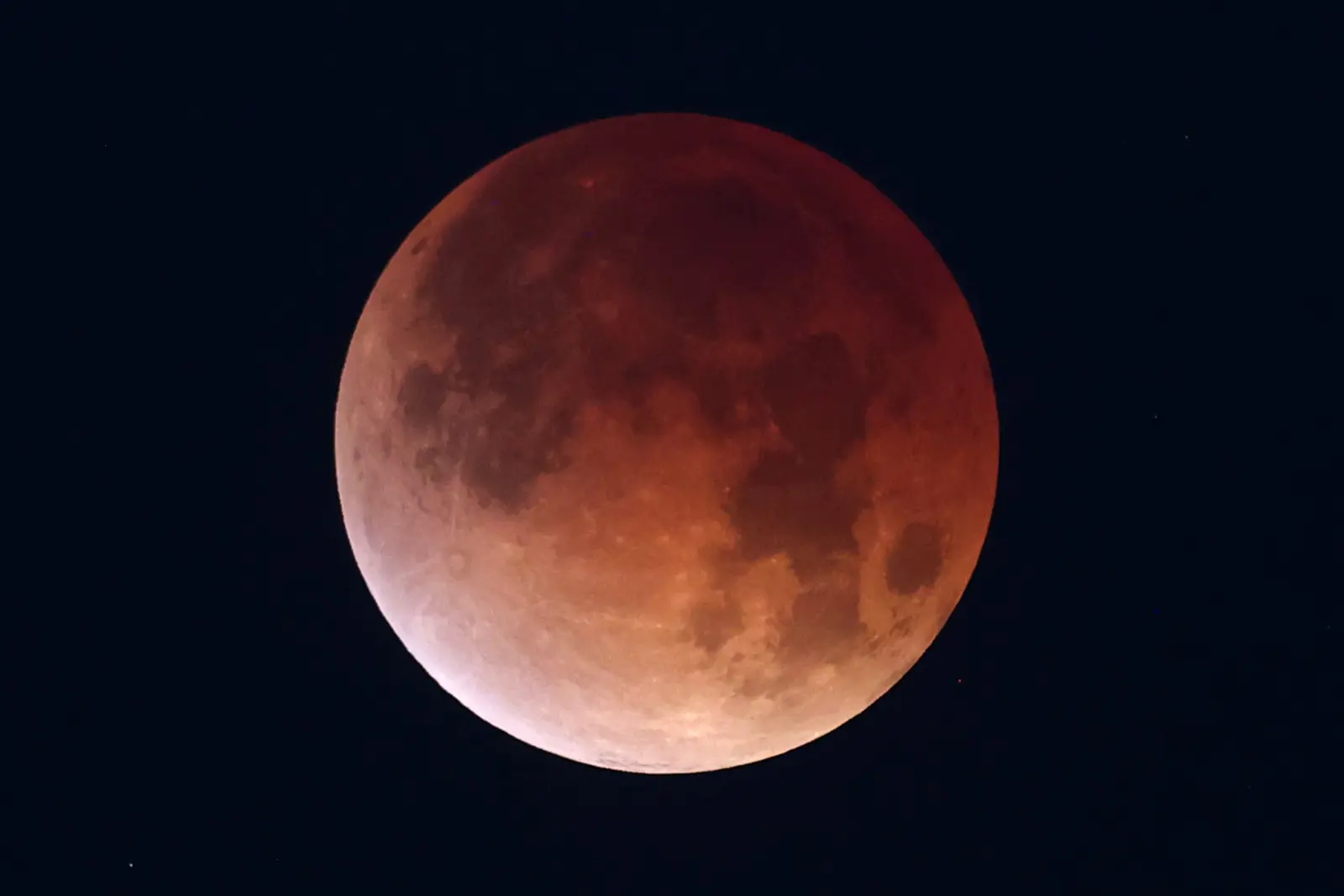
Lunar Eclipse
When Earth steps between the Sun and Moon, our world paints the night with red.
A Shadow on the Moon
A lunar eclipse occurs when the Moon passes through Earth's shadow at full Moon, temporarily dimming or dramatically reddening the lunar disk. Unlike a solar eclipse — which is visible only along a narrow path — a lunar eclipse is visible from any location on Earth where the Moon is above the horizon, making it among the most widely observed of all astronomical events.
Earth's shadow has two concentric zones. The inner, darkest region is the umbra, where Earth completely blocks the Sun as seen from the Moon. Surrounding it is the lighter penumbra, where Earth only partially covers the solar disk and some direct sunlight still reaches the Moon's surface. The character of any given lunar eclipse — whether subtle, dramatic, or spectacular — depends entirely on how deeply the Moon's path cuts into these zones.
Lunar eclipses have fascinated and unsettled observers across every culture for millennia. Babylonian astronomers recorded and predicted them from the 8th century BCE. Greek philosophers used the curved shape of Earth's shadow on the Moon as early evidence that our planet is spherical. Today, scientists use lunar eclipse observations to probe the Moon's surface properties, measure the precise Earth–Moon distance, and even study Earth's own atmospheric composition.
Earth's Shadow: Umbra, Penumbra, and Geometry
The Sun is not a point source of light but a disk about half a degree across as seen from Earth. This finite angular size means Earth's shadow is not a simple cylinder but a system of nested cones. Understanding those cones is the key to understanding every type of lunar eclipse.
The umbra is the inner, darkest cone. Rays traced from opposite edges of the Sun to opposite edges of Earth converge to a point behind Earth — the umbral tip — defining a region where Earth completely blocks the Sun's disk. Any part of the Moon within the umbra receives no direct sunlight at all. The umbra is a converging cone: it narrows with distance from Earth.
The penumbra is the outer, lighter region that surrounds the umbra. Rays from opposite edges of the Sun to the same edge of Earth define a diverging cone where the Sun is only partially obscured by Earth. A point on the Moon inside the penumbra still receives some direct sunlight, so the Moon dims there but does not go dark.
At the Moon's average distance from Earth, the umbra's diameter is a little less than three times the Moon's diameter, while the penumbral annulus (the ring of penumbra around the umbra) is roughly one lunar diameter wide. This geometry is why the Moon can fit entirely within the umbra during a total eclipse and still be surrounded by penumbra at the same time.
A lunar eclipse can occur only at full Moon, when Earth lies roughly between the Sun and Moon. However, the Moon's orbit is tilted by about 5° to the ecliptic — Earth's orbital plane — so most full Moons pass above or below Earth's shadow entirely. An eclipse happens only when the full Moon is close to one of the two lunar nodes, the points where the Moon's orbit crosses the ecliptic. These favorable alignments recur in eclipse seasons spaced roughly 173 days apart.
Types of Lunar Eclipse
Three main types of lunar eclipse are defined by how far the Moon penetrates into Earth's shadow system, with a notable subtype within the total category.
A penumbral lunar eclipse occurs when the Moon passes only through Earth's penumbra, never entering the umbra. From any point on the Moon's visible face, Earth only partially blocks the Sun, so the Moon receives reduced but not zero sunlight. The visible effect on Earth is a subtle overall dimming of the lunar disk, often so faint that casual observers do not notice it. If the Moon lies entirely inside the penumbra at maximum, the event is called a total penumbral eclipse — a rare subtype.
A partial lunar eclipse occurs when part of the Moon dips into the umbra while the rest remains in the penumbra or in full sunlight. The umbra-covered portion appears distinctly and strikingly darker than the rest of the disk, as though a dark curved bite has been taken out of the Moon. The sharpness of this boundary — the clear contrast between umbral dark and penumbral dim — is one of the most visually striking aspects of a partial eclipse.
A total lunar eclipse occurs when the entire Moon passes within Earth's umbra at mid-eclipse. The sequence has five distinct stages: penumbral ingress, when the Moon first touches the penumbra; umbral ingress (partial eclipse begins), when the Moon's limb first enters the umbra; totality, when the Moon is completely immersed in the umbra; umbral egress (partial eclipse ends), as the Moon exits the umbra; and penumbral egress, as it clears the penumbra entirely.
Within the total category, a central lunar eclipse is one where the Moon passes close to the geometric center of Earth's umbra — near the antisolar point, the point directly opposite the Sun. Central eclipses tend to have the longest durations of totality and the deepest, darkest coloration. They occur in approximately 59.6% of all total lunar eclipses.
Why the Moon Turns Red: The Blood Moon Explained
During a total lunar eclipse, the Moon does not go black. Instead it glows in shades of copper, orange, or deep red — a phenomenon widely called a "blood moon." The explanation lies in Earth's atmosphere acting as a giant lens and color filter simultaneously.
If Earth had no atmosphere, the umbra would be a region of near-perfect darkness and the eclipsed Moon would be almost invisible to the naked eye. In reality, Earth's atmosphere refracts (bends) sunlight around the curve of Earth and redirects it into the umbral cone. As this light travels through a long, dense path of air at Earth's limb, shorter wavelengths — blue and violet — are strongly scattered away by Rayleigh scattering, the same process that makes the daytime sky blue. The longer wavelengths — red and orange — are scattered far less and thread through the atmosphere to illuminate the Moon from within the umbra.
The result is that an observer on the Moon during totality would see a thin ring of vivid red and orange light surrounding a dark Earth — all of Earth's sunrises and sunsets, projected simultaneously onto the Moon's surface. The same light, viewed from Earth, gives the Moon its characteristic blood-red hue.
The exact color and brightness vary considerably from one eclipse to the next, controlled by the state of Earth's atmosphere at the time. A clear, aerosol-free atmosphere produces a brighter, more orange eclipsed Moon. After major volcanic eruptions, when fine ash and sulfur aerosols load the stratosphere, the Moon can turn a dark brownish-gray and nearly disappear at totality. Because atmospheric conditions are never identical, no two total lunar eclipses look exactly alike in color or brightness.
"Blood moon" is a popular term, not a formal astronomical designation. Astronomers describe such events simply as total lunar eclipses and characterize their appearance qualitatively or using the Danjon scale of lunar eclipse brightness. Some writers also use "blood moon" in reference to tetrads — sequences of four consecutive total lunar eclipses — sometimes with biblical or prophetic associations, but this usage is not standard in astronomy.
Duration, Frequency, and the Saros Cycle
Lunar eclipses of all types occur on average about three times per year worldwide, constrained by orbital geometry to intervals of 1, 5, or 6 synodic months between successive events. Approximately 29% of all lunar eclipses are total. In the 21st century (2001–2100), there are 228 lunar eclipses: 86 penumbral, 57 partial, and 85 total — about 0.85 total lunar eclipses per year. Any given location on Earth, assuming clear skies, can expect to see a total lunar eclipse on average roughly once every 2.5 years.
The duration of totality — the interval during which the Moon lies entirely within the umbra — depends on how centrally the Moon crosses the shadow and how fast it is moving. A Moon near apogee (farthest from Earth) moves more slowly and subtends a smaller angle, both of which favor longer totalities. A Moon passing through the center of the umbra travels the maximum chord length. The theoretical maximum totality is close to 107 minutes. The longest measured totality of the 20th century occurred on 16 July 2000 at approximately 1 hour 46.4 minutes; the longest of the 21st century so far was 27–28 July 2018, at 1 hour 42 minutes 57 seconds. At the opposite extreme, the shortest totality of the 21st century was 4 April 2015, at about 4 minutes 48 seconds — the Moon barely grazed the edge of the umbral cone. The historical record appears to include extremes as short as roughly 1 minute 42 seconds, computed for 17 October 1529.
Eclipse recurrence is governed by the Saros cycle, a period of approximately 18 years 11⅓ days (about 6,585.32 days). After one Saros, the geometry of the Sun–Earth–Moon system at full Moon nearly repeats because three lunar periods come back into close alignment: 223 synodic months, 242 draconic months, and 239 anomalistic months all equal roughly 6,585.32 days. The result is a nearly identical eclipse — same type, similar magnitude, similar position of the Moon within Earth's shadow.
Every lunar eclipse belongs to a numbered Saros series. Each series contains roughly 70–80 eclipses and spans about 12–13 centuries from its first member to its last. Modern catalogs such as NASA's Five Millennium Catalog of Lunar Eclipses list the Saros number for each eclipse, linking every event to its ancient and future cousins.
History of Observation and Prediction
Systematic observation of lunar eclipses began in Mesopotamia no later than the 8th century BCE. One of the earliest securely dated records is a partial lunar eclipse on 6 February 747 BCE, in the first year of the reign of Babylonian king Nabonassar. This epoch was later chosen by Ptolemy as the starting point for his astronomical calculations, a sign of how central these records were to ancient science. Babylonian astronomical diaries from the 8th through 1st centuries BCE contain systematic eclipse records giving dates, times, and qualitative descriptions such as "total" or "north part dark."
Chinese chronicles are also among the oldest sources. The Zhou-Shu (Book of Zhou), reportedly recovered from a tomb in 280 CE, contains a lunar eclipse reference associated with 29 January 1137 BCE, making it one of the oldest known eclipse mentions in any written record. Subsequent Chinese dynasties maintained eclipse records that were both astronomical observations and political omens, since an eclipse was often read as a heavenly warning about imperial conduct.
In the Greek world, lunar eclipses appear as both historical anchors and literary references. A total lunar eclipse on 28 August 413 BCE occurred during the Athenian siege of Syracuse; the Athenian commander Nicias, unnerved by what he took as a bad omen, delayed the fleet's departure — a delay that led to the destruction of the expedition. This eclipse is now used by historians to anchor the chronology of the Sicilian Expedition. A total lunar eclipse before the Battle of Gaugamela on 20 September 331 BCE was recorded as the Moon being "suffused with the hue of blood," and it helps confirm the dating of Alexander the Great's campaign. The playwright Aristophanes alluded to a lunar eclipse in his comedy The Clouds, while the Fall of Constantinople in 1453 was preceded by a partial lunar eclipse interpreted by Byzantine chroniclers as the fulfillment of prophecy.
By the time of Aristotle, Hipparchus, and Ptolemy, Greek astronomers had arrived at a correct geometric model: a lunar eclipse occurs when Earth passes between the Sun and Moon at full Moon and the Moon lies near one of its orbital nodes, explaining why eclipses do not happen every month. Combined with Babylonian numerical records, this understanding enabled increasingly accurate eclipse prediction. The Babylonians themselves had already empirically discovered the 18-year pattern — what we now call the Saros — by the 7th–5th centuries BCE, as evidenced by cuneiform texts listing eclipse intervals of 223 months. The word "Saros" in its modern sense was popularized by the astronomer Edmund Halley, but the underlying cycle was an ancient Babylonian discovery.
Lunar Eclipses Through History
- 1137 BCE (Jan 29)Earliest Chinese reference
The Zhou-Shu (Book of Zhou) contains what may be the oldest known written mention of a lunar eclipse, associated with this date.
- 747 BCE (Feb 6)Babylonian record under Nabonassar
One of the earliest securely dated eclipse records: a partial lunar eclipse in the first year of King Nabonassar's reign. Ptolemy later used this as the epoch for his calculations. Saros 31.
- 413 BCE (Aug 28)Syracuse eclipse delays Athenian fleet
A total lunar eclipse during the Athenian siege of Syracuse caused commander Nicias to delay withdrawal; the ensuing disaster destroyed the Sicilian Expedition. Saros 60.
- 331 BCE (Sep 20)Eclipse before Gaugamela
A total lunar eclipse was recorded before Alexander the Great's Battle of Gaugamela; sources describe the Moon as 'suffused with the hue of blood.' Helps confirm Alexander's campaign chronology.
- ~3rd century BCEAristarchus measures Moon's size and distance
Using timing of the Moon's passage through Earth's umbra and the known angular speed of the Moon, Aristarchus derived one of the first numerical estimates of lunar diameter and Earth–Moon distance.
- ~150 BCEHipparchus refines lunar distance
Using refined eclipse timings and lunar orbit models, Hipparchus improved measurements of lunar diameter and the Earth–Moon distance to approximately 60–70 Earth radii — close to the modern mean of ~60.3 Earth radii.
- 1453 (May, during Fall of Constantinople)Blood moon at Constantinople
A partial lunar eclipse during the siege was interpreted by Byzantine chroniclers as fulfilling prophecy of the city's fall.
- 17th centuryEclipses used for longitude determination
Observers at different locations recorded local times of the same eclipse phase (e.g., start of totality), converting the time difference into a difference in longitude — an early technique in absolute cartography.
- 16 Jul 2000Longest total eclipse of the 20th century
Totality lasted approximately 1 hour 46.4 minutes, nearly at the theoretical maximum, as the Moon passed almost exactly through the center of Earth's umbra.
- 27–28 Jul 2018Longest total eclipse of the 21st century
Totality lasted 1 hour 42 minutes 57 seconds, with total umbral contact (partial + total phases) lasting approximately 3 hours 55 minutes.
- 14 Mar 2025Total lunar eclipse (upcoming)
Visible across the Americas and parts of western Europe and Africa; a typical total eclipse with totality on the order of roughly an hour.
- 7 Sep 2025Second total lunar eclipse of 2025
The Moon passes south of Earth's shadow center; visible across large parts of the globe, with totality somewhat under an hour.
What Lunar Eclipses Have Taught Us
Ancient Greek observers noted that Earth's shadow on the Moon is always curved, regardless of the Moon's position in the sky. Only a spherical body casts a consistently circular shadow from any angle — one of the earliest empirical arguments for a round Earth.
Aristarchus (~3rd century BCE) used eclipse timings to estimate the Moon's diameter and, combining this with Eratosthenes' measurement of Earth's diameter, computed the Earth–Moon distance. Hipparchus and Ptolemy later refined these values to approximately 60–70 Earth radii, strikingly close to the modern mean of ~60.3 Earth radii (~384,400 km).
Babylonian astronomers, through centuries of systematic record-keeping, recognized that the Sun–Earth–Moon geometry repeats after approximately 223 synodic months (~18 years 11⅓ days), allowing them to forecast eclipses with considerable reliability. This remains one of the most important empirical discoveries in the history of astronomy.
From the 17th century onward, the simultaneous visibility of eclipse phases from widely separated locations allowed observers to determine longitude differences by comparing local clock times — an important pre-chronometer technique for absolute cartography.
Analysis of sunlight refracted through Earth's atmosphere during total lunar eclipses — the same light that gives the Moon its red color — revealed absorption signatures showing that ozone is confined to a layer between roughly 50 and 80 km altitude in Earth's stratosphere and lower mesosphere.
NASA's Diviner Lunar Radiometer aboard LRO observes how rapidly different parts of the lunar surface cool during the rapid temperature drop of a lunar eclipse. Because rocks and fine-grained regolith cool at different rates, this data reveals rock size distribution, density, and thermal inertia in the uppermost surface layer — properties not easily obtained by any other method.
Laser reflectors placed on the Moon by Apollo and Lunokhod missions allow Earth–Moon distance to be measured to centimetre accuracy. During lunar eclipses, reduced background illumination from the lunar surface can favour laser ranging measurements. LLR data has confirmed the Moon's slow recession due to tidal interaction and detected Earth's rotational slowdown.
Notable Total Lunar Eclipses, 2000–2025
21 Jan 2000
Total lunar eclipse
9 Jan 2001
Total lunar eclipse
16 May 2003
Total lunar eclipse
9 Nov 2003
Total lunar eclipse
4 May 2004
Total lunar eclipse
28 Oct 2004
Total lunar eclipse
3 Mar 2007
Total lunar eclipse
21 Feb 2008
Total lunar eclipse
21 Dec 2010
Total lunar eclipse
15 Jun 2011
Total lunar eclipse
10 Dec 2011
Total lunar eclipse
15 Apr 2014
Total lunar eclipse — first of 2014–2015 tetrad
8 Oct 2014
Total lunar eclipse — second of 2014–2015 tetrad
4 Apr 2015
Total lunar eclipse — shortest totality of the 21st century (~4 min 48 s)
28 Sep 2015
Total lunar eclipse — fourth of 2014–2015 tetrad
31 Jan 2018
Total lunar eclipse — totality 1 h 16 min
27–28 Jul 2018
Total lunar eclipse — longest totality of 21st century: 1 h 42 min 57 s
21 Jan 2019
Total lunar eclipse — widely visible across Americas and Europe
26 May 2021
Total lunar eclipse
16 May 2022
Total lunar eclipse
8 Nov 2022
Total lunar eclipse
25 Mar 2024
Penumbral lunar eclipse — subtle dimming only, no umbral phase
18–19 Sep 2024
Partial lunar eclipse — part of Moon entered umbra
14 Mar 2025
Total lunar eclipse — visible in Americas, western Europe, Africa; totality ~1 hour
7 Sep 2025
Total lunar eclipse — Moon passes south of shadow center; wide global visibility
Frequently Asked Questions
Sources
- Lunar Eclipse Phenomena: Modeled and Explained — arXiv
- Eclipses and the Moon — NASA Science
- Lunar eclipse — Wikipedia
- When the Sky Goes Dark: a Deep Dive into Eclipses — Museum of Science, Boston
- Historically significant lunar eclipses — Wikipedia
- Lunar Eclipses of Historical Interest — NASA GSFC
- Lunar Eclipse Page — NASA GSFC
- What are lunar eclipses and how do they occur? — Space.com
- Periodicity of Lunar Eclipses — NASA GSFC
- Lunar Eclipse Statistics — EclipseWise
- List of lunar eclipses in the 21st century — Wikipedia
- Lunar eclipse — Encyclopaedia Britannica
- The science of eclipses — ESA
- What do lunar eclipses teach us about Earth? — Space.com
- Century's longest lunar eclipse July 27 — EarthSky
- Be prepared for the shortest total lunar eclipse of the century — The Conversation
- Catalog of Lunar Eclipses: 0001 to 0100 — NASA GSFC
- Blood on the Moon: The Upcoming 2025 Total Lunar Eclipse — Museum of Science, Boston