Milky Way
Our home galaxy — a barred spiral of 100–400 billion stars spanning 100,000 light-years, ancient beyond reckoning and still full of surprises.
The Milky Way
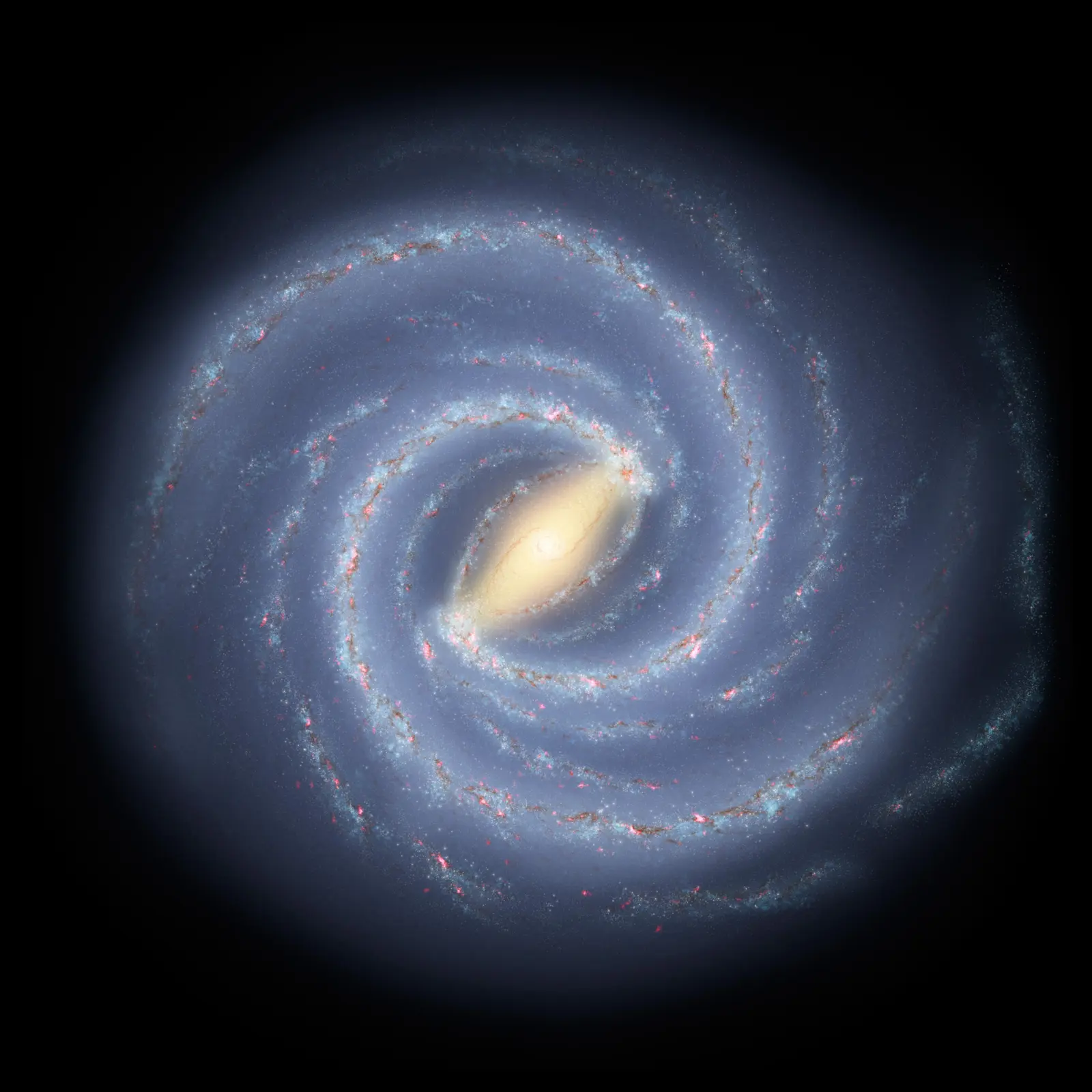
The Milky Way is the barred spiral galaxy that contains the Solar System, Earth, and every star visible to the naked eye from our planet. Its name comes from the hazy white band of diffuse light stretching across dark skies — a band that Galileo Galilei first resolved into individual stars in 1610. Today, astronomers classify it morphologically as type SB(rs)bc: a barred spiral with a modest central ring structure and moderately wound arms.
In terms of sheer scale, the Milky Way's stellar disk spans roughly 100,000 light-years from edge to edge, while its invisible dark-matter halo extends far beyond — reaching an estimated radius of nearly 950,000 light-years. Within that disk live somewhere between 100 and 400 billion stars, and the number of planets almost certainly matches or exceeds that count. The galaxy's total mass, dominated by dark matter, is estimated at about 1 trillion solar masses, though the stellar mass alone is a comparatively modest 46–64 billion solar masses.
At the very center of all this sits Sagittarius A* (Sgr A*), a supermassive black hole roughly 4.1 million times the mass of the Sun. In May 2022, the Event Horizon Telescope collaboration released the first direct image of Sgr A*, confirming decades of indirect evidence with an image of a bright emission ring surrounding the black hole's shadow. Our own Solar System sits roughly 27,000 light-years from that center, on the inner edge of a minor spiral feature called the Orion Arm, tucked between two of the galaxy's major spiral arms.
Structure of the galaxy
The Milky Way is organized into several distinct structural components: a thin disk, a thick disk, a central bulge and bar, spiral arms, and an extended halo. The thin disk is where most of the galaxy's star formation occurs today. At the location of the spiral arms it is only about 1,000 light-years thick, though its full vertical extent reaches perhaps 4,000 light-years. The thick disk, a somewhat older stellar population with a different chemical composition, is considerably deeper — about 8,500 light-years in scale height. Rather than lying perfectly flat, the disk is warped into a gentle S-shaped curve when viewed from outside.
The central region is dominated by a bar-shaped concentration of stars extending several kiloparsecs to either side of the nucleus. Observations with the Spitzer Space Telescope in 2005 confirmed that this bar is larger than previously appreciated, though its exact half-length — estimated anywhere from roughly 3,000 to 16,000 light-years — and its orientation relative to our line of sight (somewhere between 10° and 50°) remain subjects of active research. Stars, gas, and dust caught up in the bar's gravitational potential funnel material toward the galaxy's center.
Beyond the bar, the disk breaks into spiral arms. Modern surveys, particularly Spitzer infrared imaging, point to two major stellar arms — Scutum–Centaurus and Perseus — attached to the ends of the central bar and containing the highest densities of both young and old stars. Two additional arms, Norma and Sagittarius, are classified as minor arms: they are rich in gas and active star-forming regions but comparatively poor in old stars. The Sun sits between the Sagittarius and Perseus arms in the Orion Arm (or Orion Spur), a partial arm segment about 10,000 light-years long that contains familiar landmarks such as the Orion Nebula and the Cygnus Rift. The HI neutral hydrogen disk, tracing gas rather than stars, extends far beyond the stellar disk — to about 228,000 light-years from the center.
Surrounding all of this is the galactic halo, a roughly spherical region containing old stars, globular clusters, and an enormous, largely invisible dark-matter halo whose edge a 2020 study places at a radius of roughly 950,000 light-years. The Monoceros Ring, a ring-like structure of gas and stars beyond the main disk, is thought to be tidal debris from past accretion events.
Sagittarius A*: the central black hole
At the heart of the Milky Way lies Sagittarius A*, a compact and intensely bright radio source first identified in the 1970s. Decades of high-resolution infrared observations tracking the orbits of individual stars in the Galactic Center — most famously the star S2 — revealed that these stars follow tight Keplerian orbits around an unseen, extraordinarily massive and compact object. Those measurements, carried out independently by teams led by Andrea Ghez and Reinhard Genzel, showed the central mass to be approximately 4.1 million solar masses confined to a region far too small to be a star cluster, pointing unmistakably to a supermassive black hole.
The definitive visual confirmation came on 12 May 2022, when the Event Horizon Telescope (EHT) collaboration released the first direct image of Sgr A*. The data were gathered in April 2017 at a wavelength of 1.3 mm using eight radio observatories spread across the globe and combined using very-long-baseline interferometry to create a virtual Earth-sized telescope. The resulting image shows a bright ring of emission approximately 50 microarcseconds in diameter surrounding a central shadow — precisely the size expected for a 4-million-solar-mass black hole at a distance of about 8 kiloparsecs, and in close agreement with the predictions of general relativity. Because Sgr A* varies on timescales of minutes, the team applied multiple independent imaging algorithms and averaged thousands of reconstructed images to extract a robust, consistent picture of the ring structure.
Sgr A* is only the second black hole imaged by the EHT, after M87* in 2019. Both objects show a bright ring and central shadow despite differing in mass by a factor of roughly 1,500, demonstrating the universality of strong-gravity light bending predicted by Einstein's equations. Best-fit simulations of the accretion flow around Sgr A* favor a spinning black hole observed nearly face-on, with strong magnetic fields in the surrounding plasma, though these inferences carry greater uncertainty than the ring detection itself.
How humans came to understand the Milky Way
- Pre-1600Ancient observations
Across cultures, the Milky Way was recognized as a diffuse luminous band arching across the night sky, but its physical nature remained unknown and debated.
- 1610Galileo resolves the band into stars
Using one of the first astronomical telescopes, Galileo Galilei pointed it at the Milky Way and found the glowing band to be composed of countless individual faint stars. He published the discovery in Sidereus Nuncius (Starry Messenger) in March 1610 — the first observational proof that the Milky Way is a stellar system.
- 1785Herschel's star-gauge map
William Herschel, assisted by his sister Caroline, counted stars in hundreds of different directions using a large reflecting telescope. Assuming stars have similar brightness and that his telescope reached the system's edge, he inferred a flattened, disk-like stellar system with the Sun near its center — the first quantitative structural model of the Galaxy. Herschel did not account for interstellar dust, so his model was far too small, but it firmly established the Milky Way as a coherent stellar system.
- 1904Kapteyn discovers two star streams
Dutch astronomer Jacobus Kapteyn, applying statistical analysis to stellar proper motions, found that stars do not move randomly but fall into two preferred streams flowing in nearly opposite directions. This discovery was the first hint of systematic galactic rotation, later formalized by Bertil Lindblad and Jan Oort.
- 1922The Kapteyn Universe
Kapteyn published a sophisticated statistical model of the Milky Way as a lens-shaped ellipsoid with the Sun near the center — a more rigorous version of Herschel's approach. Like Herschel, he underestimated interstellar absorption and therefore the Galaxy's true size, but his work pioneered large-scale stellar statistics and provided key early evidence for galactic rotation.
- 1917–1918Shapley maps the globular clusters and moves the Sun from center
Using the 60-inch telescope at Mount Wilson Observatory and exploiting the period–luminosity relation of RR Lyrae variable stars as standard candles, Harlow Shapley measured distances to dozens of globular clusters. He found they form a spherical halo centered far from the Sun, in the direction of Sagittarius, demonstrating that the Milky Way is far larger than previously thought and that the Sun lies in its outer regions, not near the center. His absolute distances were overestimated because of unaccounted interstellar extinction, but the qualitative insight proved correct.
- 1920The Great Debate (Shapley–Curtis)
In a famous public debate, Shapley argued for a large Milky Way encompassing the spiral nebulae, while Heber Curtis maintained that spiral nebulae are separate 'island universes.' Shapley was correct that the Milky Way is large and the Sun off-center, but wrong that spiral nebulae are contained within it.
- 1923–1924Hubble proves the Milky Way is one galaxy among many
Edwin Hubble identified Cepheid variable stars in the Andromeda Nebula (M31) and measured its distance at about 900,000 light-years (the modern value is ~2.5 million light-years), placing it far beyond the Milky Way and establishing that the Universe contains many separate galaxies.
- 1920s–1930sGalactic rotation confirmed
Building on Kapteyn's evidence of ordered stellar motions, Bertil Lindblad and Jan Oort demonstrated that the Milky Way is a differentially rotating disk, with inner regions completing their orbits faster than outer ones — confirming the modern picture of a rotating spiral galaxy.
- 2005Spitzer confirms the central bar and refines the spiral arm count
Infrared surveys with NASA's Spitzer Space Telescope confirmed that the Milky Way is a barred spiral galaxy with a bar larger than previously appreciated. Spitzer results also indicated two dominant stellar arms (Scutum–Centaurus and Perseus) rather than four, with Norma and Sagittarius demoted to minor arms.
- 12 May 2022Event Horizon Telescope images Sagittarius A*
The EHT collaboration released the first direct image of Sagittarius A*, the Milky Way's central supermassive black hole. The image, derived from April 2017 observations at 1.3 mm, shows a bright emission ring of ~50 microarcseconds consistent with a ~4 million solar mass black hole, in agreement with general relativity.
Formation, age, and future
The Milky Way is approximately 13.6 billion years old, meaning its earliest stellar progenitors formed very shortly after the Big Bang. The sequence of its assembly is now being reconstructed in considerable detail thanks to surveys of stellar ages, chemical compositions, and kinematics. The thick disk — the older, kinematically hotter stellar population — began forming around 13 billion years ago. Around 11 billion years ago, the Milky Way experienced a significant merger with a large companion galaxy, an event linked to a burst of star formation and to the buildup of the stellar halo, which contains many old stars that were likely accreted during such collisions.
Over the past 8–10 billion years, the galaxy has grown more quietly, accreting gas and smaller satellites rather than undergoing further large mergers. The Large and Small Magellanic Clouds — the Milky Way's two largest satellite galaxies — are still interacting with their host and contributing gas to the galaxy's outskirts via the Magellanic Stream. The Milky Way's halo harbors more than 50 known satellite galaxies, and their spatial distribution may trace a broader ring-like structure linked to past accretion.
The galaxy's long-term future is dominated by one looming event: a collision with the Andromeda Galaxy, currently approaching at several hundred kilometers per second. Simulations predict the two galaxies will collide in approximately 4.3 billion years. The merger will likely produce a large elliptical or lenticular galaxy over subsequent billions of years. Despite the violence implied by two enormous stellar systems merging, the vast distances between individual stars mean very few direct stellar collisions will occur — the outcome will be a gravitational reshuffling rather than a physical crash.
New discoveries: 2022–2024
The Event Horizon Telescope released the first direct image of the Milky Way's central black hole, showing a bright ring of radio emission ~50 microarcseconds across consistent with a ~4 million solar mass object, in agreement with general relativity.
A major 2024 analysis using Gaia astrometric data reported 87 previously unknown stellar streams in the Milky Way's halo — thin ribbons of stars that are the gravitationally shredded remnants of past accretion events. The discovery dramatically expanded the known stream population and strengthened the case that the galaxy's halo is built from many consumed satellites.
A Nature-published study reconstructed the galaxy's history between roughly 13 and 8 billion years ago, finding it was far more active in that period — merging with other galaxies and forming stars rapidly — before settling into its current relatively quiet state.
In 2024, astronomers assembled the largest low-frequency radio color image of the Milky Way yet made, revealing hidden star-forming regions, supernova remnants, and previously unresolved large-scale structure. The same survey produced the first-ever map of magnetic field structures within a spiral arm.
A 2024 study identified a small group of stars sharing distinctive chemical signatures and formation histories as likely remnants of a destroyed dwarf galaxy, nicknamed Loki, that was absorbed by the Milky Way in the distant past — a concrete example of the mergers that built the galactic halo.
New work using the chemical compositions ('metallicities') of stars to trace the galaxy's spiral structure — chemical cartography — confirmed that spiral arms are systematically richer in heavy elements than the surrounding disk and revealed previously undetected arm segments, refining the overall picture of the Milky Way's shape.
Frequently asked questions
Sources
- Milky Way - Wikipedia
- Relative Sizes of the Earth and the Milky Way Galaxy — NRAO
- The Milky Way Galaxy — Las Cumbres Observatory
- Our Milky Way Galaxy: How Big is Space? — NASA Science
- Milky Way Galaxy — Britannica
- Spiral Structure — Lumen Learning / SUNY Astronomy
- Chemical Cartography Reveals the Milky Way's Spiral Arms — UT Austin CNS
- Discovering Mount Wilson Chapter 6: Harlow Shapley & the Milky Way
- How we learned the shape of the Milky Way — Astronomy Magazine
- Jacobus Kapteyn — UNLV Physics
- Here's the best timeline yet for the Milky Way's big events — Science News
- The exciting teenage years of our Milky Way galaxy — Max Planck Society
- The Milky Way may have devoured another galaxy named Loki — Space.com
- EHT: First Sagittarius A* Event Horizon Telescope Results III — arXiv
- Astronomers Reveal First Image of the Black Hole at the Heart of Our Galaxy — EHT
- Telescopes Get Extraordinary View of Milky Way's Black Hole — NASA JPL
- Astronomers just revealed a stunning new view of the Milky Way in radio — Science Daily