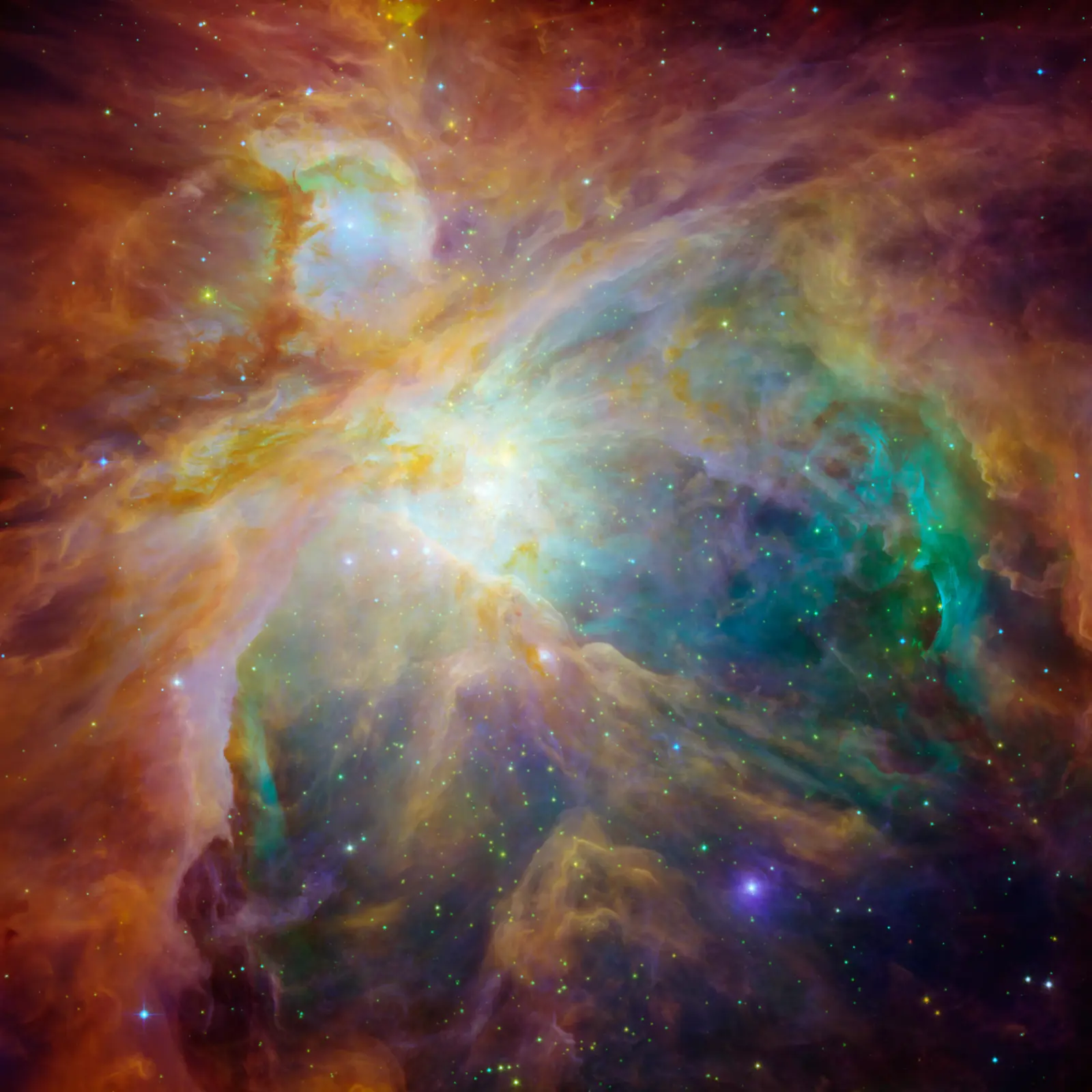
Orion Nebula
The nearest stellar nursery — a glowing cloud of gas and dust where new stars and planets are being born right now, just 1,350 light-years away.
The Orion Nebula
The Orion Nebula — catalogued as Messier 42 (M42) and NGC 1976 — is a vast diffuse emission nebula and ionized hydrogen (H II) region located in the constellation Orion, hanging below the three stars of Orion's Belt in the region known as the sword. At roughly 1,350 light-years from Earth, it is the closest large star-forming region to our planet, and on a dark night it is faintly visible to the naked eye as a hazy patch of magnitude +4.0.
The nebula spans approximately 25 light-years and contains between 2,000 and 3,000 solar masses of gas and dust. Its brilliant glow is powered by a tight cluster of four massive, hot stars at its core — the Trapezium — whose fierce ultraviolet radiation strips electrons from the surrounding hydrogen, causing the gas to shine. This same radiation sculpts the nebula's structure, carving cavities and filaments while simultaneously eroding the nascent planetary systems of hundreds of smaller, younger stars.
M42 is far more than a picturesque object in amateur telescopes. It is an active laboratory where astronomers can observe every phase of stellar and planetary birth simultaneously: collapsing molecular cloud cores, protostars wrapped in dusty cocoons, protoplanetary disks that may one day form alien solar systems, brown dwarfs too small to sustain nuclear fusion, and freely wandering planet-mass objects apparently unbound to any star. No other region of the sky offers such a comprehensive window onto how stars and planets come to be.
Physical character and structure
The Orion Nebula is not a simple cloud of uniform gas. It is the brilliantly lit, ionized surface layer of a much denser, colder object — OMC-1, the first core of the Orion Molecular Cloud — seen in projection against open space. The hot H II region we call M42 is essentially a blister on the face of OMC-1, lit from within by the Trapezium's ultraviolet flood. Behind and around this luminous skin, temperatures plunge from around 10,000 K in the ionized gas to as low as 10 K in the densest pockets of the surrounding molecular cloud, a temperature range of a thousand-fold spanning just a few light-years.
The bright region spans roughly 85 by 60 arcminutes on the sky — about one and a half degrees by one degree, or three full Moons placed side by side — though its full photographic extent when faint outer wisps are included covers close to two degrees. At a distance of about 1,350 light-years, this angular breadth corresponds to a physical diameter of roughly 25 light-years for the extended nebular complex, while the intensely bright core where most of the visible emission originates is considerably smaller.
The nebula's composition is dominated by hydrogen, with helium and trace heavier elements. Its characteristic red-pink glow in photographs is H-alpha emission: photons released when ionized hydrogen atoms recapture electrons and cascade down through energy levels. Lanes and filaments of cool dust, threaded through the gas, absorb starlight and produce the dark rifts and mottled textures visible in high-resolution images, sometimes likened to smouldering, crackling fire. The chemistry is remarkably productive: estimates cited by Space.com and Cosgrove's Cosmos suggest the nebula's chemistry generates enough water molecules to fill Earth's oceans approximately 60 times every day.
At the heart of the nebula, the Trapezium stars have blown a hot, low-density bubble roughly 2 parsecs (about 6.5 light-years) in radius. This cavity is filled with shocked stellar-wind gas at temperatures of approximately 2 million K and densities around 1 atom per cubic centimetre. The expanding bubble has swept up a massive shell — sometimes called the Orion Veil — estimated at roughly 2,600 solar masses, moving outward at approximately 13 km/s. Where the bubble faces the dense molecular cloud of OMC-1, its expansion is effectively stalled by the much higher gas density there (10,000 to 100,000 atoms per cubic centimetre), creating a striking asymmetry: the nebula opens freely toward us while being dammed against its own birthplace behind it.
At the interface between the ionized region and the molecular gas sits one of the most studied structures in astrophysics: the Orion Bar, an edge-on photodissociation region (PDR) where ultraviolet radiation from the Trapezium dismantles molecules and alters the chemistry of the gas. Observations with SOFIA have mapped the magnetic field threading the OMC-1 core, revealing a global hourglass shape pinched around the dense interior, indicating that gravity, turbulence, and magnetism all play significant roles in governing how material collapses to form new stars.
The Trapezium Cluster and the Orion Nebula Cluster
Dominating the bright heart of M42 is the Trapezium, a compact group of four massive, luminous O- and B-type stars arranged in a trapezoid pattern within a region only about 1.5 light-years across. Two of these four principal stars are themselves binary systems, giving at least six stars in the classical asterism. The entire Trapezium sits embedded in the larger Orion Nebula Cluster (ONC), a young open cluster containing approximately 2,000 to 2,800 stars within a diameter of roughly 20 light-years.
The Trapezium's most important member, the O-type star θ¹ Ori C, is the principal source of ionizing ultraviolet radiation responsible for making the entire nebula glow. Its intense wind drives the expanding bubble described above and ultimately governs the shape and fate of the nebula. The Trapezium stars are estimated to be only about 2 million years old — extraordinarily young by astronomical standards — yet their influence on the surrounding several light-years is already profound. Models suggest the massive stars may in fact be somewhat younger than many of the lower-mass cluster members, because intact protoplanetary disks survive close to the Trapezium: if the massive stars had been irradiating those disks for as long as the older low-mass stars have existed, the disks would long since have been destroyed.
The ONC as a whole contains stars spanning a wide range of masses, from objects heavier than the Sun down through solar-mass and sub-solar-mass stars to brown dwarfs — objects too low in mass to sustain hydrogen fusion. Hubble Space Telescope observations identified many of these brown dwarfs for the first time in visible light, helping to define the low-mass end of the stellar initial mass function in a young cluster. The abundance of such objects illustrates the remarkable range of outcomes when a molecular cloud fragments and collapses.
Star and planet formation: proplyds and the birth of solar systems
The Orion Nebula earned its reputation as the finest natural laboratory for star and planet formation precisely because it allows astronomers to observe nearly every stage of the process at once, in a single nearby region. Molecular cloud clumps collapse under gravity, heating as they shrink until dense, hot protostellar cores ignite nuclear fusion. Conservation of angular momentum forces the infalling material into a rotating disk around the newborn star — a protoplanetary disk — within which dust grains collide and stick, growing from micron-sized motes into larger aggregates and eventually into the planetesimals that can build rocky planets and the cores of gas giants. Many such disks in Orion are observed at different orientations: some appear in emission, glowing against the dark background; others are silhouetted as dark ovals against the bright nebular backdrop.
The Orion Nebula was the first place in the sky where protoplanetary disks were clearly resolved around individual young stars, and these objects are widely known as proplyds — a contraction of protoplanetary disks. Early radio observations with the VLA in the 1980s detected solar-system-sized condensations in the nebula associated with low-mass young stars surrounded by evaporating accretion disks. In 1993, Hubble Space Telescope imaging provided direct confirmation of the proplyds, and Hubble has since catalogued more than 150 such objects in M42 alone.
A typical Orion proplyd consists of a central T Tauri-like young star surrounded by a circumstellar disk of gas and dust tens to a few hundred astronomical units in size. The disk is exposed to the Trapezium's ultraviolet radiation, which photo-evaporates its outer layers, creating a bright ionization front on the side facing the Trapezium and a comet-like tail of ablated material streaming away from it. Close to the Trapezium, this photoevaporation is severe enough to potentially truncate disks and limit the mass available for planet formation; farther out, disks are better shielded and more likely to survive intact. Infrared observations show that even in heavily irradiated environments, dust grains within the disks are already growing, taking the first steps toward building planetesimals. The sheer number of proplyds in Orion is frequently cited as compelling evidence that the formation of planetary systems is a common, rather than exceptional, outcome of star birth.
History of observation
- 2nd century CEPtolemy lists it as a star
The nebula's position in Orion's sword is recorded in Ptolemy's Almagest simply as a star, with no indication of nebulosity.
- 1603Bayer designates Theta Orionis
Johann Bayer assigns the label Theta (Θ) Orionis to the middle 'star' of the sword in his Uranometria atlas, still unaware of any nebulosity.
- 26 Nov 1610Peiresc recognises the nebula
French astronomer Nicolas-Claude Fabri de Peiresc observes the region telescopically and recognises it as a fuzzy cloud rather than a point star — the first recorded recognition of its nebular nature. His notes remained unpublished for centuries, delaying recognition of his priority.
- 1611–1619Cysat publishes the first description
Swiss Jesuit Johann Baptist Cysat independently observes the nebula and publishes a description in a 1619 monograph on comets, making it the first published scientific account of the Orion Nebula.
- c. 1654Hodierna makes the earliest known drawing
Italian astronomer Giovanni Battista Hodierna produces the earliest known sketch of the Orion Nebula, depicting three of the Trapezium stars, though his work remained largely unknown to later astronomers.
- 1656–1659Huygens resolves stars and publishes landmark sketch
Christiaan Huygens, using long-focal-length refractors with improved optics, observes the nebula around 1656 and resolves multiple individual stars within it — the Trapezium. In 1659 he publishes the first widely known and detailed sketch of M42 in Systema Saturnium. His work so dominated subsequent knowledge that the bright central region of the nebula came to be called the Huygens Region.
- 1716Halley draws attention to the nebula
Edmond Halley discusses Huygens's discovery and brings renewed attention to the object in European astronomical circles.
- 1733De Mairan describes M43
Jean-Jacques d'Ortous de Mairan describes the detached northern portion of the nebular complex — later catalogued as M43 — as a distinct nebulous region.
- 4 Mar 1769Messier catalogues M42
French comet-hunter Charles Messier formally adds the Orion Nebula to his catalogue as Messier 42, describing it as 'the beautiful nebula in the sword of Orion, around the star Theta which it contains with three other smaller stars.' He also records M43 as a separate entry, crediting de Mairan. His detailed 1771 published drawing became the standard reference for 18th-century astronomers.
- 1880First photograph of a nebula
Henry Draper takes the first successful astrophotograph of the Orion Nebula, marking the beginning of the photographic era in nebular astronomy.
- 1993Hubble confirms protoplanetary disks
HST imaging provides direct confirmation of protoplanetary disks (proplyds) around young stars in the Orion Nebula, revolutionising understanding of planetary system formation.
- Oct 2004 – Apr 2005Hubble's sharpest mosaic
A large ACS mosaic produces Hubble's sharpest view of M42, resolving more than 3,000 stars, numerous proplyds, brown dwarfs, and intricate gas and dust structures across a field the apparent size of the full Moon.
- 11 Sep 2022JWST first images of the inner Orion Nebula
The James Webb Space Telescope obtains NIRCam images of the inner Orion Nebula as part of the PDRs4All Early Release Science program (ID 1288), delivering the sharpest and most detailed infrared view ever of the region around the Trapezium cluster.
- Jun 2023Hubble–JWST comparison released
ESA releases a direct side-by-side comparison of Hubble visible-light and JWST infrared views of a portion of M42, dramatically illustrating how infrared light penetrates dust to reveal embedded stars and disks invisible to Hubble.
- Late 2023Rogue Jupiter-mass pairs discovered
Analyses of JWST Orion data reveal evidence for at least 40 pairs of free-floating Jupiter-mass objects — dubbed JuMBOs — apparently unbound to any star, challenging standard models of star and planet formation.
- 2024JWST maps Orion Molecular Cloud-2
JWST NIRCam imaging of OMC-2, a cold filament behind the Orion Nebula, reveals every stage of star formation from youngest stellar embryos to protoplanetary discs and newly formed pre-main-sequence stars in a single field of view.
- Jul 2025Exoplanet forming inside Orion observed directly
Combined JWST and ALMA observations produce direct imagery of an exoplanet forming in the protoplanetary disk of HOPS-315, a protostar inside the Orion Nebula that is itself still in the process of forming — one of the clearest cases of planet formation caught in progress.
Hubble Space Telescope: a generation of discovery
No single observatory has done more to transform understanding of the Orion Nebula than the Hubble Space Telescope. In 1993, HST provided the first direct confirmation of protoplanetary disks around young Orion stars, and subsequent campaigns have built an increasingly detailed census of everything the nebula contains. The most ambitious of these campaigns, conducted between October 2004 and April 2005 using the Advanced Camera for Surveys, produced a panoramic mosaic that has become one of the most celebrated astronomical images ever made: a field the apparent size of the full Moon resolved into the individual light of more than 3,000 stars of widely varying masses, many seen in visible light for the first time.
That mosaic reveals the full complexity of M42's internal structure. Near the centre, arcs and bubbles trace where stellar winds from the Trapezium collide with and compress surrounding gas. Dark pillars near the M43 region point accusingly toward the Trapezium like fingers, their dense material apparently resisting UV-driven erosion long enough to survive while the surrounding nebula is stripped away. Numerous tadpole-shaped proplyds — each a young star wearing a comet-tailed evaporating cocoon — crowd the field near the Trapezium. Toward the bottom of the mosaic, a population of faint, red objects marks the locations of brown dwarfs, seen in visible light in Orion for the first time and helping astronomers constrain the low-mass end of the stellar initial mass function in a young cluster.
M43, the detached H II region at the upper left of the mosaic, offers a natural contrast. While M42 is ionized by four massive Trapezium stars working together, M43 is powered by a single massive star, leading astronomers to describe it as a miniature Orion Nebula — a simpler system where the influence of a single star on its birth cloud can be studied in relative isolation. Hubble data from M42 have also been used in three-dimensional visualisations that reconstruct the nebula as a glowing, bowl-shaped cavity open toward the observer, with proplyds and bow shocks resolved at high fidelity within the scene. Complementary Hubble-Spitzer infrared comparisons revealed additional faint, embedded stars invisible in optical light, foreshadowing what JWST would later achieve.
James Webb Space Telescope: infrared revolution
When the James Webb Space Telescope turned its NIRCam instrument toward the inner Orion Nebula on 11 September 2022, as part of the PDRs4All Early Release Science program (ID 1288), it produced the highest-resolution infrared view of the region ever obtained. Where Hubble's optical images are blocked by dust, JWST's longer-wavelength infrared light passes through, revealing structures — filaments, cavities, embedded protostars, jets, and protoplanetary disks — that had been effectively invisible. The images resolve structures down to scales comparable to the size of the Solar System.
The PDRs4All program's primary scientific target is the photodissociation region (PDR) at the boundary between the H II region and the OMC-1 molecular cloud — the Orion Bar and its surroundings. This is the zone where UV radiation from the Trapezium dissociates molecules, reshaping both the physical structure and chemical composition of the gas. JWST detects thin, meandering filaments rich in hydrocarbon molecules and molecular hydrogen, likely stirred by turbulent gas motions, as well as dense filaments that may trigger a new generation of star formation deeper in the cloud. Large, well-studied proplyds such as HST-10 are resolved in unprecedented infrared detail, illuminating how disks are being sculpted and potentially truncated by the harsh UV environment.
In June 2023, ESA released a direct Hubble–JWST comparison of a portion of M42 that became widely circulated. The juxtaposition is striking: where Hubble shows bubbles of glowing gas floating before thick dust clouds, JWST shows the same scene transformed — filaments of heated gas emerge from obscurity, cavities open in the cloud, and dozens of additional young stars with protoplanetary disks appear where there was only darkness in visible light. The comparison illustrates not a contradiction between the two observatories but a complementarity: Hubble excels at tracing ionized gas and bright surface structures, while JWST peers behind and within the dust to expose the deeper machinery of star birth.
Late 2023 brought one of the most surprising results from JWST's Orion campaign: evidence for at least 40 pairs of free-floating, Jupiter-mass objects within the nebula, sometimes called Jupiter-Mass Binary Objects or JuMBOs. These candidates appear as planet-mass objects in the nebular field, apparently orbiting each other rather than any star. Their existence poses a genuine puzzle: planetary-mass objects could conceivably form in collapsing cloud cores like very low-mass stars, or they could form in protoplanetary disks and later be gravitationally ejected — but binary pairs of such objects are difficult to explain by either mechanism. Formal peer-reviewed characterisation of these candidates remains an active area of research.
By 2024, JWST's Orion work extended beyond M42 itself into the colder, denser Orion Molecular Cloud behind the nebula. ESA's JWST Picture of the Month highlighted observations of OMC-2, a long filament of cold gas and dust in the Orion A cloud located about 1,280 light-years away. In a single NIRCam field, the image captures every stage of star formation simultaneously: youngest stellar embryos deeply buried in dust, protoplanetary discs glowing faintly in infrared, and newly minted pre-main-sequence stars blazing free of their cocoons, surrounded by billowing outflows. The programme (ID 5804) aims to study how outflows from young stars affect further star formation in the filament, how UV emission from young stars alters disk chemistry, and how gas and dust accrete onto the dozens of protostars in the region. Together, these 2022–2024 JWST results provide a three-dimensional picture of the Orion star-forming complex from cold molecular gas all the way through to young, shining stars.
The wider Orion Molecular Cloud complex and OB1 association
M42 is only the brightest, most visible feature of a sprawling star-forming complex that extends hundreds of light-years across the Orion constellation. The Orion Molecular Cloud complex contains two principal giant molecular clouds — Orion A and Orion B — and is home to a variety of other notable objects including the Horsehead Nebula, the reflection nebula M78, and the cluster and nebula NGC 2024 (the Flame Nebula). The entire complex sits in the Orion Arm of the Milky Way, the same spiral arm in which the Sun resides, making it a relatively local example of the kind of star-forming environment that has existed throughout the galaxy's history.
Orion A is a long, north-to-south filamentary cloud, sometimes called the integral-shaped filament, spanning tens of parsecs. Near its northern end, directly behind the bright face of M42, lies the dense core OMC-1, the immediate parent cloud of the Trapezium and the Orion Nebula Cluster. Within OMC-1, the Orion BN/KL region is an extraordinarily active and violent massive star-forming core, with powerful molecular outflows disturbing the surrounding environment. To the north of M42, reflection nebulae NGC 1973, 1975, and 1977 are illuminated by B stars and have carved their own smaller wind-blown bubble, distinct from the larger Trapezium-driven Orion Veil.
The entire complex is embedded within the Orion OB1 association, a loose grouping of massive O and B stars divided into four historically defined subgroups — OB1a, OB1b, OB1c, and OB1d — that represent successive episodes of star formation spread over approximately 10 million years. OB1a, northwest of Orion's Belt, is the oldest at roughly 8–10 million years; OB1b spans the Belt itself; OB1c occupies the sword and head region; and OB1d, which includes the Orion Nebula Cluster and NGC 2024, is the youngest at less than 2 million years and is still closely associated with its parent molecular material. This temporal sequence traces how feedback from older generations of massive stars — through radiation, winds, and supernova explosions — progressively shapes the clouds from which younger generations emerge, a self-propagating chain of star formation across a molecular cloud complex.
What the Orion Nebula has taught us
More than 150 proplyds identified by Hubble in M42 alone established that the formation of planetary disks around young stars is a routine outcome of star birth, not an exceptional event, greatly strengthening the expectation that planetary systems are widespread in the galaxy.
Observations of the Trapezium's influence — carving cavities, photoevaporating disks, and suppressing the growth of hundreds of lower-mass stars — quantified how powerfully the most massive stars reshape their birth environment and affect the final masses of nearby stars and their potential planets.
The proximity and richness of M42 and the surrounding Orion Molecular Cloud means astronomers can observe collapsing cloud cores, protostars, protoplanetary disks at various evolutionary stages, and recently formed stars all within a single region, enabling a coherent picture of the birth sequence.
Hubble and JWST observations have identified large numbers of brown dwarfs in the Orion Nebula Cluster, revealing that objects too low-mass to sustain hydrogen fusion are a common product of molecular cloud fragmentation and significantly extending the known stellar initial mass function.
JWST data from 2023 revealed at least 40 pairs of Jupiter-mass objects apparently unbound to any star, challenging existing models of star and planet formation and raising new questions about how sub-stellar-mass objects can form and be ejected in pairs from young stellar clusters.
Radio, far-infrared, and [C II] mapping revealed that the stellar wind of θ¹ Ori C has blown a ~2-parsec-radius hot bubble into OMC-1, driving an expanding shell (the Orion Veil) of ~2,600 solar masses at ~13 km/s — directly demonstrating how massive-star feedback restructures molecular clouds.
In July 2025, combined JWST and ALMA observations produced direct imagery of an exoplanet forming in the disk of HOPS-315, a protostar inside the Orion Nebula still in the process of forming, providing one of the clearest direct snapshots of planet formation ever obtained.
Frequently asked questions
Sources
- Orion Nebula | Description, Images, Distance, & Facts — Britannica
- Messier 42 - M42 - Orion Nebula — AstroPixels
- Orion Nebula: Facts about Earth's nearest stellar nursery — Space.com
- Messier 42 (The Orion Nebula) — NASA Science / Hubble Messier Catalog
- Messier 42 - The Great Orion Nebula — Cosgrove's Cosmos
- Orion Nebula — Wikipedia
- Hubble's sharpest view of the Orion Nebula — ESA/Hubble
- Hubble and Webb showcase part of the Orion Nebula — ESA/Webb
- The inner Orion Nebula seen with JWST — PDRs4All
- Western researchers among first to capture James Webb Space Telescope images of Orion Nebula — Western University
- Webb unveils young stars across every stage of formation — ESA/Webb
- Disruption of the Orion Molecular Core 1 by the stellar wind of θ¹ Ori C — PMC
- Anatomy of Orion Molecular Clouds — The Astrochemistry Perspective — Frontiers in Astronomy and Space Sciences
- Orion Molecular Cloud (OMC-1) — SOFIA Science Center / IRSA
- Orion molecular cloud complex — Wikipedia
- Messier 42: Orion Nebula — Messier-Objects.com
- Messier 42 - The Orion Nebula — Universe Today