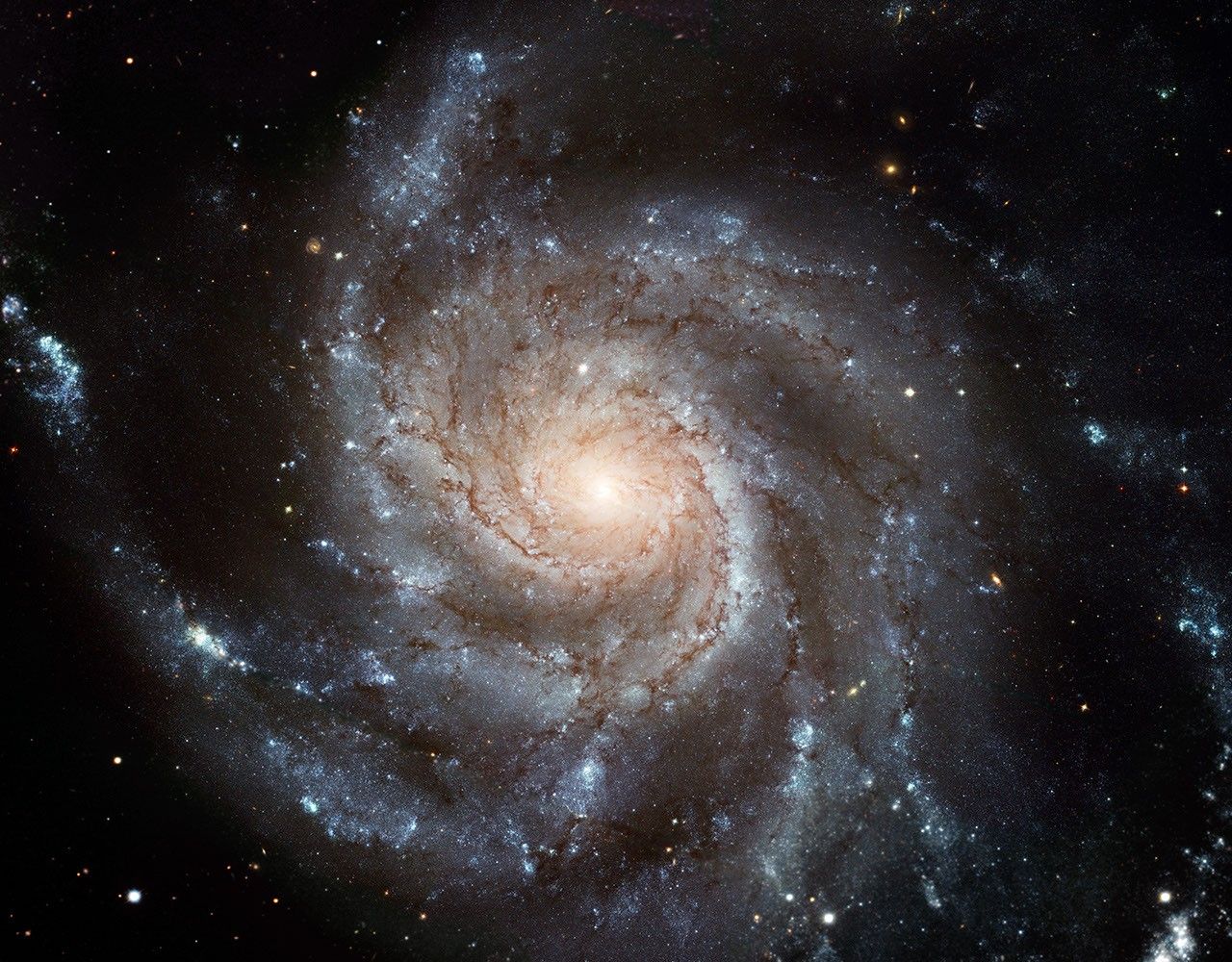
Pinwheel Galaxy
A vast face-on spiral galaxy in Ursa Major, roughly twice the diameter of the Milky Way and host to two landmark supernovae in the past 15 years.
Pinwheel Galaxy
The Pinwheel Galaxy — catalogued as Messier 101 and NGC 5457 — is one of the largest and most visually striking spiral galaxies in the nearby universe. Located in the constellation Ursa Major, close to the handle of the Big Dipper, it lies roughly 21 to 25 million light-years from Earth and presents itself nearly face-on, giving observers a direct, unobstructed view of its sweeping spiral arms. Its disk spans approximately 170,000 light-years, making it roughly twice the diameter of the Milky Way and placing it among the biggest known disk galaxies.
The galaxy is classified as a late-type spiral (SAB(rs)cd), meaning its arms are loosely wound and somewhat patchy rather than forming sharp, continuous lanes — a structure astronomers describe as "flocculent." Its arms are rich in hot, blue young star clusters and packed with ionized hydrogen nebulae (H II regions), marking intense, ongoing star formation spread across the disk. A 1991 survey catalogued 1,264 individual H II regions within M101's disk, an exceptionally high number for a single galaxy.
M101 is the dominant member of the M101 Group of galaxies and gravitationally interacts with several dwarf companions, most notably NGC 5474. These interactions have nudged the outer disk into a subtly asymmetric shape that deep images reveal clearly. In the modern era the galaxy has drawn intense scientific attention as the site of two landmark supernovae: SN 2011fe in 2011 and SN 2023ixf in 2023, both of which became among the best-studied stellar explosions of their respective types.
From discovery to the modern era
- 1781Discovery by Pierre Méchain
French astronomer Pierre Méchain first observed M101 and reported it to Charles Messier, who verified its position and included it in the Messier Catalogue. Méchain described it as a "nebula without star" — faint, large, and difficult to see clearly.
- 1784William Herschel's observations
Herschel observed the galaxy and noted its mottled nebulosity. He also independently catalogued several bright knots along its spiral arms — including NGC 5447, NGC 5461, and NGC 5462 (recorded on 14 April 1789) — believing them to be separate nebulae. They are now understood to be massive H II star-forming complexes embedded in M101's arms.
- 19th centuryLord Rosse identifies spiral structure
Using his large reflecting telescope at Birr Castle, Lord Rosse became the first to record M101's spiral structure in detail, establishing it as one of the classic "spiral nebulae" of the era.
- Mid-1990sHST Key Project Cepheid distance
The Hubble Space Telescope H₀ Key Project measured Cepheid variable stars in M101 and derived a distance of approximately 24 ± 2 million light-years (~7.3 ± 0.6 Mpc), providing the first precise extragalactic distance to the galaxy.
- 2006Hubble's record-breaking mosaic released
NASA and ESA released a landmark 16,000 × 12,000-pixel Hubble mosaic of M101, assembled from 51 separate exposures taken over nearly ten years in ultraviolet, visible, and near-infrared light. At the time it was the largest and most detailed image of a galaxy Hubble had ever published.
- August 2011SN 2011fe discovered
The Palomar Transient Factory detected a Type Ia supernova in one of M101's spiral arms. Designated SN 2011fe, it reached a peak apparent magnitude of about 9.9 — easily visible in small amateur telescopes — and became one of the closest and best-observed Type Ia supernovae in decades, providing critical constraints on progenitor systems and the cosmic distance scale.
- 19 May 2023SN 2023ixf discovered
Japanese amateur astronomer Kōichi Itagaki detected a new stellar explosion in M101 at magnitude 14.9; the Zwicky Transient Facility later recovered a precovery image from two days earlier. Classified as a Type II-L core-collapse supernova, SN 2023ixf rapidly brightened to a peak of about magnitude 10.8 and became one of the brightest core-collapse supernovae of the 21st century.
Physical structure and spiral arms
M101's most immediately striking feature is its size. At approximately 170,000 light-years in diameter it is roughly twice as wide as the Milky Way and qualifies as one of the largest disk galaxies known. Its face-on orientation — the galaxy's disk is tilted only slightly relative to our line of sight — exposes the full grandeur of its spiral pattern to observers on Earth, and inspired the informal name "Pinwheel Galaxy."
The spiral arms are classified as flocculent: rather than continuous, well-defined lanes like those of a grand-design spiral, M101's arms appear as patchy, discontinuous filaments of luminous material. Spitzer Space Telescope infrared images reveal dusty knots and warm-dust filaments throughout the arms, heated by embedded clusters of young, massive stars. Optical images show these same regions as brilliant blue-white arcs punctuated by the pink glow of ionized hydrogen nebulae.
Among M101's most remarkable features is its extraordinary population of H II regions — sites of active star formation lit up by ultraviolet radiation from newly formed O- and B-type stars. A comprehensive 1991 survey catalogued 1,264 such regions within the disk. Several are large and luminous enough to have received their own NGC designations: NGC 5461, NGC 5462, and NGC 5471 are among the brightest, and SN 2023ixf exploded near NGC 5461 in 2023. This density of star-forming activity marks M101 as an unusually productive stellar nursery among nearby spirals.
The inner disk appears broadly symmetric, but long-exposure images reveal that the outer disk and the overall spiral pattern are significantly asymmetric, with the central bulge offset from the geometric center of the disk. This lopsided quality is attributed to gravitational tidal interactions with the galaxy's dwarf companions, particularly NGC 5474. These past encounters are thought to have amplified the spiral structure and triggered large-scale bursts of star formation across the disk.
Companion galaxies and the M101 Group
M101 is the dominant galaxy in its own small gravitational group, the M101 Group. The group includes at least nine galaxies, with the principal companions being NGC 5204, NGC 5474, NGC 5477, NGC 5585, and Holmberg IV. M101's gravitational influence has left clear marks on several of these satellites, most conspicuously on NGC 5474.
NGC 5474 is classified as a peculiar dwarf spiral. It orbits closer to M101 in projection than any other group member, and the tidal forces of the interaction have visibly displaced its stellar disk from its own nucleus — a striking offset that immediately flags the galaxy as tidally disturbed. The star-forming regions of NGC 5474, traced by H-alpha emission, are also offset from the nucleus and displaced into the distorted disk, indicating that the gravitational encounter has not only warped the galaxy's shape but redistributed and possibly triggered new episodes of star formation within it.
The interaction works both ways: the same tidal forces that bent NGC 5474 out of shape pushed M101's outer disk into its observed asymmetry. Dynamical models of satellite–host encounters reproduce the general offset core and asymmetric outer arms seen in deep images of M101, confirming that the peculiarities of both galaxies share a common gravitational history.
Hubble Space Telescope observations
No observatory has shaped the modern portrait of M101 more profoundly than the Hubble Space Telescope. Over nearly a decade of observations, Hubble accumulated 51 separate exposures of the galaxy in ultraviolet, visible, and near-infrared light. These data were combined — together with ground-based images to fill gaps in Hubble's coverage — into a 16,000 × 12,000-pixel mosaic released in 2006. At the time it was the largest and most detailed image of a galaxy that Hubble had published, and it remains one of the most reproduced astronomical images of its era.
The mosaic reveals individual star clusters, dust lanes, and H II regions distributed across the face of the galaxy in extraordinary detail. Hubble data from these observations have been used to study M101's stellar populations — distinguishing the age and composition of stellar generations across different regions of the disk — and to probe the large-scale structure of the spiral pattern at a resolution unattainable from the ground.
The ESA/Hubble image field of view for the published mosaic covers approximately 17.78 × 17.78 arcminutes, meaning the faint, outermost extensions of M101's disk — which span nearly 29 arcminutes in total — extend beyond the Hubble frame. Ground-based imagers have captured this diffuse outer envelope in deep wide-field exposures, where it reveals the full lopsided outline of M101's gravitationally perturbed disk.
What M101 has taught astronomers
The Hubble Space Telescope H₀ Key Project measured Cepheid variable stars in M101 in the mid-1990s, deriving a distance of ~24 ± 2 million light-years — one of the key rungs in the extragalactic distance ladder used to measure the expansion rate of the universe. Subsequent refinements and cross-checks from methods including the planetary nebula luminosity function have kept the distance estimate in the 21–25 million light-year range.
A 1991 survey catalogued 1,264 H II regions within M101's disk, an unusually high count that makes the galaxy a prime laboratory for studying the conditions that govern large-scale star formation in spiral galaxies. Several of these complexes — NGC 5461, NGC 5462, NGC 5471 — are so large and luminous they carry individual NGC catalogue numbers.
The 2011 discovery of SN 2011fe in M101's spiral arms gave astronomers one of the closest and best-observed thermonuclear supernovae in decades. Pre-explosion archival Hubble images tightly constrained which type of stellar system could be the progenitor, and its brightness (peak magnitude ~9.9) made it accessible to amateur telescopes. It has been heavily used to calibrate the Type Ia cosmic distance scale.
When amateur astronomer Kōichi Itagaki discovered SN 2023ixf on 19 May 2023, it was the closest supernova to Earth in approximately five years. Brightening to peak magnitude ~10.8, it was classified as a Type II-L core-collapse event from a red supergiant progenitor of roughly 15 solar masses, embedded in a dusty circumstellar environment. The explosion's total energy was estimated at (0.3–1.4) × 10⁵¹ ergs. Intensive early-time monitoring — including 35 days of data from 123 citizen-science observers in the Unistellar network — made it one of the most data-rich young supernovae ever studied.
Detailed studies of NGC 5474, M101's closest companion, demonstrated that M101's gravity has displaced the dwarf's stellar disk from its nucleus and redistributed its star-forming regions. The same interaction explains M101's own asymmetric outer disk, providing a nearby, well-resolved example of how gravitational encounters between a large spiral and its satellites shape both participants.
Distance: measuring the Pinwheel
Pinning down M101's precise distance has been a decades-long project that illustrates the challenges of extragalactic distance measurement. The first rigorous modern estimate came from the Hubble Space Telescope H₀ Key Project in the mid-1990s, which measured the periods and luminosities of Cepheid variable stars in the galaxy and derived a distance of approximately 24 ± 2 million light-years (~7.3 ± 0.6 Mpc). This became a key rung on the cosmic distance ladder.
Subsequent recalibration of the Cepheid period–luminosity relation — particularly using Hipparcos satellite parallaxes of nearby Cepheids to re-anchor the zero point — led some researchers to push the implied distance to M101 to roughly 27 million light-years (~8.3 Mpc), about 10 percent farther than the original Key Project value. A contemporaneous estimate using the planetary nebula luminosity function by Feldmeier, Ciardullo & Jacoby (1996) yielded 25.1 ± 1.6 million light-years, consistent with the Cepheid result within uncertainties.
Further revisions of local distance anchors and metallicity corrections to the Cepheid scale have since brought the consensus estimate back toward the original Key Project distance. Modern databases such as NASA/IPAC's NED typically quote a value close to 24 million light-years, and many outreach sources round either to ~21 million light-years (6.4 Mpc) or ~25 million light-years, depending on which calibration they follow. The overall uncertainty remains of order ±10%, reflecting genuine systematic differences among methods rather than observational error alone.
Frequently asked questions
Sources
- Messier 101 (NGC 5457) Pinwheel Galaxy — Go-Astronomy.com
- Messier 101 (The Pinwheel Galaxy) — NASA Science
- M101 – The Pinwheel Galaxy | Galactic Hunter
- The Pinwheel Galaxy, M101, in the Infrared — Spitzer/Caltech
- Pinwheel Galaxy complete guide — BBC Sky at Night Magazine
- Hubble image of M101 — ESA/Hubble
- Pinwheel Galaxy — Wikipedia
- SN 2023ixf — Wikipedia
- Bright Supernova Blazes in M101 — Sky & Telescope
- Supernova in the Pinwheel Galaxy — Unistellar
- Bright, young supernova now visible in M101 — Astronomy.com
- Messier 101: Pinwheel Galaxy — Messier-objects.com
- NGC 5474 — Wikipedia
- Messier 101 — SEDS Messier Database
- Spiral Galaxy M101 — Spitzer/Caltech