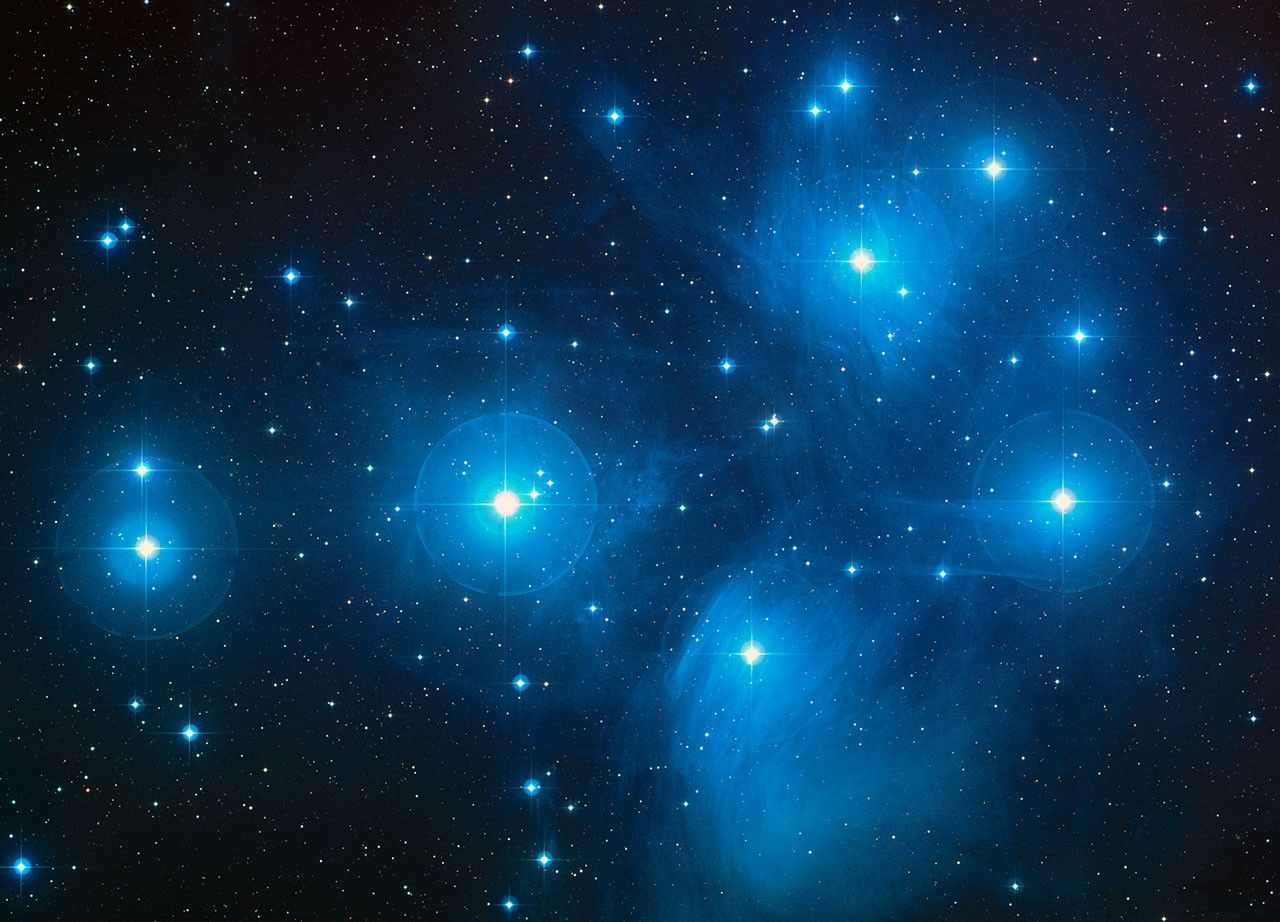
Pleiades
The Seven Sisters — humanity's most storied star cluster, a young blaze of hot blue suns 440 light-years away and far larger than anyone imagined.
The Pleiades — Seven Sisters of the Winter Sky
The Pleiades — catalogued as Messier 45 and popularly called the Seven Sisters — is a young open star cluster in the constellation Taurus, lying roughly 440 light-years from Earth. It is one of the nearest star clusters to our solar system and one of the most conspicuous objects in the night sky, visible to the naked eye as a compact, hazy knot of blue-white light. On a clear, dark night most observers count six individual stars; under excellent conditions a dozen or more become apparent, while binoculars or a small telescope reveal hundreds.
The cluster is dominated by hot, luminous B-type stars and is enveloped in a striking blue reflection nebula — not the remnant of the stars' own birth cloud, but an unrelated interstellar dust sheet through which the cluster is currently passing. At an age of roughly 100 million years, the Pleiades are young by stellar standards: the Sun is more than forty times older. The cluster has long served as a premier natural laboratory for studying stellar evolution, brown dwarfs, and the process by which stars disperse into the Galactic disc over time.
No star cluster on Earth's sky has been observed, named, or mythologized as persistently as the Pleiades. From Mesopotamian cuneiform tablets of the third millennium BCE to Homer's epics, from the Nebra sky disk of Bronze Age Europe to the oral traditions of Aboriginal Australia and the Kiowa of North America, the cluster recurs as one of humanity's most universal astronomical landmarks. Recent observations using the Gaia space observatory and NASA's TESS spacecraft have revealed that the familiar compact cluster is merely the bright core of a far larger stellar family — a stream of more than 3,000 co-born stars arcing nearly 1,900 light-years across the sky.
Physical Characteristics
The Pleiades cluster sits at a distance of approximately 440 light-years — equivalent to about 136.7 parsecs, as measured by the Gaia DR2 mission with a parallax of 7.317 ± 0.002 milliarcseconds. This value definitively resolved a long-standing discrepancy: the Hipparcos satellite had returned a distance of only about 115 parsecs, in tension with stellar models and every independent measurement. Subsequent determinations — from the Hubble Space Telescope's Fine Guidance Sensors (133.5 pc), Very Long Baseline Interferometry (136.2 pc), and finally Gaia — all converge on the range 133–137 pc, firmly establishing the cluster's true distance.
At roughly 100 to 120 million years old, the Pleiades are genuinely young. The bright core of the cluster, containing the famous naked-eye stars, spans about 15 to 20 light-years, while less massive members extend considerably farther. The total mass of the gravitationally bound cluster is estimated at around 800 solar masses, and the membership list includes more than 1,000 statistically confirmed stars, with some estimates reaching 1,500–1,600 when fainter members are included. Approximately 25 percent of cluster members by number are brown dwarfs — objects too lightweight to sustain hydrogen fusion — though these contribute less than 1.5 percent of the cluster's total mass and have a negligible influence on its dynamical evolution.
The dominant stellar population consists of hot, blue B-type stars. These are massive, luminous objects already beginning to evolve off the main sequence in some cases. Below them, the cluster's HR diagram traces a clean zero-age main sequence through A- and F-type stars down through K- and M-dwarfs and into the substellar regime. Because all cluster members formed together from a single molecular cloud and share the same distance and age, the Pleiades HR diagram is one of the most important calibration benchmarks in stellar astrophysics — used to test models of convection, rotation, lithium depletion, and magnetic activity.
The substellar mass function of the Pleiades — the distribution of brown dwarf masses — follows a single power law of the form dN/dM ∝ M^(−0.60 ± 0.11) over the mass range 0.03 to 0.48 solar masses, based on deep optical surveys covering several square degrees around the cluster centre. Over the broader range extending up to roughly 10 solar masses, the overall cluster mass function is better described by a log-normal distribution. The smooth rise of the mass function into the substellar domain supports theories in which brown dwarfs form through the same fragmentation process as ordinary stars, rather than being a separate population.
The Reflection Nebula
Long-exposure photographs of the Pleiades reveal a system of wispy, blue nebulosity threading among the bright stars. The most prominent portion, surrounding and associated with the star Merope (23 Tauri), is catalogued as NGC 1435 — also called Tempel's Nebula or the Merope Nebula. The brightest compact knot within it, known as IC 349 or Barnard's Merope Nebula, lies so close to the star that it was only resolved in detail by the Hubble Space Telescope.
The Pleiades nebulosity is a reflection nebula: it does not emit light of its own but instead scatters the blue light of the hot cluster stars off interstellar dust grains. Crucially, this material is not the original molecular cloud from which the Pleiades formed — that cloud dispersed long ago, approximately 100 million years in the past. Instead, the Pleiades are presently passing through an entirely unrelated interstellar dust cloud that happens to lie along their path through the Galaxy. The dust cloud drifts at roughly 11 to 18 kilometres per second relative to the cluster stars, producing a slight asymmetry in the nebula's brightness and structure.
The blue colour of reflection nebulae arises because small dust particles scatter shorter wavelengths of light more efficiently than longer ones — the same physical mechanism responsible for Earth's blue sky. Because the illuminating Pleiades stars are themselves hot and intrinsically blue-white, the combined effect produces the vivid azure tones captured in photographs. Radio observations of neutral hydrogen (H I) have mapped a large cavity or wake extending several degrees east of the cluster, tracing the interaction between the moving cluster and the surrounding interstellar medium.
The Named Stars of the Pleiades
- Alcyone
Brightest Pleiad; apparent magnitude 2.86; spectral type B7 IIIe (blue giant). The dominant naked-eye star and the traditional centre of the cluster.
- Atlas
Magnitude 3.62; spectral type B8 III. Named for the Titan father of the mythological sisters, along with Pleione it forms the close pair at the cluster's eastern edge.
- Electra
Magnitude 3.70; spectral type B6 IIIe. In Greek myth, the sister who veiled herself in grief over the fall of Troy, founded by her son Dardanus.
- Maia
Magnitude 3.86; spectral type B7 III. The eldest sister in mythology; mother of Hermes by Zeus. One of the most luminous members.
- Merope
Magnitude 4.17; spectral type B6 IVev. The illuminating star of NGC 1435 (Merope Nebula); mythologically said to hide in shame for having loved a mortal.
- Taygeta
Magnitude 4.29; spectral type B6 IV. A spectroscopic binary; mythologically mother of Lacedaemon, founder of Sparta.
- Pleione
Magnitude ~5.09 (variable); spectral type B8 IVpe. A shell star whose brightness varies as it periodically ejects and reabsorbs a disk of material. Named for the Oceanid mother of the sisters.
- Celaeno
Magnitude 5.44; spectral type B7 IV. Sometimes called 'the Lost Pleiad.' A B-type subgiant.
- Asterope (Sterope I)
Magnitude 5.64; spectral type B8 Ve. An emission-line B-type main-sequence star; forms a visual pair with 22 Tauri (Sterope II, magnitude 6.41, B9 V).
Mythology and Cultural History
Few astronomical objects have been as universally noticed and named as the Pleiades. Because the cluster is bright, compact, and seasonally prominent — rising high in the Northern Hemisphere winter sky and heliacally in spring in many temperate latitudes — it became a natural calendar marker for agricultural and pastoral societies worldwide. Its appearance and disappearance in the sky signalled planting and harvest seasons, the coming of rains, and periods of mourning or renewal, depending on the culture.
In Greek mythology the Pleiades are the seven daughters of the Titan Atlas and the Oceanid Pleione: Maia, Electra, Taygete, Celaeno, Alcyone, Sterope (Asterope), and Merope. The hunter Orion pursued the sisters for seven years; Zeus, taking pity on them, transformed them into stars and set them in the sky, where Orion's constellation still appears to chase them across the heavens. A second tradition holds that the sisters killed themselves from grief — either over their father Atlas's punishment of bearing the heavens, or over the death of their half-sisters the Hyades — and were then placed among the stars. The earliest literary references to the Pleiades appear in the works of Hesiod and in Homer's Iliad and Odyssey, where the cluster serves both as a seasonal calendar and a navigational guide for sailors.
Central to Greek storytelling is the puzzle of the 'lost Pleiad': if the cluster is called the Seven Sisters, why are only six stars easily visible? Classical authors proposed two answers. Merope is said to hide in shame because she, alone among her sisters, married a mortal — the king Sisyphus — rather than a god. Electra, by contrast, is said to have veiled herself in grief when Troy — founded by her son Dardanus — was destroyed by the Greeks. This narrative device of the hidden or faint seventh sister recurs in myths from cultures with no known contact with Greece, suggesting an independent convergence on the same striking astronomical puzzle.
In Mesopotamia, the Pleiades were known by the Sumerian name MUL.MUL, meaning simply 'stars' — a designation suggesting their singular importance. The cuneiform compendium MUL.APIN, preserved in copies dating to at least the seventh century BCE but containing astronomical material tracing back to roughly the 26th century BCE, uses the heliacal visibility of the Pleiades as one of the anchor points for intercalating months in the lunar calendar. This makes the Pleiades one of the earliest documented objects in the history of scientific astronomy — used not merely as a mythological symbol but as a precise calendrical instrument.
In Bronze Age Europe, the Nebra sky disk — a bronze artifact with gold inlays found in central Germany and dated to around 1600 BCE — is widely interpreted as depicting the Sun, Moon, and a cluster of stars identified with the Pleiades. The cluster's rising and setting were connected across Celtic Europe to the cross-quarter day between the autumn equinox and winter solstice, a period associated with Samhain (later absorbed into Halloween and All Souls' Day), and with traditions of mourning and remembrance of the dead. Scholars have suggested that the cluster's acronychal rising — rising in the east as the Sun sets — during this season reinforced the association of the Pleiades with tears and loss.
Across Aboriginal Australia, a widespread and independently evolved tradition holds the Pleiades to be a group of seven young women pursued by a male figure identified with Orion — a structural parallel to the Greek myth that has attracted considerable scholarly attention. As in the Greek tradition, a common motif explains why only six stars are easily visible: one sister hides, or has been captured, or is simply lost. Although the specific narratives differ across language groups, the broad pattern is consistent enough across the Australian continent to indicate ancient and deep-rooted astronomical observation.
Among Native American peoples, the Pleiades held diverse but consistently prominent roles. The Zuni of New Mexico knew the cluster as the 'Seed Stars': when the Pleiades disappeared below the western horizon at dusk in spring, that heliacal setting signalled the time to plant crops — a precise agricultural calendar encoded in the sky. The Kiowa people connected the cluster to Devils Tower in Wyoming: according to tradition, seven sisters fleeing a bear prayed for deliverance, and the Great Spirits raised the rock beneath them, creating the tall tower; the sisters were carried to the sky as the Pleiades, and the vertical grooves on the tower's sides are said to be the bear's claw marks. Cultures as geographically and linguistically diverse as the Chinese, Polynesian, Persian, Egyptian, and Hindu traditions each developed their own Pleiades mythologies, most consistently treating the cluster as a group of women or maidens and as a marker of the seasons.
Key Moments in Pleiades Astronomy
- c. 2600–700 BCEMesopotamian calendrical use
The MUL.APIN cuneiform compendium records the Pleiades (MUL.MUL, 'the Stars') as a reference point for intercalating months in the Babylonian lunar calendar, representing one of the earliest documented uses of a star cluster in systematic astronomy.
- c. 800–700 BCEGreek literary references
The Pleiades appear in Hesiod's Works and Days as agricultural seasonal markers, and in Homer's Iliad and Odyssey as navigational guides. The mythology of the seven daughters of Atlas is established in these early texts.
- c. 1600 BCE (discovered modern era)Nebra sky disk
A bronze disk with gold inlays, found in central Germany and dated to approximately 1600 BCE, depicts what scholars widely interpret as the Sun, Moon, and the Pleiades — the earliest known visual representation of a specific star cluster.
- 1610Galileo resolves the cluster
Galileo Galilei used his telescope to resolve the Pleiades into individual stars, publishing the first telescopic star chart of the cluster in Sidereus Nuncius — revealing many stars invisible to the naked eye.
- 1769Messier catalogues M45
Charles Messier includes the Pleiades in his catalogue of non-cometary nebulous objects as Messier 45, giving the cluster its modern designation.
- 1859Tempel's Nebula discovered
Ernst Wilhelm Leberecht Tempel visually discovers the reflection nebula around the star Maia; subsequent observations reveal nebulosity associated with Merope and other stars, catalogued as NGC 1435.
- 1890sPhotography confirms nebulosity
Long-exposure photographic plates confirm and extend the complex of reflection nebulosity around multiple Pleiades stars, establishing that the blue glow is scattered starlight rather than self-luminous gas.
- 1997Hipparcos distance controversy
The Hipparcos satellite reports a distance of approximately 115 parsecs to the Pleiades, significantly shorter than model-based and other independent estimates of 130–137 pc, triggering a decade-long controversy in stellar astrophysics.
- 2004–2005HST Fine Guidance Sensors measurement
Soderblom et al. use the Hubble Space Telescope's Fine Guidance Sensors to measure the Pleiades distance as 133.5 parsecs (~435 light-years), contradicting the Hipparcos value and supporting stellar models.
- 2014VLBI settles the distance
Very Long Baseline Interferometry observations (Melis et al.) yield a Pleiades distance of 136.2 parsecs, closely matching model predictions and HST results, effectively resolving the Hipparcos discrepancy.
- 2016–2018Gaia confirms and refines
The Gaia space observatory measures the Pleiades cluster parallax as 7.317 ± 0.002 milliarcseconds, placing the cluster at 136.67 ± 0.04 parsecs (≈445.8 light-years), setting the definitive modern distance.
- 2023–2024Greater Pleiades Complex identified
Andrew Boyle et al. combine Gaia orbital data, TESS stellar rotation periods, and spectroscopic chemical abundances to identify a 'Greater Pleiades Complex' of more than 3,000 co-born stars spanning approximately 1,900 light-years — tripling the known stellar family of the Pleiades and revealing it as the dense core of a vast dispersed stream.
The Greater Pleiades Complex — A Cluster 20 Times Larger Than We Thought
By combining Gaia astrometry (to identify stars on similar Galactic orbits), TESS photometry (to measure stellar rotation periods as an age proxy), and spectroscopic data from the Sloan Digital Sky Survey (to verify matching chemical abundances of elements such as magnesium and silicon), Andrew Boyle et al. identified a continuum of more than 3,000 stars sharing the Pleiades' age, chemistry, and trajectory through the Galaxy.
The newly identified stellar population does not form a compact cluster; instead it traces an arc roughly 1,900 light-years long across the sky. NASA described the ensemble as the 'Greater Pleiades Complex,' and popular summaries noted that the Pleiades 'could be 20 times bigger than we thought' in spatial extent. The familiar Messier 45 cluster is merely the bright, gravitationally bound core of this far larger structure.
The team concluded that the Greater Pleiades Complex stars almost certainly formed together approximately 100 million years ago in a much more compact cluster — analogous in scale to the present-day Orion Nebula Cluster. Supernova explosions from the most massive members, combined with Galactic tidal forces, gradually dispersed the majority of the stars into the long stream now mapped by Gaia and TESS.
Stars spin down predictably as they age, so rotation period provides an independent age estimate through a technique called gyrochronology. TESS's near-continuous photometry of stars across large areas of sky allowed the team to measure rotation periods for thousands of candidate Pleiades siblings — a critical confirmation that the dispersed stream members are genuinely the same age as the core cluster, not chance alignments.
Before this work, the Pleiades were described as a cluster with roughly 1,000 confirmed member stars. The Greater Pleiades Complex result raises the total known stellar family to more than 3,000 — tripling the membership count — while also dramatically expanding the recognised physical extent of the system from a core of ~15–20 light-years to a stream of ~1,900 light-years.
Brown Dwarfs and the Substellar Population
The Pleiades is one of the premier laboratories for the study of brown dwarfs — objects more massive than giant planets but too lightweight (below about 80 times the mass of Jupiter) to sustain stable hydrogen fusion in their cores. Because the cluster is young enough that brown dwarfs are still relatively warm and bright, yet old enough that they have separated clearly from pre-main-sequence low-mass stars in the HR diagram, it occupies an ideal observational niche for census and characterisation of substellar objects.
Deep imaging surveys of the Pleiades covering areas of several square degrees, complete to I-band magnitudes of around 22, probe stellar and substellar masses from roughly 0.025 to 0.45 solar masses. Such surveys have identified dozens of brown dwarf candidates, with major programmes finding 40 or more in a single field, most of them new discoveries at the time. Near-infrared J, H, and K photometry of these very low-mass stars and brown dwarfs has been used to reproduce the integrated near-infrared light of the cluster and constrain substellar atmosphere models.
Despite their large numbers — accounting for roughly 25 percent of cluster members by count — brown dwarfs contribute less than 1.5 percent of the Pleiades' total mass. This means they have a negligible effect on the cluster's dynamical evolution. Analyses of the present-day radial distribution and mass function suggest that the cluster's early dynamical history has had little discernible effect on the current mass distribution, at least across the stellar and substellar ranges probed by available surveys. The smooth transition of the mass function from stars into the brown dwarf regime supports models in which substellar objects form through the same cloud fragmentation process as ordinary stars.
Frequently Asked Questions
Sources
- Hubble Refines Distance to Pleiades Star Cluster — NASA Science
- How Far are the Pleiades, Really? — Harvard Center for Astrophysics
- How far away are the Pleiades? — SYFY Wire
- Pleiades — Wikipedia
- Pleiades in folklore and literature — Wikipedia
- eSky: Pleiades — Glyph Web
- NASA's TESS Spacecraft Triples Size of Pleiades Star Cluster — NASA Science
- Astronomers discover the famous Pleiades star cluster could be 20 times bigger than we thought — Space.com
- The Pleiades – or 7 Sisters – known around the world — EarthSky
- Ghostly reflections in the Pleiades — ESA/Hubble
- Merope Nebula — Messier Objects
- Brown dwarfs in the Pleiades cluster: Clues to the substellar mass function — HAL
- Around the Pleiades — arXiv (ar5iv)
- How Gaia sheds light on the Milky Way star cluster population — ScienceDirect
- The Pleiades Star Cluster — Royal Museums Greenwich