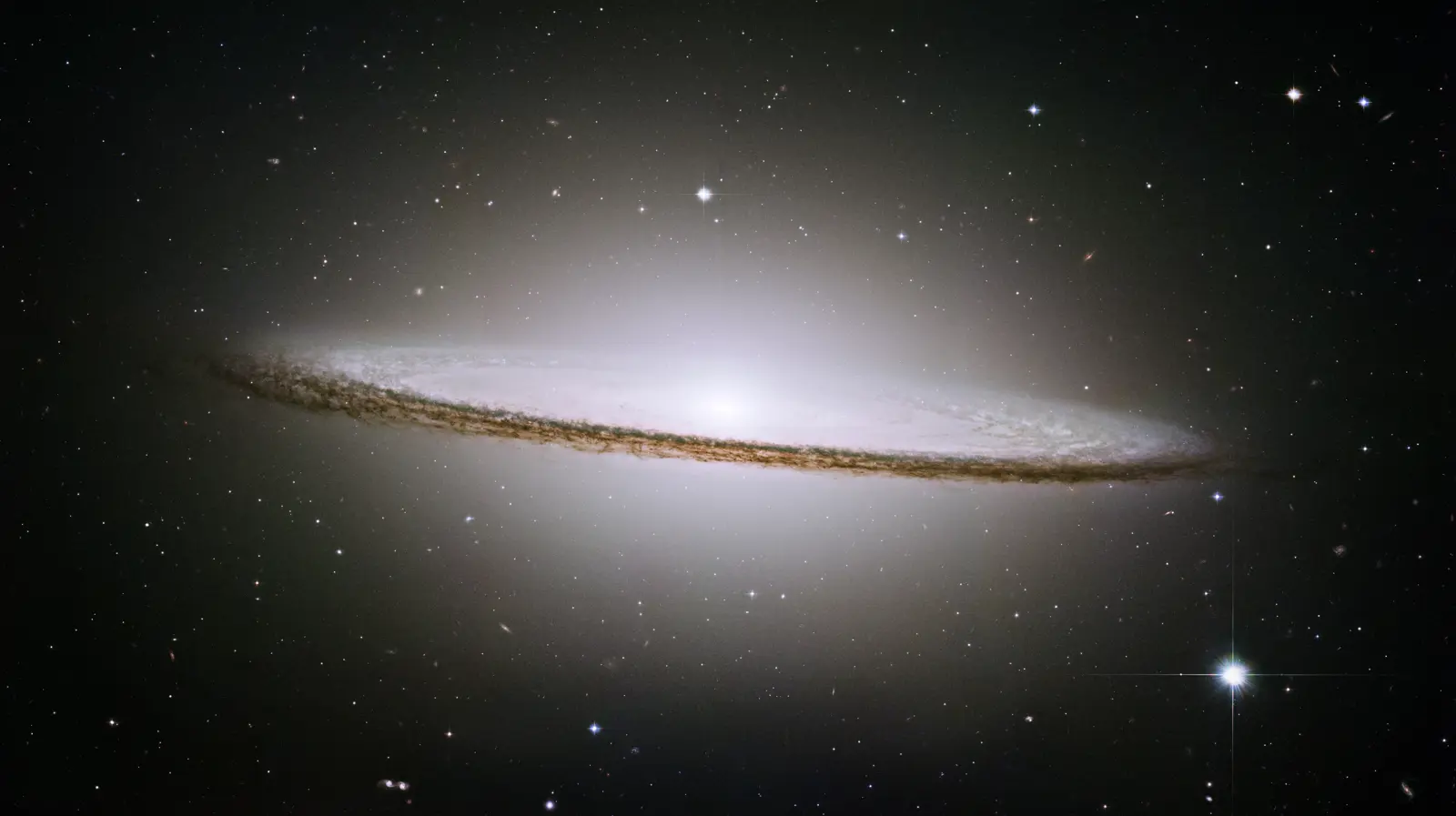
Sombrero Galaxy
A massive hybrid galaxy 30 million light-years away — part spiral, part elliptical, all mystery.
The Sombrero Galaxy
The Sombrero Galaxy, designated Messier 104 (M104) and NGC 4594, is one of the most recognisable and scientifically compelling galaxies in the night sky. Located approximately 29–31 million light-years from Earth in the constellation Virgo — near its border with Corvus — it is seen nearly edge-on from our vantage point, an orientation that dramatically reveals a bright central bulge bisected by a dark, sweeping dust lane. The combined effect in visible-light images strikingly resembles the broad-brimmed hat for which the galaxy is named.
With a total mass of roughly 800 billion solar masses and a central supermassive black hole of at least one billion solar masses, M104 ranks among the most massive objects in the Virgo region of the Local Supercluster. It hosts approximately 1,200 to 2,000 globular clusters — about ten times the number orbiting the Milky Way — and its outer halo is dominated by unusually metal-rich stars that point to a turbulent merger-driven past. These characteristics blur the traditional boundary between spiral and elliptical galaxies, making the Sombrero a benchmark object in debates about galaxy formation and classification.
Observed by French astronomers in the 18th century and studied by every major space telescope since, the Sombrero continues to yield surprises. Spitzer Space Telescope infrared data in the 2000s revealed the dust lane to be a massive star-forming ring and uncovered a stellar halo far larger than expected for a spiral galaxy. Hubble Space Telescope imaging resolved thousands of ancient globular clusters and measured the extreme metal richness of the halo. More recently, the James Webb Space Telescope offered a new mid-infrared view of the galaxy's dust ring structure. The Sombrero is now understood not as a peculiar spiral or a disguised elliptical, but as a hybrid system whose current form most likely reflects a major galaxy merger billions of years ago.
Discovery and Study
- May 1781Méchain's first observation
French astronomer Pierre Méchain observed the galaxy and described it as a very faint nebula. Charles Messier noted it in his personal copy of his catalog on 11 May 1781, but it was not included in the published edition at the time.
- 9 May 1784Herschel's independent discovery
William Herschel independently observed the galaxy and recorded a 'dark stratum' across the disk — the first written description of what is now understood to be the prominent dust lane that gives the galaxy its sombrero-like profile.
- 1912Slipher measures the redshift
Vesto Slipher at Lowell Observatory used spectroscopy to measure the galaxy's recession velocity at approximately 1,000 km/s (~621 miles per second). This large velocity was one of the earliest observational clues that spiral nebulae were external galaxies far beyond the Milky Way, contributing to the eventual picture of an expanding universe.
- 1921Added to the Messier catalog as M104
Camille Flammarion discovered Messier's 1781 handwritten note and identified the object with NGC 4594. The galaxy was formally incorporated into the Messier catalog as M104.
- 1990sSupermassive black hole confirmed
A team led by John Kormendy combined spectroscopy from the Canada–France–Hawaii Telescope with Hubble Space Telescope data to measure stellar motions near the nucleus. The required central dark mass was approximately one billion solar masses (10⁹ M☉), making it one of the nearest known billion-solar-mass black holes and among the most massive central objects in any nearby galaxy.
- 2003Iconic Hubble mosaic released
A large Hubble Space Telescope mosaic provided one of the most detailed visible-light images of the Sombrero Galaxy ever produced, clearly showing the bright central bulge, the sharp dust lane, and the nearly edge-on disk. The image became one of Hubble's most widely reproduced.
- 2012Spitzer reveals hidden elliptical halo
Spitzer Space Telescope infrared imaging showed that M104's stellar halo is far larger and more massive than previous optical studies had indicated, more closely resembling the extended halo of a giant elliptical galaxy than a typical spiral. This prompted a reclassification debate: M104 was now described as an elliptical galaxy with a large embedded disk, rather than a simple edge-on spiral.
- 2020HST halo metallicity study (Cohen et al.)
Hubble Space Telescope photometry of stars in M104's outer halo, reaching ~16 and ~33 kpc from the center, revealed that the halo is dominated by metal-rich stars with an almost complete absence of low-metallicity stars. The average metallicity was the highest measured in any galaxy halo to that point. Using a metallicity–accreted-mass relation, the study inferred that the halo was likely built in a single major merger a few billion years ago, possibly between a spiral disk galaxy and an elliptical, explaining M104's hybrid character.
- 2024James Webb Space Telescope mid-infrared imaging
JWST's MIRI instrument captured mid-infrared images of the Sombrero Galaxy, revealing the smooth inner disk and the clumpy, filamentary structure of the outer dust ring in unprecedented clarity. The combined Hubble and JWST imagery showed both the old stellar bulge (dominant in visible light) and the dust-rich star-forming ring (dominant in mid-infrared) in complementary detail.
- 2025New ESA/Hubble analysis highlights ultra-massive black hole
ESA/Hubble communications described the galaxy's central black hole as approximately 9 billion solar masses — more than 2,000 times the mass of the Milky Way's central black hole — though this figure, derived from bulge–black-hole scaling relations rather than a new direct dynamical measurement, remains the subject of ongoing discussion in the literature.
Physical Structure
The Sombrero Galaxy is a massive early-type disk galaxy seen at a nearly edge-on inclination. Its defining visual feature is the juxtaposition of an extremely bright, large central bulge with a dark dust lane cutting across it like the brim of a hat. The bright disk spans roughly 50,000 light-years in its principal optically-defined extent, but deep infrared imaging reveals a far more extended stellar halo that pushes the total size of the galaxy's stellar envelope to approximately 100,000 light-years — comparable to the Milky Way or larger, depending on which boundary is measured.
The bulge of M104 is unusually large and luminous even by the standards of early-type spirals, dominating the galaxy's optical appearance and a substantial fraction of its total stellar mass. This massive classical bulge is thought to have been assembled through an intense burst of star formation early in the universe's history, and possibly shaped further by a major merger event. Embedded within the bulge, kinematic studies have detected a smaller inner disk tilted relative to the main disk plane, inferred from stellar velocity patterns in detailed imaging.
The prominent dust lane visible in optical images is, in three dimensions, a symmetric dust ring encircling the bulge. Most of the galaxy's cold atomic hydrogen and dust reside within this ring. Infrared spectroscopy from the Spitzer Space Telescope established that the ring is the primary site of ongoing star formation in M104, while the nucleus itself — despite hosting a supermassive black hole — shows little to no significant current star formation, a characteristic consistent with its classification as a Low-Ionization Nuclear Emission-line Region (LINER).
The stellar halo of the Sombrero is arguably its most scientifically remarkable structural component. Hubble Space Telescope photometry of individual stars in fields at roughly 16 and 33 kiloparsecs from the center revealed a halo dominated by metal-rich stars, with a median metallicity of approximately [Z/H] ≈ −0.15 even at distances equivalent to roughly 17 bulge effective radii. Stars with very low metallicity form only a negligible fraction of the halo population. This is anomalously metal-rich compared to the halos of massive spiral galaxies and even many giant ellipticals, which typically contain a substantial proportion of old, metal-poor stars accreted from small satellites. A weak radial metallicity gradient of about 0.01 dex per kiloparsec is present, with the metal-poor fraction increasing slowly outward. More metal-poor stars appear to follow flatter radial density profiles than their metal-rich counterparts, suggesting a more spatially extended distribution for the old accreted component.
Deep imaging around M104 has also revealed a large stellar tidal stream wrapping around the disk, interpreted as the disrupted remains of a dwarf satellite galaxy cannibalized within the last few billion years. Researchers find no evidence that this particular stream is responsible for the galaxy's global morphology — the dominant structural peculiarities of M104 appear to predate this relatively recent minor merger event.
The Globular Cluster System
One of the most striking properties of the Sombrero Galaxy is its extraordinarily rich population of globular clusters. Estimates place the total number at approximately 1,200 to 2,000 clusters — roughly ten times the number orbiting the Milky Way. NASA's Hubble analysis cites nearly 2,000 globular clusters as the best current estimate.
The clusters are ancient, with ages of approximately 10 to 13 billion years, comparable to the oldest globular clusters in the Milky Way's halo and bulge. This indicates that the formation of M104's massive spheroid was rapid and occurred in the early universe. The surface density profile of the globular cluster system broadly follows the light profile of the galaxy's bulge, though it departs from this pattern in the innermost regions. The ratio of globular clusters to total luminosity is unusually high compared with galaxies that have small bulges, but is consistent with the specific frequencies seen in other galaxies with very large spheroidal components. This connection between globular cluster richness and bulge mass is a key piece of evidence linking M104's cluster system to its unusual structural history. Hubble's angular resolution is sufficient to individually resolve many of these clusters, making M104 one of the most important extragalactic laboratories for studying globular cluster populations and their connection to galaxy assembly.
Classification Debate: Spiral, Elliptical, or Something Else?
Few nearby galaxies have generated as much debate about their fundamental nature as the Sombrero. Traditional catalogs, including the Third Reference Catalogue of Bright Galaxies (RC3), list M104 as an early-type spiral — typically coded SA(s)a — because of its clear stellar disk and dust lane. However, a growing body of observations has made this classification increasingly inadequate.
Spitzer Space Telescope infrared observations in the 2000s were a turning point. By tracing the stellar mass rather than just the visible light, Spitzer showed that M104's outer stellar halo is far larger and more massive than earlier optical studies had indicated, resembling the extended halo of a giant elliptical galaxy rather than the modest halos of typical spirals. The galaxy's globular cluster specific frequency — the number of clusters relative to total luminosity — also resembles that of giant ellipticals more than ordinary spirals. These findings prompted some researchers and institutions, including the National Astronomical Observatory of Japan, to describe M104 as essentially an elliptical galaxy that has a disk-shaped structure inside, rather than a conventional spiral.
The 2020 Hubble halo metallicity study (Cohen et al., accepted to the Astrophysical Journal) added a crucial dimension to this debate. By measuring the metallicity distribution function of individual halo stars using Hubble photometry, the team found that M104's halo metallicity matches the population of elliptical galaxies far better than disk galaxies. Almost no low-metallicity stars were present — normally a signature of early, low-mass galaxy accretion — while the halo was instead dominated by metal-rich stellar populations. This is unlike any previously measured galaxy halo. Using the relationship between metallicity and accreted stellar mass, Cohen et al. inferred that the halo's accreted mass is comparable to the halo's total mass, implying that M104 built its spheroid in a single major merger event several billion years ago. The authors suggested that the Sombrero may represent the product of a merger between a spiral disk galaxy and an elliptical, which would naturally produce a system with a spiral-like disk and an elliptical-like spheroid and cluster system.
As of the early 2020s, the working consensus among researchers is that the Sombrero Galaxy is best described as a peculiar hybrid system — a spiral disk embedded within a giant-elliptical-like spheroid and halo — rather than a clean member of either the spiral or elliptical class. ESA and NASA communications describe it as 'enigmatic,' with features of both classes that do not combine into a standard Hubble type. Current sources, including updated Wikipedia and institutional outreach, label it a 'peculiar galaxy of unclear classification.' The ongoing classification debate is itself scientifically productive: M104 sits at the intersection of different formation pathways and may represent a class of merger-built hybrid galaxies that are more common than previously thought.
The Supermassive Black Hole
The Sombrero Galaxy harbors one of the most massive black holes known in the nearby universe. In the 1990s, John Kormendy and collaborators combined optical spectroscopy from the Canada–France–Hawaii Telescope with Hubble Space Telescope data to measure stellar kinematics in the nucleus of M104. The observed rise in stellar rotation and velocity dispersion toward the center required a central dark mass of approximately one billion solar masses (10⁹ M☉) to be gravitationally concentrated within a compact region. At the time, this made M104 the nearest known billion-solar-mass black hole to Earth, and it remains among the most massive black holes measured in any nearby galaxy via direct dynamical methods.
More recent discussions, including a 2025 ESA/Hubble communication, have quoted a significantly larger figure of approximately nine billion solar masses — more than 2,000 times the mass of the Milky Way's central black hole, Sagittarius A*. This larger value appears to derive from reinterpretation using bulge–black-hole mass scaling relations applied to M104's large spheroidal component, rather than from a new direct dynamical or interferometric measurement. Researchers have noted that how the bulge or spheroid of M104 is defined has a strong effect on where the galaxy falls on these scaling relations, with the expected black-hole mass being highly sensitive to the adopted morphological decomposition. As of the available literature, no new refereed dynamical study specifically establishing a nine-billion-solar-mass value has been identified; the figure circulates primarily through institutional press materials and outreach content.
Whatever the precise mass, the black hole in M104 is associated with a low-luminosity active galactic nucleus. The nucleus is spectroscopically classified as a LINER — a Low-Ionization Nuclear Emission-line Region — indicating ionized gas being excited at low levels, likely by weak accretion onto the black hole. X-ray observations detect emission from the core consistent with material falling inward. Despite the extraordinary mass of the central object, the nucleus is described as 'fairly calm': star formation in the nucleus is negligible, and the black hole does not power a conspicuous jet like the one associated with the comparably-massed black hole in Messier 87. The underluminous character of M104's black hole relative to its putative mass makes its accretion state a topic of ongoing astrophysical interest.
What Observations Have Revealed
In 1912, Vesto Slipher measured the Sombrero's recession velocity at approximately 1,000 km/s — far too high for any object within the Milky Way. This was one of the earliest observational demonstrations that spiral nebulae are independent 'island universes,' predating Edwin Hubble's Cepheid-based proof by over a decade.
Dynamical studies in the 1990s using Hubble and CFHT spectroscopy established a central black hole mass of approximately 10⁹ solar masses — making it the nearest known billion-solar-mass black hole to Earth at the time, and one of the most massive in any nearby galaxy.
Infrared observations from the Spitzer Space Telescope revealed that the dark dust lane seen in visible light is, in three dimensions, a large symmetric ring encircling the bulge. This ring contains most of the galaxy's cold gas and dust and is the primary site of ongoing star formation — while the nucleus itself shows almost no current star formation.
Spitzer infrared imaging uncovered an extended, massive stellar halo far larger than expected for a spiral galaxy. This spheroidal component is more consistent with the halos of giant elliptical galaxies, leading to a fundamental rethinking of M104's classification.
Hubble photometry of individual halo stars (Cohen et al. 2020) found a median halo metallicity of approximately [Z/H] ≈ −0.15, with almost no metal-poor stars — the highest metallicity measured in any galaxy halo. This suggests the halo was built rapidly in a single major merger event billions of years ago, rather than through gradual accretion of small, metal-poor satellites.
M104 hosts approximately 1,200 to 2,000 globular clusters, roughly ten times the Milky Way's complement. Their ages — 10 to 13 billion years — indicate formation in the early universe and provide strong constraints on when the galaxy's massive spheroid was assembled.
Deep imaging around M104 has mapped a large stellar tidal stream wrapping around the disk, interpreted as the remnants of a dwarf satellite galaxy accreted over the last few billion years. This stream appears to be unrelated to the main structural peculiarities of the galaxy, which are thought to predate this minor merger.
Mid-infrared imaging from JWST's MIRI instrument revealed that the outer dust ring is composed of numerous clouds and filaments rather than a smooth, uniform band, and highlighted the smooth inner disk that is less prominent in visible-light Hubble images. The Hubble–JWST comparison offered a comprehensive view across optical and mid-infrared wavelengths of this complex, layered system.
The Sombrero Galaxy: Common Questions
Sources
- Messier 104 (NGC 4594) Sombrero Galaxy | Virgo | Go Astronomy
- M104 — AstroWorldCreations
- Sombrero Galaxy M104 | Gallery | NAOJ
- Messier 104 (The Sombrero Galaxy) — NASA Science
- M104, The Sombrero Galaxy — Astrodoc
- The enigmatic assembly process of the Sombrero galaxy — IAA-CSIC
- Sombrero Galaxy — Wikipedia
- Hubble provides a new view of a galactic favourite — ESA/Hubble
- The Strikingly Metal-rich Halo of the Sombrero Galaxy (Goudfrooij et al.) — STScI
- A large tidal stream observed in the Sombrero galaxy — IAC
- Orbit-Based Dynamical Models of the Sombrero Galaxy (NGC 4594) — UT Austin
- Good Luck Sorting This Hat — Astrobites
- Beyond the brim, Sombrero Galaxy's halo suggests turbulent past — EurekAlert
- Transition video: Hubble and Webb's views of the Sombrero Galaxy — ESA/Webb