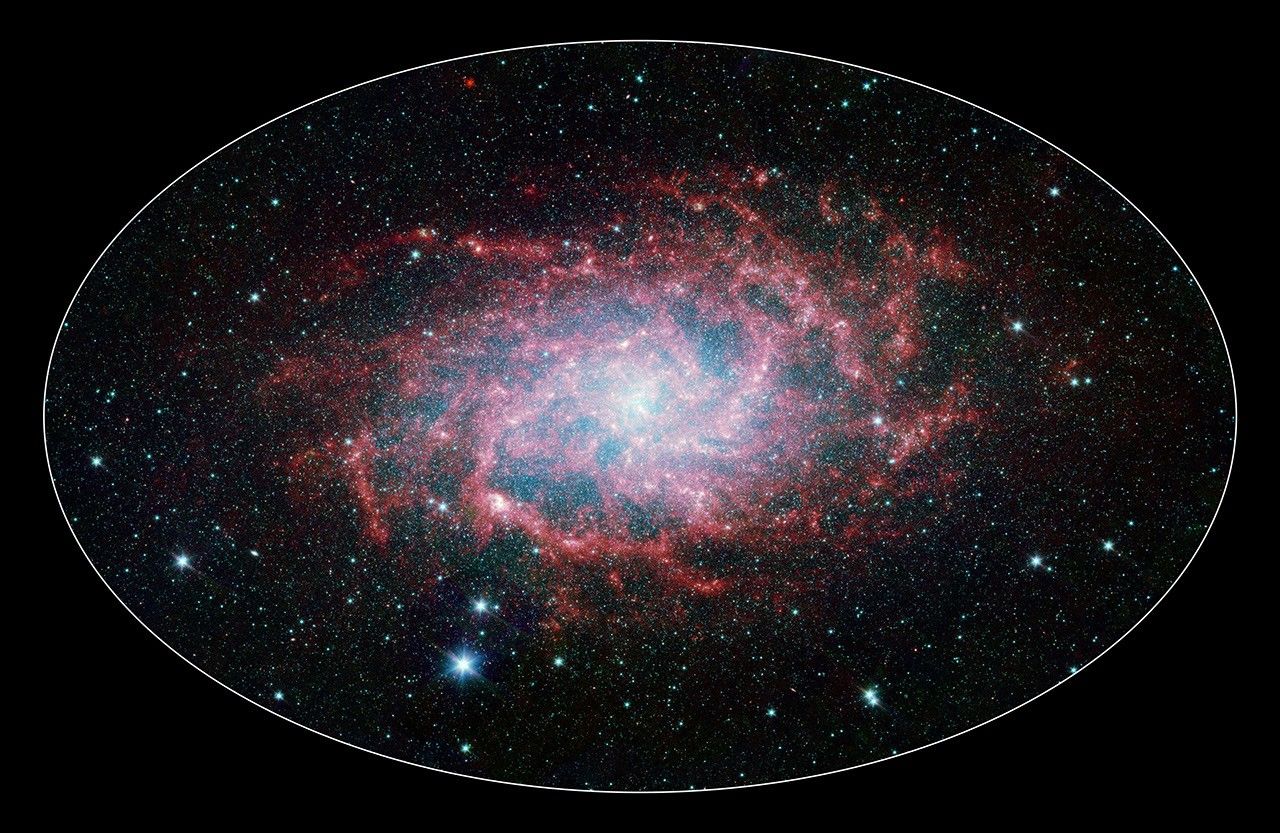
Triangulum Galaxy
The third-largest galaxy in the Local Group — a face-on spiral ablaze with star formation, home to one of the largest stellar nurseries in the known universe.
Triangulum Galaxy
The Triangulum Galaxy — catalogued as Messier 33 (M33) and NGC 598 — is a spiral galaxy roughly 3 million light-years from Earth, located in the northern constellation Triangulum. It is the third-largest member of the Local Group of galaxies, trailing only the Andromeda Galaxy (M31) and the Milky Way in size and mass. Spanning approximately 50,000 light-years across its bright disk, it is classified as a late-type spiral (Sc or Scd), characterised by loosely wound arms, an exceptionally low central bulge, and no confirmed supermassive black hole at its core.
Visually, M33 has an apparent magnitude of about 5.7 and an angular extent of roughly 70–73 by 42–45 arcminutes — large enough that it can, under very dark skies, be glimpsed with the naked eye, making it one of the most distant objects ever seen without optical aid. Despite its modest total mass of 10 to 40 billion solar masses, it punches far above its weight in star formation: Hubble surveys show that its star-formation rate is approximately ten times higher than the average found in the much larger Andromeda Galaxy.
M33 is host to NGC 604, one of the largest and most luminous H II regions in the entire Local Group — a giant stellar nursery roughly 1,300–1,500 light-years across, dwarfing the Orion Nebula by a factor of 40 to 100. The galaxy also harbours a nuclear ultraluminous X-ray source that is the most luminous X-ray object in the Local Group, as well as M33 X-7, an eclipsing X-ray binary that has been instrumental in constraining how massive stellar-mass black holes form.
From early sightings to modern surveys
- Before 1654Probable first record — Giovanni Battista Hodierna
Italian astronomer Giovanni Battista Hodierna listed a 'cloud-like nebulosity' near the constellation Triangulum in his work De systemate orbis cometici. The object is generally identified with M33, though his description is not uniquely specific; this is considered a probable rather than certain first sighting.
- 25–26 Aug 1764Charles Messier's independent observation
Charles Messier independently observed the galaxy and later published it in his Catalogue of Nebulae and Star Clusters (1771) as Messier 33 — the first unambiguous catalogue entry for the Triangulum Galaxy.
- 11 Sep 1784William Herschel catalogues M33 and its nebulae
Herschel catalogued M33 as H V-17. In the same observing programme he also catalogued the giant H II region NGC 604 (as H III.150) and noted several other H II regions later designated NGC 588, 592, and 595.
- 1850Lord Rosse identifies spiral structure
William Parsons, 3rd Earl of Rosse, using his large reflecting telescope at Birr Castle, identified M33 as a spiral nebula — one of the earliest objects recognised to display spiral structure.
- 1888NGC designation: NGC 598
J. L. E. Dreyer's New General Catalogue assigned the galaxy its NGC number, 598, building on the 19th-century nebular catalogues.
- 1922–1923Variable stars discovered in M33
Astronomers John Charles Duncan and Max Wolf discovered variable stars within M33, providing the observational foundation for the galaxy's distance determination.
- 1926Hubble measures Cepheid distance — M33 confirmed as external galaxy
Edwin Hubble identified 35 classical Cepheid variables in M33 and used the period–luminosity relation to estimate the galaxy's distance, demonstrating conclusively that it lies far beyond the Milky Way and is a separate, external galaxy.
- 2007M33 X-7 characterised as record-breaking X-ray binary
The eclipsing X-ray binary M33 X-7 was found to contain a stellar-mass black hole of approximately 15.7 solar masses — the largest known at the time — orbiting an O-type companion star every 3.5 days, providing key constraints on massive binary evolution.
- Jan 2019Hubble 665-megapixel mosaic released
A landmark Hubble Space Telescope mosaic of M33, combining approximately 54 pointings into a roughly 665-megapixel image, was released at an American Astronomical Society meeting, offering an unprecedented resolved view of the galaxy's stellar populations.
- 2022PHATTER star-formation history published
The PHATTER team (Panchromatic Hubble Andromeda Treasury: Triangulum Extended Region) published photometry for more than 22 million individual stars across ~38 kpc² of M33's disk and derived a time-resolved star-formation history in ~50 Myr bins back to 630 Myr ago, revealing a hidden bar and dual spiral arms in the old stellar population.
- Jan 2023AAS presentation: two morphologies for young and old stars
Results presented at the 241st AAS meeting demonstrated that M33's young stars trace a flocculent spiral pattern while old, red stars outline two regular spiral arms radiating from a central bar at least ~80 Myr old — reframing the galaxy's long-assumed 'flocculent' nature.
- 2024Webb NIRCam images NGC 604 in unprecedented detail
NASA's James Webb Space Telescope captured near- and mid-infrared views of NGC 604, revealing tendrils of gas, dust cavities carved by stellar winds, polycyclic aromatic hydrocarbon emission at the boundaries of the H II region, and red supergiant stars in the surrounding field.
- 2024VLT/MUSE integral-field spectroscopy of M33's ISM
A study led by Anna Feltre (INAF–Arcetri) used the MUSE spectrograph on ESO's Very Large Telescope to map gas motions, ionisation, chemical abundances, and feedback processes across star-forming regions in M33, complementing PHATTER's stellar-population perspective with detailed gas-physics mapping.
Physical structure and morphology
The Triangulum Galaxy is presented nearly face-on to observers on Earth, an orientation that makes its spiral structure relatively easy to trace despite the galaxy's modest surface brightness. It is classified as a late-type spiral — Sc or Scd — meaning its arms are loosely wound and its central concentration of older stars is minimal. In fact, M33 is considered a 'pure disk' galaxy: it lacks a classical bulge and shows no compelling evidence for a supermassive black hole at its nucleus. Galaxies of this kind are estimated to constitute only around 15–18 percent of all spirals.
For decades, M33 was widely described as a flocculent spiral — one whose arms appear patchy and fragmented rather than sweeping and grand-design. The PHATTER survey, which resolved photometry for more than 22 million individual stars across the disk, revealed a more nuanced picture. Young stellar populations (roughly younger than 80 million years) are responsible for the flocculent appearance: they trace the clumpy, irregular pattern of ongoing star formation. Older stellar populations, by contrast, arrange themselves into two distinct spiral arms anchored by a central bar that is at least 79 million years old. The galaxy's apparent disorganisation is therefore largely a surface illusion driven by the brilliance of young stars; the underlying mass distribution is structured, barred, and two-armed.
The northern spiral arm of M33 contains several large H II regions, most prominently NGC 604, while the southern arm hosts denser concentrations of hot young stars. The disk is rich in molecular gas and dust, fuelling a star-formation rate that Hubble surveys place at roughly ten times the average rate seen in comparable regions of Andromeda. Approximately 100 supernova remnants have been catalogued within the galaxy, implying an average supernova rate of about one event every 147 years — a direct tracer of the high rate at which massive stars are born and die.
M33 contains at least 54 confirmed globular clusters, with estimates suggesting possibly over 100. Intriguingly, these globular clusters are on average several billion years younger than those of the Milky Way, pointing to a different formation and assembly history — perhaps reflecting fewer early major mergers or a different sequence of accretion events.
NGC 604: the giant stellar nursery
NGC 604 is the defining landmark of the Triangulum Galaxy. Located in one of M33's spiral arms, northeast of the galaxy's nucleus, it is one of the largest and most luminous H II regions in the entire Local Group. With a diameter of approximately 1,300–1,500 light-years (around 460 parsecs), it is 40 to 100 times larger than the visible extent of the Orion Nebula in the Milky Way, and its luminosity has been measured at roughly 45 million solar luminosities — more than 6,300 times brighter than the Orion Nebula. Were NGC 604 situated at the distance of the Orion Nebula, it would outshine Venus in the night sky.
The nebula is dominated by ionised hydrogen produced by ultraviolet radiation from a central stellar population of more than 200 massive, hot stars — predominantly O-type stars and Wolf–Rayet stars with individual masses ranging from roughly 15 to 60 solar masses. The stellar population is very young, with an age of approximately 3 to 3.5 million years, and evidence suggests that a discrete burst of star formation around 3 million years ago drove the current intense luminosity. This youth means NGC 604 is observed in an early, energetic phase: stellar winds and ionising radiation from the central stars have carved cavities and bubble-like structures into the surrounding gas and dust.
NGC 604 differs from similarly extreme star-forming regions such as R136 in the Tarantula Nebula of the Large Magellanic Cloud in that its massive stars are more spatially dispersed — resembling a large OB association rather than a compact super star cluster. This looser configuration makes it an excellent laboratory for studying how stellar feedback shapes the interstellar medium in a less crowded environment. NGC 604 is frequently described as a small-scale analogue of starburst galaxies, and its proximity — only about 3 million light-years away — allows astronomers to resolve individual stars and gas structures at sub-parsec scales that would be inaccessible in more distant systems.
James Webb Space Telescope imaging of NGC 604, released in 2024, revealed the region in unprecedented near- and mid-infrared detail. NIRCam images show tendrils and clumps of red emission extending from the stellar-wind-blown cavities, while ionised hydrogen glows in blue-white. Bright orange features trace polycyclic aromatic hydrocarbons — carbon-based molecules that fluoresce in the ultraviolet-irradiated photodissociation regions at the edges of the H II region. MIRI imaging at mid-infrared wavelengths is dominated by cooler gas and dust emission rather than hot stars, and reveals red supergiant stars in the surrounding stellar field. William Herschel noted this nebula in 1784 as H III.150; it became the first such feature to receive an NGC designation within the Triangulum Galaxy.
X-ray sources: the nuclear ULX and M33 X-7
The nucleus of the Triangulum Galaxy is itself an H II region — an unusual characteristic — and it hosts an ultraluminous X-ray source with a luminosity of approximately 1.2 × 10³⁹ erg per second. This makes it the most luminous X-ray source in the Local Group. Its X-ray output is modulated by about 20 percent on a period of 106 days, consistent with binary or accretion-driven variability. Despite this powerful X-ray activity, the nuclear region does not harbour a classical supermassive black hole: constraints from observations indicate that any central black hole must have a mass no greater than about 3,000 solar masses, far below the millions-to-billions found at the centres of comparable spirals.
Elsewhere in the disk, M33 contains one of the most astrophysically significant known stellar X-ray binaries: M33 X-7. This system consists of a stellar-mass black hole, with a mass of approximately 15.7 solar masses — the largest stellar-mass black hole known at the time of its 2007 characterisation — in a close, eclipsing orbit with an O-type supergiant companion. The orbital period is just 3.5 days. Because the system is eclipsing, precise measurements of both the compact object and the companion star can be extracted from timing and spectroscopy. M33 X-7 has therefore been a cornerstone system for testing models of black-hole formation and the evolution of massive binary stars.
Membership in the Local Group
The Local Group is a gravitationally bound collection of roughly 40 to 100 galaxies extending across about 10 million light-years. It has a broadly 'dumbbell' structure: one concentration centred on the Milky Way and its satellite galaxies, the other centred on the Andromeda Galaxy and its satellites. The Triangulum Galaxy occupies an intermediate position, closer to Andromeda than to the Milky Way.
Andromeda (M31) lies roughly 2.5 to 2.65 million light-years from the Sun, while M33 sits at approximately 2.7 to 2.85 million light-years. The separation between Andromeda and Triangulum is about 750,000 light-years. This proximity, combined with the direction and speed of M33's motion — it is moving toward Andromeda — has led astronomers to consider M33 a possible satellite or gravitational companion of Andromeda. Modelling indicates that M33 likely had a close encounter with Andromeda roughly 2 to 4 billion years ago, an event that probably triggered widespread star formation across Andromeda's disk.
The ultimate fate of the Triangulum Galaxy is an open question. The Milky Way and Andromeda are approaching each other at approximately 120 to 123 kilometres per second and are expected to collide and merge into a large elliptical galaxy several billion years from now. M33's long-term trajectory in this scenario could lead to several outcomes: it might be tidally disrupted and absorbed by Andromeda before the main merger, it might participate in the collision as a third party, it could collide with the Milky Way independently, or it might be dynamically ejected from the Local Group entirely. Its exact orbital history and future remain active subjects of modelling and debate.
Standout discoveries about M33
The PHATTER survey (2022–2023) found that while M33's young stars trace a flocculent, patchy spiral, the older stellar population reveals two well-defined spiral arms radiating from a central bar at least 79–80 million years old — overturning the long-held view of M33 as a purely flocculent galaxy.
PHATTER's CMD-based star-formation history found that the true star-formation rate in M33 is about 1.6 times larger than estimates based on ultraviolet and H-alpha emission — suggesting standard integrated-light methods systematically undercount star formation in galaxies like M33.
The nucleus of M33 hosts an ultraluminous X-ray source with a luminosity of ~1.2 × 10³⁹ erg/s — the brightest X-ray object in the Local Group — despite the galaxy's core lacking a supermassive black hole.
The giant H II region NGC 604 spans ~1,300–1,500 light-years and shines at roughly 45 million solar luminosities. If it were at the same distance as the Orion Nebula, it would outshine Venus. Its central stellar population of over 200 massive stars formed in a burst ~3 million years ago.
Unlike most spirals of comparable mass, M33 has no classical central bulge and shows no evidence of a supermassive black hole at its nucleus. Such 'pure disk' galaxies are estimated to represent only about 15–18% of spiral galaxies.
M33's globular clusters are, on average, several billion years younger than those in the Milky Way, indicating a different galactic assembly history — likely involving fewer early major mergers or a delayed accretion sequence.
Edwin Hubble's identification of 35 classical Cepheid variables in M33 in 1926 and his use of the period–luminosity relation to measure the galaxy's distance was one of the decisive demonstrations that 'spiral nebulae' are independent star systems — external galaxies — far beyond our own.
Triangulum Galaxy — common questions
Sources
- Messier Object 33 — SEDS Messier Catalogue
- The Triangulum Galaxy — AstroBackyard
- M33: Facts About the Triangulum Galaxy — Space.com
- M33, The Triangulum Galaxy — Astrodoc
- Messier 33 (The Triangulum Galaxy) — NASA Science / Hubble Messier Catalogue
- New Stellar Biography of the Triangulum Galaxy Just Released — AAS Nova
- New Stellar Biography of the Triangulum Galaxy — Astrobites
- The Structure of the Triangulum Galaxy in Surveyed Stellar Populations — AAS 241st Meeting PDF
- Old and new stars paint very different pictures of the Triangulum Galaxy — University of Washington News
- Hubble Sees Central Region of Triangulum Galaxy — Sci.News
- The Triangulum galaxy up close — ESO Picture of the Week
- Peering Into the Tendrils of NGC 604 with NASA's Webb — STScI
- NGC 604 — a gigantic gas cloud in the Triangulum Galaxy — ESA/Hubble
- Triangulum Galaxy — Wikipedia
- Local Group — Wikipedia
- Triangulum galaxy is 2nd-closest to Milky Way — EarthSky
- A close-up look at the Triangulum Galaxy — ESA/Hubble video