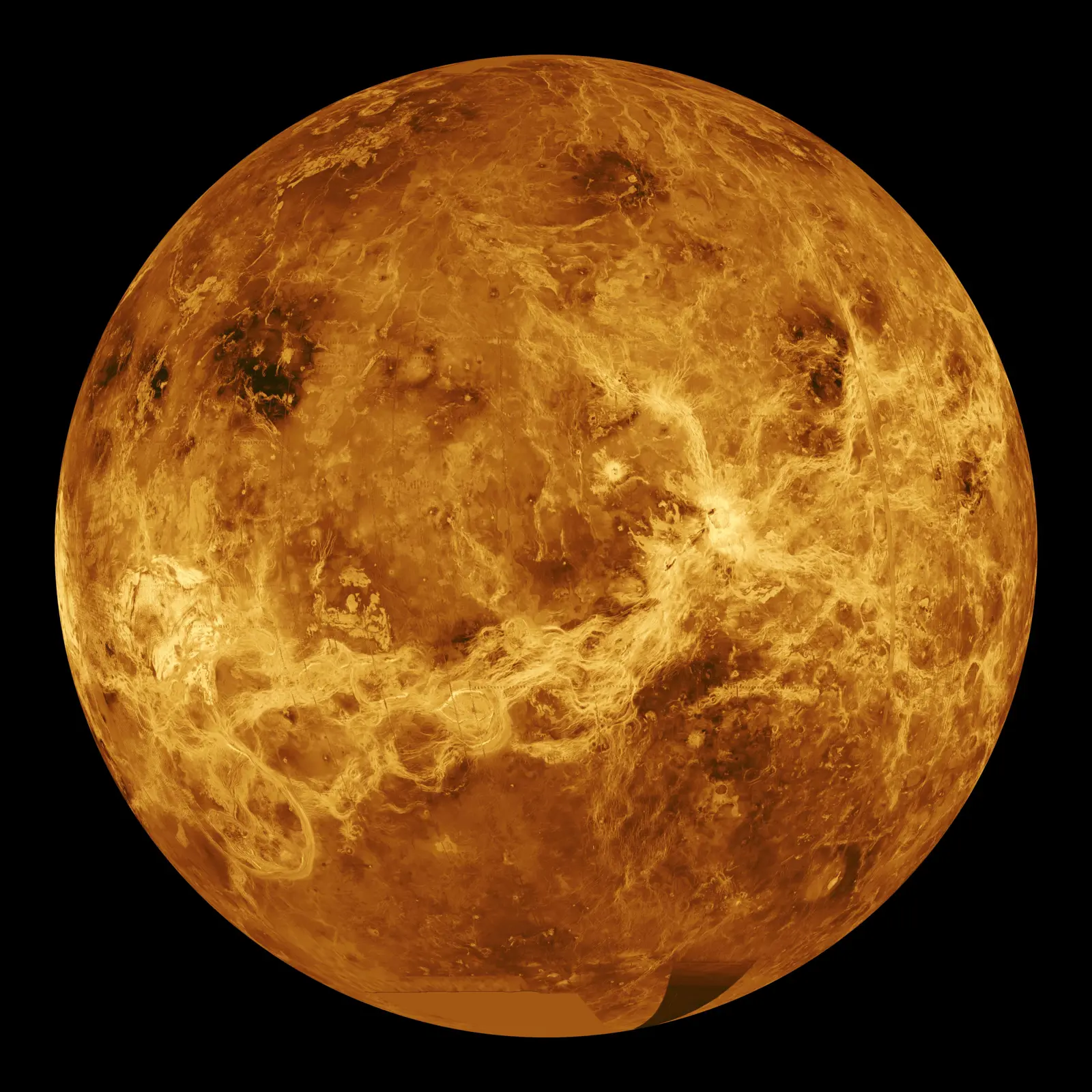
Venus
The Solar System's hottest planet — a cloud-shrouded world of crushing pressure, runaway greenhouse heat, and vast volcanic plains.

Venus
Venus is the second planet from the Sun, orbiting at an average distance of about 108 million kilometres (0.72 AU). Similar in size to Earth, it has an equatorial diameter of roughly 12,104 km and a mass of about 4.87 × 10²⁴ kg, around 81.5–82% that of Earth.
Despite not being the closest planet to the Sun, Venus is the hottest planet in the Solar System. A dense atmosphere of carbon dioxide drives an extreme runaway greenhouse effect, producing a mean surface temperature of about 737 K (≈464 °C) and a surface pressure roughly 92–95 times that of Earth at sea level.
The planet is completely shrouded in clouds of concentrated sulfuric acid, so its surface remained hidden until radar mapping revealed a world of vast volcanic plains, thousands of volcanoes, and deformed tectonic terrain.
Atmosphere and the runaway greenhouse
Venus's atmosphere is composed of more than 96% carbon dioxide and about 3–3.5% nitrogen, with trace amounts of sulfur dioxide, carbon monoxide, water vapor, argon, helium, and neon making up roughly the final 1%. The planet is wrapped in a continuous cloud layer, with the main deck extending from about 48 to 68 km altitude and hazes reaching from around 32 up to 90 km.
The cloud particles are dominated by highly concentrated sulfuric acid droplets, formed by reactions between sulfur dioxide and the small amount of water vapor in the very dry atmosphere. Minor components include solid sulfur, nitrosylsulfuric acid, and phosphoric acid.
Venus has the most powerful greenhouse effect in the Solar System. The high carbon dioxide concentration and great atmospheric mass make the atmosphere extremely opaque to infrared radiation, trapping heat re-emitted by the surface; collisional broadening in the dense CO₂ allows it to absorb a wider range of wavelengths than at Earth-like pressures. Although roughly 80–85% of incoming sunlight is reflected by the bright cloud tops — so Venus absorbs less solar energy than Earth — the trapped infrared cannot easily escape, driving surface temperatures above 700 K, hotter than the surface of Mercury.
Models and observations suggest Venus likely experienced a runaway greenhouse early in its history, in which any oceans evaporated and added water vapor — itself a strong greenhouse gas — to the atmosphere, causing further warming and evaporation. Over time most of this water was lost through processes such as photodissociation and the escape of hydrogen, leaving the very dry atmosphere now dominated by CO₂ and sulfuric acid aerosols.
Rotation and orbit
Venus rotates in a retrograde direction, spinning opposite to most planets, so that from the surface the Sun would appear to rise in the west and set in the east. Its sidereal rotation period is about 243.02 Earth days — longer than its 224.7-day orbital period around the Sun.
Because its slow retrograde spin combines with its orbital motion, the solar day on Venus (from sunrise to sunrise) is about 116.75–117 Earth days, considerably shorter than the time it takes to rotate once on its axis relative to the stars.
Surface and geology
Almost all detailed knowledge of Venus's surface comes from radar mapping by NASA's Magellan orbiter, which from 1990 imaged about 98% of the planet at roughly 100 m resolution through the dense clouds. Earlier, coarser radar maps came from Pioneer Venus in the late 1970s and the Soviet Venera 15 and 16 orbiters in the early 1980s.
About 75% of Venus's surface consists of lowland lava plains formed by extensive basaltic volcanism. Two major highland regions stand out: Aphrodite Terra near the equator, roughly the size of South America and stretching around a third of the planet's circumference, and Ishtar Terra near the north pole, about the size of Australia and containing the Maxwell Montes range, which rises some 11 km above the plains.
Magellan revealed thousands of volcanoes, from large shield volcanoes to small cones and domes. The largest known, Sif Mons, is about 500 km across and 3 km high with a roughly 40 km summit caldera. Distinctive features include flat-topped, steep-sided 'pancake' domes up to about 62 km wide formed from viscous lava, 'tick' domes with radial spurs, and large circular to oval coronae interpreted as surface expressions of mantle upwellings.
Apart from Earth, Venus has the fewest impact craters of any rocky planet, and most large craters appear fresh. Crater counts indicate an average surface age of roughly 300–600 million years, leading to the global resurfacing hypothesis of a planet-wide volcanic event, though more recent modeling allows for more piecemeal resurfacing with some surfaces possibly as young as ~150 million years. Highly deformed tessera terrains make up about 7% of the surface and are locally the oldest preserved units, with ages estimated around 750 million years; a 2020 study of Magellan data found layering compatible with stacked volcanic flows.
Radar data show abundant faults, grabens, rifts, and mountain belts, indicating vigorous tectonic deformation, but there is no clear evidence of Earth-style plate tectonics or subduction zones. With no liquid water or ice and weak surface winds, erosion and sediment deposition are minimal, preserving volcanic and tectonic features for hundreds of millions of years.
Milestones in Venus exploration
- Dec 14, 1962Mariner 2 flyby
First successful mission to another planet; passed about 35,000 km from Venus and made the first in-situ measurements, establishing a very hot surface and dense CO₂ atmosphere.
- Oct 1967Venera 4 atmospheric entry
First probe to enter another planet's atmosphere and return data, transmitting between roughly 55 and 25 km altitude and confirming a CO₂-dominated, dense atmosphere.
- Dec 15, 1970Venera 7 lands
First successful soft landing on another planet and first to transmit data from a planetary surface, confirming extreme conditions of about 90 bar and around 470 °C.
- Oct 1975Venera 9 and 10
Returned the first images from the surface of another planet, confirming a rocky, basaltic surface.
- 1978Pioneer Venus
NASA's first dedicated Venus orbiter plus a multiprobe that sampled the atmosphere; first U.S. spacecraft to carry orbital radar to study Venus through the clouds.
- 1984–85VeGa balloons
Soviet VeGa 1 and 2 missions deployed landers and balloons that floated in the cloud layers — the first long-duration in-situ atmospheric platforms at Venus.
- Aug 1990Magellan orbit insertion
Launched May 1989, Magellan radar-mapped about 98% of the surface at 100–220 m per pixel before being deorbited in 1994.
- Apr 11, 2006Venus Express orbit insertion
First European spacecraft to orbit Venus; studied atmospheric dynamics, clouds, composition, and atmospheric escape until contact was lost in December 2014.
- Dec 7, 2015Akatsuki orbit insertion
After a failed 2010 attempt, JAXA's climate orbiter entered orbit using reaction control thrusters — Japan's first successful mission to another planet — carrying five cameras to study the atmosphere and super-rotation.
Future missions and the phosphine debate
A new cohort of Venus missions is planned for the early 2030s. NASA's DAVINCI (Deep Atmosphere Venus Investigation of Noble gases, Chemistry, and Imaging) is a carrier-relay orbiter with an atmospheric descent probe, with a tentative launch around 2030 and a provisional window of October 2030 to September 2032. It will directly sample the lower and middle atmosphere, measuring noble gases, trace gases, isotopes, temperature, pressure, and winds while imaging the surface during descent.
NASA's VERITAS (Venus Emissivity, Radio Science, InSAR, Topography, and Spectroscopy) orbiter, selected in June 2021, was originally planned for the late 2020s but has been delayed several years into the early 2030s amid budget and workforce constraints. It will perform high-resolution radar mapping and infrared spectroscopy to study tectonics, volcanism, resurfacing history, and possible active volcanism. ESA's EnVision, an orbiter carrying a NASA-provided radar, is also planned for the early 2030s to map Venus's surface and subsurface.
In 2020 a team reported a spectral feature interpreted as phosphine (PH₃) in Venus's clouds at abundances of order tens of parts per billion — a finding of interest because on Earth phosphine is associated with biological or industrial processes. The claim remains unconfirmed and highly contested: subsequent analyses questioned the reality of the signal, suggested it could be attributed to sulfur dioxide, and found no statistically significant phosphine when more conservative processing was applied. In-situ sampling by future missions such as DAVINCI is considered essential to resolve whether phosphine is truly present.
Frequently asked questions
Sources
- Venus - Wikipedia
- Venus | Facts, Color, Rotation, Temperature, Size, & Surface - Britannica
- Venus: Facts - NASA Science
- Venus, Earth's twin sister - The Planetary Society
- ESA - Greenhouse effect, clouds and winds
- ESA - Venus's surface
- Venus, backwards rotation and orbital period
- Venus's Ancient Layered, Folded Rocks Point to Volcanic Origin - NC State
- Geology of Venus - Wikipedia
- Venus Exploration - NASA Science
- Every mission to Venus ever - The Planetary Society
- List of missions to Venus - Wikipedia
- DAVINCI - Wikipedia
- NASA's DAVINCI Mission
- DAVINCI, a return to Venus' clouds - The Planetary Society