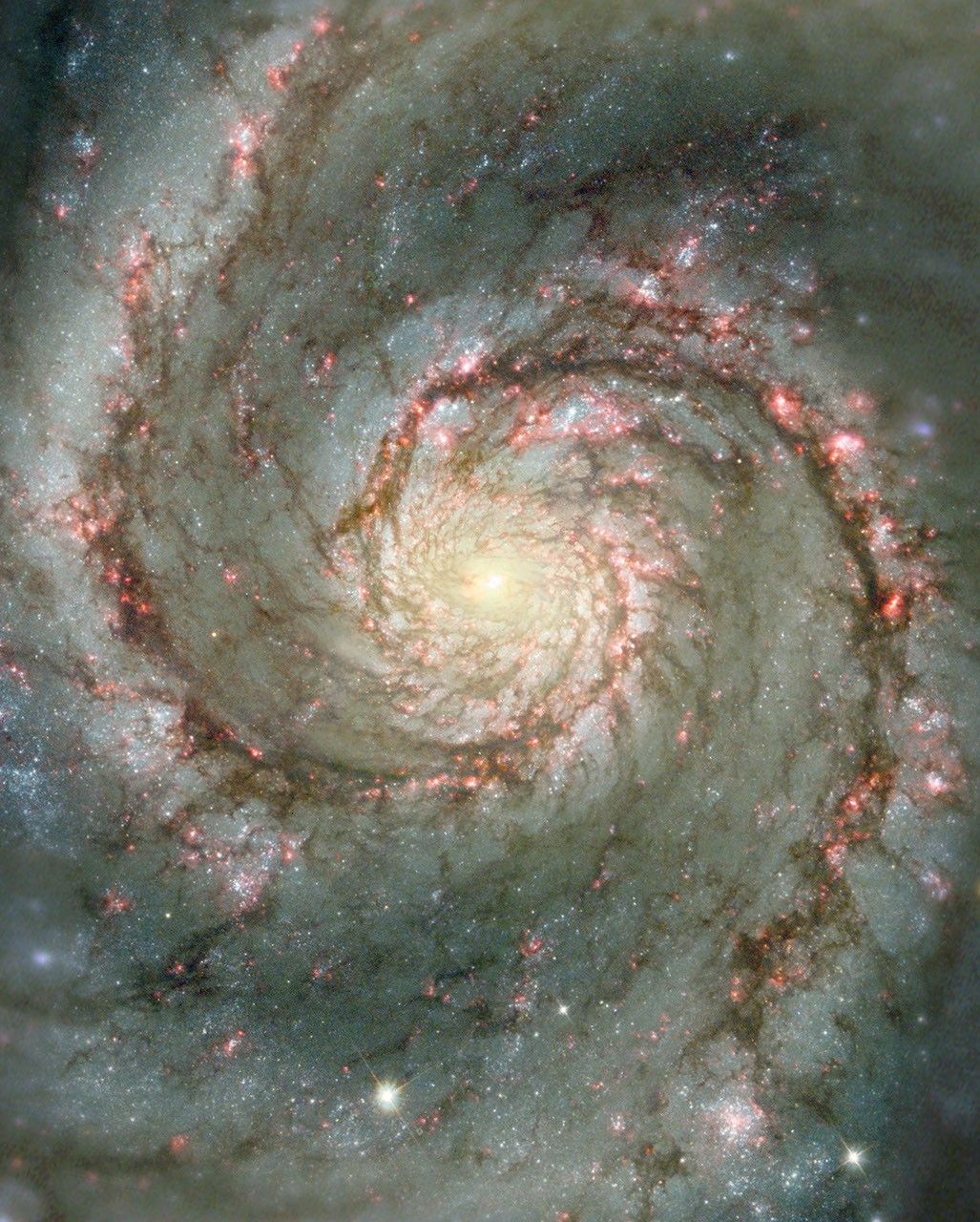
Whirlpool Galaxy
The galaxy that first revealed the spiral universe — and keeps delivering surprises.
The Whirlpool Galaxy
The Whirlpool Galaxy — cataloged as Messier 51 (M51), NGC 5194, and sometimes M51a — is one of the most celebrated and scientifically productive galaxies in the night sky. Located approximately 25 million light-years from Earth in the constellation Canes Venatici, it is a textbook example of a grand-design spiral galaxy: a system whose two sweeping, symmetrical arms trace a precise pinwheel shape across roughly 76,900 light-years of space.
What makes M51 exceptional is not merely its beauty. Its perfectly ordered spiral structure is the direct product of an ongoing gravitational drama with a smaller companion galaxy, NGC 5195, whose repeated passages through M51's disk have sculpted the arms, ignited waves of star formation, and funneled gas toward the galactic nucleus. The pair are gravitationally bound and on a slow trajectory toward eventual merger.
M51 is also historically pivotal. In 1845 it became the first galaxy in which spiral structure was ever recognized — a discovery that would eventually reshape humanity's understanding of the scale and architecture of the cosmos. In the modern era it has hosted three supernovae in fewer than two decades, yielded one of the most extensive X-ray source catalogs of any external galaxy, and produced a candidate planet detected across 25 million light-years of space — possibly the first world ever identified beyond the Milky Way.
Physical Characteristics
The Whirlpool Galaxy spans approximately 76,900 light-years (23.6 kiloparsecs) in diameter, measured along the D25 isophote, and contains an estimated 160 billion solar masses of material. Its apparent magnitude of 8.4 places it at the threshold of visibility for the unaided eye under ideal conditions and makes it an easy target for modest binoculars or small telescopes. With over a hundred billion individual stars, its luminosity is comparable to that of the Milky Way.
The distance to M51 has been measured through multiple independent techniques, with results ranging from roughly 23.5 to 31 million light-years depending on the method and epoch. ESA's Hubble resources quote approximately 25 million light-years, while ESA's Herschel program cites around 30 million light-years. These variations reflect genuine uncertainties in extragalactic distance measurement rather than errors in any single study.
M51 is classified morphologically as a grand-design spiral, meaning its spiral structure is globally organized into two dominant, symmetric arms rather than the patchy, multi-armed pattern seen in flocculent spirals. These arms are visually spectacular: they are outlined by dark dust lanes on their inner (leading) edges, transition through bright pink hydrogen-ionization regions (H II regions) where hot young stars excite surrounding gas, and are punctuated by compact blue star clusters of recently formed massive stars. This orderly sequence of dust, gas, and young stellar populations along each arm is a direct consequence of the density-wave mechanism that drives star formation through the disk.
At M51's heart lies a Seyfert 2 active galactic nucleus (AGN), powered by a central supermassive black hole with a mass exceeding one million solar masses. A Seyfert 2 designation indicates that the nucleus is actively accreting material, producing an ionization cone and hard radiation, but that our line of sight to the central engine is partially obscured — in this case, likely by a dusty torus surrounding the black hole. The nuclear activity and the ongoing interaction with NGC 5195 are linked: tidal forces from the companion help funnel interstellar gas toward the galaxy's center, sustaining or episodically boosting accretion.
From Faint Nebula to Spiral Galaxy
- 13 Oct 1773Charles Messier records M51
While searching for comets, Messier observed a 'very faint nebula without any stars' in Canes Venatici. He cataloged it as Messier 51 — seeing only a diffuse patch, with no hint of spiral form or companion.
- 1781Pierre Méchain identifies the companion
Messier's colleague Pierre Méchain examined M51 and reported it appeared to be a double object with two nuclei, effectively identifying the companion later cataloged as NGC 5195 (M51b). Both objects were still considered simple nebulae.
- 1845Lord Rosse resolves the spiral structure
Using his 72-inch reflector, the 'Leviathan of Parsonstown', William Parsons, 3rd Earl of Rosse, became the first person to clearly see and draw the spiral arms of M51, designating it a 'spiral nebula'. This was the first galaxy in which spiral structure was ever recognized — a landmark in the history of astronomy.
- Early 20th centuryM51 recognized as an external galaxy
Advances in spectroscopy and the measurement of stellar distances established that spiral nebulae like M51 are not solar systems forming within the Milky Way but vast star systems — galaxies — located millions of light-years away. The debate was effectively resolved by the early 1920s.
- 2 Apr 1994Supernova SN 1994I discovered
A Type Ic supernova appeared in M51, becoming one of the most intensively studied nearby supernovae in ultraviolet and optical light, including Hubble observations.
- Jun 2005Supernova SN 2005cs discovered
A Type II supernova erupted in M51's inner spiral arm. Hubble pre-explosion imagery was used to identify the progenitor star — one of the early successes in tracing supernova origins back to specific stars in archival observations.
- 31 May 2011Supernova SN 2011dh discovered
A third supernova in 17 years appeared in M51. Classed as Type II, subsequent research suggested the progenitor was a yellow supergiant, possibly in a binary system.
- Sep 2021Candidate extragalactic planet announced
Analysis of Chandra X-ray Observatory data revealed a candidate planet, M51-ULS-1b, detected via a transit-like eclipse of an X-ray binary in M51. If confirmed, it would be the first planet identified outside the Milky Way.
- Mar 2025NASA SVS updates Hubble–Chandra composite
NASA's Scientific Visualization Studio released an updated visible-vs.-X-ray comparison of M51 using reprocessed archival Hubble and Chandra data, reflecting the ongoing integration of multiwavelength datasets.
The Gravitational Partnership with NGC 5195
The defining feature of the Whirlpool system is not the main galaxy alone but its interaction with the smaller companion galaxy NGC 5195 (also designated M51b), visible just beyond the end of one of M51's spiral arms. NGC 5195 is a dwarf companion galaxy, and although it is far less massive than M51, its repeated gravitational encounters with the larger system have profoundly shaped everything from M51's large-scale morphology down to its nuclear activity.
The predominant model, supported by numerical simulations and multiwavelength observations, holds that NGC 5195 has passed through M51's disk at least twice in geologically recent cosmic time. The first passage is estimated to have occurred roughly 500 to 600 million years ago, when NGC 5195 approached from behind M51's disk (relative to our line of sight) and crossed through it. This encounter is credited with establishing M51's grand-design two-armed structure and predominantly affecting the inner disk and the southern spiral arm. A second passage is inferred to have occurred only 50 to 100 million years ago, crossing the disk again and leaving NGC 5195 currently positioned slightly behind M51 as viewed from Earth — an arrangement confirmed by the reddening of NGC 5195's light where it shines through one of M51's dust-laden foreground spiral arms. This second passage produced observable 'kinks' in the spiral arms and more strongly influenced the outer disk and northern arm.
The mechanism by which the interaction amplifies M51's spiral pattern is the tidally forced density wave. As NGC 5195's gravity distorts the disk of M51, it drives large-scale waves of compression through the thin disk of gas and dust. Gas clouds caught in the leading (inner) edges of these density waves are compressed, triggering the gravitational collapse that forms new stars. The result is the characteristic sequence visible along M51's arms: dark dust lanes on the inside of each arm, then brilliant pink H II regions where ionized hydrogen glows, then bright blue clusters of massive young stars just downstream in the wave pattern.
The interaction has also generated extensive tidal debris visible in deep imaging. A Northwest plume of low-surface-brightness material extends to approximately 43 kiloparsecs (about 140,000 light-years) from M51's center. Additional faint structures — dubbed the Northeast plume and South plume — have also been identified, tracing mass loss and angular-momentum redistribution in the outer halo as the pair evolves dynamically. The system as a whole is gravitationally bound, and both galaxies are on a trajectory that will ultimately lead to coalescence into a single merged remnant, though the precise timescale for full merger remains model-dependent.
Nuclear Activity and Black-Hole Outbursts
M51's Seyfert 2 nucleus harbors a supermassive black hole with a mass exceeding one million solar masses. As material falls toward the black hole, it is superheated and produces copious X-ray emission from the core region. Chandra X-ray Observatory observations have revealed two arc-like X-ray structures surrounding the nucleus, interpreted as signatures of successive outbursts from the central black hole. The inner arc is estimated to have taken 1 to 3 million years to reach its current position; the outer arc took 3 to 6 million years, implying at least two distinct epochs of elevated nuclear activity.
Just outside the outer X-ray arc lies a slender arc of hydrogen gas glowing in the Hα emission line. This alignment suggests that the expanding hot gas driven by the black-hole outbursts has 'snow-plowed' cooler surrounding gas outward, possibly compressing it sufficiently to trigger a new episode of star formation in the compressed shell. These outbursts may themselves have been triggered or intensified by the interaction with NGC 5195, which disrupts gas in the disk and can drive inflows toward the nucleus, periodically feeding the central engine.
A Galaxy Ablaze with Supernovae
The Whirlpool Galaxy has produced three well-documented supernovae in the modern era, making it one of the most supernova-productive nearby galaxies on record. The occurrence of three stellar explosions within seventeen years has prompted considerable discussion among astronomers about whether M51's elevated star-formation rate — itself a consequence of the interaction with NGC 5195 — makes it statistically more likely to produce massive stars that end their lives as supernovae.
The first, SN 1994I, was discovered on 2 April 1994 and reached peak brightness around 10 April 1994. It was classified as a Type Ic supernova — a variety in which the exploding star has lost both its hydrogen and helium envelopes prior to the explosion, leaving a naked stellar core — and became one of the most extensively studied nearby supernovae in ultraviolet and optical wavelengths, including dedicated Hubble observations.
The second, SN 2005cs, appeared in June 2005 in M51's inner spiral arm and was classified as a Type II supernova, meaning the progenitor retained its hydrogen envelope. Its significance extended beyond the explosion itself: ESA and NASA astronomers were able to examine archival Hubble images of the exact location taken before the explosion and identify the progenitor star — an early demonstration of the power of pre-explosion imaging in linking supernova types to specific stellar populations.
The third, SN 2011dh, was detected on 31 May 2011 and was near maximum brightness in June of that year. Also classified as a Type II supernova, subsequent analysis of pre-explosion Hubble imagery pointed to a yellow supergiant progenitor, with some evidence suggesting the star may have been in a binary system at the time of explosion — a finding that has broader implications for understanding the variety of progenitor configurations that can produce Type II events.
X-Ray Universe: Binaries, Hot Gas, and a Candidate Planet
Deep Chandra observations accumulating roughly 900,000 seconds (approximately 10.4 days) of total exposure time have made M51 one of the most thoroughly X-ray-mapped external galaxies. Early Chandra work identified just over 100 X-ray point sources in the system; the expanded dataset raised that count to nearly 500, of which approximately 400 are estimated to lie within M51 itself, with the remainder being foreground or background objects projected along the same line of sight.
The vast majority of these point sources are X-ray binaries — systems in which a neutron star or stellar-mass black hole accretes material from a companion star, heating infalling gas to millions of kelvin and producing luminous X-ray emission. At least ten of the brightest are inferred to contain black holes rather than neutron stars, and in eight of these, the black hole is likely fed by strong stellar winds from a high-mass companion more massive than the Sun. These high-mass black-hole X-ray binaries have remained consistently bright across a decade of Chandra monitoring, indicating a steady and substantial wind-driven accretion flow. Many are found close to regions of active star formation, consistent with their origin as recently formed massive stars that have already evolved and collapsed into compact objects.
Beyond individual point sources, M51 exhibits diffuse X-ray emission from gas heated to tens of millions of kelvin by the combined effects of supernova explosions and stellar winds from the galaxy's abundant massive-star population. This hot interstellar medium permeates the disk and extends into the halo, tracing the cumulative energetic feedback from the elevated star formation driven by the interaction with NGC 5195.
Perhaps the most striking Chandra result tied to M51 is the reported detection of a candidate extragalactic planet. The object, designated M51-ULS-1b, was identified through a transient eclipse — a brief but significant drop in X-ray flux — observed in the output of an X-ray binary system called M51-ULS-1, in which a neutron star or black hole orbits a massive B-type supergiant companion. The three-hour eclipse was interpreted as a Saturn-sized planetary body transiting the compact X-ray-emitting region. If confirmed, M51-ULS-1b would be the first planet candidate identified outside the Milky Way, at a distance of roughly 28 million light-years. However, confirmation is deeply challenging: given the inferred wide orbital separation, another transit — and hence another observable eclipse — would not be expected for approximately 70 years. The discovery, published in Nature Astronomy, remains classified as a candidate.
Observing Across the Spectrum: Hubble, Chandra, and Webb
No single observatory has monopolized M51 — its scientific richness has drawn observations across the full electromagnetic spectrum, and the galaxy has become a benchmark target for demonstrating multiwavelength astronomy. Hubble provides the reference optical view, resolving individual star clusters, star-forming regions, and the fine structure of dust lanes across the spiral arms. In Hubble imagery, the arms emerge as rivers of light punctuated by pink H II regions and brilliant blue-white stellar associations, set against a background of billions of older, yellower stars.
Chandra's X-ray vision cuts through obscuring dust to reveal an entirely different population of sources: the hundreds of X-ray binaries, the diffuse hot gas, and the hard emission concentrated around both the nucleus of M51 and the center of its companion NGC 5195. The X-ray map overlaid on the optical image strikingly shows how closely the brightest X-ray regions correlate with the sites of most active star formation — a direct demonstration of how massive stars, formed in the arms, quickly produce compact remnants that then accrete and radiate in X-rays.
The James Webb Space Telescope has added an infrared perspective that neither Hubble nor Chandra can provide. Webb's near-infrared imaging reveals M51's spiral arms in far greater detail than optical observations because infrared light is far less attenuated by dust. In Webb imagery, the dusty arms take on a rope-like or filamentary appearance, tracing the fine structure of cold molecular clouds where new stars are still deeply embedded and invisible at optical wavelengths. Combined Hubble–Webb–Chandra composites of M51 have become showcase products in public outreach, with each observatory contributing a distinct physical layer: Hubble traces young stellar light and ionized gas, Webb maps cooler dust and embedded protostars, and Chandra highlights the hottest gas and compact high-energy sources. NASA's Scientific Visualization Studio released an updated Hubble–Chandra comparison in March 2025, reflecting ongoing reprocessing and integration of archival data.
What M51 Has Taught Astronomy
Lord Rosse's 72-inch Leviathan resolved M51's arms in 1845, making it the first object in which any spiral structure was recognized — a discovery that opened the study of spiral nebulae and ultimately led to recognizing galaxies as island universes.
M51 became the canonical example demonstrating that a companion galaxy's gravitational influence can organize a disk into two symmetric, dominant spiral arms through density-wave forcing, replacing patchier flocculent structure with a coherent grand-design pattern.
SN 1994I (Type Ic), SN 2005cs (Type II), and SN 2011dh (Type II) provided exceptional opportunities for multiwavelength supernova follow-up, progenitor identification in pre-explosion Hubble imagery, and studies of stellar evolutionary pathways to core collapse.
Chandra revealed two successive arc-like X-ray structures surrounding M51's nucleus, consistent with distinct epochs of black-hole outburst activity separated by millions of years, with evidence that the expanding hot gas has compressed surrounding material and may have triggered new star formation.
A transient X-ray eclipse in the binary M51-ULS-1 was interpreted as a Saturn-sized planet transiting the X-ray-emitting compact object — potentially the first planet candidate detected beyond the Milky Way, demonstrating that X-ray transit searches can probe planetary populations in other galaxies.
Deep Chandra imaging accumulated ~900,000 seconds of exposure and detected approximately 500 X-ray sources in the M51 system, including at least 10 likely stellar-mass black-hole binaries sustained by wind accretion from high-mass companions.
Despite its tidally enhanced star formation, M51's star-formation efficiency — the fraction of available gas converted to stars per unit time — is approximately 1%, similar to the global efficiency in the Milky Way and other disk galaxies, suggesting a universal self-regulating mechanism.
Common Questions About the Whirlpool Galaxy
Sources
- Out of this whirl: The Whirlpool Galaxy (M51) and companion galaxy — ESA/Hubble
- A multi-wavelength view of the Whirlpool Galaxy (M51) — ESA/Herschel
- Whirlpool Galaxy — Wikipedia
- The Whirlpool Galaxy (M51) and companion galaxy NGC 5195 — ESA/Hubble Science
- Researchers show that the shape of the Whirlpool galaxy has been molded by repeated passage through its disc — IAC
- Chandra Captures Galaxy Sparkling in X-rays — NASA
- Audio Podcasts :: Transcript :: Chapter 7: Whirlpool Galaxy (M51) — Chandra X-ray Center
- NASA Space Telescope Finds Possible Planet in the Whirlpool Galaxy — ExplorersWeb
- Messier 51 (The Whirlpool Galaxy) — NASA Science / Hubble Messier Catalog
- Oct. 13, 1773: The discovery of the Whirlpool Galaxy — Astronomy.com
- Hubble Observes the Supernova in the Whirlpool Galaxy — NASA Science
- The Whirlpool Galaxy: Visible and X-ray Views — NASA SVS
- Whirlpool Galaxy Exploding With Supernovas — Space.com
- SN 2005cs in M51 — before progenitor star's explosion — ESA/Hubble
- First Peek at Spitzer's Legacy: Mysterious Whirlpool Galaxy — Caltech/Spitzer