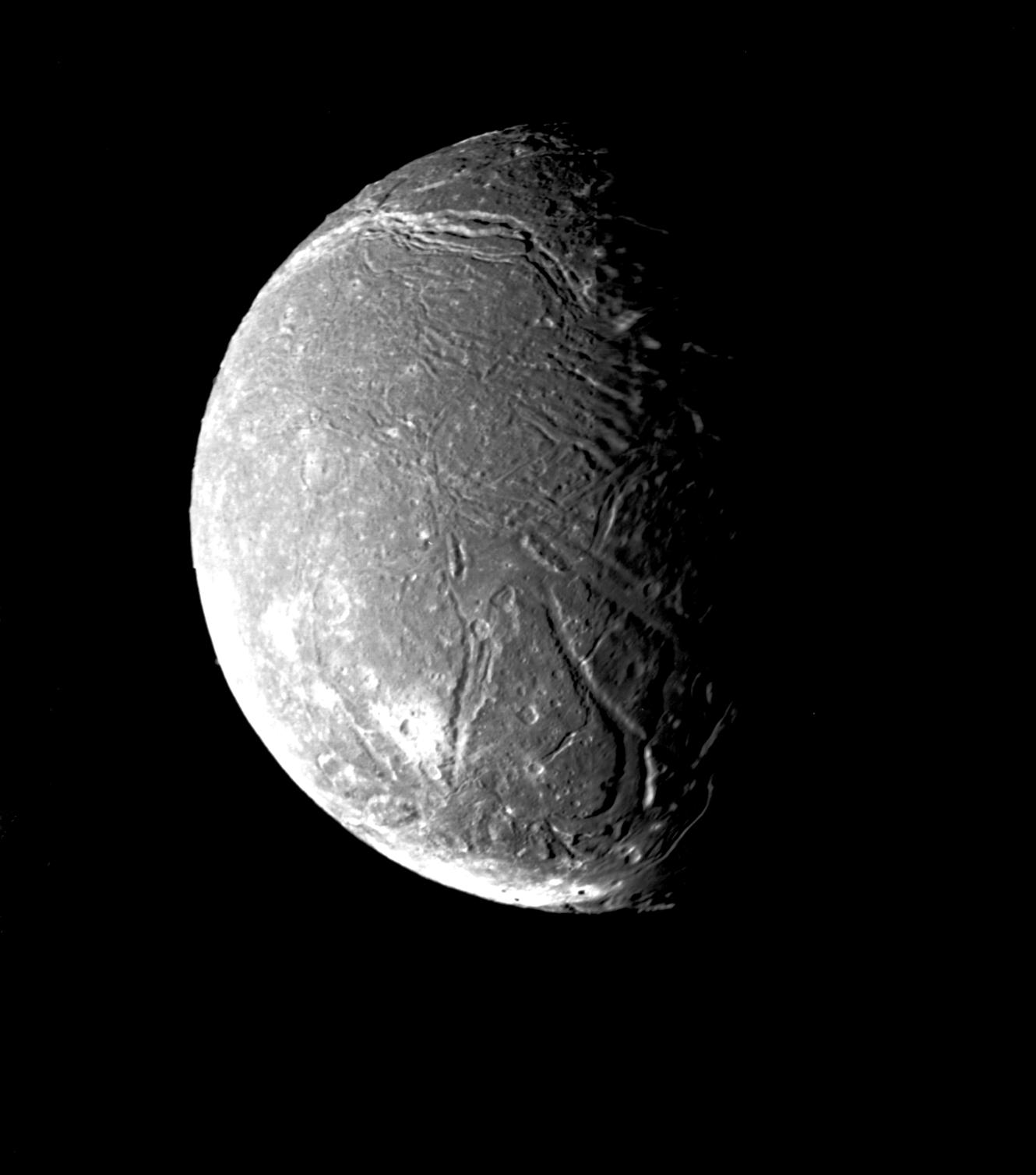
Ariel
Uranus's brightest moon — a tectonically scarred ice world hiding secrets of a possible ancient ocean beneath its fractured surface.
Ariel
Ariel is the brightest of the five large moons of Uranus and the second-closest of that group to the planet. With a mean diameter of approximately 1,160 km, it ranks among the mid-sized icy satellites of the outer Solar System — smaller than Earth's Moon but geologically far more eventful than its appearance might suggest. Its surface is the youngest and most heavily modified of any large Uranian moon, crossed by vast canyon systems, fault valleys, and smooth plains that speak to a turbulent internal history.
Discovered in 1851 by the English astronomer William Lassell, Ariel remained little more than a point of light for over a century. The single spacecraft to have visited it, NASA's Voyager 2, swept through the Uranian system on 24 January 1986 and returned the first and only close-up images — revealing a world of rift valleys and resurfaced plains that stunned planetary scientists. Since then, Earth- and space-based spectroscopy, culminating in analyses incorporating James Webb Space Telescope data, has uncovered abundant carbon dioxide ice on the surface and pointed toward an interior that may once have harboured a global ocean up to roughly 170 km deep.
A landmark 2025 study reinterpreted long, trench-like grooves running along Ariel's canyon floors as spreading centres — analogous to Earth's mid-ocean ridges — implying that warm material from the interior has actively welled up and created new crust. These findings cement Ariel's status as a candidate ocean world and a primary science target for NASA's proposed Uranus Orbiter and Probe, the top-priority flagship mission recommended by the 2023–2032 Planetary Science Decadal Survey.
Discovery and exploration
- 24 Oct 1851Discovery by William Lassell
English astronomer William Lassell, using a large reflecting telescope at his private Liverpool observatory, discovers Ariel — and on the same observing campaign, Umbriel. Lassell later proposes a Roman-numeral numbering scheme (I–IV outward from Uranus) that becomes the standard.
- 1851Name proposed by John Herschel
At Lassell's request, Sir John Herschel (son of Uranus's discoverer William Herschel) suggests the name Ariel — a character appearing in both Shakespeare's The Tempest and Alexander Pope's The Rape of the Lock.
- 24 Jan 1986Voyager 2 flyby
Voyager 2 makes its closest approach to Uranus, imaging Ariel in detail for the first and only time. The spacecraft reveals a bright, tectonically deformed surface with extensive graben, canyon systems, and smooth resurfaced plains — evidence of significant past geological activity. Coverage is limited to the southern hemisphere, which was the only sunlit face at the time.
- 2020sJWST-era compositional advances
Analyses incorporating James Webb Space Telescope data confirm that Ariel's surface is mantled by abundant CO₂ ice mixed with smaller amounts of CO ice. Studies led by Richard Cartwright (NASA Ames / JHU/APL) argue that these carbon-bearing molecules most likely originate from interior chemical processes rather than external sources, strengthening the case for an active interior.
- 3 Feb 2025Medial grooves identified as spreading centres
A study led by Chloe Beddingfield (JHU/APL), published in The Planetary Science Journal, reanalyses high-resolution Voyager 2 images and identifies trench-like medial grooves on Ariel's canyon floors as spreading centres — features analogous to Earth's mid-ocean ridges, where warm interior material ascends and creates new crust. The canyon walls fit together like puzzle pieces when groove-floor material is digitally removed, implying the valleys were pulled apart as new material was emplaced from below.
- 2023–2032 (planned)Decadal Survey names Uranus Orbiter and Probe top priority
NASA's 2023–2032 Planetary Science and Astrobiology Decadal Survey designates a Uranus Orbiter and Probe as the highest-priority flagship mission of the decade. Ariel, highlighted as a prime ocean-world candidate, is among the key moon targets. Launch is baselined around 2031–2032, with Uranus arrival in approximately 2044–2045.
Discovery and naming
William Lassell (1799–1880) was a wealthy English brewer whose passion for astronomy led him to construct a series of increasingly powerful reflecting telescopes at his private observatory near Liverpool. On 24 October 1851, Lassell was observing Uranus with one of these instruments when he identified two previously unknown satellites orbiting closer to the planet than the moons Titania and Oberon, which William Herschel had found in 1787. The two new moons — Ariel and Umbriel — were announced together and are often cited as a joint discovery.
Lassell's find was not without historical complication. William Herschel had previously claimed the existence of up to six Uranian satellites beyond Titania and Oberon, but Lassell's 1851 observations matched none of Herschel's supposed additional moons. Detailed re-examination concluded that Herschel's extra satellites were almost certainly faint background stars misidentified as moons, so credit for Ariel and Umbriel was formally awarded to Lassell. He subsequently proposed a numbering scheme assigning Roman numerals I through IV to the four then-known moons in order of distance from Uranus — a convention that eventually became standard.
The name Ariel was suggested by Sir John Herschel at Lassell's request. It echoes a character found in two celebrated literary works: the spirit Ariel in Shakespeare's The Tempest, and a figure in Alexander Pope's mock-epic poem The Rape of the Lock. This literary tradition — drawing names from Shakespeare and Pope for the Uranian moons — has been followed for all subsequently discovered Uranian satellites.
Physical characteristics and composition
Ariel has a mean diameter of approximately 1,160 km, making it the fourth-largest of Uranus's known moons. Its mean density of about 1.59 g/cm³ is consistent with a body composed of roughly equal parts water ice and silicate rock — a mixture typical of mid-sized icy satellites in the outer Solar System. Interior models indicate that Ariel is likely differentiated: the denser rocky material has sunk toward the centre, forming a rocky core, while lighter ices dominate the outer layers. Sufficient early heating — from the decay of radioactive elements in the rocky component and from tidal interactions with Uranus — is thought to have driven this separation.
The surface is dominated by water ice but also carries a prominent coating of carbon dioxide (CO₂) ice, the strongest CO₂ absorption features seen on any of the large Uranian moons. JWST-era analyses have confirmed that the surface is mantled by abundant CO₂ ice mixed with smaller amounts of CO ice and other carbon-bearing molecules. Studies led by Richard Cartwright and colleagues argue that these volatile species most likely arise from interior chemical processes rather than being delivered purely by external impacts or implanted by magnetospheric charged particles, pointing to a geochemically active interior with ongoing or geologically recent exchange between the subsurface and the surface.
Ariel's average albedo — the fraction of incoming sunlight it reflects — is the highest of the five large Uranian moons, at roughly 0.3. Despite this, the surface is not pristine white: carbonaceous material mixed into the ice darkens it considerably. Brightness measurements at opposition (when the Sun is directly behind the observer) show a sharp surge, indicating that the surface is made up of a highly porous, fine-grained regolith in which particles cast minimal shadows when illuminated from directly behind the observer. This same porosity gives the surface low thermal inertia: it warms and cools rapidly as sunlight strikes it, consistent with a fluffy, insulating layer maintained by long-term micrometeorite bombardment.
Ariel orbits Uranus at a mean distance of 190,900 km from the planet's centre, completing one circuit every 2.52 Earth days. Its orbit is prograde (in the same direction as Uranus's rotation), has low inclination relative to Uranus's equatorial plane, and is slightly eccentric. Like the other large Uranian moons, Ariel rotates synchronously — it keeps the same face permanently turned toward Uranus, just as Earth's Moon always shows the same face toward Earth.
Surface geology
Ariel's surface is the youngest and most geologically complex of the large Uranian moons. Where bodies like Oberon and Umbriel preserve ancient, heavily cratered terrains dating back billions of years, Ariel shows clear signs of extensive resurfacing that has overprinted or obliterated much of its early impact record. The moon carries relatively few large ancient craters but many smaller ones, a pattern that indicates later geological activity erased older, larger features. Crater-count modelling places at least some of this activity within the last billion years or less.
Three broad terrain types are recognised on Ariel. The oldest and most extensive is cratered terrain, densely covered with impact craters of varying sizes — the baseline record of the early Solar System bombardment. Cutting across and through the cratered terrain are zones of ridged terrain: bands of ridges and troughs extending for hundreds of kilometres, the product of intense tectonic deformation. Finally, smooth plains occupy canyon floors and low-lying depressions within the cratered terrain; these are among the youngest surfaces on Ariel and are thought to have formed by cryovolcanic or tectonic resurfacing — the extrusion or flooding of icy material from below.
The most visually dramatic features on Ariel are its interconnected rift valleys and large canyons, formally termed chasmata. Named examples include Kachina Chasma and Kewpie Chasma. These fault-bounded valleys — grabens formed by crustal extension — can reach depths of up to roughly 10 km (about 6 miles). They are thought to record a period of global or regional expansion of Ariel's crust, possibly driven by the freezing and expansion of subsurface water, tidal stresses, or both. The extensive scale of these features implies that the interior once provided substantial energy to drive the deformation.
A major reinterpretation of Ariel's canyon geology emerged from a 2025 study led by Chloe Beddingfield of JHU/APL, published in The Planetary Science Journal. The team examined trench-like features called medial grooves running along the floors of Ariel's major canyons, which had been visible but unexplained in Voyager 2 images for nearly four decades. The study concluded that these grooves are spreading centres — structures directly analogous to Earth's mid-ocean ridges, where warm material from the interior ascends to the surface and creates new crust, splitting the overlying terrain apart. As evidence, the researchers showed that the opposing canyon walls fit together like puzzle pieces when groove-floor material is digitally removed, implying the valleys were literally pulled open as new material was emplaced from below. The canyon floors also show regularly spaced ridges consistent with repeated deposition events characteristic of spreading. These medial grooves appear to be among the youngest features on Ariel and are interpreted as geologic conduits — pathways through which CO₂, CO, and other volatiles have migrated from the interior to the surface.
What science has revealed about Ariel
Ariel's albedo of ~0.3 is the highest of the five classical large moons, indicating a cleaner, more ice-rich and/or younger surface repeatedly refreshed by geological activity — despite long-term darkening by the Uranian magnetosphere.
Crater counts and morphological analysis show that large ancient craters have been obliterated by later resurfacing. Some geological activity on Ariel is modelled to have occurred within the last billion years.
Ariel's surface is transected by vast grabens and chasmata — fault-bounded valleys formed by crustal extension — some estimated to reach depths of roughly 10 km, among the deepest known tectonic features on any icy moon in the outer Solar System.
Beddingfield et al. (2025) identified trench-like medial grooves on canyon floors as spreading centres analogous to Earth's mid-ocean ridges, where internal material ascends and creates new crust. Opposing canyon walls fit together like puzzle pieces, confirming extensional splitting.
Infrared spectroscopy and JWST-era observations confirm abundant CO₂ ice mixed with CO ice on the surface. Studies by Cartwright and colleagues argue these carbon-bearing volatiles are sourced from the interior rather than delivered externally — evidence for an active interior-surface connection.
Thermal evolution models and geological evidence suggest Ariel may once have harboured a global subsurface ocean up to ~170 km deep. Antifreeze agents such as ammonia salts could allow residual liquid water to persist at depth even today.
Voyager 2 imaging showed smooth plains with lobate and lineated morphologies consistent with erupted or flowed icy material. The imaging team noted 'strong evidence for the presence of extrusive material' on Ariel — one of the clearest signs of past cryovolcanism among Uranian moons.
Voyager 2 and the first close look
For the first 135 years after its discovery, Ariel was nothing more than a faint speck of light resolvable only as a point source even through the largest ground-based telescopes. That changed on 24 January 1986, when Voyager 2 — the only spacecraft ever to visit Uranus — swept through the Uranian system at closest approach to the planet. During a period of intense activity lasting only hours near closest approach, the spacecraft returned detailed images of the five large moons, transforming them from points of light into real, distinct worlds.
Ariel emerged from Voyager 2's cameras as one of the mission's most striking geological discoveries. The imaging team immediately recognised that Ariel was different from its neighbours Oberon and Umbriel: its surface was brighter, its crater population different in character, and its terrain heavily cut by the large fault systems and smooth-floored valleys that would later be interpreted as grabens and cryovolcanic resurfacing units. The team reported 'strong evidence for the presence of extrusive material' — the scientific language for flows or eruptions of icy material from below — making Ariel one of the most geologically compelling Uranian moons.
An important limitation of the Voyager 2 dataset is that only Ariel's southern hemisphere was visible during the encounter. Uranus has an extreme axial tilt of about 98°, meaning that at the time of the flyby one pole was pointed almost directly toward the Sun. The northern hemisphere of Ariel lay in complete darkness. As a result, all existing close-up geological knowledge of Ariel comes from roughly half the globe, and significant terrain types may remain unseen. Voyager 2 also provided compositional data through its ultraviolet spectrometer, helping constrain the bulk ice-and-rock composition that applies to Ariel along with the other large Uranian moons.
The broader context of the Voyager 2 Uranus encounter was equally important. The spacecraft discovered that Uranus possesses a highly unusual magnetic field — strongly tilted relative to the planet's rotation axis and offset from its centre — creating a corkscrew magnetotail and complex radiation belt environment that bathes the moons. Analysis showed that interaction with this magnetosphere darkens and chemically alters the trailing hemispheres of the moons over time. The fact that Ariel's surface remains relatively bright despite this bombardment reinforces the conclusion that recent resurfacing has continually refreshed its ice.
Interior and ocean-world candidacy
Ariel's mean density of approximately 1.59 g/cm³ points to a body composed of roughly equal parts water ice and silicate rock. At a central pressure of about 0.3 GPa (roughly three times atmospheric pressure on Earth's surface), models indicate that Ariel is differentiated — its denser rocky material has settled into a central core, while lighter ices form an outer mantle. Early heating from radioactive decay in the rocky core and from tidal interactions with Uranus was likely sufficient to drive this differentiation and to warm the interior significantly.
The geological record preserved on Ariel's surface — the vast graben systems, the young smooth plains, the apparent cryovolcanic flows — requires an internal heat source capable of mobilising subsurface material. A 2022–2023 re-evaluation of the large Uranian moons' interiors concluded that active or long-lived subsurface oceans are plausible for Ariel and its companions, given updated heat budgets, thermal evolution models, and the presence of potential antifreezes such as ammonia salts that depress the freezing point of water. A 2025 study went further, combining analysis of Ariel's fractures and grabens with models of past orbital eccentricity and tidal heating to estimate that Ariel may once have harboured a global subsurface ocean up to approximately 170 km deep — a substantial fraction of the moon's radius.
Whether that ocean survives in any form today is uncertain. Models that rely only on radiogenic heating suggest this may be insufficient to maintain a large modern ocean. Newer studies incorporating past tidal heating — potentially boosted by historical orbital resonances with other Uranian moons — and the additional antifreeze effect of dissolved salts or ammonia allow for the possibility that liquid water persists at depth even now, though direct confirmation awaits a future mission with a magnetometer capable of detecting ocean induction signatures. Ariel currently lacks any detected atmosphere; it is essentially airless, with at most a tenuous exosphere produced by sputtering and sublimation at levels far below what is typically classed as an atmosphere.
The discovery of CO₂ and CO ice on the surface — and the interpretation that these volatiles are sourced from the interior — provides the most compelling present-day evidence linking Ariel's surface chemistry to its internal state. If the medial grooves identified by Beddingfield et al. (2025) are genuinely spreading centres, they represent active conduits between a potentially ocean-bearing interior and the surface, making Ariel a dynamic world in an unexpected corner of the Solar System.
Future exploration
No spacecraft has visited the Uranian system since Voyager 2 in 1986, and no mission has ever entered orbit around Uranus. The 2023–2032 Planetary Science and Astrobiology Decadal Survey, the field's primary strategic planning document, designated a Uranus Orbiter and Probe (UOP) as NASA's highest-priority flagship mission for the decade — the first time a Uranus mission has held that distinction. Ariel's status as a leading ocean-world candidate is central to the scientific justification.
Current concept studies baseline a UOP launch around 2031–2032, using a commercial heavy-lift launcher such as Falcon Heavy with a Jupiter gravity assist, arriving at Uranus approximately 2044–2045 after a cruise of roughly 2.9 billion km. The mission would consist of an atmospheric entry probe released into Uranus's atmosphere and a long-lived orbiter to study the planet, its rings, magnetosphere, and moons. Planetary scientist Richard Cartwright has described Ariel as the 'most interesting moon' and 'the best target for improving our understanding of ocean worlds,' alongside Miranda, in the context of this mission. Science goals for Ariel would include high-resolution imaging of its young and geologically complex surface, near- and mid-infrared spectroscopy to map CO₂, ammonia, carbonates, and other ices, and magnetometer measurements searching for the induction signature of a subsurface ocean.
Several other Uranus mission concepts have been studied — including the ESA MUSE concept, NASA/JPL OCEANUS and QUEST proposals, and the PERSEUS and UMaMI mission ideas — all of which would perform multiple Ariel flybys as part of a Uranian system tour. However, none currently carries the institutional priority or momentum of the UOP flagship. China's proposed Tianwen-4 outer-planets mission envisions a Uranus flyby around 2045, which could yield opportunistic imaging of Ariel, though not the sustained, repeated observations of an orbiter. In practical terms, the 2020s and early 2030s are the period of mission design and launch preparation; in-situ exploration of Ariel itself will almost certainly occur in the 2040s.
Frequently asked questions
Sources
- Evidence of Past Ocean on Uranus' Moon Ariel
- New Study Suggests Trench-Like Features on Uranus' Moon Ariel May Be Windows to Its Interior — JHU/APL
- Ariel — NASA Science
- Ariel | Uranian moon — Britannica
- A hidden ocean may have once existed on Uranus' moon Ariel — Space.com
- Ariel: Uranus' moon — NOAA Science On a Sphere
- Evidence of a past, deep ocean on Uranian moon Ariel — PSI Blog
- 35 Years Ago: Voyager 2 Explores Uranus — NASA History
- Voyager 2 in the Uranian system: imaging science results — PubMed
- Uranus' Moon Ariel has Deep Gashes, Could Reveal its Interior — Universe Today
- Compositions and Interior Structures of the Large Moons of Uranus — JGR Planets
- Uranus' mysterious moons: why NASA wants to explore Ariel and Miranda — The Planetary Society
- Exploration of Uranus — Wikipedia
- The Astrobiological Potential of the Uranian Moon System — Astrobiology.com
- New Study Suggests Trench-Like Features on Uranus' Moon Ariel — Astrobiology.com (2025)
- In Search of Sprites — the Discovery of Ariel and Umbriel — NASA ADS
- Ariel (moon) — Wikipedia