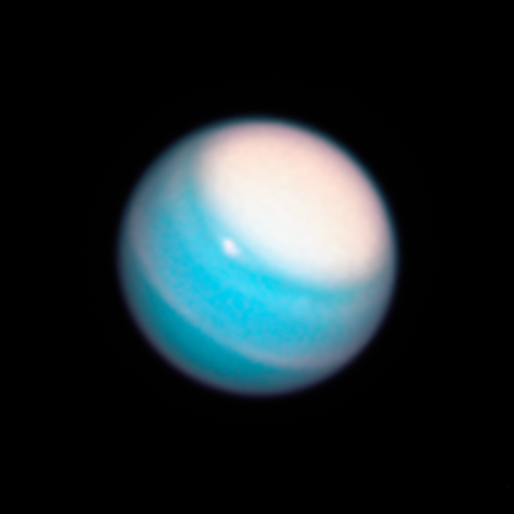
Uranus
The tilted ice giant — third-largest planet in the Solar System, spinning on its side beneath a methane-blue haze.
Uranus
Uranus is an ice giant and the third-largest planet in the Solar System by diameter and the fourth-largest by mass. It has a mass of about 14.5 Earth masses, a mean radius of roughly 4 Earth radii, and a diameter near 51,000 km.
Its most distinctive feature is an axial tilt of about 97–98°, which means the planet effectively rotates on its side. It completes a rotation in roughly 17 hours and 14 minutes, spinning in a retrograde direction. Methane in its atmosphere gives Uranus its characteristic blue-green color. Unlike the gas giant Jupiter, Uranus is classed among the ice giants for its composition.
Discovery and orbit
Uranus was discovered on 13 March 1781 by William Herschel in Bath, England. It was the first planet to be discovered with a telescope. Herschel initially reported the object as a possible comet or star before its planetary nature was confirmed by later observations and orbital calculations.
Uranus orbits the Sun once every approximately 84.02 Earth years (about 30,687 Earth days) at an average distance of roughly 2.9 billion kilometers, or about 19 astronomical units.
Atmosphere and climate
Uranus's atmosphere is dominated by hydrogen (about 83% by volume) and helium (about 15%), with methane making up about 2.3% as the third most abundant gas. Trace constituents include hydrogen deuteride and inferred traces of hydrogen sulfide, water, and ammonia at depth. Methane is strongly enriched relative to the Sun and absorbs red light, giving the planet its blue-green appearance.
The atmosphere is extremely cold. Temperatures at the tropopause range from about 49 to 57 K depending on latitude, and the 49 K (−224 °C) measurement is the coldest planetary atmospheric temperature recorded in the Solar System. Above the tropopause, temperatures rise through the stratosphere to roughly 800–850 K in a near-uniform thermosphere extending thousands of kilometers above the 1-bar level.
Clouds are organized in layers by pressure. A thin methane ice cloud deck sits near 1–2 bar, with deeper layers of hydrogen sulfide and ammonia clouds around 3–10 bar, ammonium hydrosulfide near 20–40 bar, and water clouds expected at roughly 50–100 bar. Higher up, ultraviolet sunlight breaks down methane to form a photochemical haze above the main clouds.
Ring system
Uranus has 13 known rings. They were discovered on 10 March 1977 during a stellar occultation observed with NASA's Kuiper Airborne Observatory by James L. Elliot, Edward W. Dunham, and Jessica Mink. Nine rings were identified by the end of 1977; Voyager 2 imaging in 1986 revealed two more, and the Hubble Space Telescope found two outer rings (ν and μ) in 2003–2005, bringing the total to 13.
The rings comprise nine narrow main rings (6, 5, 4, α, β, η, γ, δ, ε), two dusty inner rings (1986U2R/ζ and λ), and two outer rings (ν and μ). They are among the darkest in the Solar System, with a Bond albedo of 2% or less, and are probably composed mainly of water ice mixed with dark, radiation-processed organic material. Most main rings contain large bodies between about 20 cm and 20 m across, while the broad faint rings are dominated by dust.
Recent work with the Keck Observatory, Hubble, and the James Webb Space Telescope has clarified the two outer rings. The μ ring appears blue and is made of tiny icy grains thought to be knocked off the small moon Mab by micrometeorite impacts. The ν ring appears reddish and is composed mainly of dark rocky material with roughly 10–15% carbon-rich organic compounds.
Moons
Uranus has 28 known moons according to NASA. Its five major moons are Miranda, Ariel, Umbriel, Titania, and Oberon. They are often called the literary moons because they are named mainly for characters from Shakespeare, with two names drawn from Alexander Pope.
Miranda is the smallest of the major moons and has a highly unusual, jumbled surface of craters, scarps, and deep rift valleys, suggesting a history of disruption and reformation. Titania is the largest Uranian moon, heavily cratered with long valleys and large trenches. Oberon, the second-largest, is heavily cratered and geologically inactive, with dark material in many crater floors and at least one tall mountain.
Voyager 2 flyby and future exploration
Voyager 2 made the only close visit to Uranus to date, with closest approach on 24 January 1986 at about 81,500 km above the cloud tops. The spacecraft returned more than 7,000 images and discovered 11 new moons and 2 new rings during an encounter window spanning late 1985 to February 1986. A planetary rotation period of 17 hours 14 minutes was derived from its radio and magnetic measurements.
Voyager 2's magnetometer revealed an unusual magnetic field: a dipole tilted about 59° from the rotation axis and offset from the planet's center by roughly one-third of Uranus's radius, producing a highly asymmetric, time-variable magnetosphere. Its electron radiation belts were second in intensity only to Jupiter's, yet very little cold plasma was detected, giving the appearance of a near 'vacuum magnetosphere.'
Modern re-analyses published in 2024 show that Uranus was struck by an unusual solar-wind event in the days before the flyby that strongly compressed its magnetosphere. The subsolar magnetopause was pushed inward from about 28 Uranus radii to roughly 17, a state estimated to occur only about 4–5% of the time. This compression likely intensified the radiation belts and depleted ambient plasma, meaning Voyager observed an atypical configuration; the average subsolar magnetopause is estimated nearer 22 Uranus radii.
The 2023 Planetary Science and Astrobiology Decadal Survey identifies a Uranus Orbiter and Probe as the highest-priority flagship mission for the coming decade. The concept would place an orbiter around Uranus for multi-year coverage and deliver an atmospheric entry probe, carrying magnetometers, plasma instruments, and auroral imagers to characterize the tilted, offset magnetic field and address the limitations of the single Voyager flyby.
Uranus FAQ
Sources
- Uranus - Wikipedia
- Uranus planet | Canadian Space Agency
- Uranus - NASA Science
- Uranus: A guide to the coldest planet in the solar system | Space
- Atmosphere of Uranus - Wikipedia
- Uranus Moons - NASA Science
- Rings of Uranus - Wikipedia
- New Study Uncovers Distinct Origins of Uranus's Two Outer Rings
- The anomalous state of Uranus's magnetosphere during the Voyager 2 flyby - Nature
- 35 Years Ago: Voyager 2 Explores Uranus - NASA
- Mining Old Data From NASA's Voyager 2 Solves Several Uranus Mysteries - JPL