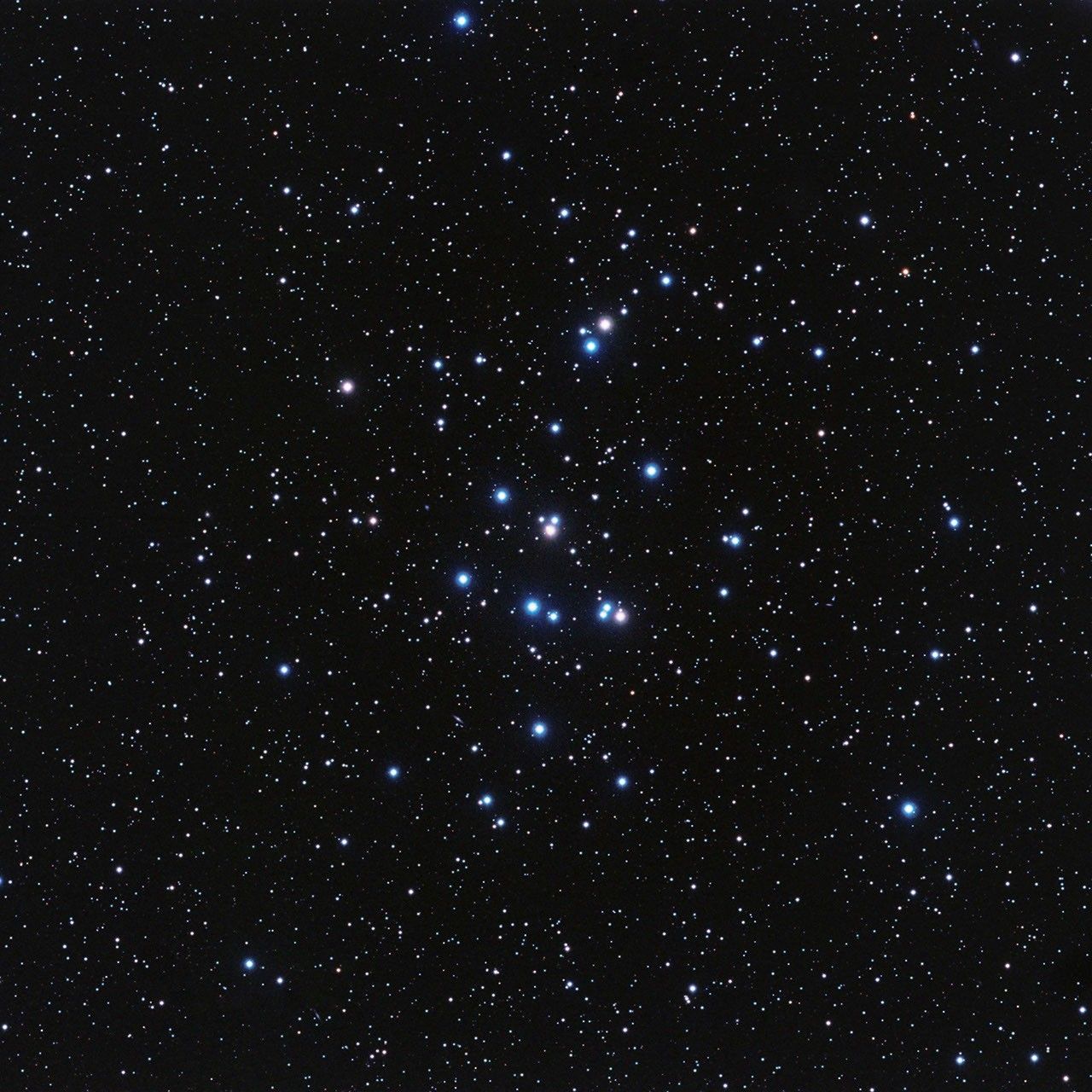
Beehive Cluster
A swarm of roughly 1,000 stars floating 600 light-years away in Cancer — observed since antiquity, resolved by Galileo, and now known to host its own planetary systems.
The Beehive Cluster
The Beehive Cluster — also catalogued as Messier 44 (M44), NGC 2632, and known by its classical Latin name Praesepe — is one of the nearest, richest, and most historically observed open star clusters in the sky. It lies approximately 600 light-years from Earth in the constellation Cancer, appearing to the naked eye as a soft, nebulous patch of light with an integrated apparent magnitude of about +3.7 and an angular diameter of roughly 1.5 degrees (approximately three times the width of the full Moon).
The cluster contains on the order of 1,000 gravitationally bound stars spanning a tidal radius of about 12 parsecs (roughly 39 light-years), with a more concentrated core of about 3.5 parsecs radius. Its stellar population is dominated by dim M-dwarf stars (approximately 68%), with Sun-like F, G, and K stars making up a further 30%, a small fraction of brighter A-type stars, five evolved red giants, and at least 11 white dwarfs representing the burned-out remnants of the cluster's originally most massive members. The total stellar mass of the cluster is estimated at 500–600 solar masses.
At an age of roughly 600–700 million years, the Beehive is a middle-aged open cluster. Its age and kinematics closely resemble those of the Hyades cluster, suggesting a possible common origin in the same ancient star-forming complex. The Beehive is scientifically important as a benchmark for stellar evolution, gyrochronology, and white-dwarf physics at this intermediate age — and it gained renewed prominence in 2012 as the site of the first exoplanets ever found orbiting Sun-like stars in an open cluster.
Observing the Beehive
Under a dark, transparent sky, the Beehive Cluster is visible to the unaided eye as a hazy, unresolved smudge near the centre of Cancer — a constellation whose individual stars are otherwise faint and easily overlooked. The cluster is, in many respects, the easiest target in Cancer and one of the most prominent naked-eye deep-sky objects in the winter and spring sky. Its apparent diameter of roughly 1.5 degrees makes it far too large to fit within the field of a typical telescope eyepiece at moderate magnification; binoculars or a rich-field telescope at very low power give the best views, resolving the misty patch into a sparkling swarm of stars spread generously across the field.
The brightest individual cluster members shine at around magnitude 6 to 6.5, just at or slightly beyond the unaided-eye limit, so the cluster's naked-eye glow of magnitude +3.7 is the combined light of hundreds of stars rather than any single brilliant sun. From light-polluted suburban or urban sites the cluster often fades below the detection threshold of the naked eye, yet remains an easy binocular object. Because Cancer sits between the prominent winter constellations Gemini and Leo, the Beehive serves as a useful wayfinding landmark for star-hoppers navigating this region of the sky.
Ancient observations and historical names
The Beehive Cluster has been noticed, named, and interpreted by sky-watchers across many cultures for more than two millennia. Its proximity — a mere 600 light-years away — and its cumulative brightness make it one of the few open clusters readily perceptible without optical aid, ensuring its place in astronomical records from antiquity onward.
Among the earliest surviving textual references is the Greek poet Aratus of Soli, whose didactic astronomical poem Phainomena (c. 260–270 BC) describes the cluster as Achlus, meaning 'Little Mist', situating it as a faint haze beneath Cancer and flanked by two stars identified with two celestial donkeys. A century later, Hipparchus (active c. 130 BC) catalogued the same object as Nephelion, or 'Little Cloud', in his star catalog. The most influential ancient treatment came from Claudius Ptolemy in his 2nd-century AD Almagest, which enumerated seven naked-eye nebulae; Ptolemy describes the Beehive as a 'nebulous mass in the breast of Cancer', a phrasing that echoed through medieval astronomy.
The Latin name Praesepe — meaning 'manger' or 'crib' — reflects the dominant Greco-Roman mythological image for the cluster. In this tradition the two flanking stars of Cancer, Asellus Borealis (γ Cancri, the Northern Ass) and Asellus Australis (δ Cancri, the Southern Ass), are divine donkeys feeding from the manger between them. The myth connected to these figures draws on the Gigantomachy: according to one tradition, Dionysus, Silenus, and their companions rode asses into battle against the Giants. The braying of the animals terrified the Giants into flight, and in gratitude Dionysus placed the asses and their manger (Greek: Phatnē) among the stars. The manger of that myth is M44.
Ancient authors also used the cluster as a practical weather tool. Pliny the Elder recorded that if Praesepe is invisible on an otherwise clear night, a violent storm is imminent. Aratus similarly noted that variations in the appearance of the Manger and its flanking Asses could predict rain or wind — an early instance of astronomical phenomena being pressed into meteorological service.
Other cultural traditions gave the cluster entirely different characters. In Chinese uranography, M44 falls within the asterism Guǐ Xiù ('Ghost' or 'Ghost Mansion'), the 23rd lunar mansion. Ancient Chinese observers likened its misty appearance to 'a cloud of pollen blown from willow catkins', but the cluster also carried a more ominous name, Jīshī qì (積屍氣), sometimes rendered as 'Exhalation of Piled-up Corpses' — a ghostly, otherworldly interpretation of the same nebular quality that inspired more pastoral imagery in the Mediterranean world. In Arabic sky-lore, the cluster together with γ and δ Cancri formed the eighth lunar mansion, an-nathra. In the Hindu nakshatra system, these same stars — including the Beehive — defined Puṣya, the eighth nakshatra, often translated as 'the nourisher', preserving the feeding/manger symbolism across traditions.
Galileo and the telescopic era
The Beehive Cluster holds a distinguished place in the history of telescopic astronomy. When Galileo Galilei turned his newly fashioned instrument toward the sky in 1609, Praesepe was among the very first deep-sky objects he examined. He recorded that 'the nebula called Praesepe contains not one star only but a mass of more than 40 small stars', resolving what ancient observers had catalogued as a featureless smudge into a collection of discrete suns.
This was scientifically consequential. Before the telescope, objects like Praesepe and the Milky Way were assumed to be continuous luminous material of uncertain nature. By showing that Praesepe was composed of many individual stars too faint to separate by eye alone, Galileo provided early demonstration that the sky's nebulosity is largely the product of unresolved starlight — a principle he extended to the Milky Way itself in Sidereus Nuncius (1610). The Beehive was thus an early piece of evidence in a much larger argument about the structure of the cosmos.
Charles Messier included the cluster as the 44th entry in his famous catalog of nebulae and star clusters (published 1774–1781), giving it the designation M44 by which astronomers still commonly refer to it. The New General Catalogue assigns it the number NGC 2632.
From ancient skies to modern planets
- c. 260 BCAratus names the cluster Achlus
In the poem Phainomena, Aratus of Soli describes the Beehive as a 'Little Mist' beneath Cancer, flanked by the two celestial asses and serving as a weather sign.
- c. 130 BCHipparchus catalogues Nephelion
The Greek astronomer Hipparchus records the cluster as 'Little Cloud' in his star catalog — one of the earliest systematic treatments of a nebular object.
- 2nd century ADPtolemy's Almagest
Claudius Ptolemy lists the Beehive among seven naked-eye nebulae, describing it as a 'nebulous mass in the breast of Cancer'. The Latin name Praesepe (manger) becomes established.
- 1609Galileo resolves the cluster
Galileo Galilei examines Praesepe with a telescope and records more than 40 individual stars, demonstrating that the ancient 'nebula' is a congregation of faint suns.
- 1774–1781Messier Catalogue: M44
Charles Messier includes the Beehive as entry 44 in his catalog of nebulae and star clusters, giving it the designation M44 still in universal use.
- September 2012First hot Jupiters in an open cluster
Samuel N. Quinn and collaborators announce Pr0201 b and Pr0211 b — two hot Jupiters discovered via radial velocity — the first planets found orbiting Sun-like stars in any open cluster.
- 2016First multi-planet system in an open cluster
Extended radial-velocity monitoring reveals Pr0211 c, a second outer planet around Pr0211, making Pr0211 the first confirmed multi-planet system in an open cluster.
- Mid-2010sK2 transit survey
NASA's repurposed Kepler spacecraft (K2) identifies transiting planets around six additional Beehive stars (K2-95, K2-100 through K2-104) and a two-planet system around K2-264, extending the cluster's known planetary population into the sub-Neptune regime.
- 2020sGaia-era refinements
Gaia EDR3/DR3 data refine the cluster's distance (~180–190 pc), membership census (~1,010 high-probability members), and tidal structure. Praesepe and the Hyades are used jointly as benchmark clusters for gyrochronology, lithium depletion, and the white-dwarf initial–final mass relation.
Stellar population and structure
The Beehive's membership is strongly skewed toward low-mass stars, as is typical of an evolved open cluster. A comprehensive modern survey identifies approximately 1,010 high-probability members, of which around 68% are M dwarfs — cool, dim red stars with masses well below that of the Sun. About 30% are F, G, and K stars: Sun-like dwarfs occupying the main sequence. A small fraction, roughly 2%, are A-type stars, which are somewhat hotter and more massive than the Sun. Five stars have evolved off the main sequence to become giants: four K0 III giants and one G0 III giant, representing intermediate-mass stars that have exhausted their core hydrogen.
The cluster shows clear mass segregation — a signature of dynamic evolution. Massive, luminous stars have sunk toward the gravitational centre over hundreds of millions of years through stellar encounters, while lighter stars populate an extended halo and are more readily lost to the Galactic gravitational field. The core radius is approximately 3.5 parsecs (about 11.4 light-years), and the half-mass radius is close to 3.9 parsecs (about 12.7 light-years). The tidal radius, beyond which stars are no longer gravitationally bound to the cluster, extends to about 12 parsecs — roughly 39 light-years.
At least 11 white dwarfs have been securely identified as cluster members. These are the cooling remnants of originally B-type stars — the most massive stars the cluster formed — that have since shed their outer envelopes and are slowly cooling into inertness. Their cooling ages, when combined with the cluster's total age of 600–700 million years, allow astronomers to trace back the original masses of the progenitor stars and calibrate the initial–final mass relation: the empirical function describing how a star's birth mass determines the mass of its eventual white-dwarf remnant. Work in the early 2020s using Gaia photometry and astrometry has refined both the membership of these white dwarfs and their masses and radii, contributing to a joint Hyades–Praesepe calibration of this relation for intermediate-mass stars.
Brown dwarfs — objects too light to sustain hydrogen fusion — appear to be rare in Praesepe. This is not because they were never present, but because such low-mass objects are most susceptible to tidal stripping and evaporative loss over the cluster's lifetime. Gaia-based surveys in the 2020s confirm a sharp drop in the mass function below the hydrogen-burning limit, consistent with the picture of a dynamically evolved cluster that has shed much of its lowest-mass population into the Galactic field over the past 600–700 million years. The cluster also contains several Delta Scuti variables — short-period pulsating stars near the main sequence turn-off — as well as the eclipsing binary TX Cancri and the metal-line star epsilon Cancri among its notable members.
Relationship to the Hyades
Perhaps the most striking contextual fact about the Beehive is how closely it resembles the Hyades cluster in Taurus. The two clusters share nearly the same age (both estimated at approximately 600–700 million years), have comparable stellar populations and total masses, and move through the Galaxy with similar velocity vectors. This is more than coincidence: the evidence strongly favours a common origin, with both clusters forming from the same large star-forming complex within the Galactic disk. They are often treated as a matched pair in stellar-physics research, providing two independent but nearly identical test beds at the same evolutionary stage.
In the 2020s, the Hyades–Praesepe pair has become a cornerstone of gyrochronology — the method of inferring a star's age from its rotation period. K2 light curves provide rotation periods for hundreds of F, G, K, and M stars in the Beehive, and these data, calibrated against the well-determined cluster age, allow researchers to test and refine models of magnetic braking and angular momentum loss. Spectroscopic surveys measuring lithium abundances in Praesepe's F–K stars further constrain models of internal mixing and complement the rotational data. Together, rotation and lithium define the cluster's position in the age–activity–abundance parameter space, making it one of the most important single anchor points for stellar chronometry in the solar neighborhood.
Planetary systems in the Beehive
A hot Jupiter orbiting a late F-dwarf member star, with an orbital period of 4.4264 days and a minimum mass of 0.540 Jupiter masses. Detected via radial velocity using the 1.5-m Tillinghast telescope at the Fred Lawrence Whipple Observatory. One of two planets announced simultaneously in September 2012 — the first exoplanets found around Sun-like stars in any open cluster.
A more massive hot Jupiter orbiting a late G-dwarf member, with a period of 2.1451 days and a minimum mass of 1.844 Jupiter masses. Announced alongside Pr0201 b in September 2012. The survey of 53 single F–K dwarf members yielded two hot Jupiters, implying a hot-Jupiter occurrence rate of at least 3.8% in this metal-rich cluster environment.
A second, outer planet in the Pr0211 system, discovered through extended radial-velocity monitoring. Its detection made Pr0211 the first confirmed multi-planet system in any open cluster, providing a test case for how planetary architectures evolve in the cluster environment.
NASA's K2 mission identified transiting planets around six additional Beehive stars — K2-95, K2-100, K2-101, K2-102, K2-103, and K2-104 (one planet each) — and a two-planet system around K2-264. These planets are generally sub-Neptune in size on short orbital periods, extending the cluster's known planetary inventory well beyond the hot-Jupiter regime.
A K2 study identified two mini-Neptune-sized planets transiting a Beehive member star on the outskirts of the cluster's core. The inner planet has an orbital period of approximately 5.8 days and the outer planet approximately 19.7 days. At the time of publication, this was only the second known multi-transit system in open clusters younger than 1 billion years.
Significance of the cluster's exoplanets
Because all stars in the Beehive formed at approximately the same time and from the same parent cloud, planets found there share a common age and chemical context. This makes the cluster uniquely valuable for planet-formation and migration studies. The 2012 discovery of two hot Jupiters demonstrated that giant planets can migrate to very close orbits within 600 million years of formation — placing firm constraints on the timescale of the disk-driven migration mechanism thought to produce such planets.
The subsequent identification of a diverse planetary population — hot Jupiters via radial velocity, sub-Neptunes via K2 transits, and a multi-planet architecture in the Pr0211 system — gives the Beehive one of the most complete planetary inventories of any open cluster. Ongoing work in the 2020s uses Gaia-improved stellar radii to refine planet sizes, and places Praesepe alongside younger clusters (such as the Pleiades, at roughly 100–150 million years) to study how planet occurrence rates and atmospheric properties evolve over the first billion years of a stellar system's life. The Beehive thus serves as a snapshot of planetary systems at a transitional age — old enough that dynamical sculpting is well underway, but young enough that atmospheric escape and tidal circularization are still active.
Frequently asked questions
Sources
- Beehive Cluster - Wikipedia
- Messier 44 - NASA Science
- Get a buzz from the Beehive - Astronomy Now
- The Beehive Cluster: A swarm of 1,000 stars - EarthSky
- The Discovery of the First Hot Jupiters in an Open Cluster - arXiv
- First Planets Found Around Sun-Like Stars in a Cluster - NASA/JPL
- Astronomers Find Two-Planet System in Beehive Cluster - Sci.News
- Messier 44 (NGC 2632) Beehive Cluster | Cancer - Go-Astronomy.com
- Messier 44 - The Beehive Cluster (Praesepe) - Universe Today