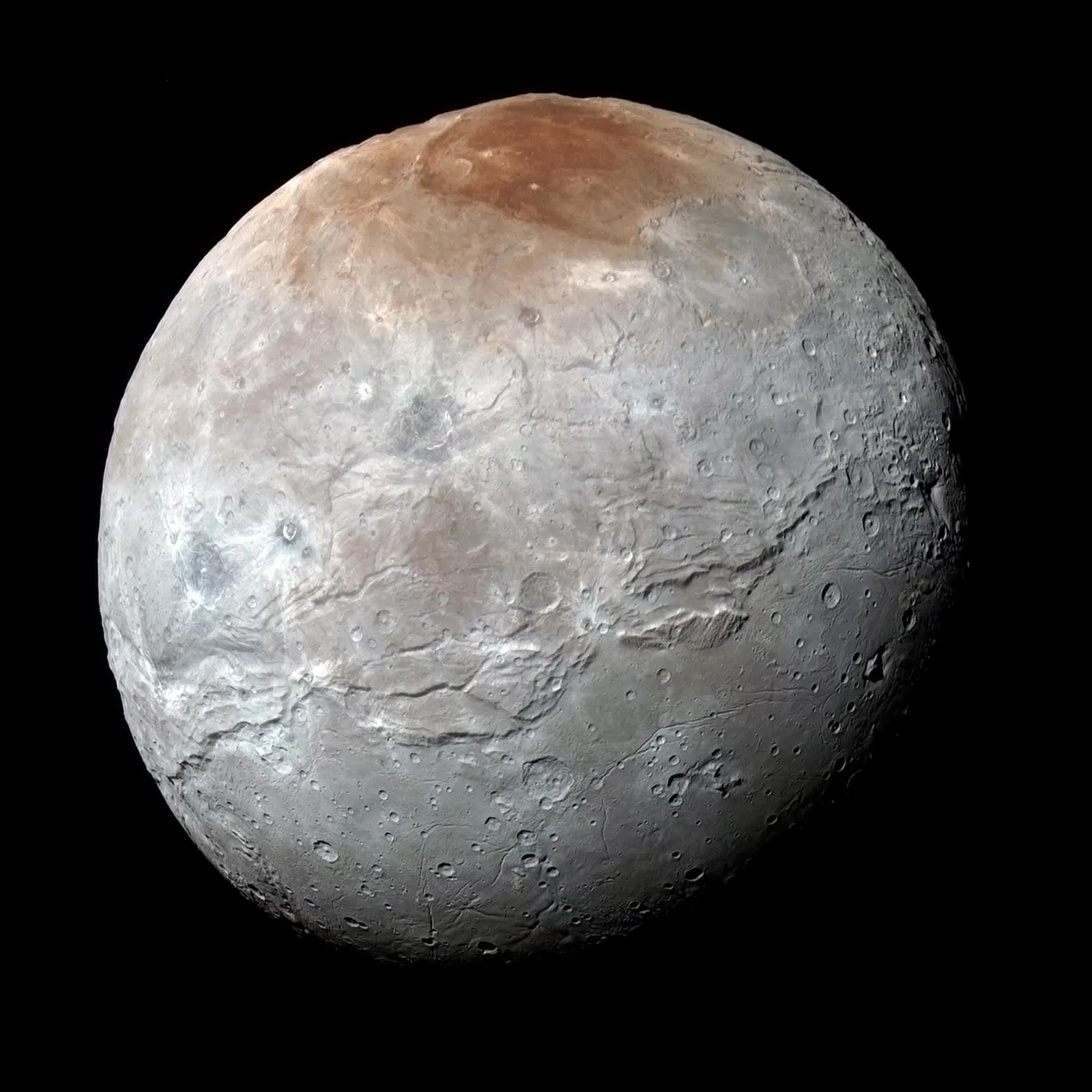
Charon
Pluto's giant companion — a near-twin that turned the solar system's smallest dwarf planet into a true binary world.
Charon
Charon is the largest moon of the dwarf planet Pluto and one of the most unusual satellites in the solar system. With a diameter of roughly 1,214 km — just over half of Pluto's 2,377 km — it is so large relative to its parent body that the two share a common centre of mass that lies outside Pluto itself. This configuration makes Pluto and Charon a genuine binary system: each body orbits the shared barycenter, and both are locked in mutual tidal synchrony, perpetually showing the same hemisphere to the other.
Before the arrival of NASA's New Horizons spacecraft in 2015, Charon appeared in even the best telescopes as little more than a blurry speck beside Pluto. The flyby transformed that picture entirely, revealing a world of deep canyons, smooth resurfaced plains, a striking reddish-brown north polar cap, and a global tectonic belt that records a dramatic interior history. More recently, the James Webb Space Telescope has added carbon dioxide and hydrogen peroxide to Charon's known surface inventory, extending the story of chemical processing on this remote, icy world.
Charon orbits in the Kuiper Belt alongside Pluto and four smaller moons — Styx, Nix, Kerberos, and Hydra — all of them beyond Neptune, roughly 40 astronomical units from the Sun. The Pluto–Charon system completes one orbit of the Sun every 248 Earth years.
Discovery and study
- 22 Jun 1978Discovery by James W. Christy
While examining photographic plates at the U.S. Naval Observatory in Flagstaff, Arizona, astronomer James W. Christy noticed a recurring elongated 'bump' on one side of Pluto's image that shifted position with a period of 6.4 days — matching Pluto's own rotation. Working with colleague Robert Harrington, he concluded the bump was a satellite and assigned it the provisional designation S/1978 P 1. The moon was soon named Charon, after the mythological ferryman who transported souls across the river Styx, consistent with Pluto's underworld theme.
- 1978–2015Ground-based and Hubble observations
Over several decades, mutual occultation and transit events allowed astronomers to refine the sizes and masses of Pluto and Charon. Hubble Space Telescope imaging resolved the two bodies separately and revealed Pluto's smaller moons. These observations confirmed the binary nature of the system and established Charon's bulk density, implying a rock–ice interior.
- 19 Jan 2006New Horizons launches
NASA's New Horizons spacecraft launched from Cape Canaveral, beginning a nine-year journey to the Pluto system. Its payload included LORRI (a high-resolution camera), Ralph (a visible/infrared imaging spectrometer), Alice (a UV spectrograph), and REX (a radio science experiment), among others.
- 14 Jul 2015New Horizons flyby
New Horizons made its closest approach to the Pluto system, passing within about 11,100–12,500 km of Pluto and roughly 27,000–28,800 km of Charon. The spacecraft returned the first high-resolution images and compositional spectra of Charon, overturning the assumption that it was an old, inert body and revealing a geologically complex world.
- 25 Oct 2016Full data downlink complete
The last of the approximately 6.25 GB of science data collected during the Pluto–Charon encounter was transmitted to Earth and confirmed received, closing the primary data-return phase of the New Horizons mission.
- 2022–2023JWST observations
The James Webb Space Telescope conducted four observations of the Pluto–Charon system using its Near-Infrared Spectrograph (NIRSpec), providing full coverage of Charon's northern hemisphere at wavelengths unavailable to earlier instruments.
- 1 Oct 2024JWST detects CO₂ and H₂O₂ on Charon
A Southwest Research Institute–led team announced in Nature Communications the first detections of carbon dioxide and hydrogen peroxide on Charon's surface. The CO₂ is interpreted as likely interior-derived material exposed by impact craters; the H₂O₂ is a signature of ongoing radiation processing of surface water ice.
A binary system: the Pluto–Charon barycenter
What makes Charon exceptional — even among large planetary moons — is not merely its size but the gravitational relationship it has with Pluto. Charon's mass is approximately 12.18% of Pluto's mass, an extraordinarily high ratio compared with any other moon–planet pairing in the solar system. As a consequence, the system's centre of mass, or barycenter, lies outside Pluto's physical surface, in empty space between the two bodies. Pluto does not simply have a moon orbiting it; instead, both Pluto and Charon orbit this external point, with the separation between their centres averaging about 19,596 km.
The pair is also in a state of mutual tidal locking — a condition unique among solar-system binary systems. Charon's orbital period is exactly 6.387221 days, identical to Pluto's rotation period. The same hemisphere of Charon perpetually faces Pluto, and the same hemisphere of Pluto perpetually faces Charon. An observer standing on the Pluto-facing side of Charon would see Pluto fixed in the sky, neither rising nor setting, growing and shrinking in phase as the Sun moves. An observer on the far side would never see Pluto at all. This double tidal lock arose because Charon is unusually large relative to Pluto and orbits at an extremely close distance — only about 8.2 Pluto diameters, compared with roughly 30 Earth diameters for the Earth–Moon system — so tidal torques were strong enough to synchronize both bodies over geological time.
The International Astronomical Union still formally classifies Charon as a satellite of Pluto rather than as a co-equal dwarf planet, while acknowledging the unusual binary-like dynamics of the pair. Many planetary scientists informally describe the system as a binary dwarf planet. Among known bodies in the solar system, Pluto–Charon is one of a small group of confirmed mutually tidally locked pairs; Eris and its moon Dysnomia, and the trans-Neptunian pair Salacia–Actaea, are comparable examples.
Surface: a world of canyons, plains, and a red polar cap
Prior to New Horizons, Charon was expected to be an ancient, heavily cratered body with little internal activity. The 2015 images overturned that picture immediately. The most prominent global feature is an enormous equatorial tectonic belt — a chain of chasms, graben, and scarps that encircles much of the moon near the equator and separates two very different hemispheres. To the north lies comparatively smooth, less-cratered terrain; to the south, older and more rugged ground.
Within this belt, New Horizons captured huge canyons hundreds of kilometres long and several kilometres deep. Their scale rivals or exceeds the Grand Canyon on Earth, and their origin is interpreted as global extensional tectonics — the crust was stretched and cracked as the interior expanded. The leading explanation for that expansion is the freezing of an ancient subsurface ocean: when liquid water freezes it expands by roughly 9%, and a large enough ice-covered ocean would force the shell above it to fracture and pull apart exactly as observed. Models suggest Charon's ocean was roughly 15 km thick at its greatest extent, likely mixed with ammonia that lowered the freezing point and kept it liquid longer. That ocean has long since frozen solid.
The smooth northern plains — the most prominent of which is the region informally called Vulcan Planum — bear far fewer large craters than the surrounding terrain, implying relatively recent resurfacing on geological timescales. Crystalline water ice dominates the surface spectrum everywhere New Horizons and subsequent analyses have probed. Because cosmic-ray bombardment amorphizes crystalline ice on timescales far shorter than the age of the solar system, researchers have argued that some process — most probably past cryovolcanism — periodically replenished fresh crystalline ice. In one model, pressurized water–ammonia liquid from the freezing ocean cracked through the outer shell, erupted at the surface, froze instantly, and settled as fine ice crystals, resurfacing whole regions.
Charon's most visually striking feature is its dark reddish-brown north polar cap, known informally as Mordor Macula. The cap is a thin deposit sharply bounded from the brighter mid-latitudes and is chemically distinct from the surrounding water-ice terrain. New Horizons and subsequent modelling established that the cap is dominated by tholins — complex organic macromolecules produced by radiation processing of simpler ices — and the mechanism that builds it is a multistep cycle tied to the Pluto–Charon system's extreme seasons.
Pluto's tenuous atmosphere slowly leaks methane, nitrogen, and carbon monoxide into space. Some of this gas is gravitationally captured by Charon and migrates ballistically across the surface. At Charon's winter pole, temperatures fall to approximately −258 °C, cold enough to freeze these volatiles out as a thin icy veneer. Even during polar night, the pole is bathed in Lyman-alpha ultraviolet light scattered by interplanetary hydrogen. This UV breaks apart methane ice, producing ethane and more complex hydrocarbons. When the long polar winter ends and sunlight returns, the more volatile ices — methane, nitrogen, CO — sublimate away, but ethane and higher organics remain, continuing to absorb UV and solar-wind particles until they convert into the complex, reddish, non-volatile tholin residue that constitutes the cap. Over millions of years this cycle has built the distinctive dark polar feature visible today.
Internal structure and formation
Charon's bulk density of approximately 1.70 g/cm³ — about 1.6 times the density of water — points to a roughly equal mixture of rock and ice, estimated at about 55% rock and 45% water ice by mass. This makes Charon somewhat less rock-rich than Pluto, which contains roughly 70% rock. Interior models consistent with this density and with the global tectonic features observed by New Horizons favour a differentiated structure: a denser silicate rocky core surrounded by an outer water-ice mantle, possibly with a former liquid interface between the two.
The energy to differentiate this interior and melt internal ice came from two sources: the heat deposited by whatever collision formed Charon, and the slow decay of radioactive elements within Charon's rocky component. Together these sources could produce enough heat to melt a substantial volume of ice and sustain a subsurface ocean for hundreds of millions of years before the body gradually cooled and the ocean froze solid. The global fracture system — the equatorial tectonic belt and the deep chasms — records the moment when that freezing began to dominate. Current modelling suggests the ocean is now entirely frozen, in contrast to Pluto's interior, which may still retain liquid water at depth.
The origin of Charon is most widely attributed to a giant impact: a large Kuiper Belt object struck proto-Pluto in a glancing blow, ejecting a disk of debris that coalesced into Charon and the four smaller moons. This hypothesis accounts naturally for the high angular momentum of the Pluto–Charon system, Charon's large size relative to Pluto, and the nearly circular, closely spaced orbit. A variant known as the 'kiss-and-capture' scenario proposes instead that proto-Pluto and proto-Charon formed independently and were brought into a gravitational embrace by a grazing, low-velocity encounter that left both bodies largely intact. Proponents note that a fully disruptive impact would be expected to mix the compositions of the two bodies more thoroughly than observed: Pluto is considerably more rock-rich than Charon, which is more naturally explained if the two formed separately and retained distinct bulk compositions. Both scenarios share the implication that a collision or close encounter deposited substantial heat into Charon's interior, initiating the ocean and the geological history recorded on its surface.
New Horizons: the 2015 flyby in detail
NASA's New Horizons spacecraft was launched on 19 January 2006 and reached the Pluto system on 14 July 2015, making its closest approach to Pluto at approximately 11,100–12,500 km and to Charon at roughly 27,000–28,800 km. The spacecraft carried seven scientific instruments; four were most relevant to characterising Charon.
LORRI, the Long Range Reconnaissance Imager, provided panchromatic images at a global resolution of about 0.7 km per pixel and selected frames as sharp as roughly 25 metres per pixel, sufficient to resolve boulders and small craters. Ralph, a combined visible-colour and near-infrared imaging spectrometer, produced colour and compositional maps of Charon's surface, confirming water-ice dominance and localised reddish polar regions. Alice, an ultraviolet imaging spectrograph, performed a solar occultation as Charon passed in front of the Sun, searching for any atmosphere. REX, a radio experiment, conducted an Earth occultation using signals from NASA's Deep Space Network to probe bulk properties and constrain atmospheric density.
The occultation experiments set extremely tight upper limits on any bound atmosphere around Charon; no substantial atmosphere was detected, consistent with the absence of a significant atmospheric source at Charon's surface temperature. The particle instruments SWAP and PEPSSI confirmed that Charon shows no evidence of a significant intrinsic magnetic field and that it does not interact strongly with the solar wind, unlike Pluto whose extended atmosphere creates a notable plasma environment. All approximately 6.25 GB of science data collected during the encounter were fully downlinked and confirmed received by 25 October 2016.
Instruments used at Charon
- Long Range Reconnaissance Imager
High-resolution panchromatic camera; provided global mapping at ~0.7 km/pixel and best-resolution frames at ~25 m/pixel.
- Multispectral Visible Imaging Camera / Linear Etalon Imaging Spectral Array
Combined visible-colour imager (MVIC) and near-infrared imaging spectrometer (LEISA); mapped surface composition and colour, confirming water-ice dominance and reddish polar regions.
- Ultraviolet Imaging Spectrograph
Performed solar occultation by Charon to search for an atmosphere; placed stringent upper limits confirming no substantial atmosphere exists.
- Radio Science EXperiment
Used Earth occultations via DSN radio signals to probe atmospheric density and bulk properties.
- Solar Wind Around Pluto / Pluto Energetic Particle Spectrometer Science Investigation
Characterised the energetic particle environment around the Pluto–Charon system and constrained the presence of a magnetic field.
What New Horizons and JWST revealed
Rather than the dead, ancient world expected before the flyby, New Horizons found a body with smooth resurfaced plains, deep canyon systems, and a global tectonic belt — all evidence of substantial geological activity driven by an interior that was once warm and partially molten.
A vast equatorial belt of chasms, graben, and scarps indicates that Charon underwent several kilometres of radial expansion, best explained by the freezing and volumetric expansion of an ancient subsurface water–ammonia ocean.
The presence of abundant crystalline water ice — which cosmic-ray irradiation should destroy on timescales far shorter than the surface age — requires a process that replenishes it. Modelling points to past cryovolcanic eruptions of pressurised water–ammonia liquid through fractures opened by the freezing ocean.
Charon's dark reddish north polar cap (Mordor Macula) is built from organic tholins produced when methane escaping from Pluto's atmosphere is cold-trapped at Charon's pole during the long polar winter, photolysed by Lyman-alpha UV into ethane and more complex hydrocarbons, and finally converted by continued UV and solar-wind irradiation into red, refractory organic residues that accumulate over millions of years.
Solar and Earth occultation experiments with Alice and REX confirmed that Charon has at most an extremely tenuous exosphere, with atmospheric density less than about one-millionth that of Earth.
A Southwest Research Institute–led team using JWST NIRSpec reported the first detections of carbon dioxide (likely interior-derived material exposed by impacts) and hydrogen peroxide (a product of space weathering of surface water ice) in results published in 2024, expanding Charon's known surface inventory beyond water ice, ammonia-bearing species, and organics.
Frequently asked questions
Sources
- Charon Moon Overview, Characteristics & Atmosphere — Study.com
- Charon: Pluto's Moon — NOAA Science On a Sphere
- Charon — Pluto's dwarf planet partner — Space.com
- Charon — NASA Science
- Charon (moon) — Wikipedia
- SwRI scientists identify a possible source for Charon's red cap
- New Horizons Probes the Mystery of Charon's Red Pole — NASA
- Ancient Water World: Tectonics on Pluto's Moon Charon Point to Frozen Subsurface Ocean — AmericaSpace
- Yet another active world: Charon — The Planetary Society
- The interiors of Pluto and Charon: Structure, composition, and differentiation — AGU / GRL
- SwRI-led team discovers carbon dioxide and hydrogen peroxide on Pluto's moon Charon
- New Horizons — NASA Science
- New Horizons — eoPortal
- Tidal locking — Wikipedia
- Pluto's moon Charon found to lack atmosphere — MIT News