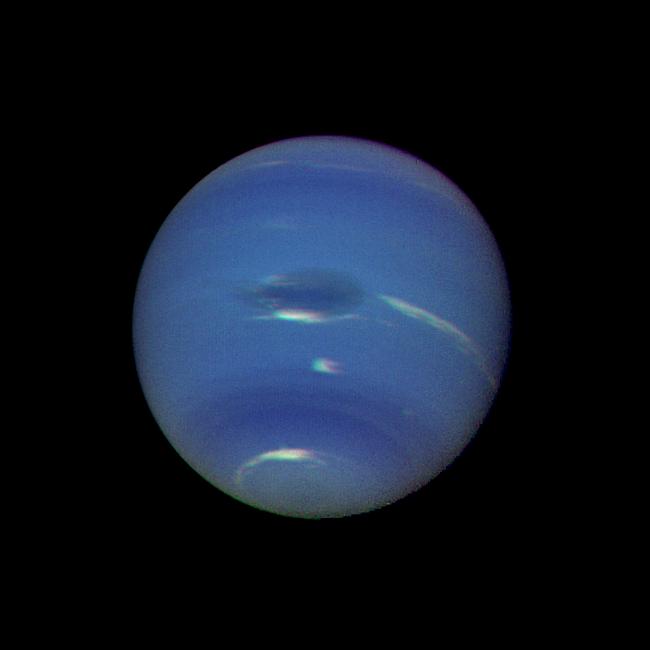
Neptune
The Solar System's outermost ice giant — a deep-blue world of supersonic winds, faint rings, and the icy moon Triton.
Neptune, the windiest world
Neptune is the Solar System's outermost major planet, an ice giant orbiting the Sun at an average distance of about 4.5 billion km (≈30.1 AU). With a mean diameter of roughly 49,244 km — almost four times that of Earth — it ranks as the fourth-largest planet by diameter and the third-most-massive, at about 17.1 Earth masses.
Despite its size, Neptune is the densest of the giant planets, with a mean density near 1.64 g/cm³. Methane in its atmosphere absorbs red light and reflects blue, lending the planet its deep blue color. It completes one orbit roughly every 165 Earth years, while rotating in about 16 hours.
Atmosphere and weather
Neptune's observable atmosphere is composed mainly of hydrogen (~80%) and helium (~19%), with methane making up roughly 1–2%, plus trace amounts of hydrogen deuteride, ethane, and condensed ices such as water, ammonia, and ammonium hydrosulfide. The atmosphere is layered into a troposphere, stratosphere, and thermosphere.
It is the windiest planet in the Solar System, with winds reaching about 2,100 km/h (≈580 m/s) — roughly three times stronger than those of Jupiter and around nine times stronger than typical Earth winds. Internal heat, rather than sunlight, is a major driver of this vigorous weather, since Neptune radiates more energy than it receives from the Sun.
Temperatures range from about 72 K (−201 °C) near the 1-bar cloud-top level, dipping to roughly 51.8 K (−221.3 °C) at the tropopause, while the interior rises to approximately 5,400 K at the planet's center. With an axial tilt of about 28.3°, Neptune experiences Earth-like seasonal geometry, but each season lasts roughly 40 Earth years because of its very long orbit.
Dark spots and giant vortices
Voyager 2's 1989 flyby revealed a huge, roughly Earth-sized anticyclonic storm in the southern hemisphere, morphologically similar to Jupiter's Great Red Spot.
Hubble observations a few years later showed the original Great Dark Spot had disappeared, replaced by other dark vortices at different latitudes. Individual dark storms persist for only months to a few years.
Dark spots are thought to be tropospheric vortex structures located below the bright methane-ice clouds, so they appear as darker openings in the upper cloud decks.
Moons
Neptune has 16 known moons, including 7 inner regular moons and 9 outer or irregular moons. Triton was the first to be discovered, by English merchant-astronomer William Lassell on 10 October 1846 — just 17 days after Neptune itself was found. Nereid followed in 1949, Voyager 2 brought the total to eight in 1989, and ground-based surveys in the early 2000s added several small outer moons.
Triton is the largest Neptunian moon, with a diameter of about 2,705 km — slightly smaller than Earth's Moon — and accounts for nearly all of the mass of Neptune's satellite system. It orbits Neptune in a retrograde (backward) direction, making it the only large moon in the Solar System to do so.
Ring system
Neptune has five named main rings — Galle, Le Verrier, Lassell, Arago, and Adams, ordered from the planet outward. They are faint, narrow, and clumpy compared with Saturn's rings, and are named after astronomers associated with Neptune's discovery or early study, including Johann Gottfried Galle, Urbain Le Verrier, William Lassell, François Arago, and John Couch Adams.
The outermost Adams ring is the most distinctive, containing five bright named arcs: Courage, Liberté, Égalité 1, Égalité 2, and Fraternité. NASA notes two especially bright ring regions at about 53,000 km and 63,000 km from Neptune, and a very faint ring is also associated with the moon Galatea.
Voyager 2's Neptune encounter
- Oct 10, 1846Triton discovered
William Lassell discovered Neptune's largest moon just 17 days after the planet itself was found.
- 1949Nereid found
The discovery of Nereid raised the known moon count to two.
- Aug 25, 1989Voyager 2 flyby
Voyager 2 passed about 5,000 km (3,408 miles) above Neptune's north pole — the first close-up of Neptune and the final planetary flyby of the Voyager Grand Tour.
- 1989New moons and rings
The flyby discovered or confirmed six moons (Proteus, Despina, Galatea, Larissa, Thalassa, Naiad) and four new rings, and revealed the Great Dark Spot, a strongly tilted magnetic field, and Triton's geologically young, geyser-venting surface.
Frequently asked
Sources
- How Big is Neptune? - Space
- Neptune - Wikipedia
- Neptune | Planet, Moons, Rings, Temperature, Mass, Diameter - Britannica
- Neptune: Facts - NASA Science
- Neptune's Atmosphere: Composition, Climate & Weather - Space
- Moons of Neptune - Wikipedia
- Triton - NASA Science
- Rings of Neptune - Wikipedia
- Neptune's Rings - NASA Science
- 30 Years Ago: Voyager 2 Explores Neptune - NASA
- Humanity Glimpses Neptune Up Close - American Physical Society