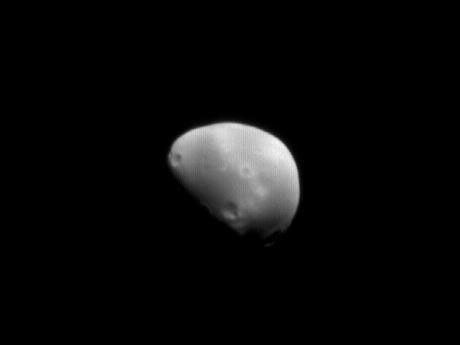
Deimos
The smaller, outer moon of Mars — a dark, dust-blanketed world whose origin may rewrite the story of the Red Planet's past.
Deimos
Deimos is the smaller and more distant of the two natural satellites of Mars, orbiting the planet at a mean distance of about 23,463 km from Mars's center — roughly 6.9 times the planet's radius. An irregular, heavily cratered body measuring approximately 16 × 12 × 10 km, it is one of the smallest known moons in the Solar System. Despite its diminutive size, Deimos has attracted sustained scientific interest because its composition, density, and orbital properties do not fit neatly into any single model of how moons form, making it a key object in the broader debate about the early history of Mars and its surroundings.
The moon completes one orbit of Mars in just over 30 hours, moving so slowly relative to the Martian day that, as seen from Mars's equator, Deimos takes about 2.48 Earth days to cross the sky from rising to setting. Its surface is extremely dark — reflecting only about 7% of incoming sunlight — and is blanketed by a thick, unusually fine-grained regolith that partly buries older craters and gives Deimos a smoother overall appearance than its companion moon Phobos. Two craters have been formally named: Voltaire and Swift, honouring the writers who famously predicted Martian moons before they were discovered.
Discovered in 1877 by American astronomer Asaph Hall using the 26-inch refractor at the U.S. Naval Observatory, Deimos has since been photographed by a succession of Mars-orbiting spacecraft. The most detailed modern observations came from the UAE's Emirates Mars Mission (Hope), whose close flybys beginning in March 2023 revealed spectral properties that have reinvigorated the debate over the moon's origin. JAXA's Martian Moons eXploration (MMX) mission, planned for launch in 2026, promises to bring Deimos science to a new level through sustained close observation.
Discovery
The existence of Martian moons had been speculated about for centuries before they were found. Writers such as Jonathan Swift and Voltaire made educated guesses — Swift even assigned the hypothetical moons plausible orbital periods in his 1726 novel Gulliver's Travels, a prescient coincidence that later earned two of Deimos's craters their names. The actual search, however, required a combination of excellent instrumentation, favourable geometry, and personal determination.
Asaph Hall, an astronomer at the U.S. Naval Observatory in Washington D.C., undertook a systematic search for Martian satellites in August 1877, during one of Mars's close oppositions. His instrument was the observatory's 26-inch Clark refractor, at that time the world's largest refracting telescope, which Hall had been placed in charge of in 1873. On the night of August 11, 1877, Hall spotted a faint object near Mars. Poor weather from fog rising off the Potomac River interrupted the observation before he could confirm the sighting. He was reportedly encouraged by his wife, Angeline Stickney Hall, to persevere through the frustrating conditions and continue his search.
Hall recovered the object and confirmed it was a satellite of Mars — what is now called Deimos — with the official discovery date commonly given as August 12, 1877 in modern UTC-aligned reckoning. Less than a week later, on August 17–18, he confirmed a second, inner moon, Phobos, and both discoveries were publicly announced. Hall named the moons after the mythological sons of Ares (the Greek equivalent of Mars): Deimos, meaning dread, and Phobos, meaning fear.
Key Events in Deimos's Exploration
- Aug 11–12, 1877Discovery by Asaph Hall
Hall first spotted Deimos on the night of August 11 using the 26-inch Clark refractor at the U.S. Naval Observatory. Fog interrupted the observation; recovery and confirmation followed, with the discovery commonly dated to August 12.
- Aug 17–18, 1877Discovery of Phobos announced
Hall confirmed Mars's inner moon Phobos days after Deimos, and both discoveries were publicly announced together. The moons were named for the mythological sons of Ares.
- 1977Viking 2 Orbiter close flyby
NASA's Viking 2 Orbiter came within approximately 30 km of Deimos, providing the first truly close-range imagery of the moon, limited by 1970s camera technology.
- 1997–2006Mars Global Surveyor observations
NASA's Mars Global Surveyor acquired close-up images of Deimos, improving on Viking-era resolution and contributing to shape and surface characterisation.
- 2003–presentMars Express ongoing observations
ESA's Mars Express has used its High Resolution Stereo Camera (HRSC) to image Deimos in stereo and color during favourable orbital geometries, providing topographic and surface-property data.
- Feb 21, 2009HiRISE enhanced-color image
NASA's Mars Reconnaissance Orbiter captured a notable enhanced-color, high-resolution image of Deimos with its HiRISE camera, among the sharpest orbital images of the moon obtained up to that time.
- 2013–2022ISRO's Mangalyaan images the far side
India's Mars Orbiter Mission (MOM / Mangalyaan) used its highly elliptical orbit to photograph the far side of Deimos — the hemisphere facing away from Mars — which is rarely visible to spacecraft orbiting closer to Mars.
- Mar 10, 2023UAE Hope probe first close flyby
The Emirates Mars Mission (Hope) made its first close flyby of Deimos, approaching to within approximately 110 km and capturing the highest-resolution global images of the moon to date, including full coverage of the far side. Multi-wavelength observations spanning infrared to extreme ultraviolet revealed spectral properties more consistent with Martian material than with D-type asteroids.
- Mar 2025ESA Hera gravity-assist flyby
ESA's Hera spacecraft, en route to the Didymos–Dimorphos asteroid system, passed within approximately 300 km of Deimos during a Mars gravity assist. Its Hyperscout-H multispectral imager (25 filters, visible to near-IR) and a JAXA-developed Thermal Infrared Imager captured new close-up images and mapped surface temperatures.
- FY 2026 (planned)JAXA MMX launch
Japan's Martian Moons eXploration (MMX) mission is scheduled for launch on an H3 rocket in Japanese fiscal year 2026, with an expected launch window in November–December 2026. It will perform multiple Deimos flybys during its time in the Martian system before returning Phobos samples to Earth in 2031.
Physical Characteristics
Deimos is an irregular, roughly potato-shaped body with triaxial dimensions of 16.08 × 11.78 × 10.22 km. Its mean radius is 6.27 km, giving a mean diameter of about 12.5 km — small enough that a brisk jog would cover its circumference in a few hours. The total surface area is 522 km², comparable to a mid-sized city. Despite this compactness, the moon has been significantly shaped by billions of years of impact cratering, mass-wasting, and dust accumulation.
The mass of Deimos is approximately 1.51 × 10¹⁵ kg, and its mean density is 1.465 g/cm³ — substantially lower than typical solid rock, which indicates either a porous interior, a composition rich in low-density carbonaceous material, or both. Surface gravity at the mean surface is only about 0.003 m/s², roughly three ten-thousandths of Earth's. The escape velocity is correspondingly low at just 5.556 m/s, equivalent to about 20 km/h — a fast running pace on Earth. In practice, this means that ejecta from even modest impacts is routinely flung off Deimos entirely, with Mars's gravity then keeping the escaping debris in roughly the same orbital region as the moon.
Deimos is tidally locked to Mars, meaning its rotation period equals its orbital period of 30.312 hours, and the same hemisphere always faces Mars. Its surface temperature averages around 233 K (approximately −40 °C). The geometric albedo of just 0.068 makes it one of the darker objects in the Solar System — it reflects less than 7% of sunlight, contributing to its faint apparent magnitude of about 12.9 as seen from Earth, well below naked-eye visibility.
Orbit and Dynamics
Deimos follows a nearly perfect circle around Mars. Its orbital eccentricity is only 0.00033, meaning the difference between its closest and farthest point from Mars is a mere 15.4 km. The orbit is also nearly equatorial, inclined just 0.93° to Mars's equatorial plane, and prograde — Deimos travels in the same direction as Mars rotates. These properties are strikingly different from what would be expected of a randomly captured asteroid, which would typically arrive on a more eccentric and inclined path.
The average orbital speed of Deimos is 1.3513 km/s, and its distance from Mars's center is 23,463 km — about 6.92 Mars radii. The orbital period of 30.3 hours is only modestly longer than a Martian solar day (about 24.7 hours). As a result, for an observer standing on the Martian equator, Deimos moves very slowly across the sky; approximately 2.48 Earth days (about 2.41 Martian sols) elapse between the moon rising and setting. Because its orbit is so close to the equatorial plane, Deimos cannot be seen at all from Martian latitudes greater than 82.7°.
The long-term orbital evolution of Deimos is the opposite of Phobos's fate. Phobos orbits inside Mars's synchronous orbit radius and is slowly spiralling inward toward the planet; Deimos orbits outside the synchronous radius, so tidal forces very gradually push it outward. Over extremely long timescales, Deimos is expected to slowly drift away from Mars and eventually escape the planet's gravitational hold — though this will occur far in the future.
Surface Geology and Regolith
One of Deimos's most striking features is how smooth it looks compared with Phobos. Both moons are heavily cratered, but on Deimos many craters have been partly or completely buried by a thick blanket of regolith — the loose, pulverised surface material produced and reworked by meteorite impacts over billions of years. NASA estimates this regolith may reach depths of approximately 100 metres in some areas. Only two surface features carry formal names: the craters Voltaire and Swift, each about 3 km across and named after the writers who famously predicted Martian moons before they were found. The largest crater on Deimos has a diameter of about 2.3 km, and most craters measure less than 2.5 km across.
Studies of Deimos's geomorphology show that loose surface material actively migrates downslope from ridges and elevated terrain, accumulating in topographic lows. This mass-wasting process is aided by the moon's extremely low gravity: even the gentle vibrations caused by distant impacts can mobilise fine grains, rounding off crater rims and softening the overall relief. Craters up to about 200 metres in diameter can be entirely filled by infalling material, leaving only faint depressions or rim traces. The result is a landscape that appears gently undulating rather than sharply pitted.
The physical properties of the regolith are unusual. Near-surface density measurements constrain the bulk regolith to roughly 1.1 g/cm³ or less — far below the density of solid rock — indicating a highly porous, loosely packed structure. Deimos also has one of the lowest radar albedos of any object ever detected by radar in the Solar System, consistent with an extremely fine-grained, powdery surface. Research presented at the Lunar and Planetary Science Conference suggests that, in addition to impact-generated regolith, Deimos has accreted a coating of interplanetary dust particles (IDPs) over some four billion years. Modelling indicates this IDP layer could be several metres thick and rich in carbon-bearing material, which helps explain the very dark, carbonaceous spectral signature observed even if the moon's interior were not originally strongly carbonaceous.
Deimos's escape velocity is so low that ejecta from impacts frequently leaves the moon. Mars's gravity then keeps this debris in roughly the same orbital region, forming a transient cloud of dust and fragments that gradually redeposits on Deimos over time. This recycling mechanism reinforces the fine-grained character of the surface and may contribute to the sharing of dust material between Deimos, Phobos, and Mars.
Composition
Deimos's spectral reflectance places it firmly among dark, carbon-rich bodies. In broadband observations its spectrum resembles C-type asteroids, which are the most common asteroid type in the outer main belt and are thought to be rich in carbonaceous and silicate material. Earlier analyses also drew comparisons to D-type asteroids, which tend to be even darker and redder, and are thought to contain organic-rich material typical of bodies that formed in the outer Solar System beyond Jupiter.
However, detailed spectral data from the Emirates Mars Mission's Hope probe, obtained during close flybys from 2023 onward, have complicated this picture. Observations spanning infrared to extreme ultraviolet found that Deimos lacks some of the specific spectral signatures expected of D-type asteroids. In the infrared, Deimos's spectrum more closely resembles basalt — the volcanic rock that dominates Mars's surface — than it does carbonaceous meteorites such as the Tagish Lake meteorite, which is often used as a proxy for D-type composition. These results, while not definitive, are more consistent with Deimos being composed largely of Martian material than with it being a captured outer-belt asteroid.
Origin: An Unresolved Debate
Three broad hypotheses have been advanced to explain how Deimos came to orbit Mars: capture from the asteroid belt, co-accretion alongside Mars from the solar nebula, and formation from a debris disk generated by a giant impact on Mars. Current evidence increasingly disfavours the first two in their simplest forms, pointing toward the third as the most physically coherent explanation — though the question will not be definitively settled until sample-return missions deliver material for laboratory analysis.
The captured-asteroid hypothesis was historically popular because Deimos's dark, carbonaceous surface resembles outer-belt asteroids. However, capture of a single body from a solar orbit is dynamically difficult. It requires removing a large amount of the incoming object's orbital energy — a process that typically demands either a very dense primordial Martian atmosphere for aerodynamic braking or a precisely timed gravitational interaction. Models show that the atmosphere required for efficient capture would need to be implausibly thick, and the fine-tuning is extreme. Furthermore, Deimos and Phobos both have low densities, suggesting porous, rubble-pile structures that would likely be disrupted by the intense aerodynamic forces of the braking pass. A more physically plausible capture mechanism involves the tidal dissociation of a binary asteroid: if a pair of asteroids passed close to Mars, tidal forces could separate the pair, with one body becoming gravitationally bound. This mechanism avoids the need for a dense atmosphere, but it remains a hypothesis and has not displaced impact-disk formation as the mainstream view.
Co-accretion — the idea that Deimos formed at the same time as Mars from the same local material — is generally considered the least likely of the three scenarios. Deimos and Phobos have low albedos and low densities that are inconsistent with the basaltic crust of Mars. If they had formed directly from the same reservoir of material as the planet, their physical properties should resemble Mars's rocky interior more closely than they do.
The giant-impact debris-disk model has gained the most traction in recent years. In this scenario, a body with a few percent of Mars's mass struck the planet long ago, ejecting material into orbit that eventually coalesced into Phobos and Deimos. Hydrodynamical simulations show that such an impact can produce a disk of partially molten rock; clumps within this disk can accrete into moons, with small bodies surviving in the outer regions as long-lived satellites. Crucially, this model naturally reproduces Deimos's present low-eccentricity, low-inclination, prograde orbit without invoking fine-tuned capture mechanisms. Detailed thermodynamic modelling of the impact disk suggests that moons formed in its cooler outer regions would develop physical properties — low density, low albedo — that closely resemble those of primitive asteroids, even though the material originated from Mars. This reconciles the apparent contradiction between asteroid-like surface properties and an in-situ Martian origin.
The spectral data from Hope's Deimos flybys strengthen the case for impact-disk formation. The moon's infrared spectrum aligns better with basaltic Martian material than with carbon-rich D-type asteroids, supporting the view that Deimos is made primarily of Mars-derived material. Researchers involved in these studies note that the results do not completely rule out capture — the true compositional diversity among D-type asteroids is still poorly constrained — but the balance of evidence currently favours the impact hypothesis. A definitive answer is expected from JAXA's MMX mission, whose sample return from Phobos will permit isotopic and mineralogical tests that can distinguish between captured primitive asteroids and Mars-derived debris.
Exploration History
No spacecraft has ever orbited or landed on Deimos. All close observations have been obtained by Mars-orbiting spacecraft and, in one case, by a mission making a gravity-assist flyby. The succession of spacecraft has progressively improved coverage and resolution, though large gaps remain in spectral and thermal data.
The first close-range images came from NASA's Viking 2 Orbiter in 1977, which approached to within approximately 30 km of Deimos, revealing the cratered, regolith-blanketed surface for the first time at fine scale. Mars Global Surveyor (1997–2006) improved on Viking's coverage and contributed to shape and surface characterisation, followed by ESA's Mars Express, which has provided stereo and color imaging through its High Resolution Stereo Camera since its arrival in 2003. NASA's Mars Reconnaissance Orbiter captured a notable enhanced-color image of Deimos on February 21, 2009, with its HiRISE camera — among the sharpest images of the moon obtained up to that time.
India's Mars Orbiter Mission (Mangalyaan), which operated from 2013 until 2022, contributed an important observational milestone: because of its highly elliptical orbit, MOM was able to photograph the far side of Deimos — the hemisphere that faces away from Mars and is therefore rarely visible to spacecraft in lower, more circular Mars orbits. Most earlier missions saw primarily the Mars-facing hemisphere.
The highest-resolution and most spectrally comprehensive observations to date came from the UAE's Emirates Mars Mission. In its extended mission phase, Hope's orbit was raised specifically to enable repeated Deimos flybys. Beginning on March 10, 2023, the spacecraft made the first of several close passes, approaching to within approximately 110 km. The resulting images provided the first global, high-resolution coverage of Deimos including the far side, and the multi-wavelength data — spanning infrared to extreme ultraviolet — yielded the spectral measurements that are now informing the origin debate.
In March 2025, ESA's Hera spacecraft — primarily designed to follow up on the DART asteroid-deflection test at the Didymos–Dimorphos system — conducted a Mars gravity-assist manoeuvre that brought it within approximately 300 km of Deimos. Hera used the opportunity to image Deimos with its Hyperscout-H multispectral imager (operating across 25 filters from visible to near-infrared wavelengths) and a Thermal Infrared Imager developed by JAXA, capturing new close-up views and surface-temperature maps to constrain regolith grain size and physical properties.
Future Exploration: JAXA's MMX Mission
The most ambitious investigation of Deimos planned for the near future is JAXA's Martian Moons eXploration (MMX) mission, an international project led by JAXA with major contributions from NASA, CNES (France), DLR (Germany), and ESA. MMX is scheduled for launch on Japan's H3 rocket during Japanese fiscal year 2026, with an expected launch window in November–December 2026. After approximately one year of cruise, the spacecraft is expected to arrive in the Martian system in 2027.
MMX's primary objective is to land on Phobos and collect surface samples for return to Earth. The CNES/DLR-built IDEFIX rover will be deployed onto Phobos to characterise the surface environment. During the Phobos-focused phase (roughly 2027–2030), the spacecraft will also conduct remote-sensing observations of Deimos from a distance. After completing work at Phobos, MMX will execute multiple Deimos flybys on a spiralling outward trajectory, using its remote-sensing instruments to analyse and map Deimos's shape, topography, composition, and surface properties at the closest range yet achieved by a dedicated mission. MMX is not planned to land on Deimos.
MMX is scheduled to depart the Martian system in 2030 and return to Earth in 2031, when the sample-return capsule carrying Phobos material will reenter and be recovered. Isotopic and mineralogical analysis of these samples in terrestrial laboratories is expected to definitively resolve whether Phobos — and by implication Deimos — formed from impact-generated Martian debris or from captured asteroid material. MMX's observations of Deimos, combined with sample data from Phobos, are expected to substantially advance understanding of how both moons formed and evolved.
Key Findings About Deimos
Deimos appears notably smoother than Phobos because its unusually thick, fine-grained regolith — estimated up to ~100 m deep in places — has partially or completely filled many craters. Craters up to ~200 m in diameter can be entirely buried by downslope material movement.
Deimos has one of the lowest radar albedos of any radar-detected Solar System object, reflecting the extreme porosity and fine grain size of its surface regolith. Near-surface bulk density is constrained to ≤ ~1.1 g/cm³, far below solid rock.
Modelling suggests that interplanetary dust particles raining down on Deimos over ~4 billion years could have built up a carbon-bearing regolith coating several metres thick. This may explain Deimos's dark, asteroid-like spectral signature even if its interior is not intrinsically carbonaceous.
Close flybys by the UAE's Hope probe from March 2023 onward showed that Deimos's infrared spectrum more closely matches basaltic Martian rock than carbon-rich D-type asteroid material, weakening the captured-asteroid hypothesis and supporting formation from Mars-impact debris.
Because Deimos orbits beyond Mars's synchronous radius, tidal forces are very gradually pushing it outward. Over extremely long timescales, Deimos is expected to escape Mars's gravity entirely — the opposite fate of Phobos, which is spiralling inward.
India's Mars Orbiter Mission, operating from 2013 to 2022, used its highly elliptical orbit to obtain the first clear images of Deimos's far side — the hemisphere facing away from Mars — which is hidden from spacecraft in lower Martian orbits.
Deimos FAQ
Sources
- Deimos (moon) - Wikipedia
- The Moons of Mars - University of Rochester
- Deimos, Moon of Mars (HiRISE) - University of Arizona
- Deimos - The Solar System Wiki (Fandom)
- Deimos - NASA Science
- Mars Moons - NASA Science
- Martian Moon Deimos Might Have Reshaped Itself and Its Orbit - Sky & Telescope
- Aug. 11, 1877: Asaph Hall discovers Deimos - Astronomy Magazine
- Asaph Hall - Wikipedia
- See Mars' mysterious moon Deimos from just 68 miles away - Freethink
- Tiny Mars moon Deimos gets a rare close-up, thanks to Europe's Hera probe - Space.com
- Mars' Moon Deimos - Universe Today
- Dust Infall onto Phobos and Deimos (LPSC 2017 PDF)
- Downslope movement of material on Deimos - ScienceDirect
- Martian Moons eXploration (MMX) - JAXA
- Martian Moons eXploration - Wikipedia
- MMX - The Planetary Society
- MMX - NASA Science
- Origin of Martian Moons from Binary Asteroid Dissociation (NASA NTRS)
- Explaining the Birth of the Martian Moons - AAS Nova
- Tiny Martian Moon May Be a Chip Off the Old Block - Eos.org
- Formation of Phobos and Deimos via a giant impact - ScienceDirect