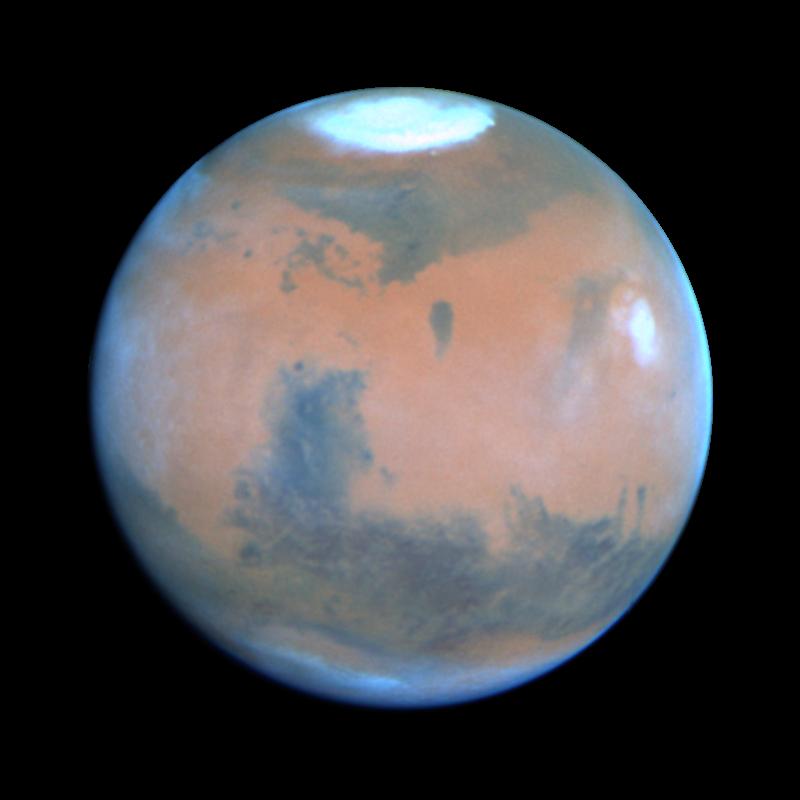
Mars
The fourth planet from the Sun — a cold, rocky desert world with the Solar System's tallest volcano, two tiny moons, and abundant evidence of an ancient watery past.

Mars
Mars is the fourth planet from the Sun and a rocky, terrestrial world about half the diameter of Earth. It has a mean diameter of roughly 6,779 km (about 0.53 Earths), a mass of 6.417×10²³ kg (about 0.11 Earth masses), a mean density of 3.93 g/cm³, and a surface gravity of 3.72 m/s² — roughly 38% of Earth's.
It orbits the Sun at an average distance of about 228 million km (1.52 AU) on a noticeably elliptical path (eccentricity ≈0.093), completing one orbit in about 687 Earth days, or 1.88 years. A Martian day, or sol, lasts 24 hours 37 minutes — only slightly longer than Earth's. Its axial tilt of about 25° is similar to Earth's, giving Mars four distinct seasons over its year of roughly 669 sols.
Atmosphere and climate
Mars has a very thin, cold atmosphere composed mostly of carbon dioxide. It is about 95–96% CO₂, with roughly 2.7–3% nitrogen and 1.6–2% argon, plus traces of oxygen, carbon monoxide, water vapor and methane. The mean surface pressure is only about 610 Pa — roughly 6–7 millibars, or about 0.6% of Earth's sea-level pressure — and it varies with altitude and season.
Surface temperatures are generally far below freezing, with a planetary mean effective temperature near −63 °C and large daily swings. Reported extremes range from about 20–30 °C at the warmest to around −140 to −153 °C at the coldest. Because the atmosphere is so thin it provides little insulation or protection, liquid water is unstable at the surface for long periods. The sky often appears hazy and red from suspended dust, and Mars experiences dust storms, water-ice and CO₂ ice clouds, and a seasonal cycle in which carbon dioxide condenses onto and sublimates from the polar caps.
Surface features
Mars hosts some of the most extreme landforms in the Solar System. Olympus Mons, a giant shield volcano on the western edge of the Tharsis Rise, stands about 21.3 km above the mean Martian surface (around 24 km above the surrounding plains in ESA's convention), making it the tallest volcano and mountain known. Its base exceeds 500 km in diameter, it covers roughly 300,000 km² — about the size of Italy — and its summit holds six nested calderas forming an irregular depression about 60 × 80 km across and up to 3.2 km deep. Crater counts suggest it may have last erupted on the order of tens of millions of years ago. It sits at the edge of the Tharsis dome, a volcanic bulge about 4,000 km across and 10 km high.
Near the equator, along the eastern flank of Tharsis, lies Valles Marineris, the largest canyon system in the Solar System. It stretches about 4,000 km long, reaches up to about 600 km wide, and plunges 2–7 km deep — locally about 9 km from rim to floor — making it more than ten times longer and wider than Earth's Grand Canyon.
At both poles, Mars has permanent ice caps composed dominantly of water ice, overlain seasonally by carbon dioxide frost that condenses from the atmosphere in winter and largely sublimates in summer. The caps show that water ice is present at or just beneath the surface in polar regions today, and together with valley networks and lakebed deposits they support the view that Mars had a wetter, more active climate billions of years ago.
Evidence for water on Mars
Orbital and rover observations reveal river valley networks, canyons, deltas and lakebeds carved or built by flowing water — among the clearest geological signs that Mars once had stable liquid water on its surface.
Clays, sulfates and salt deposits consistent with formation in liquid water provide mineralogical evidence alongside the landform record.
The Curiosity rover documented sedimentary rocks and an ancient freshwater lake environment that would have been potentially habitable for microbes.
Chloride salt deposits suggest surface water may have persisted as recently as 2 to 2.5 billion years ago, extending the period during which microbial life could have survived if it ever emerged.
NASA reports that hydrated salts associated with recurring slope lineae are the strongest evidence yet for intermittent, likely briny liquid-water flows on present-day Mars.
Two separate 2024 studies using InSight seismic data inferred liquid water in the Martian crust. One, published in National Science Review, identified a high-porosity, water-saturated layer at roughly 5.4–8 km depth at the base of the upper crust. A second, published in PNAS, found evidence for a water-saturated fractured igneous layer in the mid-crust at approximately 11.5–20 km depth. Both interpret the water as groundwater filling pores and fractures, not open underground lakes. If the mid-crustal layer extends broadly, the implied water volume could exceed many estimates of Mars's ancient surface oceans.
The moons: Phobos and Deimos
Mars has two small, dark, irregularly shaped moons, both discovered by Asaph Hall at the U.S. Naval Observatory in August 1877. Phobos, the larger, has a mean diameter of about 22.2 km (roughly 26 × 23 × 18 km) and a mass of 1.08×10¹⁶ kg. It is heavily cratered — dominated by the large crater Stickney — marked with grooves, and extremely dark (albedo about 0.071), with a spectrum resembling carbonaceous asteroids. It orbits just 9,377 km from Mars' center, closer than any other known natural satellite, completing an orbit in about 7 hours 39 minutes; because it moves faster than Mars rotates, it appears to rise in the west and set in the east. Its orbit is decaying by about 2 cm per year, and it is expected to crash into Mars or break into a ring in roughly 30–50 million years.
Deimos is smaller, about 12.6 km across with a mass of 1.5×10¹⁵ kg, and appears smoother because its craters are partly filled with regolith. It orbits about 23,460 km from the planet's center, taking 30.35 hours — just over one Martian day — and rises in the east and sets in the west very slowly. From the surface it looks like a bright star or planet, about 2 arcminutes across, similar to how Venus appears from Earth. Both moons are tidally locked to Mars and are widely suspected to be captured asteroids, though an alternative hypothesis holds they formed from re-accreted impact debris; current data do not fully resolve their origin.
Current exploration
Two NASA rovers remain active on Mars. Perseverance, the Mars 2020 mission, landed in Jezero Crater on 18 February 2021 to search for signs of ancient microbial life and to cache samples for possible return to Earth. Operating in and around the crater's ancient river delta and rim, it had driven over 30 km by October 2024 and collected 24 sealed tubes — comprising 20 rock cores, 1 regolith sample, and 3 witness tubes — by the end of 2024. In July 2024 it cored a rock nicknamed "Cheyava Falls," producing the sample "Sapphire Canyon," which showed signs of past water, organic material and potential biosignatures requiring further study. Perseverance also carried the Ingenuity helicopter, which completed 72 flights before its final flight on 18 January 2024, when rotor blade damage permanently grounded it, and demonstrated in-situ oxygen production with the MOXIE instrument.
Curiosity, part of the Mars Science Laboratory mission, landed in Gale Crater on 6 August 2012 and remains operational well beyond its original two-year prime mission — reaching Sol 4,740 in early December 2025 and still active into 2026. Climbing the lower slopes of Mount Sharp (Aeolis Mons), it has documented that ancient Gale Crater once had environments that could have supported microbial life, detected carbonate minerals such as siderite that may record a thicker ancient atmosphere, and found an increasingly diverse set of organic molecules. The two rovers operate roughly 3,700 km apart and explore different chapters of Martian history.
Frequently asked
Sources
- Mars | Facts, Surface, Moons, Temperature, & Atmosphere | Britannica
- Mars - Wikipedia
- Mars: Facts - NASA Science
- Mars | Glenn Research Center - NASA
- Mars planet | Canadian Space Agency
- Atmosphere of Mars - Wikipedia
- Olympus Mons - Wikipedia
- Background Science - Mars Express - ESA
- Moons of Mars - Wikipedia
- Phobos (moon) - Wikipedia
- Phobos - NASA Science
- Mars 2020: Perseverance Rover - NASA Science
- Ingenuity Mars Helicopter - NASA Science
- Mars Science Laboratory: Curiosity Rover - NASA Science
- Curiosity (rover) - Wikipedia
- NASA's MRO Finds Water Flowed on Mars Longer Than Previously Thought
- NASA Confirms Evidence That Liquid Water Flows on Today's Mars
- Seismic evidence of liquid water at the base of Mars' upper crust
- Liquid water in the Martian mid-crust - PNAS