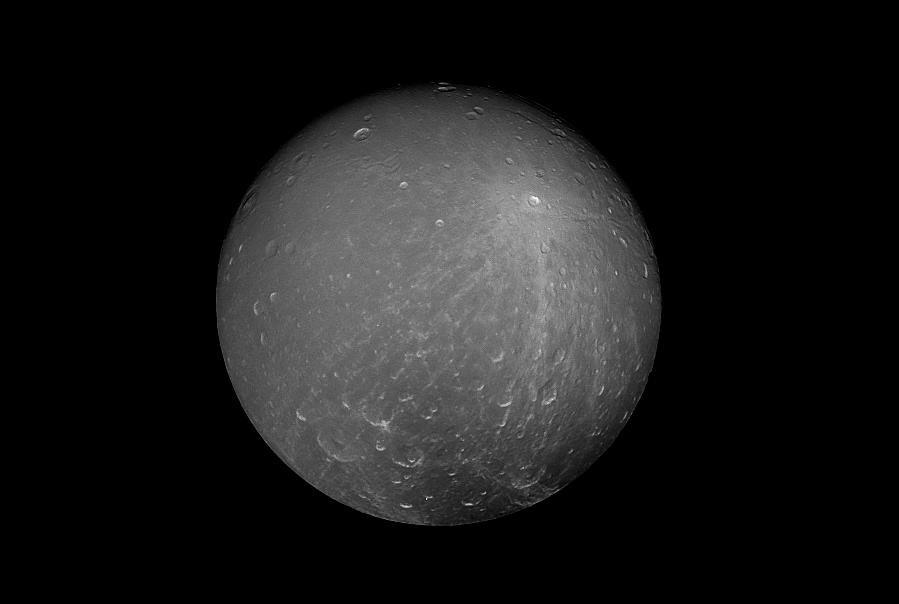
Dione
Saturn's icy moon with towering ice cliffs, a suspected hidden ocean, and two Trojan companions sharing its path around the ringed planet.
Dione
Dione is the fourth-largest moon of Saturn and the 15th-largest known moon in the Solar System. With a mean diameter of approximately 1,123 km and a bulk density of about 1.48 g/cm³, Dione is a world of roughly equal parts rock and water ice by mass — denser than a purely icy body yet far lighter than a rocky planet. At its average surface temperature of around 87 K (−186 °C), water ice becomes mechanically rigid and behaves like bedrock, sculpting a landscape of ancient impact craters, vast tectonic canyons, and dazzling bright cliffs.
Discovered in 1684 by Italian-French astronomer Giovanni Domenico Cassini, Dione received its modern mythological name — after the Titaness Dione of Greek mythology — only in 1847, when John Herschel proposed naming Saturn's moons after the siblings of Cronus. For nearly three centuries Dione was little more than a faint point of light. That changed when NASA's Voyager 1 flew past Saturn in 1980, revealing a cratered icy world laced with strange bright streaks on its trailing hemisphere. A generation later, the Cassini–Huygens orbiter transformed Dione from a sketched outline into a fully characterized world, conducting five dedicated close flybys between 2005 and 2015 that uncovered towering ice cliffs, a tenuous oxygen exosphere, and strong evidence for a global subsurface liquid-water ocean hidden roughly 100 km beneath the surface.
Dione orbits Saturn every 2.74 Earth days in a nearly circular, prograde path at 377,400 km from the planet's center. It is tidally locked, perpetually presenting the same face to Saturn. Two tiny companion moons — Helene and Polydeuces — share Dione's orbit as Trojan satellites, hovering 60° ahead and behind respectively at the gravitational sweet spots known as Lagrange points. Dione also sits in a 2:1 orbital resonance with the geyser-active moon Enceladus, a gravitational relationship thought to help sustain Enceladus's extraordinary interior heat.
From Discovery to Cassini
- 21 Mar 1684Discovery by Cassini
Giovanni Domenico Cassini discovers Dione from the Paris Observatory, along with Tethys, making it the third moon he personally found around Saturn, after Iapetus and Rhea.
- 1847Named 'Dione'
John Herschel proposes naming Saturn's moons after Titans and their siblings in Greek mythology. Dione — a Titaness associated with the oracle at Dodona — is chosen for this moon. Before this, it had been catalogued as Saturn IV in early numbering schemes.
- Nov 1980Voyager 1 Flyby
NASA's Voyager 1 obtains the first resolved images of Dione's surface during its Saturn encounter, revealing a heavily cratered icy world with intriguing bright 'wispy' streaks across the trailing hemisphere, initially interpreted as possible volatile deposits.
- Aug 1981Voyager 2 Flyby
Voyager 2 makes a more distant pass of the Saturn system, adding to the observational record of Dione. Basic physical properties — diameter ~1,120–1,130 km, density ~1.48 g/cm³ — are refined from combined Voyager data.
- 15 Oct 1997Cassini–Huygens Launch
The Cassini–Huygens spacecraft launches from Cape Canaveral, beginning a seven-year journey to Saturn.
- 1 Jul 2004Cassini Enters Saturn Orbit
Cassini fires its main engine and achieves orbit around Saturn, beginning a 13-year tour of the Saturnian system that will include repeated observations of Dione.
- 2005First Close Cassini Flyby; Wisps Resolved
High-resolution Cassini imaging reveals that Dione's 'wispy terrain' is not a coating of frost or cryovolcanic deposits but instead a network of bright tectonic ice cliffs — canyon walls and fault scarps hundreds of kilometers long with fresh water ice exposed on their faces.
- 7 Apr 2010Oxygen Exosphere Detected
During a targeted flyby, Cassini's Plasma Spectrometer (CAPS) detects molecular oxygen ions (O₂⁺) around Dione, confirming the presence of a tenuous oxygen exosphere produced by sputtering of surface ice by Saturn's magnetospheric particles.
- Oct 2016Subsurface Ocean Study Published
Researchers at the Royal Observatory of Belgium publish gravity-field modeling of Cassini data in Geophysical Research Letters, concluding that Dione's interior is best explained by a global subsurface liquid-water ocean roughly 35–95 km deep, sitting ~100 km beneath the ice shell.
- 15 Sep 2017Cassini Mission Ends
After exhausting its propellant, Cassini deliberately plunges into Saturn's atmosphere, ending 13 years of Saturn-system science. All current knowledge of Dione rests on Voyager and Cassini datasets, plus Earth-based and space-telescope observations.
Physical Characteristics
Dione is a triaxial ellipsoid measuring roughly 1128.8 × 1122.6 × 1119.2 km across its three axes, with a mean radius of 561.4 ± 0.4 km and a surface area of approximately 3.96 × 10⁶ km². Its mass of about 1.0955 × 10²¹ kg and bulk density of 1.4781 g/cm³ place it among the denser icy moons in the outer Solar System — roughly 48% denser than pure water ice. Surface gravity is only about 0.212 m/s² (roughly 2.2% of Earth's), and the escape velocity is 0.51 km/s, meaning a person could throw a baseball to escape velocity from Dione's surface.
The high density for an ostensibly icy body reveals the key truth about Dione's bulk composition: it contains roughly equal proportions of rock and water ice by mass. By volume, this works out to approximately one-third silicate rock and two-thirds water ice, because rock is considerably denser than ice. Cassini gravity and shape data confirm that the moon is differentiated — that is, it has separated into a dense rocky core surrounded by a lighter ice-rich mantle, rather than being a homogeneous mixture throughout.
Dione's surface is one of the most reflective solid surfaces in the Solar System, with a geometric albedo of 0.998 ± 0.004. This extraordinary brightness results from a near-pristine coating of water ice. Spectroscopic measurements confirm that water ice dominates the surface, with only trace amounts of carbon dioxide ice and small quantities of iron-bearing minerals mixed into the regolith. Continuous deposition of fine particles from Saturn's E ring — the diffuse ring sustained by Enceladus's geysers — may refresh portions of the surface, maintaining its brilliance. The mean surface temperature of approximately 87 K (−186 °C) means that water ice is mechanically as hard and rigid as granite at room temperature, capable of supporting mountain ranges, towering cliffs, and deep canyons without plastic deformation on geological timescales.
Interior Structure and the Subsurface Ocean
Analysis of Cassini's radio-science gravity measurements reveals that Dione's mass is somewhat concentrated toward its center, consistent with a differentiated interior rather than a uniform rock-ice mixture. The best-fitting interior model — derived using the same Bayesian gravity-inversion framework that successfully reproduced Enceladus's known internal structure — divides Dione into three layers: a large rocky core, a global liquid-water ocean, and an outer rigid ice shell.
The rocky core has a diameter estimated at roughly 70% of Dione's total diameter, corresponding to approximately 780 km. Surrounding this core, gravity data are best explained if there exists a global liquid-water ocean roughly 35–95 km deep, beginning at approximately 100 km below the surface. Atop this ocean sits the rigid ice shell, about 100 km thick, which is mechanically strong enough to explain why Dione shows no active plume activity analogous to Enceladus — the shell is simply too thick for water to reach the surface today.
The ocean inference, published in 2016 by researchers at the Royal Observatory of Belgium, rests on indirect geophysical modeling rather than direct detection. Unlike Enceladus — where plumes directly sample subsurface water — or Europa — where an induced magnetic signature unambiguously signals a conductive ocean — Dione's ocean has not been observed in any direct way. Nevertheless, several surface features independently support the notion of a warm, possibly ocean-bearing early interior. A prominent ridge called Janiculum Dorsa, roughly 500 km long and up to 1.5 km high, is underlain by crust that appears to sag by up to about 300 m, implying that the lithosphere was warm and deformable when the ridge formed — behavior consistent with a decoupled ice shell floating on a liquid layer. Ancient fracture systems and tectonic features also resemble those on Enceladus, hinting at an early period of significant internal activity.
If Dione's ocean is real, it could have persisted for most of the moon's history, sustained by radiogenic heating in the rocky core and some tidal heating from its orbital interactions. The interface between liquid water and the rocky core is of particular astrobiological interest: water-rock reactions at that interface could supply chemical energy and dissolved minerals in ways that, on Earth, sustain entire ecosystems of chemosynthetic microorganisms in the deep ocean. Dione's ocean is, however, far less accessible than Enceladus's — buried roughly twice as deep beneath the ice — so any future mission seeking to characterize it would likely require ice-penetrating radar, seismometers, or long-lived landed assets. As of the mid-2020s, no mission to the Saturn system has been approved, and Dione's ocean remains a well-motivated hypothesis awaiting confirmation.
Surface Geology
Dione's surface records a long and complex geological history, shaped by intense early bombardment, large-scale tectonic disruption, localized resurfacing, and ongoing exogenic deposition. Four broad terrain types can be distinguished: heavily cratered plains, moderately cratered plains, lightly cratered (younger) plains, and the fractured wispy terrain on the trailing hemisphere.
The heavily cratered regions contain craters up to about 100 km in diameter and crater densities consistent with ages approaching 4 billion years — relics of the Late Heavy Bombardment era that scarred most solid bodies in the Solar System. The largest recognized impact structure on Dione is Evander basin, approximately 350 km across. Other named large craters include Aeneas and Dido. These ancient regions are in stark contrast to the younger, smoother plains — often less than 30 km in crater diameter — that occupy other parts of the surface, indicating episodes of resurfacing that buried or erased earlier crater populations.
Perhaps the most visually striking feature of Dione is its 'wispy terrain,' a system of bright linear markings that covers much of the trailing hemisphere. When Voyager cameras first imaged these features in 1980, scientists interpreted them as possible deposits of volatile ices erupted from the interior along fractures — a cryovolcanic coating. Cassini's high-resolution imaging starting in 2005 told a very different story: the wisps are the bright, exposed faces of tall tectonic ice cliffs — canyon walls and fault scarps often hundreds of kilometers long, reaching up to about 300 meters in height. The cliffs appear bright because darker surface material slumps off the steep faces over time, continuously revealing fresh, unweathered water ice beneath. Their formation is attributed to large-scale normal faulting, where the crust pulled apart under global tectonic stresses, dropping blocks of terrain and creating canyon systems. The timing of these fractures — they cross plains and even cut through older craters — indicates they formed relatively late in Dione's geological history, possibly as the interior cooled and contracted following an early warmer phase.
Cassini imagery also revealed a more puzzling class of surface marking: the 'linear virgae,' extremely long, narrow, straight, and remarkably bright streaks, some tens to hundreds of kilometers in length but less than 5 km wide. These features cross multiple terrain types without deflection, ruling out simple tectonic or impact-ejecta explanations. The favored current interpretation is that they represent relatively young deposits of exogenic material — fine particles that fell onto Dione from Saturn's rings, from a past comet encounter, or from Dione's own Trojan co-orbital companions Helene and Polydeuces. Their origin remains an active area of research.
A pronounced brightness asymmetry exists between Dione's two hemispheres. The leading hemisphere — the side that faces the direction of orbital motion — is generally brighter, likely polished by micrometeoroid impacts and refreshed by E-ring particle deposition. The trailing hemisphere, while overall darker, is crisscrossed by the brilliant cliff network of the wispy terrain. Cassini's magnetospheric particle detectors found variations near Dione suggesting some low-level surface interaction with the magnetosphere, though no active cryovolcanic plumes were ever observed.
Atmosphere: A Tenuous Oxygen Exosphere
Dione possesses an atmosphere only in the loosest sense of the word. During a targeted flyby on 7 April 2010, Cassini's Plasma Spectrometer (CAPS) detected molecular oxygen ions (O₂⁺) in the immediate vicinity of the moon — the first direct confirmation of an exosphere around Dione. The measured O₂⁺ ion density is roughly 0.01–0.09 ions per cubic centimetre in the pickup-ion region near the moon, corresponding to a surface neutral O₂ density comparable to Earth's atmosphere at altitudes of roughly 300–480 km. At sea level, Earth's atmosphere is about 10¹⁵ times denser, which conveys how extraordinarily thin Dione's 'air' really is.
The production mechanism is entirely physical rather than biological or geological. As Dione orbits Saturn every 2.74 days, it is continuously bombarded by energetic charged particles — protons and heavier ions — trapped in Saturn's powerful inner magnetosphere. These particles slam into Dione's icy surface in a process called sputtering: they kick water molecules out of the surface lattice, preferentially dissociate them, and allow hydrogen — which is very light — to escape into space. The heavier oxygen atoms combine into molecular O₂ and escape into the tenuous exosphere. Solar ultraviolet photons and additional particle impacts then ionize some of this O₂, creating the O₂⁺ pickup ions that CAPS detected. Once ionized, these particles are rapidly swept up by Saturn's rotating magnetic field and carried away, so the exosphere is in a continuous cycle of production and loss.
This makes Dione part of a select group of Solar System bodies — including Rhea, Saturn's main rings, and Jupiter's icy moons Europa, Ganymede, and Callisto — that host oxygen-rich exospheres produced non-biologically by surface irradiation. It is a reminder that oxygen in an atmosphere is not automatically a biosignature; abiotic chemistry in the extreme radiation environment of a giant planet's magnetosphere can generate it efficiently from simple water ice. Cassini magnetometer measurements near Dione showed only weak field perturbations consistent with such a thin gas envelope, and one flyby geometry showed no magnetic signature at all despite CAPS detecting pickup ions — underlining how geometry-dependent such detections can be for such a wispy exosphere.
Orbital Dynamics and Trojan Companions
Dione follows a nearly circular, prograde orbit around Saturn at a mean distance of 377,400 km from the planet's centre, completing one revolution every 2.74 Earth days (approximately 65.7 hours). It is tidally locked — its rotation period exactly matches its orbital period — so the same hemisphere permanently faces Saturn. This synchronous state means Dione has a permanent 'near side' (facing Saturn) and 'far side,' as well as a fixed leading hemisphere (facing the direction of orbital motion) and a trailing hemisphere, distinctions that strongly influence its surface brightness distribution and the pattern of space-weathering it experiences.
Dione participates in a 2:1 mean-motion orbital resonance with Enceladus: for every single orbit Dione completes around Saturn, the smaller and closer Enceladus completes exactly two. This gravitational lock periodically amplifies small eccentricities and is thought to be a significant driver of the tidal heating that keeps Enceladus's interior active and sustains its famous geysers. Dione also has resonant gravitational interactions with Mimas, further shaping the orbital architecture of Saturn's inner moon system.
Two much smaller moons share Dione's orbit as Trojan satellites, occupying the gravitationally stable Lagrange points L4 and L5 of the Saturn–Dione system. Helene, roughly 30 km across, leads Dione by 60° at the L4 point. Polydeuces, less than half Helene's diameter (under ~15 km), trails by 60° at the L5 point. Polydeuces is notable for exhibiting larger excursions from its mean Trojan position than Helene — its libration around L5 is more pronounced, giving it a more wandering path than the relatively stable Helene. Both moons are dynamically analogous to Jupiter's Trojan asteroids, and both may contribute exogenic material to Dione's surface. A 2018 analysis of Dione's linear virgae proposed that some of the bright streak material could originate from Helene or Polydeuces, establishing a physical as well as gravitational connection between Dione and its tiny Trojan companions.
What Cassini Revealed
High-resolution Cassini images beginning in 2005 overturned the Voyager-era interpretation of Dione's bright wisps as cryovolcanic frost deposits. They are instead towering tectonic ice cliffs — exposed fault scarps hundreds of kilometers long and up to ~300 m high — where slumping of darker surface material continuously reveals fresh water ice.
Modeling of Cassini radio-science gravity data (published 2016, Royal Observatory of Belgium) indicates that Dione most likely harbors a global liquid-water ocean roughly 35–95 km deep, situated ~100 km beneath the ice shell and in direct contact with the rocky core — making Dione a probable ocean world.
During the 7 April 2010 flyby, Cassini's CAPS instrument detected molecular oxygen ions (O₂⁺) around Dione — confirming a sputter-produced oxygen exosphere with surface-equivalent densities comparable to Earth's thermosphere at ~300–480 km altitude.
A ridge ~500 km long and up to 1.5 km high, Janiculum Dorsa, shows downward flexure of the underlying crust by up to ~300 m, implying the ice shell was once warm and decoupled — consistent with a historically warm, ocean-bearing interior.
Cassini data revealed extraordinarily long, narrow, straight bright streaks (linear virgae) crossing Dione's surface. Their geometry rules out simple tectonic or impact origins; the favored interpretation is exogenic deposition from Saturn's rings, a past comet encounter, or Dione's Trojan moons Helene and Polydeuces.
Cassini gravity measurements show Dione's mass is concentrated toward its center, confirming a differentiated body with a large rocky silicate core (diameter ~70% of Dione's total) surrounded by a water-ice-rich mantle.
Dione FAQ
Sources
- Dione (moon) — Wikipedia
- Dione — NASA Science
- Dione — Britannica
- Dione: Saturn's Turned-Around Moon — Space.com
- Dione: Saturn's Moon — NOAA Science On a Sphere
- Discovering Mysterious Features On Saturn's Moon Dione — Smithsonian Air and Space Museum
- Mysterious Linear Features Across Saturn's Moon Dione — AGU Geophysical Research Letters
- Detection of Exospheric O₂⁺ at Saturn's Moon Dione — AGU Journals
- Cassini Detects Hint of Fresh Air at Dione — NASA JPL
- Oxygen Discovered at Saturn's Moon Dione — UCL News
- Does Dione Have a Subsurface Ocean? — Sky & Telescope
- Saturn's Moon Dione Harbors a Subsurface Ocean — Royal Observatory of Belgium
- Study Suggests Saturn's Moon Dione Has Underground Ocean — Spaceflight Now
- A Water Ocean Inside Saturn's Moon Dione — EGU Blogs
- Dione's Putative Subsurface Ocean — Lunar and Planetary Institute (PDF)