Saturn
The Solar System's ringed gas giant — a hydrogen-helium world less dense than water, encircled by ice rings and orbited by hundreds of moons.

Saturn
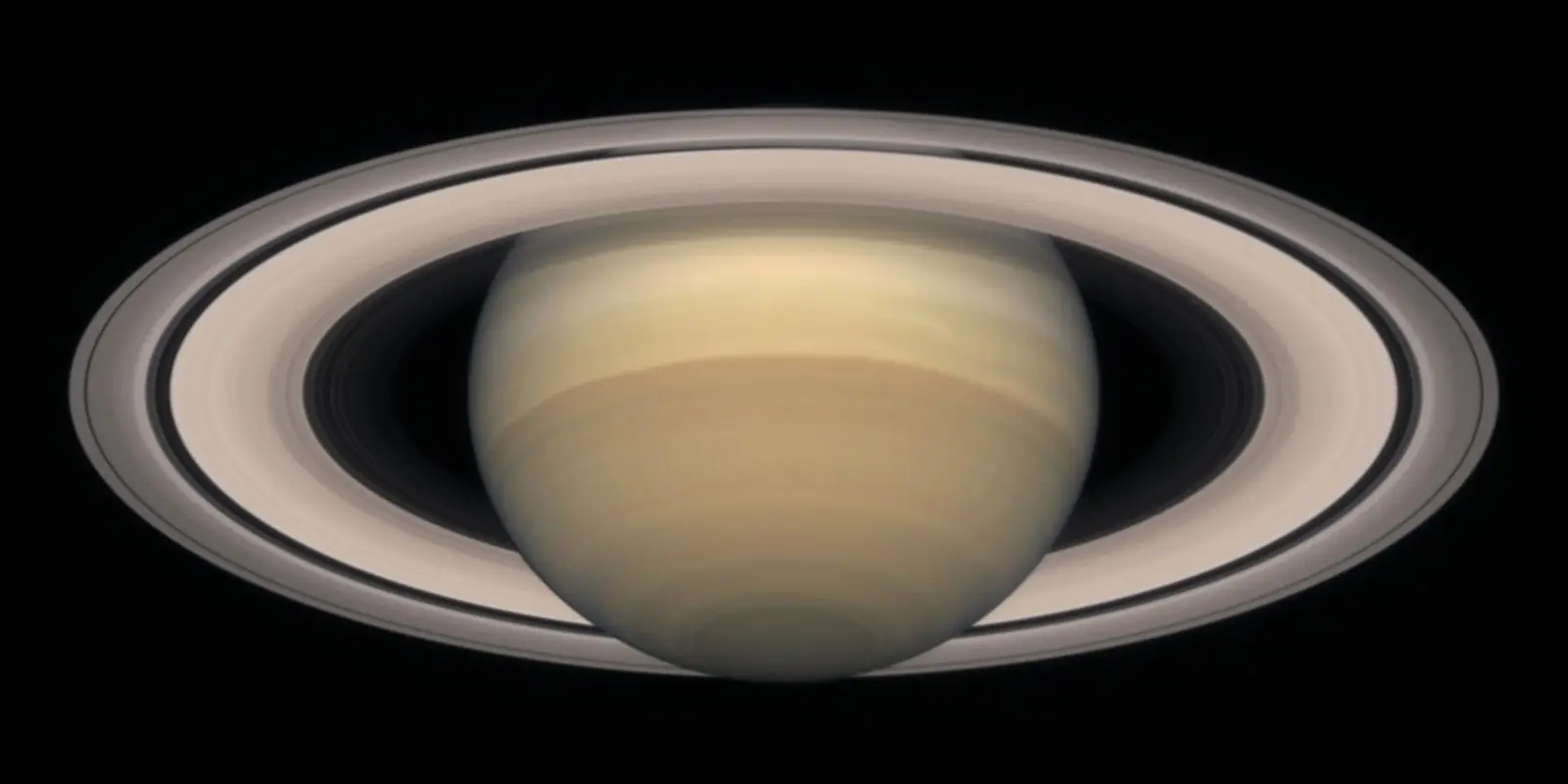
Saturn is a gas giant best known for its prominent system of rings. It has a mass of about 5.68 × 10²⁶ kg — roughly 95 times that of Earth — and a mean equatorial diameter of about 120,500 to 120,536 km, around nine times Earth's diameter. Despite its size, its mean density is only about 0.69 g/cm³, about 12–13% that of Earth, making Saturn the only planet less dense than water.
The planet completes one orbit around the Sun in about 29.4 Earth years (10,756 days), a value often rounded to 29.5 years in reference works. Like the larger gas giant Jupiter, Saturn is composed predominantly of hydrogen and helium.
Atmosphere and weather
Saturn's outer atmosphere, near the cloud tops, is about 96.3% hydrogen and 3.25% helium by volume, with trace amounts of methane (~0.45%), ammonia, hydrogen deuteride, ethane and other species. By mass, helium accounts for roughly 18–25%. The cloud structure is layered: upper clouds of ammonia ice, middle clouds of ammonium hydrosulfide ice, and lower clouds of water near the 0 °C level.
Temperatures vary strongly with altitude. The 1-bar level sits at about 135 K (−138 °C), while the stratosphere reaches Saturn's coldest measured atmospheric temperature of about 82 K (−191 °C) near 60 millibars, and the high atmosphere warms again to roughly 140–150 K. Deeper troposphere levels can reach as warm as +80 °C.
Saturn has some of the fastest winds in the Solar System. Equatorial jets in the upper atmosphere peak at about 500 m/s — roughly 1,800 km/h. A hurricane-like vortex at the south pole has winds of about 550 km/h and is roughly the size of Earth.
The planet's north pole hosts a long-lived, six-sided jet stream known as the hexagon, centered near 78° N latitude. Each of its sides is about 14,500 km long — longer than Earth's diameter — and the whole structure spans roughly 30,000 km across. First seen in Voyager images in the early 1980s and later studied in detail by Cassini, the hexagon rotates with a period of 10 h 39 m 24 s, and cloud features within it move at about 100 m/s. Most researchers interpret it as a standing wave in a strong east-west jet stream, with a polar vortex at its center.
Ring system
Saturn's rings form a flattened disk tens of thousands of kilometres wide, divided into several main rings — labelled D, C, B, A, F, G and E from the planet outward — along with thousands of narrow ringlets. The bright main rings span roughly 273,600 km across, yet they are on average only about 10 m thick, with some local structures rising kilometres above the ring plane.
The main rings are strongly dominated by water ice, with minor silicate (rocky) material and dark, UV-absorbing contaminants. Individual particles range from smaller than a grain of sand to objects as large as mountains. The C ring, Cassini Division and innermost D ring are comparatively richer in non-ice material; the D ring is unusually organic- and silicate-rich and water-poor compared with the main rings. The B ring is the densest and brightest of the main rings, while the very broad, diffuse E ring is supplied largely by icy plume material from the moon Enceladus.
The Cassini Division is the largest prominent gap within the bright main rings — a low-density region about 4,700 km (2,920 miles) wide separating the A and B rings. It is not empty: high-resolution imaging reveals numerous faint ringlets and fine structure within it, sculpted by gravitational resonances with Saturn's moons and embedded moonlets. Because the rings lie inside Saturn's Roche limit, their material cannot easily accrete into large moons.
Moons
Saturn had 274 confirmed moons in 2024, according to NASA's Saturn moons listing, a total reached after a March 2025 announcement of 128 additional moons. By 2026 the count had risen further to 285 following the announcement of 11 more moons on 16 March 2026.
Among the classic large moons, Titan was discovered in 1655 by Christiaan Huygens, and Enceladus in 1789 by William Herschel. Both are long-established members of Saturn's moon system and have become key targets in the study of potentially habitable environments.
Magnetic field and interior
Saturn's internal magnetic field is generated by a dynamo in a region of electrically conducting metallic hydrogen surrounding a central rocky and icy core. The field is dominated by a dipole aligned to within about 1° of the rotation axis, making it more axisymmetric than any other known planetary field. At the 1-bar level it measures about 0.2 gauss at the equator and 0.7–0.8 gauss at the poles, with a magnetic moment roughly 600 times Earth's — far weaker than Jupiter's.
Cassini's Grand Finale mapping revealed that the internal field, though nearly perfectly axisymmetric, has a rich higher-order spectrum likely linked to deep zonal winds, with a convecting dynamo region overlain by a thick, stably stratified layer associated with helium rain. Externally, the magnetosphere is distorted and twisted by the planet's rapid rotation and a heavy plasma torus supplied largely by Enceladus.
Because the dipole has nearly zero tilt, the usual method of using magnetic longitude as a rotation clock does not work. Saturn Kilometric Radiation, initially assumed to track the planet's spin, was found by Cassini to be variable and tied to magnetospheric dynamics rather than the deep interior. Independent gravity-field and atmospheric-wave analyses instead favour a bulk interior rotation period of about 10 h 32–34 min, though no single, unambiguous deep rotation period has yet been directly measured.
The Cassini-Huygens mission
The Cassini-Huygens mission transformed the understanding of Saturn during 13 years in orbit. ESA's Huygens probe landed on Titan on 14 January 2005 — the first landing in the outer Solar System — returning data on the moon's atmosphere, winds and surface. Radar revealed lakes and seas of liquid methane and ethane covering about 1.6 million km² (roughly 2% of Titan's surface), including large seas such as Ligeia Mare, along with evidence of rain, rivers, dunes and an active methane-based hydrologic cycle, a subsurface water ocean, and complex prebiotic organic chemistry.
At Enceladus, Cassini discovered water-ice plumes jetting from south-polar fractures known as tiger stripes, feeding Saturn's E ring. The data pointed to a global subsurface liquid-water ocean with strong indications of hydrothermal activity and organic compounds, establishing Enceladus as one of the prime potentially habitable environments in the Solar System. The mission also showed that most ions in the Saturn system originate from water ejected by this small moon.
Cassini revealed the rings to be active and dynamic — with waves, gaps and propeller-like features carved by embedded moonlets, and vertical structures up to about 3 km high — and measurements during the Grand Finale ring-plane dives constrained the ring mass, indicating the rings are substantially younger than Saturn itself. The mission monitored the great northern storm of 2010–2011, captured the first videos of lightning beyond Earth, imaged the polar hexagon, and resolved the long-standing mystery of Iapetus's bright-dark dichotomy. It also discovered new moons, including Methone and Pallene.
To avoid any chance of contaminating potentially habitable moons such as Enceladus or Titan, the spacecraft executed a Grand Finale of 22 dives between Saturn and the inner edge of the rings before being deliberately deorbited into Saturn's atmosphere on 15 September 2017, where it burned up.
Selected events
- 1655Titan discovered
Christiaan Huygens identifies Saturn's largest moon.
- 1789Enceladus discovered
William Herschel discovers the icy moon later found to host water plumes.
- 1980Voyager 1 at Saturn
Voyager 1 discovers the faint D ring and images the north polar hexagon.
- Jan 14, 2005Huygens lands on Titan
First landing in the outer Solar System.
- 2010–2011Great northern storm
A vast storm eventually encircles the planet.
- Sep 15, 2017Cassini Grand Finale
Spacecraft deorbited into Saturn's atmosphere to protect its moons.
- Mar 16, 2026Moon count reaches 285
Announcement of 11 additional confirmed moons.
Frequently asked
Sources
- Saturn - Wikipedia
- Saturn | Facts, Size, Temperature, Atmosphere, Rings & Moons - Britannica
- Saturn: Facts - NASA Science
- Saturn's Rings: Composition, Characteristics & Creation - Space.com
- The composition of Saturn's rings - arXiv
- Cassini: Saturn Rings - NASA Science
- Moons of Saturn - Wikipedia
- Saturn Moons - NASA Science
- More moons for Jupiter and Saturn! New totals here - EarthSky
- Cassini: About the Mission - NASA Science
- Saturn Unveiled: Ten Notable Findings from Cassini-Huygens - Eos
- Cassini-Huygens - Wikipedia
- ESA - Saturn's atmosphere
- Saturn - Magnetic Field, Magnetosphere, Rings - Britannica
- The landscape of Saturn's internal magnetic field from the Cassini mission
- Saturn's magnetic field is twisted and scientists just figured out why - ScienceDaily