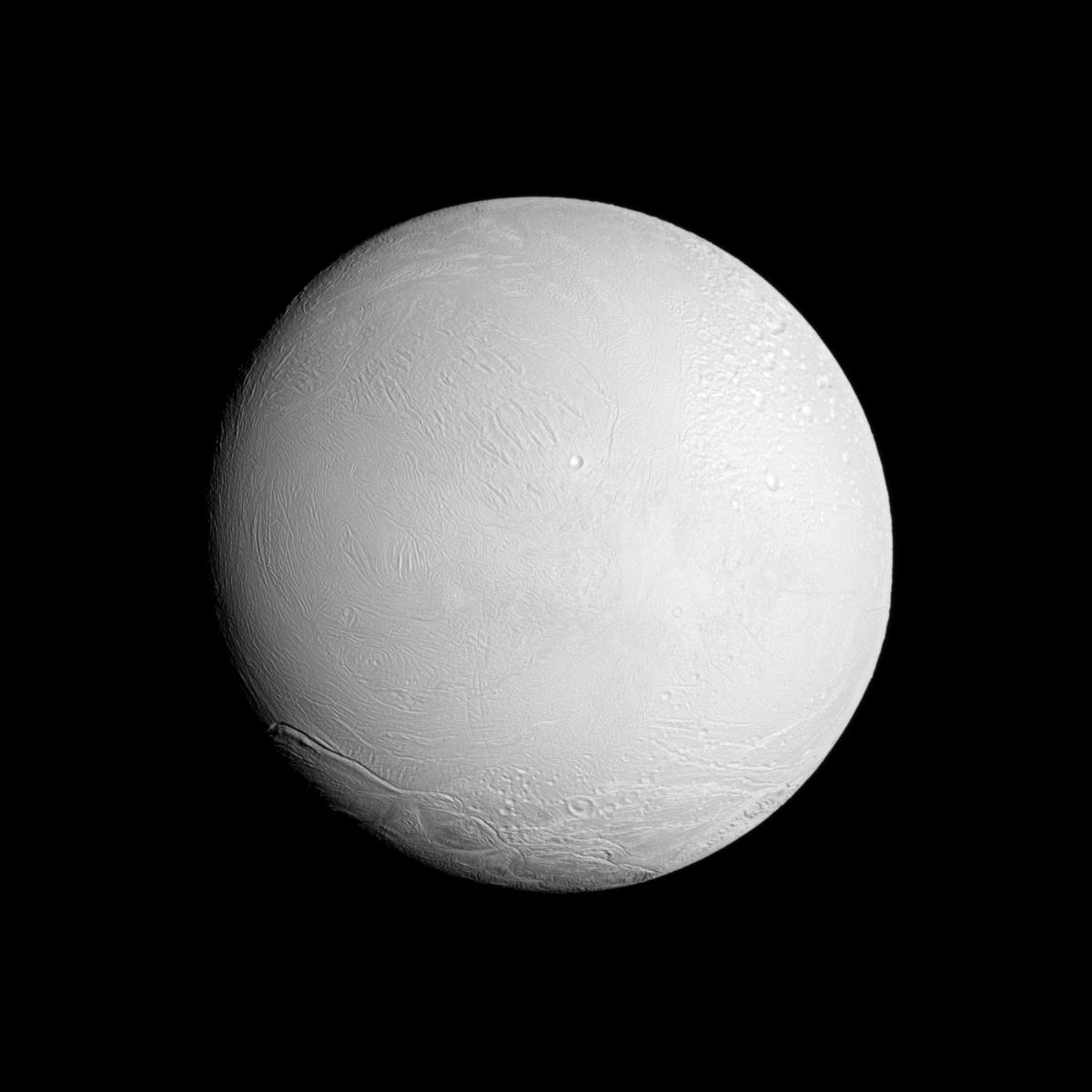
Enceladus
Saturn's icy moon with a global saltwater ocean, erupting geysers, and some of the Solar System's best odds for harbouring life.
Enceladus
Enceladus is a small icy moon of Saturn, roughly 500 kilometres across, that has emerged as one of the most scientifically compelling objects in the Solar System. Despite its modest size — barely one-seventh the diameter of Earth's Moon — Enceladus conceals a global ocean of liquid saltwater beneath an outer shell of dazzling white ice, and that ocean is almost certainly in contact with a warm, rocky, hydrothermally active seafloor.
The moon's most dramatic feature is a system of fractures at its south pole, nicknamed "tiger stripes," from which jets of water vapour and ice particles erupt continuously into space, feeding Saturn's diffuse E ring and giving scientists a direct chemical window into the ocean below. When NASA's Cassini spacecraft flew through those plumes it detected molecular hydrogen, carbon dioxide, methane, silica nanograins, and a rich inventory of organic compounds — all pointing to hydrothermal reactions at the seafloor and conditions broadly compatible with microbial life as known on Earth.
No life has been detected; Cassini was not equipped to search for organisms. But the case that Enceladus's ocean is chemically habitable has grown steadily stronger since the mission's key results were published in 2017, making the moon a top priority for future exploration by both NASA and ESA.
Physical characteristics
Enceladus is a triaxial (scalene) ellipsoid with semi-axes of 513 km, 503 km, and 497 km along the sub-Saturnian, leading–trailing, and north–south directions respectively, giving it a mean radius of 252.1 ± 0.2 km and a spherical-equivalent diameter of roughly 500–504 km. Its volume of 6.71 × 10⁷ km³ is dwarfed by the larger Saturnian moons, yet it is the sixth-largest moon in the Saturn system.
The mean density of 1.6097 ± 0.0038 g/cm³ is substantially higher than that of a body composed entirely of water ice (approximately 0.93 g/cm³), revealing that a significant fraction of the interior is rocky silicate and iron material rather than ice. Cassini gravity measurements confirmed that Enceladus is denser than Saturn's other mid-sized icy moons and is internally differentiated: a rocky, iron-bearing core overlain by a global ocean of liquid water, itself covered by an outer ice shell. The ice shell averages roughly 20–25 km in thickness globally but thins dramatically to as little as 1–5 km over the south polar terrain — a geometric fact that shapes the moon's extraordinary geological activity.
The surface is dominated by clean water ice and is accordingly almost perfectly reflective — Enceladus holds the record for the highest albedo of any known body in the Solar System, reflecting close to 100 percent of incident sunlight. This extreme reflectivity keeps surface temperatures around −201 °C (−330 °F). The bright surface is varied in character: some regions carry ancient, cratered terrain, while others exhibit smooth plains, networks of ridges, and broad tectonic fractures. The most striking features are the four prominent south-polar sulci informally called tiger stripes, each roughly 150 km long, from which most of the plume activity originates.
From discovery to ocean world
- 28 Aug 1789Discovery by William Herschel
The British astronomer William Herschel first observed Enceladus on 28 August 1789. The moon remained poorly studied for nearly two centuries because of its small size, its distance, and its proximity to the overwhelming brightness of Saturn.
- Nov 1980Voyager 1 Saturn flyby
Voyager 1 passed through the Saturn system and returned initial data on the moon's brightness, but its trajectory did not allow detailed imaging of Enceladus.
- Aug 1981Voyager 2 first close look
Voyager 2 made the first detailed observations of Enceladus, revealing a surprisingly bright, smooth, and crater-poor surface in some regions — strong evidence of geological youth or recent resurfacing. Images also helped connect Enceladus to Saturn's E ring, whose particle density peaks near the moon, hinting that the moon might be supplying material to the ring.
- 2005Cassini begins Enceladus campaign
NASA's Cassini spacecraft began its dedicated study of Enceladus, obtaining the first detailed images of the south polar region. It discovered active jets of water vapour and ice particles erupting from fractures — the tiger stripes — and confirmed Enceladus as a geologically active world.
- 2005–201522 Cassini encounters
Over a decade, Cassini made 22 close encounters with Enceladus, building up an increasingly detailed picture of the plume composition, thermal structure, and internal gravity field. The mission detected water vapour, carbon dioxide, methane, ammonia, salts, and nanograins of silica in the plume — evidence for both a liquid ocean and hydrothermal activity at the seafloor.
- 28 Oct 2015Deep plume flyby — H₂ detection
On 28 October 2015, Cassini executed a deep south-polar flyby, passing directly through the Enceladus plume. Its Ion and Neutral Mass Spectrometer (INMS) collected data whose analysis, published in Science in April 2017 (Waite et al.), revealed abundant molecular hydrogen — the key evidence for ongoing hydrothermal reactions at the seafloor.
- Apr 2017Molecular hydrogen results published
NASA and Southwest Research Institute announced the INMS finding: molecular hydrogen in the Enceladus plume, most plausibly produced by reactions between liquid water and the rocky core at high temperatures. Scientists noted that the detected H₂ levels thermodynamically favour methanogenesis — the same metabolism used by chemolithoautotrophic microbes near Earth's hydrothermal vents.
- 2024North polar heat flux discovered
A study published in Science Advances reported endogenic heat at Enceladus's north pole: an additional 46 ± 4 mW m⁻² of internal heat flux, corresponding to roughly 1.7 GW of total power north of 65°N, showing that enhanced heat flow through a relatively thin ice shell is not limited to the south pole.
- 2024 (ESA)ESA identifies Enceladus as top L4 mission target
In 2024 ESA's Expert Committee for its next Large-class mission identified Enceladus as the leading target under the Voyage 2050 science programme. Detailed mission architecture studies are ongoing, with an instrument call expected after a workshop in late 2026.
The subsurface ocean and hydrothermal vents
The evidence for a global subsurface ocean beneath Enceladus's ice rests on multiple independent lines of measurement. Cassini's gravity field measurements and observations of the moon's physical libration (a wobble in its rotation) show that the ice shell is not rigidly attached to the core — a result that requires a decoupling fluid layer, consistent with a global ocean of liquid water. The ocean is estimated to hold roughly 2 percent of the volume of Earth's oceans, occupying a shell between the rocky core and the overlying ice.
The composition of the ocean is constrained by what Cassini sampled in the plume. The ice grains ejected from the tiger stripe vents contain dissolved salts, indicating that the ocean is salty and has been in prolonged contact with rock — a setting broadly analogous to Earth's subseafloor brines. The detection of nanometre-scale silica grains is particularly significant: on Earth, such grains form when very hot water (above roughly 90 °C) reacts with silicate rock and then rapidly cools. Their presence in the Enceladus plume strongly implies that water at the ocean floor is being heated to elevated temperatures before mixing with the cooler bulk ocean — the hallmark of hydrothermal circulation.
The 2017 discovery of molecular hydrogen (H₂) in the plume, collected during the 28 October 2015 Cassini flyby, cemented the hydrothermal hypothesis. Cassini's INMS detected a statistically significant abundance of native H₂ after careful steps were taken to eliminate instrument-generated hydrogen as a source. The most plausible mechanism is serpentinisation and related reactions in which liquid water oxidises iron-bearing silicate minerals in the rocky core, releasing H₂. The measured H₂ concentration, combined with co-detected CO₂ and CH₄, indicates that Enceladus's ocean is in strong thermodynamic disequilibrium — a state that, on Earth, powers communities of chemolithoautotrophic microbes through methanogenesis (CO₂ + 4H₂ → CH₄ + 2H₂O). Southwest Research Institute scientist Christopher Glein noted that the amount of molecular hydrogen detected is high enough to support microbes analogous to those found near Earth's hydrothermal vents.
Subsequent analyses of Cassini data have extended the inventory of plume organic compounds to include esters, alkenes, and ethers — molecules that could participate in cell-membrane-like structures — and have reported strong evidence for hydrogen cyanide (HCN), a key precursor in prebiotic chemistry. The cumulative picture is of an ocean that meets the standard astrobiological criteria for habitability: liquid water, bio-essential elements (carbon, hydrogen, nitrogen, oxygen, and others), and persistent chemical energy in the form of H₂-producing hydrothermal reactions. No life has been detected; Cassini was not equipped to search for organisms, and the existing data do not prove that life exists.
Tiger stripes and the south polar heat engine
The four tiger stripe sulci — Alexandria, Baghdad, Cairo, and Damascus — are subparallel fractures each roughly 150 km long, spaced about 35 km apart, that dominate the south polar terrain. They are geologically young and remain active today, venting water vapour and ice particles at rates that continuously replenish Saturn's E ring. Tidal stresses from Saturn flex the fractures periodically, modulating (but never fully stopping) the eruption rate across Cassini's observing campaign.
The temperature contrast between the tiger stripes and their surroundings is striking. Away from the fractures, south polar surface temperatures are typically below 72 K (−201 °C), consistent with simple solar heating. Along the fractures, Cassini's Composite Infrared Spectrometer (CIRS) measured temperatures of at least 180 K (−93 °C) in places — more than 100 K warmer than the surrounding terrain, and confined to bands only hundreds of metres wide. The overall colour temperatures across the tiger stripe region fall between 113 K and 157 K, against an expected background of roughly 68 K, confirming that the heat is endogenic (coming from within) rather than from sunlight.
The total power radiated from the south polar terrain is enormous for such a small moon. CIRS measurements show a minimum of approximately 5 GW of endogenic power escaping as infrared radiation from the south pole alone. Broader analyses yield estimates of 4–19 GW for the south polar terrain's internal power, depending on assumptions about surface properties. Global conductive heat-loss estimates reach 18–35 GW in total. To put the local intensity in context, Earth's average global geothermal heat flux is about 0.09 W m⁻², while the tiger stripe zones are orders of magnitude hotter per unit area, making Enceladus's south pole one of the most intense localised heat-flux regions known in the Solar System.
Individual plume jets correspond closely to the warmest spots along the fractures, with each jet hot spot confined within a few hundred metres of the fracture centre — though the apparent width in CIRS maps is broadened by the instrument's spatial resolution. This tight spatial match between peak heat emission and individual gas-and-ice jets supports the picture of open or partially open conduits connecting the surface directly to the subsurface ocean. A 2015 PNAS model proposed that turbulent flow of ocean water within tidally flexed fissure "slots" can sustain a power output on the order of 10 GW for at least one million years — consistent with the observed heat budget and the long-term stability inferred from Saturn's E ring, which has been observed since 1966.
The south polar heat output poses a significant geophysical puzzle. Standard tidal heating and radiogenic heating models for a small icy moon initially predicted much lower global heat flows than the tens of gigawatts now inferred. Concentrating so much power into a small polar region requires non-uniform ice shell thickness and specialised fracture geometry; simple shear-heating models along faults alone fall far short of the required heat flux. The 2024 discovery of approximately 1.7 GW of endogenic heat at the north pole (from a heat flux of 46 ± 4 mW m⁻² poleward of 65°N) adds another boundary condition: both poles appear to sit over regions of anomalously thin, warm ice shell, pointing to a globally active tidal and thermal system rather than a purely localised accident of polar geology.
Key discoveries
Cassini confirmed in 2005 that Enceladus is geologically active, with jets of water vapour and ice particles erupting from the tiger stripe fractures at the south pole — the first confirmed active water-ice geysers beyond Earth.
Gravity field measurements and libration data demonstrated that Enceladus possesses a global liquid-water ocean beneath its ice shell, not merely a localised polar melt pocket.
Plume ice grains analysed by Cassini contain dissolved salts and nanometre-scale silica particles — evidence that hot water is reacting with rock on the ocean floor, implying hydrothermal circulation at elevated temperatures.
Detection of abundant H₂ in the 2015 deep plume flyby, published in 2017, provided strong evidence for ongoing hydrothermal reactions between liquid water and the rocky core, creating a chemical energy source thermodynamically capable of powering methanogenesis.
Later analyses identified esters, alkenes, ethers, and other complex organic compounds in plume-derived ice grains, along with evidence for hydrogen cyanide (HCN), a key prebiotic building block.
Material ejected from the tiger stripe plumes was confirmed as the primary source of Saturn's diffuse E ring, whose particle density peaks in the orbital vicinity of Enceladus.
A Science Advances study reported 46 ± 4 mW m⁻² of internal heat flux at the north pole, corresponding to roughly 1.7 GW, showing that anomalously thin, warm ice shell conditions extend beyond the south pole.
Habitability assessment
A community synthesis of Cassini results concludes that Enceladus's subsurface ocean meets the standard criteria used to assess habitability: it contains liquid water, bio-essential elements and compounds (carbon, hydrogen, nitrogen, oxygen, and evidence for others), and at least one persistent chemical energy source. The H₂-producing hydrothermal reactions identified from the plume data provide an energy gradient that, on Earth, sustains chemolithoautotrophic ecosystems near mid-ocean-ridge venting systems — environments that require no sunlight and are considered analogues to the conditions under which early life may have emerged.
The astrobiological significance of the HCN detection deserves emphasis. Hydrogen cyanide is a starting point for the synthesis of amino acids and nucleotide bases under a wide range of prebiotic chemistry scenarios; its presence alongside molecular hydrogen, carbon dioxide, and complex organics means that not only potential energy sources but also potential molecular building blocks of life are present in the Enceladus ocean today. Whether any of these ingredients have combined into living systems remains entirely unknown.
Importantly, confirming or refuting biology in the Enceladus ocean will require a dedicated life-detection mission. Cassini's instruments were designed to characterise the Saturn system broadly, not to detect biosignatures. The plume venting mechanism is, however, remarkable from an exploration standpoint: a spacecraft could, in principle, sample ocean-derived material without landing or drilling, simply by flying through the jets — an option no other known ocean world offers so accessibly.
Future missions
No approved, funded mission is scheduled to visit Enceladus in the near term; all concrete proposals target the late 2030s through 2050s. Two mission concepts have advanced furthest in agency planning.
NASA's Enceladus Orbilander was recommended by the 2023–2032 Planetary Science Decadal Survey as the second-highest priority new Flagship mission, after the Uranus Orbiter and Probe. As envisioned, it would orbit Enceladus for approximately 1.5 years, repeatedly flying through the plumes to accumulate and analyse plume material, then transition to a surface lander phase of roughly 2 years to study plume fallout and search directly for evidence of life. The estimated cost is approximately 4.9 billion US dollars. An example trajectory studied places launch in October 2038, a Jupiter gravity-assist flyby in October 2040, Saturn orbit insertion in August 2045, and landing in the early 2050s. The Orbilander remains a recommended concept, not yet selected or funded as an official NASA project.
ESA's Large-class programme (Voyage 2050) has similarly identified Enceladus as a leading target. In 2024, ESA's Expert Committee for its next Large-class mission — informally called L4 — selected Enceladus as the top candidate. The baseline concept combines an orbiter that would tour the Saturn moon system before focusing on Enceladus and a lander of approximately 800 kg designed to operate on the surface for at least 20 days (and potentially up to 4 weeks), analysing local material and searching for biosignatures. Current planning envisions mission adoption around 2034, launch around 2042, and arrival in the early 2050s when Saturn's illumination geometry is favourable for the south polar region. An instrument call is expected after a community workshop scheduled for late 2026.
Beyond these two leading concepts, researchers have presented additional architecture studies and technology demonstrations including TIGRE (Thermal Investigation of Geothermal Regions of Enceladus), a proposed concept incorporating an orbiter, lander, and thermal drill, as well as NASA technology studies for hopping robot platforms suited to Enceladus's low-gravity terrain. These remain at the concept stage and are not approved flight projects.
Enceladus FAQ
Sources
- Enceladus: Saturn's Moon — NOAA Science On a Sphere
- Enceladus — Wikipedia
- Enceladus — A guide to Saturn's intriguing icy moon | Space.com
- Enceladus, Saturn's moon with a hidden ocean | The Planetary Society
- Enceladus — NASA Science
- Discovery of organic compounds bolsters case that Saturn's moon Enceladus could support life | University of Washington
- 235 Years Ago: Herschel Discovers Saturn's Moon Enceladus — NASA
- Cassini at Enceladus — NASA Science
- Enceladus Hydrothermal Activity — NASA Science
- Hydrothermal Activity — NASA Cassini Mission
- SwRI scientists discover evidence for a habitable region within Saturn's moon Enceladus
- Cassini finds molecular hydrogen in the Enceladus plume — Science (Waite et al., 2017)
- NASA Study Finds Life-Sparking Energy Source and Molecule at Enceladus — JPL
- Science Objectives for Flagship-Class Mission Concepts for the Search for Evidence of Life at Enceladus — PMC
- Inside ESA's L4 mission to Enceladus — Astronomy Magazine
- Enceladus Orbilander — Wikipedia
- What's Next — NASA Cassini Science
- Sustained eruptions on Enceladus explained by turbulent dissipation in tiger stripes — PNAS
- Endogenic heat at Enceladus' north pole — Science Advances
- Jet Spots in Tiger Stripes — NASA Science
- Tiger stripes (Enceladus) — Wikipedia
- Constraining the heat flux between Enceladus' tiger stripes — Icarus (ScienceDirect)
- Architectures and Instruments for Enceladus Exploration — JGR Planets (AGU)