Eris
The distant dwarf planet whose discovery forced astronomers to redefine what a planet is — and demoted Pluto in the process.
Eris
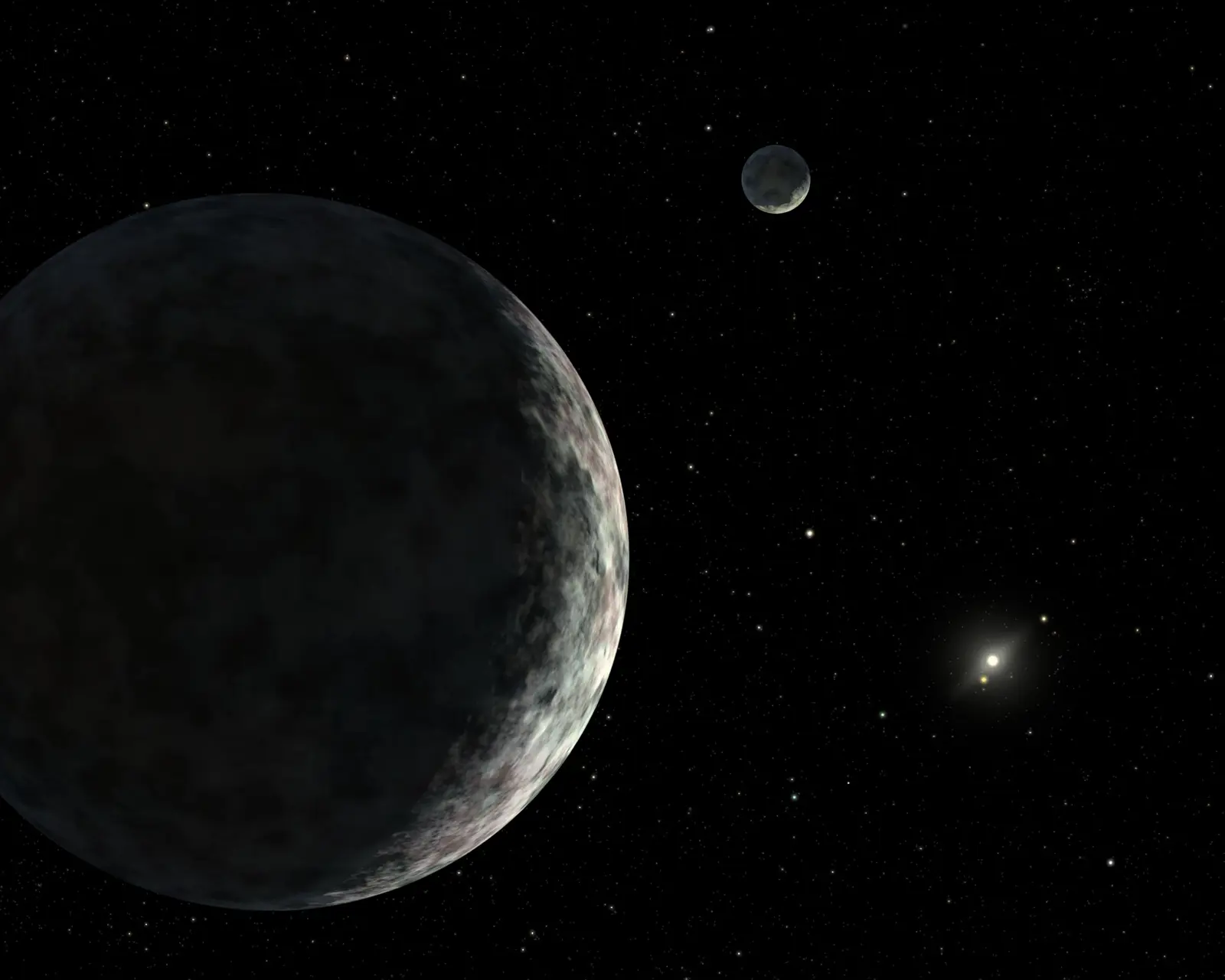
Eris (designated 136199 Eris) is a trans-Neptunian dwarf planet residing in the scattered disk — a vast, sparsely populated region of icy bodies beyond the classical Kuiper Belt. Though slightly smaller in diameter than Pluto, Eris is approximately 27 percent more massive, making it the most massive known dwarf planet in the Solar System. Its discovery in 2005 from archival images taken in 2003 at Palomar Observatory set off an intense scientific and public debate that led the International Astronomical Union (IAU) to formally redefine the word "planet" and simultaneously reclassify Pluto — along with Eris itself — as a dwarf planet.
Eris travels on a strikingly elongated orbit inclined 44 degrees to the ecliptic, swinging between about 38 AU at perihelion and roughly 97.5 AU at aphelion — a journey that takes more than 560 Earth years to complete. At its farthest point, sunlight takes approximately 13 hours to reach it. The dwarf planet is coated in a highly reflective layer of methane and nitrogen ice, giving it one of the brightest surfaces in the entire Solar System. It has one known moon, Dysnomia, whose orbit allowed astronomers to measure Eris's mass with precision. As of the mid-2020s, no spacecraft has visited Eris; all knowledge of it comes from telescopic observations, stellar occultations, and remote sensing by facilities including the James Webb Space Telescope.
Discovery
Eris was found by a team led by Caltech planetary astronomer Michael E. Brown, working with colleagues Chad Trujillo and David Rabinowitz. The discovery images were captured on 21 October 2003 using the 1.2-metre Samuel Oschin Telescope at Palomar Observatory in California, though the object's slow movement against background stars was not recognized until 5 January 2005, during a systematic re-analysis of survey images. It was assigned the provisional designation 2003 UB₃₁₃ based on its discovery epoch. Brown's team informally nicknamed the object "Xena" before it received an official name, and early media reports — including some from the discovery team itself — described it as a candidate tenth planet, larger than Pluto.
The earliest confirmed image of Eris in archival photographic plates dates to 3 September 1954, making that the earliest "precovery" observation. By examining Dysnomia's orbit and applying Kepler's third law, astronomers established that Eris was not only comparable to Pluto in size but clearly more massive — a combination that proved impossible to ignore. If Pluto qualified as a planet, Eris almost certainly did too, and the outer Solar System might harbour dozens more such bodies. This possibility propelled the IAU toward a formal, dynamical definition of the word "planet." Once that definition was adopted in August 2006, both Eris and Pluto fell into the new dwarf planet category. The IAU then approved the name Eris — after the Greek goddess of strife and discord — an explicit reference to the controversy the object had caused. Mike Brown subsequently became widely known, in his own words, as "the man who killed Pluto."
Key events in the story of Eris
- 3 Sep 1954Earliest precovery image
Eris appears on archival photographic plates at Palomar Observatory, though it goes unrecognized for decades.
- 21 Oct 2003Discovery images taken
Mike Brown, Chad Trujillo and David Rabinowitz image the object using the 1.2 m Samuel Oschin Telescope at Palomar. It is provisionally designated 2003 UB₃₁₃.
- 5 Jan 2005Motion confirmed; discovery announced
Re-analysis of survey images reveals the object's movement. The team reports the discovery to the IAU Minor Planet Center. Early media coverage describes it as a possible tenth planet larger than Pluto.
- 2005Moon Dysnomia discovered
Infrared images from the W. M. Keck Observatory reveal a satellite, later named Dysnomia after the mythological daughter of Eris. Tracking Dysnomia's orbit enables a precise measurement of Eris's mass.
- 24 Aug 2006IAU adopts new planet definition
At the IAU General Assembly in Prague, Resolution B5 defines a planet as a body that orbits the Sun, is in hydrostatic equilibrium, and has cleared its orbital neighborhood. Both Pluto and Eris fail the third criterion. The Solar System is declared to have eight planets; Pluto and Eris become the first recognized dwarf planets alongside Ceres.
- 2006Object officially named Eris
The IAU approves the name Eris — Greek goddess of strife — reflecting the discord its discovery provoked. The designation 136199 Eris is assigned.
- 6 Nov 2010Stellar occultation precisely measures Eris
Eris passes in front of a faint background star, observed from two sites in South America. Analysis yields a diameter of 2,326 ± 12 km, a geometric albedo of about 0.96, and a bulk density of 2.52 ± 0.07 g/cm³ — overturning earlier thermal-infrared estimates that had suggested a much larger body.
- May 2020New Horizons observes Eris remotely
From about 112 AU away, NASA's New Horizons spacecraft images Eris at high phase angles impossible to achieve from Earth, refining knowledge of its surface light-scattering properties. The spacecraft does not fly by Eris and has no trajectory to do so.
- 2022JWST detects deuterated methane on Eris
James Webb Space Telescope observations reveal deuterated methane (CH₃D) on Eris's surface. The low deuterium abundance suggests the methane is not primordial but produced by geochemical processes in Eris's interior, hinting at unexpected internal activity.
- 2023Interior modeling reveals 'squishy' structure
Research by Nimmo and Brown finds Eris has a rocky core with an icy shell that is more dissipative ("squishy") than expected, with residual heat from formation still slowly escaping. This internal activity may drive resurfacing and maintain the bright ice coating.
Physical characteristics
Eris is a nearly spherical body with a mean diameter of 2,326 ± 12 km, established by the 2010 stellar occultation and confirmed as the best available measurement. For context, Pluto's diameter — measured precisely by the New Horizons flyby in 2015 — is 2,376.6 ± 1.6 km, making Pluto roughly 50 km wider. Despite being slightly smaller in diameter and volume, Eris is about 27 percent more massive than Pluto, with a mass of (1.66 ± 0.02) × 10²² kg. The combination of high mass in a slightly smaller body gives Eris a bulk density of 2.52 ± 0.07 g/cm³ — substantially higher than Pluto's density of roughly 1.85–1.90 g/cm³.
This high density indicates that Eris is predominantly rocky in composition, with estimates suggesting approximately 70 percent rock and 30 percent ice by mass. Models picture a large rocky core overlain by a relatively thin icy mantle. Photometric monitoring shows very little brightness variation across a rotation, implying a surface of exceptional uniformity. Long-term studies indicate Eris is likely tidally locked with Dysnomia, rotating with a period matching its moon's orbital period of approximately 15.8–16 days — making its "day" one of the longest of any known dwarf planet. The body is consistent with hydrostatic equilibrium — the condition of being sufficiently massive for self-gravity to pull it into a nearly round shape — which is one of the defining requirements of the IAU's dwarf planet category.
Eris's geometric albedo of approximately 0.96 makes it one of the most reflective known objects in the Solar System, comparable to Saturn's moon Enceladus and markedly brighter than Pluto. This extraordinary reflectivity arises from a surface blanketed by fresh, highly reflective volatile ices. Infrared spectroscopy reveals that the dominant surface ice is methane (CH₄), similar to Pluto and Neptune's moon Triton. However, unlike Pluto and Triton — which appear reddish-orange due to organic compounds called tholins — Eris appears nearly white. This difference suggests that Eris's methane frost is continually renewed, preventing the reddening chemistry that discolors its counterparts. Nitrogen ice is also inferred from the surface's brightness and spectral properties.
Surface, atmosphere, and interior
Surface temperatures on Eris range from approximately 30 to 56 K (roughly −243 to −217 °C), depending on orbital position and whether a location faces the Sun. At such extreme cold, volatile compounds such as methane and nitrogen remain frozen solid for the vast majority of Eris's 560-year orbit. The surface is thought to be covered by a very thin layer — possibly sub-millimetre to a few centimetres thick — of nitrogen-rich ice mixed with methane, coating an underlying rocky and water-ice substrate. This frost layer is uniformly distributed, masking any topographic or compositional variation that might exist below.
Eris possesses a tenuous, seasonal atmosphere that exists only when the dwarf planet is relatively close to the Sun near perihelion. By analogy with Pluto and from the detected surface ices, this atmosphere is thought to consist primarily of nitrogen gas with methane, sublimating from the surface as solar heating increases. As Eris moves away from perihelion toward the colder depths of its orbit, the atmosphere collapses — the gases condense back onto the surface as snow or frost, refreshing the bright icy coating. Since Eris is currently near aphelion and has been in the mid-90s AU range for decades, its atmosphere is almost certainly entirely frozen onto the surface at present, leaving only a vacuum-like environment above the frost.
JWST observations published in 2022 added an unexpected dimension to understanding Eris's interior. The telescope detected deuterated methane (CH₃D) in the surface ice. The relatively low deuterium-to-hydrogen ratio compared with cometary methane indicates the methane is likely not primordial material preserved from the Solar System's formation, but instead generated by geochemical processes within Eris's interior and subsequently transported to the surface. This finding implies a more chemically active interior than previously assumed for such a distant, cold body. Complementary modeling by Nimmo and Brown (2023) showed that Eris's icy shell is more "squishy" — mechanically dissipative — than expected, and that residual heat from formation is still slowly leaking out. This internal warmth may help drive ongoing resurfacing, maintaining Eris's unusually bright, fresh-looking surface across geological timescales.
Dysnomia: Eris's moon
Eris has one known natural satellite, Dysnomia, discovered in 2005 in infrared images obtained with the W. M. Keck Observatory in Hawaii. It was named after the mythological daughter of the goddess Eris — a spirit of lawlessness — continuing the theme of discord in naming conventions for this system. Dysnomia orbits Eris in a nearly circular path at a distance of approximately 37,300 km from Eris's center, completing one orbit in about 15.78–16 days.
Dysnomia's estimated diameter is roughly 150–250 km, making it approximately one-eighth the size of Eris. Because Dysnomia is faint and unresolved in most telescopic images, its precise dimensions remain uncertain. Its scientific importance, however, is outsized relative to its modest size: by tracking Dysnomia's orbit and applying Kepler's third law of planetary motion, astronomers could derive Eris's mass with a precision unavailable through any other method. This calculation yielded the finding that Eris, despite being slightly smaller in diameter than Pluto, is some 27 percent more massive — a result with profound implications for understanding the composition and structure of both worlds.
The correspondence between Dysnomia's orbital period and Eris's rotation period strongly implies the system is tidally locked: Eris always presents the same hemisphere toward its moon, much as the Moon always shows one face to Earth. The origin of Dysnomia is thought to be analogous to the giant-impact hypothesis for the Earth–Moon system and for the Pluto–Charon pair: a large collision involving Eris in the early Solar System generated a debris disk from which Dysnomia eventually coalesced.
Orbit and location in the Solar System
Eris belongs to the scattered disk — a dynamically excited population of icy bodies with high orbital eccentricities and inclinations, distinct from the more orderly classical Kuiper Belt. Its orbit is dramatically elongated, with an eccentricity of 0.44, carrying it from a perihelion of about 38.1 AU from the Sun to an aphelion of approximately 97.49 AU. The semi-major axis is 67.69 AU and the orbital period 560.7 years. Its orbital inclination of 44.18° to the ecliptic is more than double that of Pluto (about 17°), placing it well outside the plane in which most Solar System bodies travel.
At its current location in the mid-90s AU range — still close to its aphelion — Eris is moving very slowly, covering only about 3.4 km/s on average. Light from the Sun takes roughly 13 hours to reach it at that distance. By comparison, Pluto orbits at an average of about 39 AU. Eris was near this far point in its orbit when it was first detected, which helped explain why it was recognized so late despite being a large, bright object: it was simply extraordinarily far away. The eccentric orbit also means that for portions of its 560-year cycle, Eris passes within the general region of the Kuiper Belt, though its scattered-disk classification reflects the dynamically perturbed nature of its trajectory rather than membership in the classical belt.
The 2006 planet definition and Eris's role in reshaping astronomy
Before Eris, many planetary scientists already questioned Pluto's classification as a full planet, given its small size, icy composition, and shared orbital environment with the Kuiper Belt. Eris forced the question to a head. When Brown's team initially announced their discovery, they presented it as a candidate tenth planet — an object slightly larger than Pluto on a distant, inclined orbit. If Pluto counted as a planet, Eris almost certainly had to as well, and there was no obvious cutoff to prevent a cascade of additional "planets" as survey telescopes found more Pluto-sized bodies in the outer Solar System.
The IAU convened a special working group and debated multiple competing proposals, including one framework that would have resulted in 50 or more recognized planets. After extensive discussion, the IAU General Assembly in Prague adopted Resolution B5 on 24 August 2006, establishing three criteria a Solar System body must meet to be called a planet: it must orbit the Sun, be in hydrostatic equilibrium (roughly spherical), and have cleared the neighborhood around its orbit of comparably sized bodies. Pluto and Eris satisfy the first two criteria but fail the third — both share their orbital regions with many other bodies. They were placed, together with the asteroid Ceres, into the newly created dwarf planet category. The IAU simultaneously confirmed that the Solar System has eight classical planets, from Mercury through Neptune.
Eris's name was chosen deliberately after the controversy it sparked. In Greek mythology, Eris is the goddess of strife and discord — traits that aptly described the years of debate over planetary classification that her discovery provoked. The moon Dysnomia, named after Eris's mythological daughter and a spirit of lawlessness, continued the theme. Mike Brown has noted that Eris's discovery effectively caused Pluto's demotion, earning him the informal title "the man who killed Pluto" — a distinction he wears with characteristic humor.
Exploration and future study
No spacecraft has ever made a dedicated visit to Eris. All knowledge of the dwarf planet has been assembled from ground-based telescopes, space observatories, and the chance alignment of stellar occultations. The most significant such event — the occultation of 6 November 2010 — produced Eris's most reliable size measurement. Observed from two sites in South America, the event's timing constrained Eris's diameter to 2,326 ± 12 km and its albedo to approximately 0.96, overturning earlier thermal-infrared estimates that had placed its diameter as high as 2,600–3,000 km.
NASA's New Horizons spacecraft, which flew past Pluto in July 2015 and the Kuiper Belt object Arrokoth in January 2019, conducted a remote observing campaign targeting Eris in May 2020. At the time, New Horizons was about 112 AU from the Sun and Eris about 96 AU away. From this unprecedented vantage point, the spacecraft was able to observe Eris at high phase angles — large Sun-Eris-spacecraft angles — impossible to achieve from Earth, yielding new data on the surface's light-scattering properties. However, New Horizons is not on a trajectory that brings it anywhere near Eris for a flyby, and no course change is feasible with its remaining propellant. The spacecraft transitioned to a heliophysics-focused extended mission from fiscal year 2025 onward.
Concept studies have shown that a dedicated flyby of Eris using a Jupiter gravity assist would require approximately 24–25 years of cruise time. Theoretical trajectory calculations have identified potential launch windows, including opportunities around April 2032 (arriving near 92 AU) and April 2044 (arriving near 90 AU). These remain paper studies; no agency has selected, funded, or formally proposed an Eris flyby mission as of the mid-2020s. Near-term advances in understanding Eris will continue to come from remote sensing. The James Webb Space Telescope has already observed Eris and Makemake in detail, with the 2022 detection of deuterated methane representing one of the most significant new findings about the dwarf planet since its discovery. Future occultations and continued spectroscopic campaigns will refine knowledge of its surface chemistry, atmospheric behavior, and interior structure.
What Eris has revealed
Despite being about 50 km smaller in diameter than Pluto, Eris is approximately 27 percent more massive, with a mass of 1.66 × 10²² kg. This was determined by tracking the orbit of its moon Dysnomia and applying Kepler's third law — one of the most consequential mass measurements in outer Solar System science.
Eris's discovery forced the IAU to formally define what a planet is. On 24 August 2006, the IAU adopted a three-criterion definition; both Eris and Pluto failed the third criterion (clearing the orbital neighborhood) and were reclassified as dwarf planets — a new category the IAU created at the same assembly.
The 2010 occultation revealed a geometric albedo of approximately 0.96 — meaning Eris reflects nearly all sunlight that hits it. This makes it one of the most reflective natural bodies known, comparable to Saturn's moon Enceladus and far brighter than Pluto.
Eris's bulk density of 2.52 ± 0.07 g/cm³ — substantially higher than Pluto's roughly 1.85–1.90 g/cm³ — indicates a predominantly rocky interior with an estimated composition of about 70 percent rock and 30 percent ice. The bright surface is a thin veneer of volatile frost over this dense, rocky body.
JWST observations in 2022 detected deuterated methane (CH₃D) on Eris's surface with a deuterium abundance inconsistent with a primordial origin. This suggests the methane is generated by geochemical reactions inside Eris and migrates to the surface — evidence for ongoing internal chemistry in one of the Solar System's coldest bodies.
Modeling published in 2023 found that Eris's icy shell is more mechanically dissipative than expected. Heat left over from the body's formation continues to slowly leak outward, flexing the shell and potentially driving the resurfacing processes that maintain Eris's bright, uniform frost layer.
Long-term photometric monitoring shows that Eris's rotation period — approximately 15.8–16 days — matches Dysnomia's orbital period. This indicates the system is tidally locked: Eris permanently faces the same hemisphere toward its moon, a configuration seen in the Earth-Moon and Pluto-Charon systems.
Frequently asked questions about Eris
Sources
- Eris (dwarf planet) - Wikipedia
- 20 years ago, the discovery of Eris spelled doom for planet Pluto - Astronomy.com
- 136199 Eris | Astronomy and Astrophysics | Research Starters - EBSCO
- Eris | Dwarf Planet, Kuiper Belt, Plutoid | Britannica
- The discovery of 2003 UB313 Eris - Mike Brown / Caltech
- Eris - NASA Science
- The occultation of the dwarf planet Eris in November 2010 - ESO
- Faraway Eris is Pluto's twin: Dwarf planet sized up accurately - Phys.org
- Dwarf planet Eris is squishier than expected - UC Santa Cruz News
- Pluto's 'almost twin' dwarf planet Eris is surprisingly squishy - Space.com
- Eris and Dysnomia | Science | Research Starters - EBSCO
- New Horizons - Wikipedia
- New Horizons - NASA Science