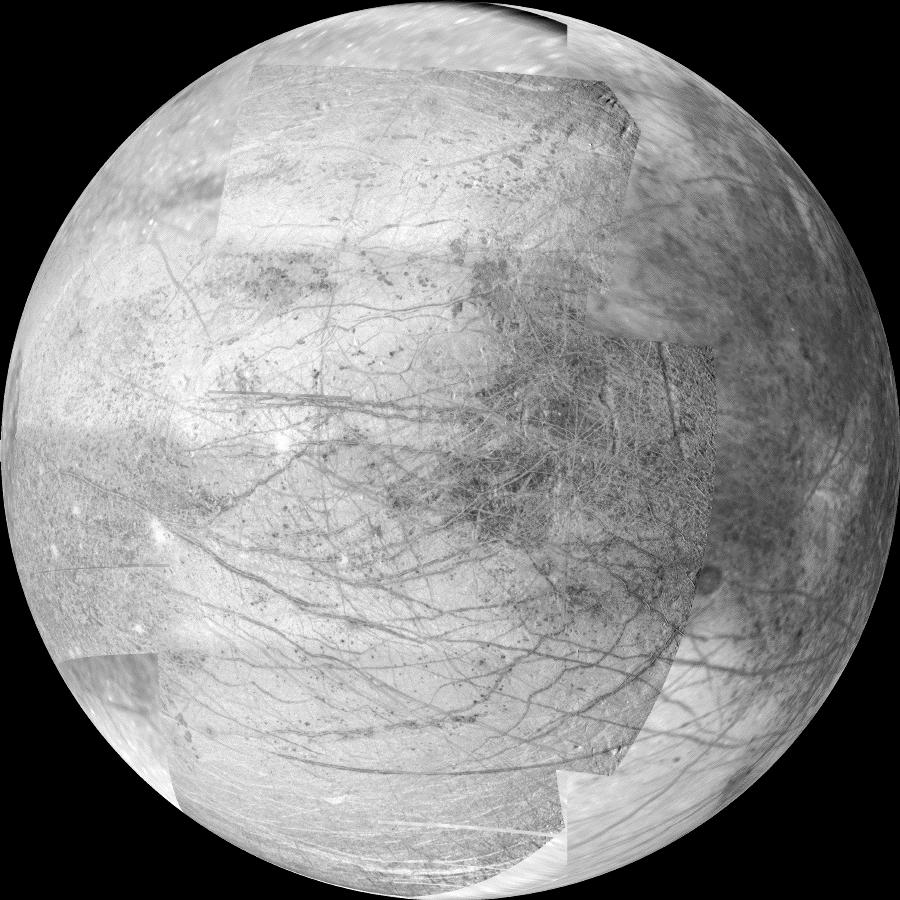
Europa
Jupiter's ice-encased ocean moon — and one of the Solar System's most promising places to search for life.
Europa
Europa is the smallest of the four Galilean moons of Jupiter and one of the most scientifically compelling worlds in the Solar System. Slightly smaller than Earth's Moon, it presents a smooth, bright surface of water ice crisscrossed by thousands of fractures, ridges, and bands — the fingerprints of a geologically restless shell floating atop a global saltwater ocean.
That hidden ocean is the reason Europa commands intense scientific interest. Evidence from the Galileo spacecraft — and subsequently from Hubble Space Telescope observations and Juno flybys — points to a body of liquid water containing more than twice the volume of all Earth's oceans combined, held liquid not by solar heat but by the gravitational kneading of Jupiter and its neighboring moons. Where there is warm, liquid water in contact with rock and a source of chemical energy, the conditions for life as we know it may exist.
Discovered by Galileo Galilei in 1610, Europa was studied only from afar for more than three centuries before spacecraft brought its alien landscape into focus. NASA's Europa Clipper, the largest planetary spacecraft the agency has ever built, launched in October 2024 and is now en route to Jupiter, where it will conduct nearly 50 close flybys of Europa beginning in 2030. Its findings will transform understanding of this ice-clad world and sharpen the debate about whether life could arise in oceans far from the Sun.
Discovery and Early Observations
Europa was first recorded by Galileo Galilei on 8 January 1610, when he turned an early telescope toward Jupiter and noted four points of light that shifted position from night to night. He recognised them as moons orbiting the planet rather than background stars — a discovery that directly challenged the prevailing geocentric model of the cosmos. The German astronomer Simon Marius independently observed the same moons at roughly the same time and is credited with proposing the name Europa, drawn from the Phoenician princess of Greek mythology who was carried to Crete by Zeus (the Greek counterpart of Jupiter).
For more than three centuries after its discovery, Europa was little more than a faint speck even in the best telescopes. Ground-based spectroscopy in the 1960s established that its surface was predominantly water ice — an intriguing finding, but the moon's true character remained hidden. The first hint of a complex world came from Pioneer 10 and Pioneer 11, which flew past Jupiter in the early 1970s but returned only limited data on the Galilean moons.
The Voyager 1 and Voyager 2 flybys in 1979 delivered the first detailed imagery of Europa's surface. The pictures were startling: the moon was astonishingly smooth and bright, almost entirely lacking the impact craters that pock older surfaces like Ganymede and Callisto. In their place was a web of long brown stripes and banded fractures extending thousands of kilometres across the globe. The scarcity of craters implied a young surface, continuously renewed by some internal process. Voyager scientists recognized that the fractured terrain resembled sea ice on Earth, but could not yet confirm the presence of liquid water below.
The decisive advance came with the Galileo spacecraft, which launched in 1989 and entered Jupiter orbit in 1995. During its extended mission, Galileo completed 12 close flybys of Europa. Its magnetometer detected a signature that Galileo's ice surface alone could not produce: Jupiter's magnetic field was being distorted in a way that implied a secondary, induced magnetic field generated within Europa itself. The best explanation — and now the scientific consensus — was a global layer of electrically conductive, salty liquid water lying beneath the ice. Galileo's cameras also captured images of fractured ice blocks that had tilted and refrozen in new positions, strongly resembling icebergs in a terrestrial polar sea, and its spectrometers identified salt minerals, sulfur compounds, and possible organic molecules on the surface. By the time the Galileo mission ended in 2003, Europa had been transformed in the scientific imagination from a curiosity into one of the prime targets in the search for life beyond Earth.
Physical Characteristics and Interior Structure
Europa is a medium-sized icy world with a mean radius of 1,560.8 km and a diameter of approximately 3,122 km, making it roughly 90 percent the size of Earth's Moon and about one-quarter the diameter of Earth. Its mass of 4.80 × 10²² kg is less than one percent of Earth's, yet its mean density of 3.013 g/cm³ — considerably higher than pure ice — reveals a predominantly rocky interior overlaid by a comparatively thin outer water layer. Surface gravity is 1.315 m/s², about 13 percent of Earth's, and the escape velocity of 2.025 km/s is low enough that the moon retains only a whisper of atmosphere.
Models of Europa's interior based on Galileo gravity and magnetic data indicate three broad layers: an iron or iron–nickel core at the centre, a rocky silicate mantle surrounding it, and an outermost global water layer that includes both the frozen surface ice and the liquid ocean beneath. The total thickness of this water layer — ice plus ocean — is estimated at roughly 100 km, far deeper than the average depth of Earth's oceans.
The ice shell is estimated to be approximately 15–30 km thick, though this range reflects genuine scientific uncertainty. NASA's science pages give a figure of about 15–25 km; Galileo-era models span 10–30 km; and a 2024 analysis of data from the Juno spacecraft's Microwave Radiometer reported a best-fit value of about 18 miles (roughly 29 km). Beneath the ice lies a global liquid ocean estimated to be 60–150 km deep. If the lower end of the ice thickness estimate is correct and the upper end of ocean depth is valid, Europa's ocean alone would be vastly more voluminous than Earth's. Current estimates suggest it contains two to three times the total volume of all Earth's oceans.
Europa orbits Jupiter at a mean distance of 670,900 km on a nearly circular path (eccentricity 0.009), completing one orbit every 3.551 Earth days. It is tidally locked, keeping one hemisphere permanently facing Jupiter. The orbital inclination to Jupiter's equator is only 0.47°, and the axial tilt relative to Jupiter is about 0.1°, meaning Europa experiences essentially no seasons. Its average orbital speed is 13.74 km/s. Europa is the smallest of the four Galilean moons, sitting between Io and Ganymede in distance from Jupiter.
The surface albedo of 0.67 makes Europa exceptionally bright — it reflects roughly 5.5 times more sunlight than Earth's Moon — owing to the prevalence of water ice. Average surface temperatures hover around –160 °C, cold enough to keep the surface ice rigid. Despite sitting 5.2 AU from the Sun and receiving only about 4 percent of the solar energy that reaches Earth, Europa's interior is kept warm by tidal flexing: the slight but repeated deformation caused by Jupiter's gravity and gravitational interactions with the neighbouring moons Io and Ganymede generates significant internal heat.
Surface Geology
Europa's surface is one of the smoothest in the Solar System in terms of large-scale topography, yet it is extraordinarily complex in detail. The near-absence of impact craters compared with similarly sized moons testifies to continuous geological resurfacing driven by tidal heating. Three broad feature classes dominate the landscape: lineae (ridges, fractures, and bands), chaos terrain, and associated dark reddish material concentrated along tectonic structures.
Lineae are the most widespread landform on Europa. These global-scale lineaments, often exceeding 1,000 km in length, were first seen in Voyager images and later resolved by Galileo into a hierarchy of features. The most common are double ridges: pairs of roughly parallel crests separated by a central trough, reaching heights of up to about 300 m above the surrounding plains with valleys roughly 0.5 km wide. A 2022 study using ice-penetrating radar in Greenland found a forming double ridge there that matched Europan double ridges closely in morphology; it was produced by repeated pressurization of a shallow subsurface water reservoir. This finding supports the hypothesis that shallow water pockets or lenses are widespread beneath Europa's ridge systems, connecting the ice shell to near-surface brines. Broader bands — some interpreted as dilation bands where the crust pulled apart and upwelling warm ice or slush filled the gap — record episodes of spreading and plate-like separation of the ice shell, analogous in some ways to seafloor spreading on Earth.
Chaos terrain consists of jumbled blocks of pre-existing crust embedded in a disrupted matrix, indicating that large portions of the icy lithosphere have melted or weakened, broken apart, and refrozen in new configurations. The iconic example is Conamara Chaos, where polygonal rafts of ice several kilometres across have been tilted, rotated, and displaced by several kilometres from their original positions. The rafts resemble icebergs; the matrix between them resembles refrozen slush. Chaos terrain is closely associated with concentrations of non-ice material and is widely interpreted as evidence for recent or recurring exchange between the subsurface ocean and the surface.
The reddish-brown and dark material concentrated along ridges, bands, and chaos regions is not pure water ice. Near-infrared spectroscopy from Galileo reveals strong hydroxyl absorption but no clean water-ice signature, indicating hydrated compounds — most likely hydrated salts such as magnesium or sodium sulfates, possibly mixed with sulfuric acid hydrates. These deposits are interpreted as endogenic: material drawn up from the subsurface ocean or brine reservoirs and chemically modified by the intense radiation at the surface. The leading hemisphere of Europa tends to have finer-grained ice, while the trailing hemisphere — more exposed to bombardment by particles trapped in Jupiter's magnetosphere — hosts larger-grained ice and more extensive non-ice material, reflecting the profound influence of Jupiter's radiation environment on surface chemistry.
Europa's geological features are classified under a formal nomenclature approved by the International Astronomical Union. Chaos regions are named for places in Celtic mythology; flexūs (low, curved, scalloped ridges formed by cyclic tidal stressing) are named for places associated with the mythological Europa; fossae are long narrow troughs; and maculae are dark spots or patches, some possibly impact scars modified by endogenic processes. The USGS global geologic map integrates Galileo imaging into a stratigraphic framework that reconstructs the sequence and styles of resurfacing across the entire moon.
The Subsurface Ocean and Habitability
Europa is considered one of the most promising candidates for extraterrestrial habitability in the Solar System because it appears to satisfy the three conditions astrobiologists regard as essential for life as we know it: liquid water, the key chemical elements (carbon, hydrogen, nitrogen, oxygen, phosphorus, sulfur), and a sustained energy source. The global ocean contains more liquid water than all of Earth's oceans combined, the rocky seafloor provides a reservoir of minerals and reactive chemistry, and tidal heating from Jupiter can sustain both the ocean's liquid state and potentially hydrothermal activity over geological timescales.
The ocean is almost certainly salty — the electrical conductivity required to explain Galileo's induced magnetic field measurement demands dissolved ions, most likely chlorides or sulfates. Water–rock interaction at the seafloor could supply hydrogen and other reduced chemical species through processes such as serpentinization, where water reacts with iron- and magnesium-bearing rock. Meanwhile, Jupiter's intense radiation field continuously breaks apart water molecules on the surface, generating oxidants such as molecular oxygen, hydrogen peroxide, and oxidized sulfur species. If these oxidants are transported downward into the ocean through ice tectonics, brine migration, or melt-through events, they can react with seafloor-derived reductants, releasing chemical energy that microorganisms could exploit — an oxidant–reductant cycle analogous to the chemical disequilibria that sustain ecosystems at deep-sea hydrothermal vents on Earth.
The possibility of hydrothermal vents at Europa's seafloor has attracted particular attention because on Earth such vents support thriving ecosystems entirely independent of sunlight, powered by chemotrophy. Tidal heating of Europa's rocky mantle could in principle drive volcanic or hydrothermal circulation. However, recent modelling work has challenged the assumption that Europa's seafloor is currently active. One study concluded that several proposed mechanisms are unlikely to drive slip along pre-existing fractures in Europa's mantle at present, suggesting the seafloor may be geologically quiet — with little or no active fracturing, volcanism, or hydrothermal venting. If confirmed, this would significantly reduce the available chemical energy for vent-dependent life. The same researchers noted that plumes of water vapour observed erupting through the ice do not require an active seafloor; they can be driven by tidal flexing, pressure changes, or near-surface melting within the ice shell alone. The question of seafloor activity remains open and is a key target for Europa Clipper.
Observations from the Hubble Space Telescope and re-analysis of Galileo data have revealed evidence for intermittent water plumes reaching approximately 160 km above Europa's surface. These features are scientifically significant because they could allow a spacecraft to sample ocean-derived or shallow-reservoir material — salts, organic molecules, isotopic ratios — without the need to drill through tens of kilometres of ice. Europa Clipper is designed to fly through any active plumes during its close flybys and analyze their composition directly.
Radiation and Atmosphere
Europa orbits inside Jupiter's powerful magnetosphere, where high-energy electrons and ions are trapped and accelerated. NASA describes the surface as being 'blasted by radiation from Jupiter,' with doses severe enough that life could not survive on the surface. This radiation environment is also a major driver of spacecraft engineering: Europa Clipper's trajectory is designed to minimize cumulative radiation exposure, and the spacecraft's electronics are heavily shielded.
Despite the hostile surface conditions, Europa does possess an atmosphere — albeit an extraordinarily tenuous one. It is classified as an exosphere rather than a true atmosphere: a surface-bound collection of gas molecules that do not interact significantly with one another. The primary constituent is molecular oxygen (O₂) produced by radiolysis, the radiation-driven splitting of water molecules in the surface ice. Traces of water vapour and hydrogen have also been detected or inferred. The surface pressure is approximately 10⁻⁸ millibars, about 100 billion times less than Earth's sea-level pressure — among the thinnest atmospheres of any body in the Solar System. Europa is nonetheless notable as one of only a handful of moons known to have an atmosphere of any kind.
From Discovery to Europa Clipper
- Jan 8, 1610Discovery by Galileo Galilei
Galileo records Europa as one of four moons orbiting Jupiter — the first confirmed moons found around another planet. Simon Marius independently observes the same moons around this time and later proposes the name Europa.
- 1960sWater ice identified
Ground-based spectroscopy establishes that Europa's surface is predominantly water ice, providing the first clue to its icy nature.
- Early 1970sPioneer flybys
Pioneer 10 and Pioneer 11 fly past Jupiter, returning limited but pioneering data on the Jovian system.
- 1979Voyager 1 and 2 flybys
Voyager 1 and Voyager 2 return the first detailed images of Europa's surface, revealing a bright, smooth, heavily fractured ice shell with very few impact craters and long brown banded features — signs of a geologically young and active world.
- Oct 18, 1989Galileo spacecraft launches
NASA's Galileo orbiter departs Earth, bound for the Jupiter system.
- Dec 8, 1995Galileo enters Jupiter orbit
Galileo begins its primary and extended missions around Jupiter, completing 12 close flybys of Europa.
- 1997–2000Galileo ocean evidence
Galileo's magnetometer detects an induced magnetic field around Europa, best explained by a global, electrically conductive salty ocean beneath the ice. Images of tilted and refrozen ice blocks and chaos terrain reinforce the ocean hypothesis.
- Sep 21, 2003Galileo mission ends
NASA deliberately pilots Galileo into Jupiter's atmosphere to avoid any risk of contaminating Europa. The mission's data continue to be analyzed for years afterward.
- 2012–2016Hubble plume detections
Hubble Space Telescope observations provide evidence for intermittent water vapour plumes erupting through Europa's ice, reaching approximately 160 km above the surface — potential windows into the subsurface ocean.
- 2022Greenland double-ridge analog
Researchers using ice-penetrating radar in Greenland identify a forming double ridge morphologically similar to Europa's most common surface feature, produced by pressurization of a shallow subsurface water reservoir — supporting the hypothesis that near-surface water pockets are widespread on Europa.
- 2024Juno ice-shell measurement
Analysis of data from Juno's Microwave Radiometer reports a best-fit ice shell thickness of about 18 miles (~29 km), refining earlier estimates.
- Oct 14, 2024Europa Clipper launches
NASA's Europa Clipper lifts off on a SpaceX Falcon Heavy from Launch Complex 39A at Kennedy Space Center at 12:06 p.m. EDT, beginning a journey of approximately 1.8 billion miles (2.9 billion km) to Jupiter.
- April 2030 (planned)Europa Clipper arrives at Jupiter
The spacecraft is expected to enter the Jovian system and begin nearly 50 close flybys of Europa, with closest approaches as low as 25 km, to systematically investigate the ice shell, ocean, and potential habitability.
Europa Clipper Mission
NASA's Europa Clipper is the most ambitious mission ever directed at an icy ocean world. Launched on 14 October 2024 aboard a SpaceX Falcon Heavy rocket from Launch Complex 39A at Kennedy Space Center, it is the largest planetary science spacecraft NASA has built. The mission's overarching goal is to determine whether Europa's ocean has the conditions needed to support life — not to detect life itself, but to assess habitability.
Rather than orbiting Europa directly — which would expose the spacecraft to Jupiter's intense radiation — Europa Clipper will orbit Jupiter and execute nearly 50 close flybys of Europa, with closest approaches as low as 25 km (16 miles). This trajectory dramatically reduces the cumulative radiation dose while still allowing the instruments to scan nearly the entire moon in detail. The spacecraft will travel approximately 1.8 billion miles (2.9 billion km) and is expected to reach Jupiter in April 2030.
The spacecraft carries nine science instruments plus a gravity experiment that uses the telecommunications system. The payload includes ice-penetrating radar to map the thickness of the ice shell and search for liquid water beneath it; cameras for high-resolution surface imaging; spectrometers to characterise surface and atmospheric composition; a magnetometer to confirm and map the ocean's properties through its induced magnetic field; a thermal imager to identify regions of warmer ice or possible active venting; and dust and plasma sensors to analyse particles in Europa's thin atmosphere and any plume material. Together these instruments address the mission's three core objectives: characterise the ice shell, characterise the ocean beneath it, and characterise the moon's composition and geology.
Science Instruments
- Radar for Europa Assessment and Sounding: Ocean to Near-surface
Ice-penetrating radar to map ice-shell thickness and detect subsurface liquid water.
- Europa Imaging System
Wide- and narrow-angle cameras for high-resolution surface mapping and geological analysis.
- Europa Thermal Emission Imaging System
Thermal infrared imager to identify warmer ice, potential active sites, and surface temperature variations.
- Mapping Imaging Spectrometer for Europa
Near-infrared spectrometer to map surface composition, identifying salts, organics, and other materials.
- Europa Ultraviolet Spectrograph
Ultraviolet spectrograph to study the atmosphere, search for plumes, and characterise surface chemistry.
- MAss SPectrometer for Planetary EXploration
Mass spectrometer to analyse gases and plume material in Europa's thin atmosphere.
- SUrface Dust Analyzer
Dust analyser to characterise particles ejected from Europa's surface, including possible ocean-derived material.
- Plasma Instrument for Magnetic Sounding
Plasma sensor to characterise the plasma environment and support magnetic sounding of the ocean.
- Europa Clipper Magnetometer
Magnetometer to measure Europa's induced magnetic field and constrain the depth, thickness, and salinity of the ocean.
- Gravity/Radio Science Experiment
Uses the spacecraft telecommunications system to measure gravitational perturbations and probe interior structure.
Key Discoveries
The Galileo spacecraft's magnetometer detected an induced magnetic field around Europa that is best explained by a global, electrically conductive (salty) liquid water layer beneath the ice — the strongest evidence that Europa harbours a subsurface ocean containing two to three times the volume of all Earth's oceans.
The near-absence of impact craters compared with other Galilean moons such as Ganymede and Callisto implies continuous geological resurfacing. Voyager and Galileo revealed a landscape of ridges, fractures, and chaos terrain consistent with a mobile ice shell driven by tidal heating.
Galileo images of Conamara Chaos showed polygonal blocks of pre-existing crust that had tilted, rotated, and drifted several kilometres from their original positions before refreezing — strong evidence for liquid water or slush at or near the surface at the time of formation.
Spectroscopy from Galileo identified dark reddish material along ridges and chaos terrain as hydrated compounds — likely magnesium or sodium sulfates and possibly sulfuric acid hydrates — interpreted as material brought up from the ocean interior and modified by radiation.
Hubble Space Telescope observations and re-analysis of Galileo data revealed evidence for intermittent plumes of water vapour reaching approximately 160 km above Europa's surface, offering a potential sampling opportunity for ocean-derived or shallow-reservoir material.
A 2022 study using ice-penetrating radar in Greenland found a forming double ridge morphologically identical to Europa's most common surface feature, generated by pressurisation of a shallow water reservoir — suggesting liquid or slushy water pockets may be widespread just beneath Europa's surface.
A 2024 analysis of data from the Juno spacecraft's Microwave Radiometer reported a best-fit ice shell thickness of approximately 18 miles (~29 km), consistent with the upper range of Galileo-era estimates and providing the tightest direct observational constraint to date.
Europa FAQ
Sources
- Europa: Facts – NASA Science
- Jupiter's moon Europa has an ice shell about 18 miles thick – Space.com
- Europa (moon) – Wikipedia
- Europa – NASA Science
- The ocean of Jupiter's moon Europa – Open University / OpenLearn
- Why Europa: Evidence for an Ocean – NASA Science
- Why Europa: Ingredients for Life – NASA Science
- Europa May Be Lifeless and Uninhabitable After All – Universe Today
- Investigating Europa's Habitability with the Europa Clipper – PMC/NIH
- Europa Clipper – NASA Science
- Europa Clipper – Wikipedia
- Europa Clipper Mission Overview – NASA Science
- Europa: A guide to Jupiter's icy moon – Space.com
- Europa | Facts, Composition & Exploration – Britannica
- Scientists explain formation of abundant features on Europa – Stanford News
- Geology of Europa – Laboratory for Atmospheric and Space Physics (PDF)
- Global geologic map of Europa – USGS
- Europa: Jupiter's Moon – NOAA Science On a Sphere
- Europa – The Planetary Society
- Meet the Solar System: Europa – Space Center Houston