Jupiter
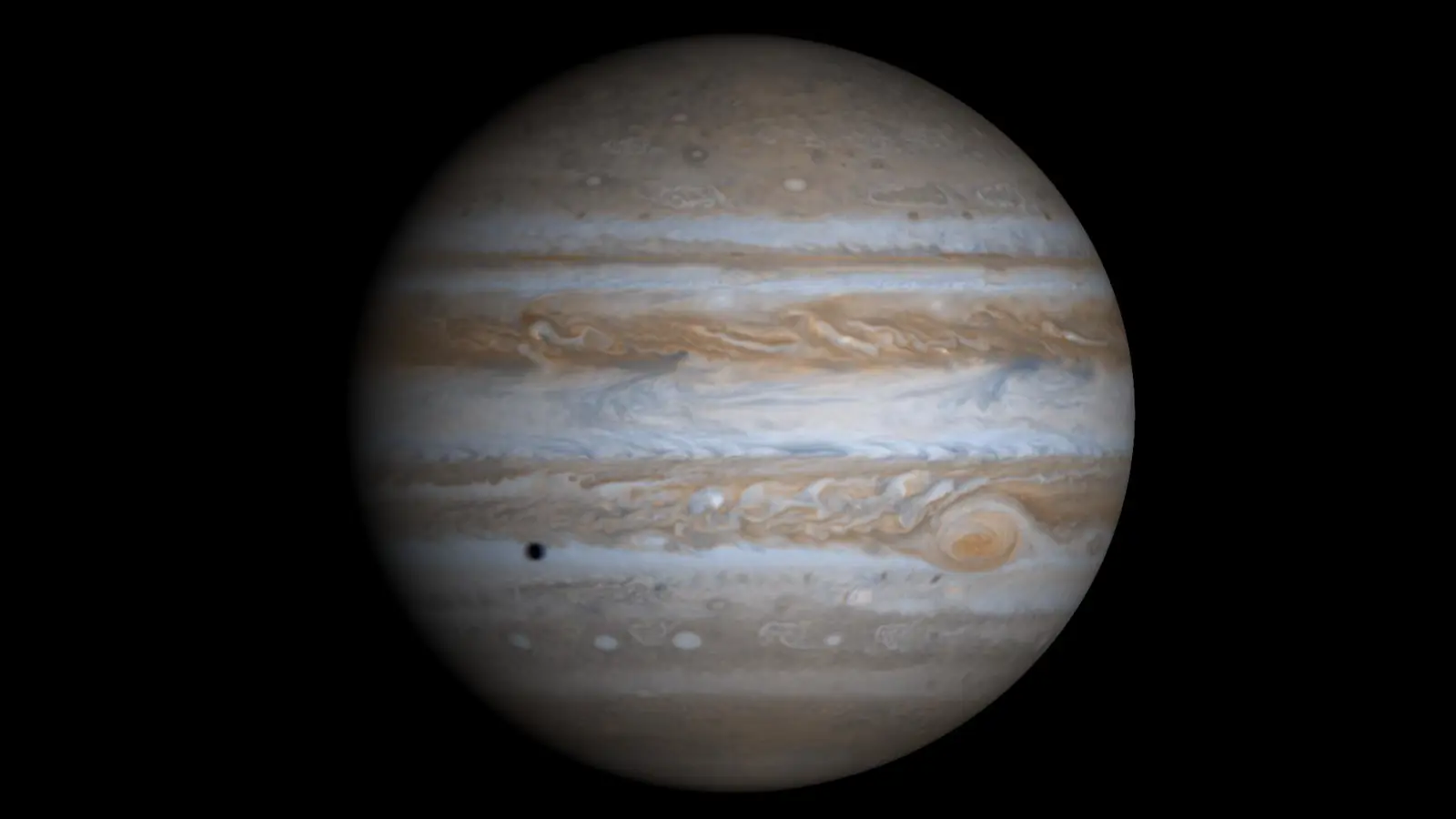
The largest and most massive planet in the Solar System — a hydrogen-helium gas giant with 101 known moons, a vast magnetosphere, and a centuries-old storm larger than Earth.

Jupiter
Jupiter is the largest and most massive planet in the Solar System. With a mass of about 1.898×10^27 kg — some 317.8 times that of Earth — and a volume roughly 1,321 times Earth's, it dwarfs every other planet. It is a gas giant composed primarily of hydrogen and helium, with trace compounds such as ammonia, water vapor, methane, and hydrogen sulfide in its atmosphere.
Its mean density of about 1.326 g/cm³ is lower than Earth's, reflecting its gaseous composition. Jupiter's rapid rotation makes it an oblate spheroid — its equatorial radius of about 71,492 km is roughly 7% larger than its polar radius of about 66,854 km. Beneath visible cloud tops of ammonia and water clouds lie layers of liquid and metallic hydrogen, and the planet likely has a dense core, though the exact interior structure remains an active research topic.
Orbit and rotation
Jupiter orbits the Sun at an average distance of about 778 million km (5.20 AU), completing one sidereal orbit every 11.86 years — about 4,332.59 days, or roughly 12 Earth years. Despite its enormous size, it has the shortest day of any planet: it rotates once every 9 hours, 55 minutes, and 30 seconds, about 9.9 hours. This rapid spin is what flattens the planet into an oblate shape, with the equatorial radius about 7% larger than the polar radius.
The Great Red Spot
Jupiter's most famous feature is the Great Red Spot, a long-lived anticyclonic storm and the largest in the Solar System, centered near 22°S in the southern hemisphere. Its peripheral wind speeds reach about 400–500 km/h (250–310 mph), and Juno gravity and microwave data indicate the storm extends 200–500 km below the visible cloud tops — far deeper than terrestrial hurricanes.
The spot has shrunk dramatically over the past century. In the late 19th century it spanned roughly 40,000–48,000 km east–west, more than three times Earth's diameter. By the 1979 Voyager flybys it had shrunk to about 23,000 km, and by April 2017 its width was about 16,350 km. Hubble observations from late 2023 to early 2024 measured it at about 16,500 km (roughly 10,250 miles) across at its widest point — only somewhat larger than Earth. Since about 2012 the spot has become more circular, with its contraction accelerating to roughly 900 km per year in length.
Around 2019, observers saw "flaking" events in which fragments of cloud peeled off the edges and dissipated. High-resolution Hubble observations from December 2023 to March 2024 showed the spot wobbling, squeezing in and out, and fluctuating in size, with winds speeding up and slowing down over weeks to months. Some researchers suggest the visible spot could dissipate within one or two decades, while others argue the observed area mainly reflects cloud coverage and that the underlying vortex may persist for many decades or centuries. The consensus is that the storm is evolving but still strong, with an uncertain ultimate lifetime.
Moons
Jupiter has 101 confirmed moons recognized by the International Astronomical Union as of March 2026. The four largest are the Galilean moons — Io, Europa, Ganymede, and Callisto — first observed in 1610 by Galileo Galilei, making them the first moons ever discovered around another planet.
Ring system and magnetosphere
Jupiter possesses the largest magnetosphere in the Solar System, driven by an unusually strong magnetic field. The equatorial surface field is approximately 4.2–4.3 gauss, while the polar surface field reaches about 11 gauss at the south pole and 14 gauss at the north pole. Because Jupiter's field is not a perfect dipole, exact values vary depending on the measurement location and reference frame used.
Jupiter's faint dust ring system sits deep within this magnetic environment. The rings are shaped in part by electromagnetic forces from the magnetosphere — especially the halo ring — while charged particles from the Io torus reflect the coupling between the rings, plasma, and magnetic field.
Recent discoveries from NASA's Juno
- Mar 7, 2024Perijove 59
Juno captured images showing Jupiter's colorful belts, swirling storms, and the Great Red Spot, along with glimpses of the moon Amalthea.
- 2024First views of Io's northern latitudes
Flybys produced the first images of Io's northern latitudes and observations of plumes rising above the horizon, extending Juno's mapping of the moon.
- Sep 20, 2024Perijove 65
Juno captured especially clear views of Jupiter's circumpolar (north polar) cyclones.
- Dec 27, 2024Most powerful volcanic event on Io
Juno's JIRAM infrared instrument detected a volcanic hotspot in Io's southern hemisphere covering about 100,000 km² — larger than Lake Superior — with a radiance well above 80 trillion watts, roughly six times the total output of all human power plants on Earth. NASA described it as the most powerful volcanic eruption ever recorded on Io. The signal saturated JIRAM's detector; researchers suggest it may represent several closely spaced hotspots overlying a large subsurface magma system.
What Juno has revealed about Jupiter
Jupiter's belts and zones extend about 3,000 km below the cloud tops.
The planet's core is likely dilute or "fuzzy" rather than sharply defined.
Juno established that Jupiter hosts deep storms and intense auroral activity.
Jupiter FAQ
Sources
- Jupiter - Wikipedia
- Jupiter Facts - NASA Science
- Jupiter | Facts, Moons, Rings, Temperature, Size, & Color - Britannica
- What Is Jupiter? (Grades 5-8) - NASA
- Great Red Spot - Wikipedia
- Hubble Shows that Jupiter's Great Red Spot Is Smaller than Ever Seen Before - NASA
- Hubble takes new look at Jupiter's Great Red Spot - ESA Hubble
- Great Red Spot | Facts, Size, & Definition - Britannica
- Jupiter's Great Red Spot: Everything you need to know - Space
- Galilean moons - Wikipedia
- Jupiter Moons - NASA Science
- The large moons of Jupiter (Galilean moons) - DLR
- IAU Minor Planet Center Confirms New Moons of Saturn and Jupiter
- More moons for Jupiter and Saturn! New totals here - EarthSky
- Magnetic Field of Jupiter - HyperPhysics
- Magnetosphere of Jupiter - Wikipedia
- The Outer Planets: Giant Planets: Magnetospheres - LASP
- NASA Juno Mission Spots Most Powerful Volcanic Activity on Io to Date - JPL
- Juno spots most extreme volcanic activity on Io to date - EarthSky
- Juno - NASA Science
- Mission Perijoves - Mission Juno
- Juno, NASA's Jupiter probe - The Planetary Society
- Jupiter - Gas Giant, Moons, Orbit - Britannica