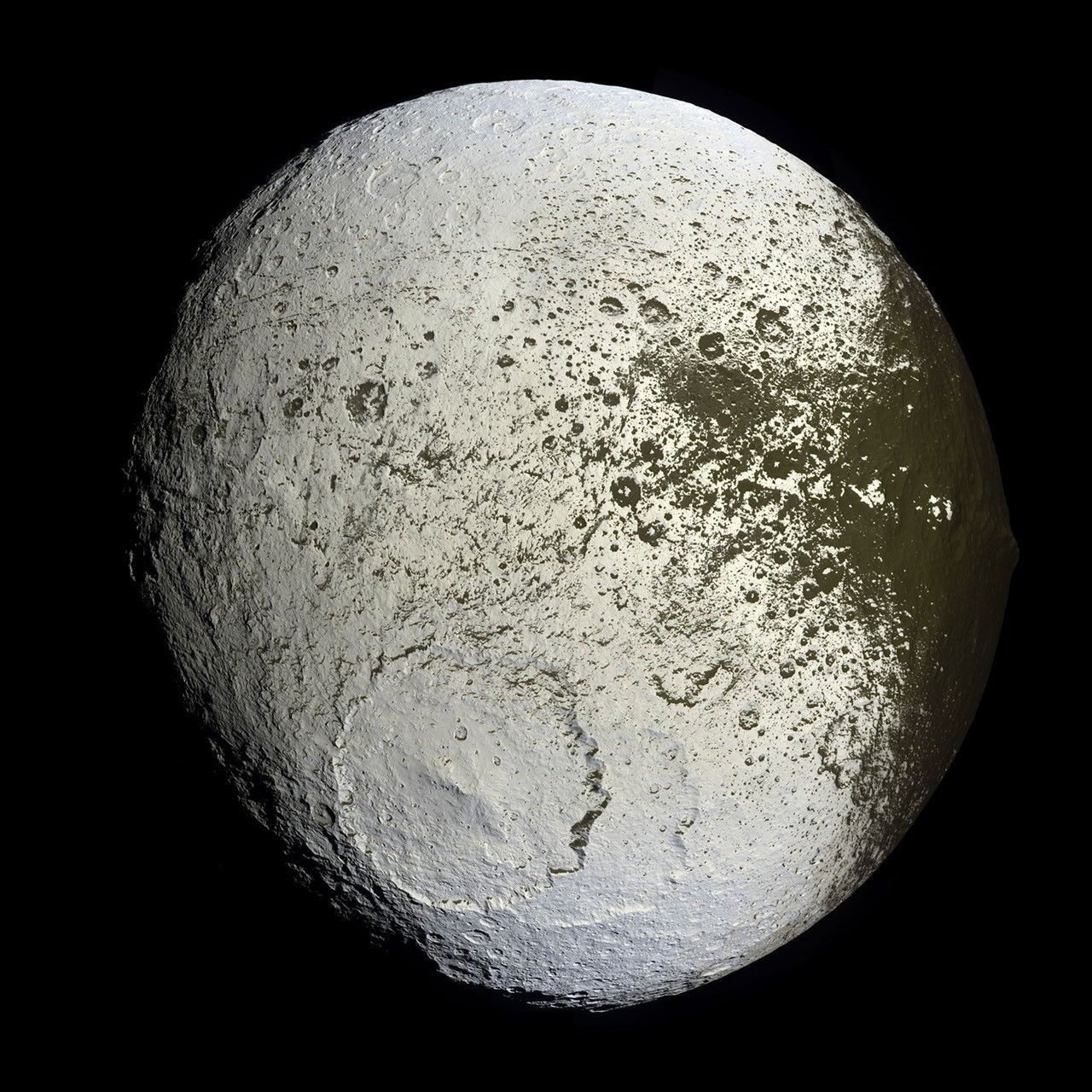
Iapetus
Saturn's enigmatic two-toned moon — one hemisphere dark as coal, the other bright as snow — concealing a 350-year-old mystery that only a spacecraft named for its discoverer could solve.
Iapetus
Iapetus is the third-largest moon of Saturn and one of the most visually striking objects in the Solar System. Its leading hemisphere is coated in material so dark — with a reflectivity of roughly 3–5%, comparable to coal — that it absorbs nearly all incident sunlight, while its trailing hemisphere and poles are covered in brilliant water ice with reflectivities above 60%. This extreme hemispheric contrast, the strongest known for any Solar System body, gave Iapetus the informal nickname of the "yin-yang moon."
The moon was discovered on 25 October 1671 by the Italian-born French astronomer Giovanni Domenico Cassini, who almost immediately noticed that Iapetus seemed to vanish from his telescope when it moved to one side of Saturn and reappear on the other. He correctly deduced that the moon was tidally locked to Saturn and must have one bright and one dark hemisphere — a conclusion that anticipated the spacecraft era by more than three centuries.
Beyond its famous two-tone appearance, Iapetus hosts another extraordinary feature: a towering equatorial ridge that runs along most of the moon's circumference, reaching heights of up to roughly 20 km and widths of about 100 km, giving it a shape often likened to a walnut. The ridge's origin — whether a frozen relic of rapid early spin, a pile of accreted ring debris, or something else — remains one of the open questions of planetary science.
The Cassini–Huygens spacecraft, named partly in honor of the moon's discoverer, conducted multiple flybys of Iapetus and one very close targeted encounter on 10 September 2007, transforming understanding of the surface composition and the processes responsible for its unique appearance. Current scientific consensus explains the albedo dichotomy as the product of two coupled processes: external deposition of dark silicate-rich dust swept up from retrograde outer moons such as Phoebe, followed by a thermal runaway that redistributes water ice from warm dark areas to cold bright ones, amplifying the contrast over billions of years.
From telescope to spacecraft
- 25 Oct 1671Discovery by Giovanni Cassini
Giovanni Domenico Cassini first observed Iapetus as a faint point west of Saturn. It was only the sixth natural satellite beyond Earth to be discovered, after the four Galilean moons of Jupiter and Saturn's Titan.
- 1705Cassini detects the brightness dichotomy
After years of puzzlement, Cassini finally observed Iapetus on the eastern side of Saturn and found it about two magnitudes fainter there. He correctly inferred the moon is tidally locked and has one bright and one dark hemisphere.
- 1671–1705Name and designation
Cassini named the four Saturnian moons he discovered Sidera Lodoicea ("stars of Louis") in honor of King Louis XIV. Iapetus was later designated Saturn V in early Roman-numeral numbering.
- 1974Soter proposes Phoebe dust hypothesis
Astronomer Steve Soter proposed that dust from Phoebe and similar retrograde bodies spirals inward under Poynting–Robertson drag and coats the leading hemisphere of Iapetus — the first quantitative exogenic model for the brightness dichotomy.
- Nov 1980 – Aug 1981Voyager 1 and 2 flybys
The Voyager spacecraft provided the first close-up images of Iapetus, confirming the stark brightness dichotomy. They revealed that the dark terrain (later named Cassini Regio) has an albedo of only about 3%, comparable to coal, while the bright side is heavily cratered water ice. The full extent of the equatorial ridge was not yet apparent.
- 1 Jul 2004Cassini–Huygens arrives at Saturn
The Cassini–Huygens spacecraft entered Saturn orbit and began a multi-year survey of the planet and its moons, including early distant observations of Iapetus.
- 31 Dec 2004First Cassini flyby of Iapetus
Cassini conducted an early flyby of Iapetus, returning improved images that revealed the equatorial ridge for the first time in detail and confirmed the global two-tone coloration.
- 10 Sep 2007Targeted close flyby — 1,640 km altitude
Cassini's closest Iapetus flyby, at a minimum altitude of about 1,640 km, returned the definitive data set on the moon's surface composition, equatorial ridge geometry, and albedo distribution. Shortly after data recording, Cassini entered safe mode due to a cosmic-ray hit on a power switch, but all Iapetus science data had already been stored and were successfully downlinked on 11–12 September.
- 2009Phoebe ring discovered
Cassini observations revealed a vast, tenuous ring of dark dust in the outer Saturn system, closely associated with Phoebe's orbit. The ring strongly supports the model in which Iapetus's leading hemisphere sweeps up Phoebe-derived dust.
- 15 Sep 2017Cassini mission ends
The Cassini spacecraft was deliberately deorbited into Saturn's atmosphere, ending 13 years of Saturn-system science. Iapetus data from the mission continue to be analysed and published.
Discovery and early observations
Giovanni Domenico Cassini, the Italian-born director of the Paris Observatory, first glimpsed Iapetus on 25 October 1671 as a faint star-like point to the west of Saturn. It was an immediate landmark: only the sixth natural satellite beyond Earth known at the time, following the four Galilean moons of Jupiter and Titan, which Christiaan Huygens had found in 1655. Cassini named his four Saturnian discoveries — Iapetus, Rhea, Tethys, and Dione — Sidera Lodoicea, the "stars of Louis," in honor of King Louis XIV.
Almost at once Cassini noticed something baffling. Iapetus was clearly visible when it lay to the west of Saturn, but when it should have appeared to the east it was essentially invisible in his telescope. The moon seemed to come and go. By 1705, with improved optics, Cassini finally recovered Iapetus on the eastern side and measured it to be about two magnitudes fainter there than on the western side. From this observation alone, and without any spacecraft, he derived two correct conclusions: Iapetus must be tidally locked, always showing the same face to Saturn as it orbits; and it must have one bright hemisphere and one dark hemisphere, so that its apparent brightness from Earth depends entirely on which face is currently turned toward us. It was a remarkable piece of deductive reasoning that would stand for nearly three centuries before spacecraft could confirm and explain it.
Physical characteristics and interior
Iapetus is a large but low-density world. Its mean diameter of approximately 1,471 km makes it Saturn's third-largest moon and the eleventh-largest moon in the Solar System. Yet its mean density of only about 1.08–1.2 g/cm³ — barely above that of liquid water — reveals that it is composed predominantly of water ice, with a rock fraction estimated at no more than roughly 20–25%. Its total mass is approximately 1.8 × 10²¹ kg, about 2% that of Earth's Moon.
Iapetus is not a perfect sphere. It has a pronounced equatorial bulge and noticeably flattened poles, giving it an oblate shape broadly consistent with having once rotated much faster than it does today. At its current synchronous rotation period of 79.3 Earth days — the same as its orbital period — no rotation-driven bulge of that magnitude would form; the shape is therefore interpreted as a "fossil figure" preserved from an earlier era of rapid spin. The interior must have cooled and stiffened before tides had fully braked the rotation, locking in the ancient shape.
The surface is ancient and heavily cratered, with crater densities comparable to the oldest terrains on other Saturnian moons. Craters show little viscous relaxation, implying a cold, mechanically rigid ice lithosphere. Large impact basins exceeding 350 km in diameter have been mapped, and mass-wasting features — landslides along crater walls and the equatorial ridge — indicate that steep slopes occasionally fail under gravity. No evidence of current or recent volcanism has been found.
The two-tone surface: Cassini Regio and the bright terrains
The most immediately striking feature of Iapetus is its hemispheric color contrast, the strongest known for any Solar System body. The leading hemisphere — the side that faces forward in the direction of orbital motion — is covered by Cassini Regio, a dark, reddish-brown region with a Bond albedo of only about 0.03–0.05, as dark as freshly laid asphalt or coal. The trailing hemisphere and polar regions, named Roncevaux Terra (north) and Saragossa Terra (south), are bright water ice with albedos of 0.5–0.6, comparable to clean snow. The difference between the two terrains spans almost an order of magnitude in reflectivity.
Voyager imaging in 1980–1981 first showed this dichotomy in photographic detail, and Cassini data from 2004 onward revealed the full complexity. The boundary between dark and bright terrain is not a sharp line but a gradual transition; at latitudes poleward of roughly 40°, the dark coating gives way to brighter ice, and dark streaks a few kilometers wide and tens of kilometers long are visible near the margins of Cassini Regio. Within the dark region, small bright craters and fresh landslide scarps expose the underlying icy substrate, confirming that the dark material is a thin surface veneer — perhaps only a few percent ice by volume — draped over much brighter ice below.
Cassini's Visual and Infrared Imaging Spectrometer (VIMS) and Composite Infrared Spectrometer (CIRS) analyzed the composition of both terrains in detail. The bright regions are dominated by relatively clean water ice, consistent with their high reflectivity and low temperatures of about 113 K. The dark material in Cassini Regio contains a mixture of components including metallic iron, nanometer-scale iron oxide (hematite), carbon dioxide, water ice mixed with darker phases, amorphous carbon, poly-hydrogen cyanide (poly-HCN), and possibly ammonia and other organic compounds. The spectral characteristics of this dark material closely match those measured by Cassini on Phoebe, Hyperion, Dione, Epimetheus, and parts of Saturn's ring system, implying a common composition and likely a common ultimate source across the Saturn system.
Origin of the brightness dichotomy: dust and thermal runaway
The scientific consensus, built on decades of modeling and confirmed by Cassini data, attributes the extreme albedo contrast to a two-stage process: external deposition of dark material followed by thermal segregation of water ice.
The first stage is exogenic. Iapetus orbits Saturn at about 3.56 million km and is tidally locked, meaning its leading hemisphere perpetually sweeps forward through space. Farther out in the Saturn system, small retrograde moons — most importantly Phoebe — are continuously bombarded by micrometeoroids, which eject dark dust from their surfaces. Radiation pressure and Poynting–Robertson drag cause this dust to spiral slowly inward toward Saturn, and Iapetus's leading hemisphere plows through the resulting retrograde dust stream. Over geologic time, this accumulates a thin coating of dark, silicate-rich, carbonaceous material on Cassini Regio. Cassini's discovery of a vast, tenuous Phoebe ring of dark dust in the outer Saturn system provided direct observational support for this mechanism.
The second stage is thermal. Once even a modest albedo contrast exists between the leading and trailing hemispheres, the darker leading side absorbs more sunlight and reaches measurably higher temperatures. Cassini measured peak daytime surface temperatures of about 129–130 K in Cassini Regio, compared with roughly 113 K in the bright terrains. This temperature difference, modest in absolute terms, is sufficient to drive sublimation of water ice from the warmer dark areas. The sublimated water molecules travel on ballistic trajectories across Iapetus's near-vacuum surface environment and preferentially recondense on the colder regions — the bright trailing hemisphere and especially the poles, which act as permanent cold traps.
The result is a powerful positive feedback. As ice sublimes from Cassini Regio, it leaves behind a thicker lag of non-volatile dark material, reducing the albedo further, raising temperatures further, and accelerating sublimation still more. Meanwhile, the bright regions accumulate frost, increasing their albedo and keeping them colder, which makes them even more effective cold traps. Calculations suggest that dark regions can lose on the order of 20 meters of ice per billion years through this process, while bright regions lose only about 10 centimeters. Over the age of the Solar System, this runaway feedback has amplified an initial modest contrast into the extreme black-and-white dichotomy observed today. The process also explains the sharp transition boundary and the near-absence of intermediate grey zones: any surface is driven toward one of two stable states, either persistently dark or persistently bright.
The equatorial ridge: a walnut in space
Iapetus possesses one of the most unusual surface features in the Solar System: a colossal ridge running almost exactly along the equator for more than 75% of the moon's circumference. Individual peaks reach more than 20 km above the surrounding plains — taller than any mountain on Dione or Rhea, and among the tallest mountain structures known relative to the size of their parent body. The ridge is approximately 100 km wide and heavily cratered, demonstrating that it formed early in Iapetus's history. Combined with the moon's oblate global shape, this feature gives Iapetus its characteristic walnut-like appearance in spacecraft images.
How the ridge formed is one of the unresolved questions of outer Solar System science. Two broad classes of hypotheses have been developed.
Endogenic models propose that the ridge is an internal feature. The most discussed version is the "fossil rotational bulge" hypothesis: when Iapetus was young, it may have spun much faster, with a rotation period as short as roughly 17 hours. At that rate, centrifugal effects would have created a pronounced equatorial bulge. If the outer shell cooled and stiffened while the interior was still being heated by decay of short-lived radionuclides such as aluminium-26 — allowing Saturn's tides to continue braking the spin — the bulge could have been frozen into the lithosphere as a permanent ridge rather than collapsing as the rotation slowed. This model requires Iapetus to have formed very early in Solar System history, approximately two million years after the first asteroids, to have incorporated enough aluminium-26 for the necessary internal heating.
Exogenic models propose that the ridge accumulated from material falling onto the equator from outside. One detailed version invokes a giant impact that ejected debris into orbit around Iapetus, forming a small sub-satellite and a surrounding debris ring. Tidal interactions would eventually have caused the sub-satellite to break apart, generating a dense low-orbit ring; ring particles would then have spiraled in and impacted along the equator at roughly horizontal velocities of about 400 m/s, gradually building up the ridge through repeated impacts. A 2021 photogeologic study by Detelich and colleagues, which analyzed crater-size frequency distributions at the ridge and at adjacent equatorial terrain, found that the ridge is measurably younger than surrounding surfaces — consistent with material added onto an already cold, thick lithosphere rather than uplifted from below. The absence of a clear flexural moat alongside the ridge, which would be expected if a thin lithosphere were bending under the ridge's enormous mass, also supports the interpretation that the shell was already mechanically strong when the ridge formed. These observations are more naturally explained by an exogenic ring-accretion scenario than by endogenic tectonic uplift, though neither model is yet definitively established.
The Cassini–Huygens mission and the 2007 close flyby
The Cassini–Huygens spacecraft, named partly in honor of Giovanni Cassini and Christiaan Huygens, arrived at Saturn in July 2004 and conducted multiple observations of Iapetus over the course of its 13-year mission. The pivotal encounter came on 10 September 2007, when Cassini made its closest targeted flyby of the moon, passing within approximately 1,640 km (roughly 1,000 miles) of the surface. This was the only very-close targeted flyby of Iapetus planned for the entire mission, and it was designed to resolve the key outstanding questions about the dark material's composition and the equatorial ridge's geometry.
Cassini's imaging cameras (ISS), VIMS, CIRS, and other instruments all collected data during the encounter. Shortly after the first data downlink, Cassini unexpectedly entered safe mode because a solid-state power switch was tripped by a galactic cosmic-ray hit. However, all Iapetus science data had already been recorded on board before the safe-mode event and were successfully recovered. High-rate science playback resumed on 11 September, and all Iapetus flyby data were returned during downlinks on 11–12 September 2007.
The 2007 flyby data, combined with earlier and later Cassini observations, fundamentally changed understanding of the moon. The dominant view before Cassini had placed organic compounds at the center of the dark material story; Cassini's infrared instruments showed instead that silicate-rich material — metallic iron, hematite, and associated minerals — is the primary colorant, matching the spectral signature of material observed on Phoebe and distributed more widely across the Saturn system. Cassini's Cosmic Dust Analyzer (CDA) also detected dust grains in the Saturn system containing oxygen, silicon, and iron, consistent with iron-bearing silicates and providing in-situ confirmation of the same class of material inferred from the spectral observations. The thermal segregation model received strong support from imaging of the transition zones near the margins of Cassini Regio, where the thinning of the dark coating and the distribution of dark streaks pointed clearly to ongoing thermal reworking of the surface.
What exploration revealed
Cassini Regio has a reflectivity of only about 3–5%, comparable to coal, while the trailing hemisphere reaches above 60% — an order-of-magnitude contrast that is the strongest hemispheric albedo dichotomy known for any Solar System body.
Cassini discovered a vast, tenuous ring of dark dust associated with Phoebe's orbit. Iapetus's leading hemisphere sweeps through this ring, providing direct observational support for the long-hypothesized exogenic coating model first proposed by Steve Soter in 1974.
Before Cassini, the dark material was widely assumed to be primarily organic. VIMS and CIRS data from the 2007 flyby showed instead that silicate-rich material — metallic iron, hematite, and related minerals — is the dominant colorant, matching spectral signatures on Phoebe and across the Saturn system.
A coupled dust-deposition and thermal-runaway model explains why the boundary between dark and bright terrain is so sharp: once a dark lag forms, warmer temperatures drive ice sublimation, removing ice from dark areas and depositing it as frost in cold bright ones, with positive feedback driving both terrains toward extreme endstates.
Crater-size frequency analyses show the ridge is heavily cratered and ancient, yet formed after the bulk of surrounding terrain — consistent with it being a secondary structure, whether a frozen rotational bulge or accreted ring debris, rather than a primary feature of Iapetus's original crust.
Iapetus's flattened poles and equatorial bulge are consistent with an early spin period as short as roughly 10–17 hours before tidal braking slowed it to the current 79.3-day synchronous rotation. The shape was preserved because the outer shell cooled and stiffened before the interior reached equilibrium.
Iapetus FAQ
Sources
- Iapetus: Saturn's Yin-Yang Moon — Space.com
- Iapetus — NASA Science
- Iapetus: Saturn's Moon — NOAA Science On a Sphere
- Iapetus (moon) — Wikipedia
- Iapetus (moon) — EBSCO Research Starters
- Remembering Cassini: The Mystery of Iapetus — Carolyn Porco
- Cassini Gets Close-Up Views of Saturn's Moon Iapetus — NASA JPL
- Iapetus Flyby — Sept. 10, 2007 — NASA Science
- Equatorial ridge on Iapetus — Wikipedia
- Iapetus's Equatorial Ridge — Planetary Geomorphology
- Iapetus' peerless equatorial ridge — The Planetary Society
- How Iapetus got its ridge — Washington University in St. Louis
- The surface composition of Iapetus: Mapping results from Cassini VIMS — ScienceDirect
- Iapetus Surface Composition — NASA JPL
- Iapetus, 350 years later, remains our most misunderstood moon — Big Think
- Crater Populations of Saturnian Satellites — AGU Journals
- Iapetus Moon Facts — Space Facts