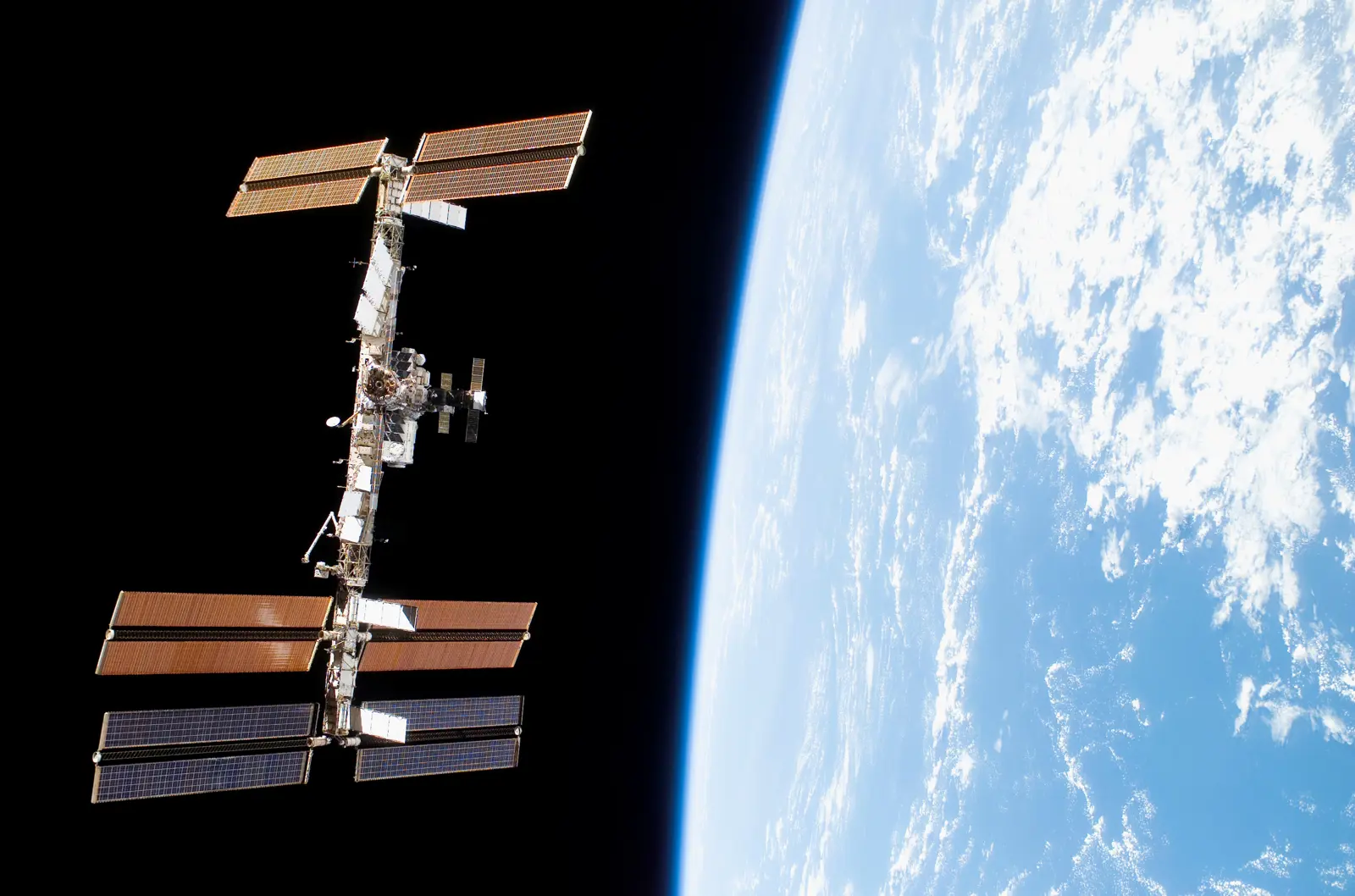
International Space Station
Humanity's permanent outpost in low Earth orbit — a football-field-sized laboratory that has hosted nearly 300 people from 26 countries without interruption since November 2, 2000.
International Space Station
The International Space Station (ISS) is the largest human-made structure ever placed in orbit and the most sophisticated scientific laboratory ever built. Stretching 109 metres (356 feet) from end to end — roughly the length of an American football field — it circles Earth at an altitude of approximately 400 kilometres, completing about 16 orbits every day. Its mass of 419,725 kilograms makes it easily visible to the naked eye from the ground as one of the brightest objects in the night sky.
The station is the product of an unprecedented international partnership. Five space agencies — NASA (United States), Roscosmos (Russia), ESA (Europe), JAXA (Japan), and CSA (Canada) — representing 15 nations cooperated to design, fund, launch, assemble, and operate it. Construction in orbit began in November 1998 and the station has been continuously inhabited since 2 November 2000, a record of unbroken human presence in space that stood at more than 25 years by late 2025.
Beyond its role as a human habitat, the ISS serves as a unique microgravity research platform where more than 3,300 investigations have been conducted by contributors from over 100 countries. Its laboratories have produced breakthroughs in fundamental physics, medicine, biology, materials science, and Earth observation. It is also widely regarded as one of the largest and most enduring examples of peaceful international cooperation in history.
Structure and modules
The ISS is built around two integrated orbital segments: the US Orbital Segment (USOS), contributed by NASA, ESA, JAXA, and CSA, and the Russian Orbital Segment (ROS), contributed by Roscosmos. The segments are physically joined and share power, cooling, communications, and crew access, but each partner agency operates and maintains its own hardware.
The backbone of the station is a 94-metre integrated truss structure from which large solar arrays extend to generate electrical power. The arrays span 73 metres. Attached to the truss and to each other are the pressurised modules where the crew lives and works. Major modules include Russia's Zarya (the first element launched, providing early power and propulsion) and Zvezda (the Russian service module housing living quarters and life support); the US-built Unity, Harmony, Tranquility, and Destiny laboratory; the European Columbus laboratory; Japan's multi-element Kibō complex; the cupola observation bay with its seven windows; the Leonardo permanent multipurpose module; and the more recent Russian additions Nauka and Prichal, the latter docked on 26 November 2021 as the station's most recently installed module. Commercial additions include the Bigelow Expandable Activity Module (BEAM) and the NanoRacks Bishop airlock.
Canada's contribution to the structure is primarily robotic: the 17-metre Canadarm2 robotic arm and the Dextre Special Purpose Dexterous Manipulator are essential for berthing arriving cargo spacecraft and for performing delicate external maintenance tasks, reducing the need for spacewalks.
Construction and habitation milestones
- 1984U.S. commits to a space station
President Ronald Reagan directs NASA to build a permanently crewed space station within 10 years, setting in motion the programme that would become the ISS.
- 1984–1993Design and international agreements
The station is designed over roughly a decade. Hardware begins to be built in the United States, Canada, Japan, and Europe from the late 1980s onward.
- 28 Jan 1998Intergovernmental Agreement signed
The 15 partner governments sign the Space Station Intergovernmental Agreement (IGA), establishing the legal and financial framework for the programme.
- 20 Nov 1998Zarya launched — assembly begins
Russia launches the Zarya Functional Cargo Block on a Proton rocket from Baikonur Cosmodrome, placing the first ISS element in orbit and beginning on-orbit assembly.
- 4 Dec 1998Unity docked — STS-88
Space Shuttle Endeavour (STS-88) carries the US-built Unity node to orbit. Astronauts dock Unity to Zarya, forming the initial two-module station configuration.
- Jul 2000Zvezda service module launched
Russia launches the Zvezda module, adding living quarters and life-support systems and making continuous human habitation possible.
- 31 Oct 2000Expedition 1 launches
Commander William Shepherd (NASA) and cosmonauts Yuri Gidzenko and Sergei Krikalev launch aboard Soyuz TM-31 from Baikonur.
- 2 Nov 2000Continuous human presence begins
Expedition 1 docks and boards the station. From this date, the ISS has been inhabited without interruption — the longest unbroken human presence in space.
- 7 Feb 2001Destiny US laboratory installed
Shuttle mission STS-98 delivers and attaches Destiny, the primary US laboratory module, significantly expanding the station's research capacity.
- 2005US segment designated a National Laboratory
The US Congress formally designates the US portion of the ISS as a national laboratory, broadening access for other agencies, academia, and industry.
- 7 Feb 2008ESA Columbus laboratory attached
The European Columbus laboratory, built by ESA, is installed — Europe's main research facility in orbit.
- 11 Mar 2008First Kibō component installed
The first element of JAXA's Kibō laboratory complex is attached, beginning assembly of Japan's multi-element research facility.
- 9 Feb 2010Tranquility node and Cupola delivered
Shuttle Endeavour (STS-130) delivers Node 3 Tranquility and the Cupola observation bay, whose seven windows became the station's most iconic viewing point.
- 26 Nov 2021Prichal docks — the latest module
The Russian Prichal nodal module docks with the station, becoming the most recently added pressurised element.
- 2 Nov 202020 years of continuous habitation
NASA and partners mark two uninterrupted decades of human presence aboard the ISS.
- Jul 2024SpaceX selected for US Deorbit Vehicle
NASA selects SpaceX to develop the US Deorbit Vehicle (USDV), which will guide the station to a controlled reentry over the South Pacific.
- 2 Nov 202525 years of continuous habitation
The ISS marks a quarter-century of uninterrupted human occupation, with Expedition 73 — seven crew members — aboard at the milestone.
Landmark research and discoveries
In 2018 NASA's Cold Atom Lab produced the first Bose–Einstein condensate in orbit. Microgravity allows these 'fifth state of matter' clouds to be trapped and studied far longer than on Earth, enabling higher-precision tests of quantum mechanics and advancing atom interferometry.
Long-duration ISS missions revealed a previously unknown condition — SANS — characterised by optic-nerve swelling, globe flattening, and vision changes affecting most astronauts. ISS studies linked it to fluid shifts and altered intracranial pressure in microgravity, driving development of monitoring tools and countermeasures for future deep-space missions.
In 2016 the Biomolecule Sequencer investigation demonstrated DNA sequencing in space for the first time using a MinION nanopore device. In 2017, Genes in Space-3 completed the first full sample-to-sequence workflow entirely on the ISS, allowing crew to identify unknown microbes on-orbit without returning samples to Earth.
The Alpha Magnetic Spectrometer (AMS-02), operating on the ISS since 2011, recorded data from more than 100 billion cosmic-ray particles and measured an unexpected excess of high-energy positrons relative to electrons arriving from all directions. The result strongly constrains models of cosmic-ray production and is consistent with certain dark-matter annihilation scenarios.
Protein crystals grown aboard the ISS are often larger and more ordered than those grown on Earth, enabling higher-resolution structural determination. ISS crystallography contributed to research on proteins linked to cancer and gum disease, and protein crystal data informed the development of a treatment candidate for Duchenne muscular dystrophy that has advanced into clinical trials.
ISS research quantified bone loss in long-duration spaceflight at roughly 1–2% per month without countermeasures, then demonstrated that combined resistive exercise and optimised nutrition can substantially reduce or nearly eliminate that loss. The findings underpin current ISS exercise protocols and contribute to terrestrial osteoporosis research.
ISS microgravity experiments refined microencapsulation techniques in which biodegradable microscopic capsules carry chemotherapy agents or imaging dyes directly to tumours. Microgravity reveals how immiscible fluids arrange within capsules, enabling precise control of capsule structure and leading to patented methods now used in manufacturing next-generation targeted cancer treatments on Earth.
Microgravity combustion studies aboard the ISS uncovered cool-flame and spherical flame behaviours that are difficult or impossible to observe on Earth. These findings have improved models of fuel efficiency and fire safety with applications to both spacecraft design and terrestrial engine development.
From its ~400 km vantage point, the ISS has produced over 3.5 million images of Earth used to study climate, land use, vegetation, water resources, air pollution, and disaster impacts. ISS imagery has supported rapid response and monitoring for floods, wildfires, volcanic eruptions, hurricanes, and earthquakes.
Notable events, records, and incidents
The ISS holds several defining records in human spaceflight. Its most fundamental achievement is simply that it has been continuously inhabited since 2 November 2000 — a streak lasting more than 25 years by late 2025. Nearly 300 people from 26 countries have visited the station, and at its most crowded — first reached during STS-127 in July 2009 — it has hosted 13 people simultaneously.
Individual duration records have repeatedly been broken aboard the station. Christina Koch spent 328 days continuously on the ISS during 2019–2020, the longest single spaceflight by a woman. Frank Rubio (NASA) set the American record with 371 consecutive days on board in 2022–2023. Peggy Whitson accumulated 675 total days in space across multiple missions, most of it on the ISS.
The station's 259 spacewalks represent an enormous engineering achievement in their own right. The longest single spacewalk associated with ISS construction was 8 hours 56 minutes, performed by James Voss and Susan Helms during STS-102 in 2001. The longest Russian spacewalk from the ISS lasted 8 hours 13 minutes, performed by Alexander Misurkin and Anton Shkaplerov during Expedition 54 to repair a station antenna.
Not all notable events have been straightforward. In July 2013, ESA astronaut Luca Parmitano's helmet filled with water from a cooling-system leak while he was on a spacewalk — a life-threatening situation that required an early termination of the excursion. NASA subsequently overhauled its EVA safety procedures. The station's ammonia-based cooling loops have failed more than once, requiring rapid-response spacewalks to replace pump modules. On 24 December 2013, astronaut Mike Hopkins conducted the second of two spacewalks to replace a faulty external water pump module.
Structural integrity has also required sustained attention. Persistent cracks in the Zvezda service module's transfer tunnel, identified since 2019, have caused small atmosphere leaks; Roscosmos and NASA have applied temporary and permanent sealants while continuing to monitor the situation. The station has also experienced multiple shelter-in-place or partial evacuation events — documented on 13 March 2009, 28 June 2011, 24 March 2012, 16 June 2015, November 2021, and 27 June 2024 — in which crew members closed hatches and took refuge in docked Soyuz vehicles as a precaution against potential debris, leaks, or propulsion anomalies, before normal operations resumed.
Partnership, cost, and governance
The ISS is often described as the most expensive single object ever constructed. Its total programme cost was estimated at approximately US$150 billion as of 2010, shared among the five partner agencies. NASA's share — including US$58.7 billion for the station hardware and an estimated US$50.4 billion for 36 Space Shuttle assembly flights at roughly US$1.4 billion per flight — accounts for approximately US$109 billion of that total. Russia contributed roughly US$12 billion, Europe and Japan approximately US$5 billion each, and Canada approximately US$2 billion. NASA's ongoing annual operations cost is approximately US$3 billion per year, representing about one third of the agency's human spaceflight budget.
The partnership is governed by the Space Station Intergovernmental Agreement (IGA), an international treaty signed on 28 January 1998 by the 15 partner governments. The IGA and associated Memoranda of Understanding define which partner owns which modules, responsibilities for operations and resupply, and the allocation of utilisation rights. Within the US Orbital Segment, utilisation is divided approximately as follows: NASA holds 76.6%, JAXA 12.8%, ESA 8.3%, and CSA 2.3% of crew time and resources. Russia operates and controls its segment independently under the same overarching treaty.
Each partner's hardware contributions reflect these shares. NASA provided the backbone truss, the large solar arrays, and the majority of US segment modules. Russia provided the Zarya and Zvezda modules along with Soyuz crew transport and Progress cargo resupply vehicles. ESA built the Columbus laboratory in Germany and operated the Automated Transfer Vehicle cargo fleet. JAXA contributed the Kibō complex and operated the HTV cargo vehicle series. Canada's CSA provided the Canadarm2 robotic arm and the Dextre dexterous manipulator, indispensable for on-orbit assembly and servicing.
Current status and end-of-life planning
As of late 2025, the ISS remains fully operational and crewed. Expedition 73, with seven people aboard, was active at the station's 25th anniversary of continuous habitation in November 2025. NASA and its international partners plan to keep the station crewed and scientifically productive through 2030.
After 2030, the station will not be abandoned in orbit. Because an uncontrolled reentry of a structure as large as the ISS would pose an unacceptable risk to populated areas, NASA has planned a controlled deorbit. In July 2024, NASA selected SpaceX to develop the US Deorbit Vehicle (USDV), a dedicated spacecraft that will dock with the station near the end of its life. The USDV will perform a series of orbit-lowering burns before executing a final deorbit maneuver targeted so that any surviving debris falls in a remote, uninhabited area of the South Pacific Ocean, commonly referred to as Point Nemo. The final reentry is currently targeted for 2031.
Under the current plan, the last crew will depart the station roughly six months before final reentry, and the deorbit vehicle itself is expected to be launched approximately 1.5 years before the final burn. The station's retirement will mark the end of one era and the planned transition to commercially operated low Earth orbit platforms, which NASA aims to support as successors to the ISS for US government research needs.
Frequently asked questions
Sources
- International Space Station Facts and Figures — NASA
- International Space Station — Space.com
- International Space Station — Wikipedia
- International Space Station — NASA (main page)
- FAQs: The International Space Station Transition Plan — NASA
- ISS Deorbit Analysis Summary — NASA (PDF)
- Here's how NASA will deorbit the International Space Station — Astronomy.com
- How NASA plans to deorbit the International Space Station — The Planetary Society
- 20 Breakthroughs from 20 Years of Science aboard the ISS — NASA
- ISS Benefits for Humanity — NASA
- Scientific research on the International Space Station — Wikipedia
- International Space Station program — Wikipedia
- International Space Station | Facts, Missions & History — Britannica