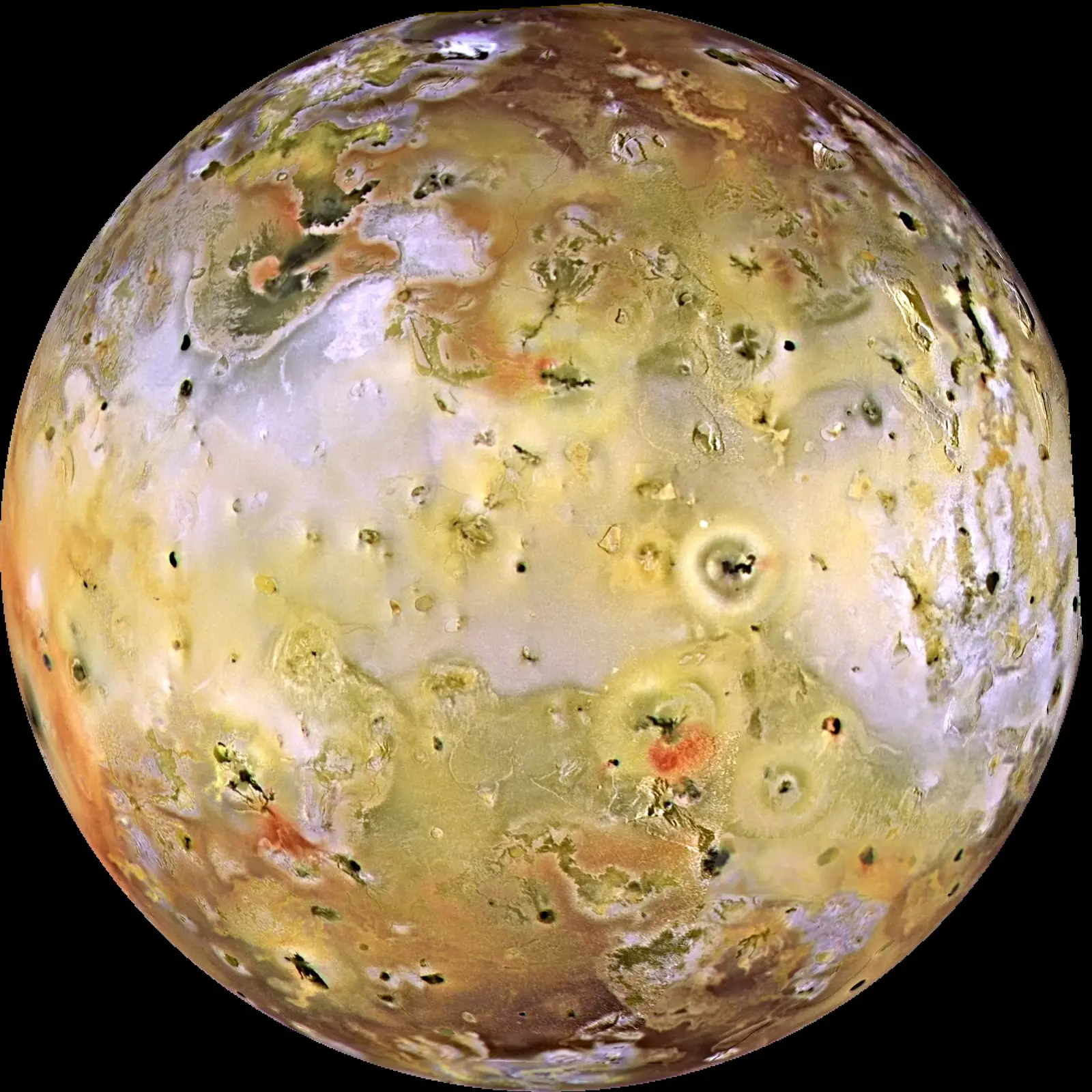
Io
The most volcanically active world in the Solar System — a moon of Jupiter sculpted entirely by fire.
Io
Io is the innermost of the four Galilean moons of Jupiter and the most volcanically active body in the Solar System. Slightly larger than Earth's Moon, with a mean radius of 1,821 km and a diameter of 3,640 km, it orbits Jupiter at an average distance of about 422,000 km and completes one orbit every 1.77 Earth days. Its surface is a mosaic of sulfur yellows, whites, and reds, punctuated by hundreds of active volcanoes whose lava temperatures can exceed 1,600 °C — hotter than almost any eruption on Earth.
What makes Io so extreme is not a radioactive interior or primordial heat but an ongoing gravitational tug-of-war. Locked in a precise orbital resonance with Europa and Ganymede, Io is perpetually squeezed and stretched by Jupiter's enormous gravity. This tidal flexing pumps more than twenty times as much heat through each square metre of Io's surface as escapes through all of Earth's crust. The result is a world where the geological clock runs extraordinarily fast: impact craters are almost entirely absent because fresh lava resurfaces every part of the moon before craters can accumulate.
Discovered in January 1610 by Galileo Galilei, Io was little more than a moving point of light for three and a half centuries. It was only when Voyager 1 swept past in March 1979 that scientists discovered, to their astonishment, volcanic plumes erupting hundreds of kilometres into space. Subsequent missions — the Galileo orbiter in the 1990s and 2000s, and NASA's Juno spacecraft with close flybys in 2023 and 2024 — have progressively revealed a world of lava lakes, towering mountains, and a deep interior likely containing a near-global ocean of molten rock.
From telescope to spacecraft
- 7 Jan 1610Galileo's discovery
Using a 20× refracting telescope, Galileo first noticed star-like points near Jupiter. By 15 January he concluded they were moons orbiting the planet, and published the discovery in Sidereus Nuncius in March 1610. He designated Io as 'Jupiter I'. Names derived from mythology — including Io — were proposed by Johannes Kepler in 1614 but only came into common use in the 19th century.
- 1973–1974Pioneer 10 and 11 flybys
Pioneer 10 (launched 1972) and Pioneer 11 (launched 1973) were the first spacecraft to explore the Jupiter system in detail. Pioneer 11 made the first close-up measurements of Io in 1974, establishing baseline physical parameters, but their imaging resolution was too limited to reveal the moon's volcanism.
- Mar 1979Voyager 1: discovery of active volcanism
Voyager 1's flyby returned the first high-resolution images of Io's surface, revealing a colorful world almost devoid of impact craters. Scientists discovered active volcanic plumes erupting into space — the first confirmed active volcanism beyond Earth. Io was immediately recognised as the most volcanically active body in the Solar System.
- Jul 1979Voyager 2 confirmation
Voyager 2 followed four months later, confirming and extending Voyager 1's findings. It imaged plumes ejecting material up to approximately 100 km above the surface and confirmed at least six volcanic plumes first identified by Voyager 1.
- 18 Oct 1989Galileo spacecraft launched
NASA's Galileo spacecraft was deployed from Space Shuttle Atlantis and set on a trajectory to Jupiter, beginning a mission that would transform understanding of Io's interior and volcanism.
- 7 Dec 1995Galileo enters Jupiter orbit
After a six-year journey, Galileo entered orbit around Jupiter and began an extended campaign of flybys of all four Galilean moons. Over roughly eight years it made six major close passes of Io, establishing that Io's volcanism is up to ~100 times more powerful than Earth's and producing evidence for a global or near-global magma ocean from magnetometer data.
- 5 Aug 2011Juno launched
NASA's Juno spacecraft launched on a mission primarily focused on Jupiter's deep atmosphere, gravity, and magnetic field, with an extended mission later approved to include targeted flybys of Jupiter's moons.
- 5 Jul 2016Juno enters polar orbit around Jupiter
Juno began its science mission in a polar orbit, well positioned for future targeted encounters with Io and other moons.
- 2022–2024Juno's close Io flyby campaign
Juno conducted a sequence of progressively closer flybys of Io, culminating in two ultra-close passes at approximately 1,500 km altitude on 30 December 2023 and 3 February 2024 — the closest any spacecraft had approached Io in more than 20 years. These encounters produced the highest-resolution global views of Io since the Galileo mission and provided new thermal maps of lava lakes, hotspot distributions, and gravity data aimed at constraining Io's interior structure.
- 27 Dec 2024Record volcanic event detected
Juno's Jovian Infrared Auroral Mapper (JIRAM) detected the most intense volcanic activity ever recorded on Io: a massive southern-hemisphere hotspot estimated to span approximately 100,000 km² and radiate more than 80 trillion watts of power.
Physical characteristics
Io is a rocky world, compositionally closer to the terrestrial planets than to the icy moons that dominate the outer Solar System. With a bulk density of about 3.53 g/cm³ — the highest of any moon — it is dominated by silicate rock and a differentiated metallic core, with very little water or ice. Its volume of 2.53 × 10¹⁰ km³ and mass of roughly 8.9 × 10²² kg place it third in size and mass among the Galilean moons, behind Ganymede and Callisto but ahead of Europa.
Surface gravity on Io is 1.796 m/s², about 18% of Earth's, so a person weighing 70 kg on Earth would weigh roughly 13 kg on Io. Despite Io's modest size, its mountains reach extraordinary heights: some peaks rise up to about 17.5 km above surrounding plains, taller than Mount Everest, produced not by volcanism but by thrust faulting and compression in the lithosphere.
The surface is one of the most visually striking in the Solar System. Sulfur and sulfur dioxide frost paint broad plains in shades of yellow, white, and greenish hues, while fresh silicate lava appears dark grey or black and older sulfurous deposits glow bright red. Fine pyroclastic particles dispersed by active plumes can produce blue tinges around erupting vents. Almost no large impact craters survive on Io's surface: the global resurfacing rate from ongoing volcanism is so high that craters are buried or erased before they can accumulate, making the surface geologically very young.
Io's atmosphere is extremely thin, composed primarily of sulfur dioxide, with surface pressures in the range of 10⁻⁸ to 10⁻⁹ bar — many orders of magnitude less than Earth's. It is continuously replenished by volcanic outgassing and by sublimation of SO₂ frost on the sunlit surface, and continuously lost to space and to Jupiter's magnetosphere. Mass loss from Io's upper atmosphere into the magnetosphere proceeds at roughly one tonne per second.
Interior structure
Io has a differentiated interior, meaning that its materials have separated into distinct layers by density. At the centre lies a metallic core composed of iron or a mixture of iron and iron sulfide (Fe–FeS). Estimates of core radius range from about 350–650 km for a nearly pure iron composition to about 550–900 km for an Fe–FeS mixture, and the core may account for roughly 20% of Io's mass. Notably, the Galileo spacecraft's magnetometer found no intrinsic dipole magnetic field, indicating that the metallic core is not vigorously convecting today in the way Earth's outer core does.
Surrounding the core is a silicate mantle whose composition resembles L- to LL-chondrite meteorites — a relatively iron-rich silicate assemblage compared to Earth, with the mantle dominated by forsterite (magnesium silicate). Interior models require a mantle in which roughly 10–20% of the rock is molten on average, with higher melt fractions concentrated beneath major volcanic centers. It is this partially molten mantle that feeds the surface volcanism.
One of the most significant findings from the Galileo mission was magnetometer evidence for a globally or near-globally continuous layer of highly conductive partially molten silicate — a 'magma ocean' — located at a depth of roughly 50 km beneath the surface and estimated to be about 50 km thick, representing approximately 10% of the mantle's volume. The temperature in this layer is estimated at around 1,200 °C. Later analyses incorporating tidal librations suggest that the mantle may be largely solid with substantial localized or layered partial melt rather than a single fully liquid global shell, but the existence of a high-melt silicate layer at tens of kilometres depth is well supported. This remains an active area of research, and Juno's gravity measurements from its 2023–2024 flybys are expected to help resolve the question.
Above the magma-rich asthenosphere lies a lithosphere at least 12 km thick and probably no more than 40 km thick, composed primarily of basaltic silicate rock overlain by a thin veneer of sulfur and sulfur dioxide deposits. Although sulfur compounds dominate what the eye sees on Io's surface, they constitute only a superficial skin over a fundamentally rocky world.
Tidal heating: the engine of Io's volcanism
The source of Io's extraordinary internal heat is not radioactive decay — the contribution from that source is far too small to account for the observed output — but tidal dissipation. Io is locked in a Laplace resonance with Europa and Ganymede: for every four orbits Io completes around Jupiter, Europa completes exactly two and Ganymede completes one. This gravitational agreement prevents Io from settling into a circular orbit; instead, the resonant tugs of Europa and Ganymede keep Io's orbit slightly eccentric.
Because Io's distance from Jupiter oscillates slightly as it travels around its eccentric orbit, the gravitational pull on different parts of Io changes continuously. The solid body of the moon flexes in response, and the tidal bulge raised by Jupiter can reach up to approximately 100 m in amplitude — the largest solid-body tide known in the Solar System. This continual flexing generates frictional heat throughout the interior in a process analogous to the warmth produced by repeatedly bending a piece of metal. The global heat flow from Io's interior exceeds 2 W/m², more than 20 times Earth's average, and the total heat output is estimated at 0.6–1.6 × 10¹⁴ watts.
A long-standing puzzle is that Io's volcanoes are not located where simple solid-body tidal heating models predict the maximum heating. Observations show that active volcanoes are systematically offset by 30–60 degrees from the predicted hottest zones. This discrepancy suggests that heat transport within the mantle, lateral melt migration, and possibly the presence of a fluid magma ocean — which shifts the phase of tidal dissipation — are all playing important roles. A 2023 modelling study revisiting tidal heating in a subsurface magma ocean confirmed that dissipation in a low-viscosity melt layer can better match both Io's observed heat flow and the geographical distribution of its volcanoes, strengthening the magma-ocean hypothesis.
Volcanism: lava lakes, plumes, and outburst eruptions
Io hosts an estimated 300–400 active volcanoes scattered across its surface, and its total volcanic activity is estimated to be up to 100 times greater than Earth's. The dominant form of volcanism is silicate — basaltic to ultramafic lavas erupting at temperatures of at least 1,300 K (around 1,030 °C) and up to approximately 1,600 K (around 1,330 °C) at the hottest spots, temperatures consistent with very high-temperature magmas and inconsistent with simple sulfur volcanism. Sulfur and sulfur dioxide also erupt from many centers, creating the distinctive colored surface deposits, but these are volumetrically superficial compared to the silicate lavas.
Three main eruption styles operate on Io. The first and most persistent are lava-lake or patera eruptions: long-lived pools of molten silicate rock contained within caldera-like volcanic depressions, slowly overturning as the solidified surface crust founders and sinks. The second style is effusive lava-flow eruptions, which produce flows that can extend up to approximately 400 km — the longest known active lava flows in the Solar System. The third style is outburst eruptions: short-lived, high-effusion-rate events of great power that can produce large plumes and rapid surface changes.
Loki Patera is the largest volcanic depression on Io, spanning approximately 202 km across. It is widely interpreted as a giant overturning lava lake, where the solidified crust periodically founders and sinks to expose fresh hot magma, producing quasi-periodic variations in its infrared brightness that have been monitored from Earth for decades. It is frequently Io's brightest hotspot in the infrared and is a major outlet for the moon's internally generated heat. Understanding Loki's dynamics is central to understanding how tidally generated heat is transported from the deep interior to the surface.
Pele is one of Io's most prominent volcanic centers and the archetype of a class of large, energetic eruptions known as Pele-type plumes. These plumes are driven by sulfur and sulfur dioxide gas exsolving from erupting silicate magma, launching gas and pyroclastic particles hundreds of kilometres above the surface in umbrella-shaped clouds that deposit characteristic rings of red and black sulfurous material around the source vent. Pele-type eruptions are typically associated with explosive, volatile-rich magma and are relatively short-lived, demonstrating how closely Io's interior magmatic system is coupled to its thin atmosphere and ultimately to Jupiter's magnetosphere.
The very largest plumes on Io reach heights of up to approximately 500 km — among the tallest eruption columns anywhere in the Solar System. Even some individual volcanic centers produce lava fountains tens of kilometres high. Mountains up to about 17.5 km tall rise from the plains, formed not by volcanic pile-up but by the compressive stresses that build as the crust is relentlessly buried under fresh lava.
Juno's close encounters with Io (2023–2024)
The Juno spacecraft, launched in August 2011 and in polar orbit around Jupiter since July 2016, conducted a systematic campaign of Io flybys between 2022 and 2024 as part of its extended mission. The distances decreased progressively through 2023: a May 2023 pass at about 35,000 km provided the first detailed infrared survey of Io's nightside and lava lakes; an October 2023 pass at about 13,000 km obtained detailed imagery of active volcanoes; and then two ultra-close passes — on 30 December 2023 and 3 February 2024 — brought Juno within approximately 1,500 km of Io's surface, closer than any spacecraft had been to Io in more than 20 years.
The December 2023 flyby produced JunoCam's highest-resolution image of Io to date. The Stellar Reference Unit, a navigation star camera repurposed as a low-light imager, obtained the highest-resolution Io surface images ever taken from an orbiting spacecraft. JunoCam also captured nightside views of Io showing glowing lava flows and scattered hotspots, directly visualising active volcanism in the dark. The two 1,500-km passes were designed with identical geometry to allow before-and-after comparisons of surface changes and to enable precision Doppler tracking of Juno's radio signal, from which Io's gravity harmonics — and constraints on its internal mass distribution, including the possible magma ocean — can be extracted.
Juno's Jovian Infrared Auroral Mapper (JIRAM) provided the most detailed global thermal maps of Io to date. Data from the 2023 flybys show that lava lakes are widespread and global: in the regions with the most complete coverage, approximately 3% of the surface area is occupied by active molten lava lakes. JIRAM imaging of individual hotspots reveals characteristic bright rings surrounding cooler central crusts — the hot annulus being the exposed molten margin of the lake where the crust has not yet solidified. The absence of large lava flows spilling over the rims of these calderas indicates that magma is being recycled within each depression rather than spreading broadly, consistent with long-lived overturning lava-lake dynamics.
On 27 December 2024, JIRAM detected the most intense volcanic activity ever recorded on Io: a massive southern-hemisphere hotspot estimated to span approximately 100,000 km² and radiate more than 80 trillion watts of power. This event, interpreted in the context of the baseline established by the earlier close flybys, underscores how dynamic Io's surface remains and how much the Juno flyby campaign has advanced the ability to characterise and contextualise extreme eruptions.
Atmosphere, plasma torus, and interaction with Jupiter
Io's atmosphere, though extremely tenuous, is scientifically significant. Composed primarily of sulfur dioxide derived from volcanic outgassing and from sublimation of SO₂ frost on the sunlit surface, it supports an ionosphere and extends into a corona of neutral gas a few Io radii into space. Mass is continuously lost — at roughly one tonne per second — partly as direct ion pickup from the exosphere and partly as neutral atoms and molecules that escape and are later ionised by solar ultraviolet radiation or by electron impacts from the surrounding plasma.
The material lost from Io feeds the Io plasma torus: a doughnut-shaped ring of ions and electrons concentrated near Io's orbital distance from Jupiter, at about 5.9 Jupiter radii. Identified by Voyager instruments in 1979, the torus consists mainly of sulfur and oxygen ions (S⁺, S²⁺, O⁺, O²⁺) derived from the dissociation and ionisation of Io's SO₂ emissions. Because Jupiter's magnetic field rotates with the planet's approximately 9.9-hour day, the torus plasma is swept around Jupiter far faster than Io orbits, sweeping past Io at a relative velocity of roughly 54–74 km/s. Newly created ions are picked up and accelerated to co-rotation speeds, heating the torus plasma to tens of thousands of degrees and causing it to radiate intensely in the extreme ultraviolet.
Io acts as a powerful electrodynamic generator within this system. The fast-moving magnetised plasma flows past Io and its atmosphere, driving an electric current of approximately 10 million amperes along magnetic field lines connecting Io to Jupiter's ionosphere. These currents flow through structures known as Alfvén wings — standing Alfvén waves propagating along the field lines. Where the current system meets Jupiter's upper atmosphere, it deposits energy that produces distinct auroral footprints: bright spots and trailing emission features visible in Jupiter's auroral ring, precisely at the magnetic longitude connected to Io. The Io footprint is one of the most persistent features of Jupiter's aurora and is a visible signature of the electrodynamic coupling between the moon and the giant planet. The same interaction modulates part of Jupiter's intense decametric radio emission.
The torus is not entirely stable. On timescales of days to months it is broadly steady, but occasional weeks-long events show major transient changes in torus brightness and composition, generally attributed to changes in Io's volcanic output and consequent fluctuations in mass supply. The exact nature of the volcanic triggering — whether outburst eruptions, changes in plume activity, or more gradual shifts — remains an open question. Simulations also show that plasma from the torus impacting Io's volcanic plume canopies can create large diffuse clouds of neutral gas above the plumes, which are subsequently ionised and fed back into the torus, creating a feedback between Io's volcanism and its space environment.
What we have learned about Io
Voyager 1's March 1979 flyby revealed volcanic plumes erupting from Io's surface, the first discovery of active volcanism beyond Earth. The finding transformed understanding of what small bodies in the Solar System can do.
Io's extreme volcanism is powered by tidal dissipation within the Laplace resonance shared with Europa and Ganymede, not by radioactive decay. Global heat flow exceeds 2 W/m², more than 20 times Earth's average, and total heat output is estimated at 0.6–1.6 × 10¹⁴ watts.
Re-analysis of Galileo magnetometer data revealed an induced magnetic field requiring a highly conductive, partially molten silicate layer at roughly 50 km depth — interpreted as a global or near-global magma ocean. A 2023 modelling study confirmed that tidal dissipation in such a layer can better match Io's observed heat flow and volcano distribution.
Io's active volcanoes are systematically displaced 30–60 degrees from where simple solid-body tidal heating models predict maximum heat generation, pointing to melt transport within the mantle, a fluid magma-ocean phase lag, or both.
JIRAM data from Juno's 2023 flybys showed that approximately 3% of Io's surface is covered by active molten lava lakes contained in calderas, with characteristic bright molten rings around cooler central crusts. Magma appears to be recycled within each caldera rather than flowing outward.
On 27 December 2024, JIRAM detected a southern-hemisphere hotspot spanning approximately 100,000 km² and radiating more than 80 trillion watts — the most intense volcanic event ever recorded on Io.
Volcanic gases from Io continuously supply the Io plasma torus at roughly one tonne per second, powering Jupiter's auroral footprint of Io and modulating part of the planet's intense decametric radio emission — making Io a major driver of Jupiter's space environment.
Instruments used to study Io
- Jovian Infrared Auroral Mapper
Measures heat signatures from volcanoes and calderas, maps surface temperatures, estimates heat flux, and maps lava-lake structure and hotspot distributions in the infrared.
- JunoCamJunoCam
Wide-angle colour camera providing visible-light images of Io's surface, including nightside views of glowing lava flows and before-and-after surface change comparisons between flyby epochs.
- Stellar Reference Unit
High-sensitivity navigation star camera repurposed as a low-light imager; obtained the highest-resolution Io surface images ever taken from orbiting spacecraft during the December 2023 and February 2024 close flybys.
- Juno Radio Science / Doppler Tracking
Precision tracking of changes in the frequency of Juno's radio downlink during close approaches to measure Io's gravity harmonics, informing models of internal mass distribution and the possible magma ocean.
Frequently asked questions about Io
Sources
- Io: Jupiter's Moon — NOAA Science On a Sphere
- Io, Jupiter's chaotic volcano moon — The Planetary Society
- Io: A guide to Jupiter's volcanic moon — Space.com
- Io: A Unique World in our Solar System (PDF) — LPL Arizona
- Io — NASA Science
- Exploring Jupiter's Moon Io — Elements Magazine
- Tidal Heating in a Subsurface Magma Ocean on Io Revisited — AGU
- Scientists to Io: Volcanoes are in the Wrong Spot — NASA JPL
- Io (moon) — Wikipedia
- The interior of Io (PDF) — LASP Colorado
- The Librations, Tides, and Interior Structure of Io — AGU
- NASA's Juno Gets a Close-Up Look at Lava Lakes on Jupiter's Moon Io — NASA JPL
- Juno Will Make A Very Close Flyby of Volcanic World Io On Saturday — Astrobiology.com
- Juno spots most extreme volcanic activity on Io to date — EarthSky
- Plasma Interaction of Io with its Plasma Torus (PDF) — LASP Colorado
- Simulating Jupiter's Plasma Torus Effects on its Volcanic Moon, Io — UT Austin
- Mass supply from Io to Jupiter's magnetosphere — arXiv
- The Io Neutral Clouds and Plasma Torus (PDF) — LASP Colorado
- 415 Years Ago: Astronomer Galileo Discovers Jupiter's Moons — NASA