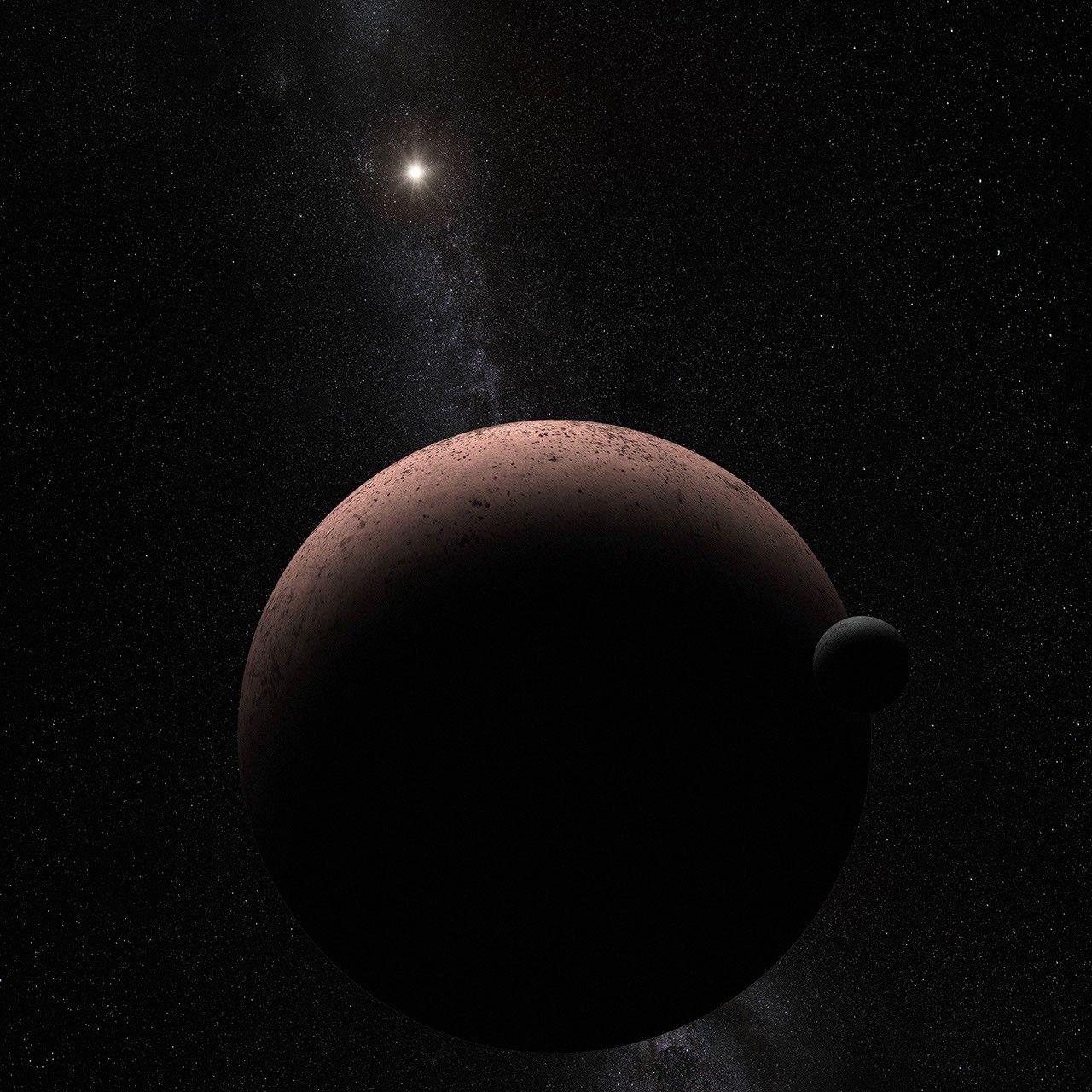
Makemake
A reddish world of frozen methane at the solar system's frontier — Makemake is one of the largest known Kuiper Belt dwarf planets, named for the creator god of Easter Island.
Makemake
Makemake (pronounced mah-kay-mah-kay) is a dwarf planet residing in the Kuiper Belt, the vast ring of icy bodies that extends beyond the orbit of Neptune. With a mean diameter of approximately 1,430 km — about two-thirds the diameter of Pluto — it ranks among the largest known trans-Neptunian objects and is broadly considered the third or fourth largest dwarf planet in the solar system, after Pluto and Eris. Its orbit carries it between roughly 38 and 53 AU from the Sun, taking about 307 Earth years to complete a single revolution.
First imaged on 31 March 2005 by Michael E. Brown, Chad Trujillo, and David Rabinowitz at Palomar Observatory, Makemake was initially nicknamed "Easterbunny" because its discovery fell just after Easter. It was formally recognised as a dwarf planet and plutoid by the International Astronomical Union in July 2008, when it also received its permanent name: Makemake, the creator deity of the Rapa Nui people of Easter Island, preserving the Easter connection in permanent form.
The dwarf planet's surface is blanketed in frozen methane and ethane, giving it a reddish-brown colour and a high reflectivity that keeps surface temperatures around −240 to −243 °C. Stellar occultation observations in 2011 showed that Makemake lacks any significant global atmosphere, yet 2025 observations with the James Webb Space Telescope detected extremely tenuous methane gas above the surface — among the most remote gas detected anywhere in the solar system. Makemake has one known moon, a small, very dark body nicknamed MK 2, discovered in Hubble Space Telescope images taken in April 2015.
Discovery and Naming
Makemake was discovered on 31 March 2005 by a team of three astronomers — Michael E. Brown of the California Institute of Technology (Caltech), Chad Trujillo, and David Rabinowitz — using the Samuel Oschin telescope at Palomar Observatory in California. The discovery was publicly announced on 29 July 2005, coinciding with the announcement of another large Kuiper Belt object, Eris. Within the team, the object was informally designated "Easterbunny" because the discovery images had been taken just after Easter Sunday.
Its provisional IAU designation was 2005 FY9. In July 2008, the IAU officially recognized 2005 FY9 as a dwarf planet and plutoid — a category of dwarf planets orbiting beyond Neptune — and granted it a permanent name. In keeping with the custom of naming classical Kuiper Belt objects after mythological beings, and wishing to preserve the Easter connection embedded in the Easterbunny nickname, Brown and his colleagues chose the name Makemake, the creator god in the mythology of the Rapa Nui, the indigenous people of Easter Island. The name thus links the object to both its discovery timing and a remote island culture whose geography mirrors its own remote position in the solar system.
Mike Brown, widely known as the astronomer whose discoveries contributed to Pluto's reclassification as a dwarf planet, has described the naming process as an opportunity to honour a culture whose mythology had not previously been represented among solar system bodies. At the time of its formal designation, Makemake became one of the four officially named large Kuiper Belt dwarf planets, joining Pluto, Eris, and Haumea.
Physical Characteristics
Makemake is an oblate spheroid, meaning it is slightly flattened at the poles. Stellar occultation measurements by the European Southern Observatory constrain its shape to axes of approximately 1,430 ± 9 km and 1,502 ± 45 km, giving a mean diameter of about 1,430 km — roughly two-thirds that of Pluto. Its radius of approximately 715 km is about one-ninth of Earth's radius. For a body this size with so few direct measurements, those dimensions represent a significant observational achievement, achieved not by a visiting spacecraft but by precisely timing the dimming of a distant star as Makemake passed in front of it.
Makemake's bulk density, derived from a combination of its moon's orbital dynamics and occultation size constraints, is approximately 1.7 ± 0.3 g/cm³. This value lies between the density of water ice (1.0 g/cm³) and typical rocky materials, indicating that Makemake is a mixture of rock and ice rather than a purely icy body. This is broadly consistent with other large Kuiper Belt dwarf planets and suggests a rocky core surrounded by an icy mantle.
The rotation period is approximately 22.5 hours, giving Makemake a day slightly shorter than Earth's. Its surface is strikingly bright: frozen methane ice and other volatiles reflect roughly 80 percent of incoming sunlight, making Makemake one of the most reflective bodies in the outer solar system. Despite this reflectivity, the surface colour is reddish-brown, a characteristic Makemake shares with Pluto. This colour is thought to arise from complex organic molecules — tholins — formed when ultraviolet radiation and cosmic rays chemically alter methane and other surface ices over geological timescales.
Spectroscopic observations in the near-infrared reveal that Makemake's surface is dominated by frozen methane absorption bands. These bands appear slightly blue-shifted compared to pure methane ice, which is a classic signature of methane dissolved in nitrogen ice — meaning small amounts of nitrogen are likely mixed into the methane-ice layer. Ethane, another irradiation product of methane, has also been detected. Studies examining the object at different rotational phases suggest the surface composition is relatively homogeneous, with no strong evidence for large patches of dramatically different composition. Surface temperatures are around −240 to −243 °C, or approximately 30 to 33 Kelvin.
Orbit and Position in the Solar System
Makemake follows a moderately elliptical orbit around the Sun as a classical Kuiper Belt object — a dynamical category denoting bodies whose orbits are far enough from Neptune to remain stable for the age of the solar system, unaffected by the strong gravitational resonances that govern other trans-Neptunian populations. Its semi-major axis of roughly 45.5 AU places its average distance from the Sun at about 6.81 billion km.
At perihelion — its closest approach to the Sun — Makemake reaches about 38.2 AU (approximately 5.71 billion km). At aphelion, the far end of its orbit, it retreats to about 52.8 AU (about 7.90 billion km). These extremes mean Makemake's distance from the Sun varies by more than 14 AU over the course of one orbit, influencing how much solar energy reaches the surface and, correspondingly, the stability of volatile ices. One complete orbit takes approximately 306.7 Earth years. At its average distance, sunlight takes roughly six hours and twenty minutes to reach Makemake.
In terms of size and position, Makemake sits between Pluto (closer to the Sun, with a 248-year orbit) and Eris (farther from the Sun at its current position, with a longer orbit). Its orbit lies entirely within the Kuiper Belt's classical cold population, and it has no known resonance with Neptune. This places it in a dynamically quiet region, which has helped preserve it largely unchanged since the early solar system.
Atmosphere: From Non-Detection to Methane Gas
The question of whether Makemake has an atmosphere has a long and evolving history. Because the surface is covered in volatile methane ice, scientists long expected that some methane would sublimate into a thin gas layer, similar to Pluto's nitrogen-methane atmosphere. For years, however, no atmosphere could be confirmed by observation.
The most definitive early constraint came from a stellar occultation observed on 7 April 2011 by a team using ESO telescopes. When Makemake passed in front of a background star, the star's light vanished and reappeared abruptly, with none of the gradual dimming or refractive bending that reveals an atmosphere. This sharp light curve showed that Makemake lacks any significant global atmosphere — unlike Pluto, whose nitrogen atmosphere produces a distinctly gradual occultation profile. The analysis, published in the journal Nature in 2012, set upper limits of just a few nanobars on any possible global gas envelope. For context, Earth's sea-level atmospheric pressure is about one bar; Pluto's thin atmosphere stands at a few microbars; the occultation limited Makemake to nanobars — a thousand times thinner than even Pluto's atmosphere.
The same occultation revealed something intriguing about the surface: unexpectedly sharp brightness variations suggesting a patchy surface, with some regions significantly darker than others. Scientists proposed that while a global atmosphere was absent, localised regions where methane or other volatiles sublimate could produce extremely localised, low-lying pockets of gas — areas with their own ephemeral micro-atmospheres — without creating a detectable planet-wide gas layer.
Later surveys of trans-Neptunian object occultations published around 2024 confirmed this picture: among large TNOs including Eris, Haumea, Makemake, and Quaoar, none showed detectable atmospheres in occultation data, with surface-pressure upper limits consistently in the range of 1 to 100 nanobars. Only Pluto, and one much smaller plutino designated (612533) 2002 XV93 (detected in 2024), showed confirmed atmosphere detections via occultation.
Then, in 2025, a team led by the Southwest Research Institute announced that the James Webb Space Telescope had detected methane gas above Makemake's surface — the first direct detection of gas from this dwarf planet. The team interpreted the detection as solar-excited fluorescence from methane molecules above the surface. Modelling by co-author Emmanuel Lellouch placed the best-fit surface pressure at approximately 10 picobars — that is, around 10⁻¹¹ bar, or roughly 100 billion times below Earth's atmospheric pressure and about a million times thinner than Pluto's atmosphere. This picobar-level pressure is well within the occultation upper limits, meaning the two results are fully consistent: the 2011 occultation set an upper limit far above the actual pressure, and JWST found gas at a level that would be entirely invisible to occultation techniques. No nitrogen gas was detected in the JWST observations. The finding also raised the possibility that some previously unexplained infrared properties of the Makemake system could be linked to this extraordinarily tenuous gas, and it identified Makemake as hosting what may be the most remote gas yet found in the solar system.
Moon MK 2
For a decade after its discovery, Makemake appeared to be a lone world with no known satellites — despite multiple telescope searches. That changed in April 2015, when astronomers using Hubble Space Telescope's Wide Field Camera 3 (WFC3) captured images that revealed a faint companion. The discovery was publicly announced on 27 April 2016, and a detailed scientific analysis titled "Discovery of a Makemakean Moon" by lead author Alex Parker (Southwest Research Institute) was published in Astrophysical Journal Letters on 27 June 2016. The moon received the provisional designation S/2015 (136472) 1 and the informal nickname MK 2.
MK 2 is estimated to be about 160 km in diameter. It is approximately 1,300 times fainter than Makemake in reflected sunlight, and its surface is strikingly dark — described as charcoal-like in NASA and ESA communications — in stark contrast to the bright, methane-ice-covered surface of Makemake. This albedo mismatch is scientifically significant: it implies MK 2 has lost, or never accumulated, the volatile methane ice that gives Makemake its high reflectivity, possibly because the moon is too small to retain such volatiles against solar radiation.
Hubble detected MK 2 at a projected separation of about 21,000 km (roughly 13,000 miles) from Makemake. Preliminary analysis of the orbit indicated it is viewed nearly edge-on from Earth. This edge-on geometry explained why so many previous searches had found nothing: in such a configuration, the moon spends much of its orbit projected very close to the bright disk of Makemake as seen from Earth, hiding in the glare. Hubble's high angular resolution and sensitivity to faint objects near bright sources were critical to the final detection. Early orbital estimates suggested an orbital period of about 12 days or longer if the orbit is near-circular, though further observations were needed to refine the shape and period of the orbit and to precisely determine the system's mass and density.
With MK 2 confirmed, all four of the major named Kuiper Belt dwarf planets — Pluto, Eris, Haumea, and Makemake — are now known to host at least one moon. This is scientifically notable because moons allow astronomers to determine a host body's mass with high precision, using orbital mechanics. Tracking MK 2's orbit yields Makemake's mass and, combined with the size from occultation, its bulk density, enabling inferences about its internal structure. A reanalysis of earlier infrared observations also suggested that some of the apparent "warmer" or darker regions previously attributed to patches of unusual terrain on Makemake itself may partly reflect the contribution of MK 2's very dark surface to the combined light signal.
Key Events in Makemake's Story
- 31 Mar 2005Discovery at Palomar Observatory
Michael E. Brown, Chad Trujillo, and David Rabinowitz first image the object using the Samuel Oschin telescope. It is informally nicknamed "Easterbunny" within the team.
- 29 Jul 2005Public announcement
The discovery is announced to the world, alongside the announcement of Eris. The provisional IAU designation 2005 FY9 is assigned.
- Jul 2008Formal designation as dwarf planet and plutoid
The IAU officially classifies 2005 FY9 as a dwarf planet and plutoid, and grants it the permanent name Makemake, after the creator deity in Rapa Nui mythology.
- 7 Apr 2011Stellar occultation by ESO
Makemake passes in front of a background star. The abrupt disappearance and reappearance of starlight shows the dwarf planet lacks a significant global atmosphere, with an upper limit of a few nanobars on any gas layer.
- Apr 2015Hubble images reveal moon MK 2
Hubble Space Telescope's Wide Field Camera 3 captures images in which a faint companion — later designated MK 2 — is detected at a projected distance of roughly 21,000 km from Makemake.
- 27 Apr 2016Moon discovery announced
NASA and ESA publicly announce the discovery of MK 2, estimated at about 160 km in diameter with an extremely dark, charcoal-like surface.
- 27 Jun 2016Scientific paper on MK 2 published
"Discovery of a Makemakean Moon" by Alex Parker (Southwest Research Institute) and colleagues appears in Astrophysical Journal Letters.
- 2025JWST detects methane gas above the surface
A Southwest Research Institute-led team reports that JWST has detected methane gas — interpreted as solar-excited fluorescence — above Makemake's surface, with a modelled surface pressure of roughly 10 picobars, far below any previous detection threshold. No nitrogen gas was detected.
What Makemake Has Revealed
The 2011 ESO stellar occultation set one of the most stringent upper limits on any trans-Neptunian atmosphere: a few nanobars at most. Yet JWST observations in 2025 detected methane gas at roughly 10 picobars — well below that limit and consistent with non-detection by occultation, revealing an atmosphere so thin it is essentially invisible to traditional techniques.
MK 2 escaped detection for a decade despite multiple telescope searches because its surface is extremely dark (charcoal-like) and its orbit is nearly edge-on from Earth, keeping it projected near the glare of the much brighter Makemake. Hubble finally separated the two in 2015.
Spectroscopic analysis shows that Makemake's methane absorption bands are slightly shifted from where pure methane ice would produce them, consistent with methane mixed into nitrogen ice — implying a more complex surface chemistry than methane alone.
The 2025 JWST methane-gas detection places Makemake as host to some of the most distant gas yet found anywhere in the solar system, at over 45 AU from the Sun — extending the known reach of detectable atmospheric chemistry to a new frontier.
The confirmation of MK 2 completed a pattern: Pluto (Charon and others), Eris (Dysnomia), and Haumea (Hi'iaka and Namaka) already had moons. With MK 2, every officially named large Kuiper Belt dwarf planet is known to have at least one companion, suggesting moon-forming collisions or captures may be common in this region.
Earlier infrared observations of Makemake had revealed apparently "warmer" or darker regions that puzzled scientists. Reanalysis after MK 2's discovery suggested some of that anomalous infrared signal came from the dark moon's surface being blended into the combined measurement, not from unusual terrain on Makemake itself.
Makemake FAQ
Sources
- Dwarf Planet Makemake Lacks Atmosphere — ESO
- Makemake — NASA Science
- Makemake — Britannica
- Dwarf Planets in our Solar System — Royal Museums Greenwich
- Hubble Discovers Moon Orbiting the Dwarf Planet Makemake — NASA Hubble
- SwRI's Parker discovers moon over Makemake in the Kuiper Belt — SwRI
- Makemake — Wikipedia
- SwRI-led team discovers methane gas on Makemake — SwRI
- Methane Gas Discovered On Makemake — Astrobiology Web
- Dwarf planet Makemake sports the most remote gas in the solar system — Science News
- Very homogeneous surface of the dwarf planet Makemake — MNRAS
- The Dwarf Planet (and Plutoid) Makemake — Universe Today
- Rare Apparition of Dwarf Planet Makemake Reveals a Largely Airless World — Scientific American