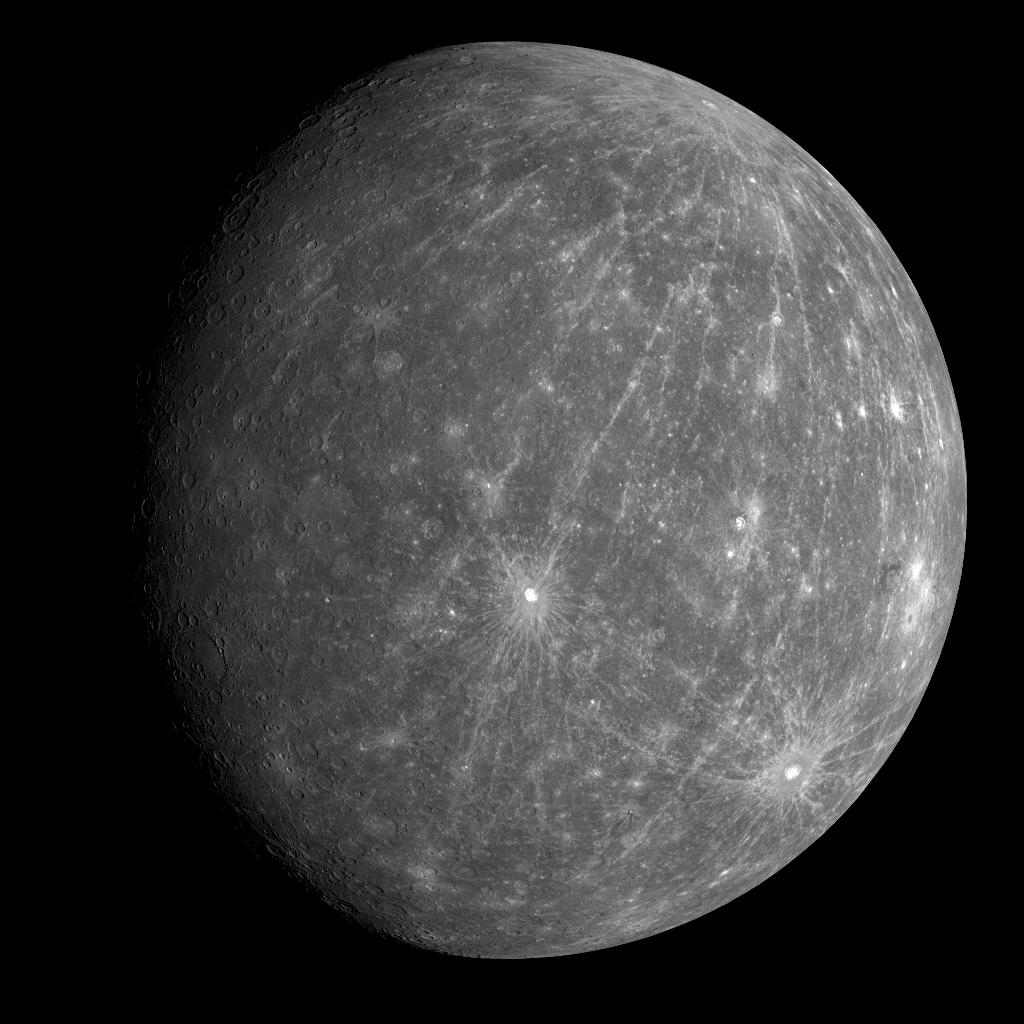
Mercury
The smallest planet in the Solar System and the closest to the Sun, a dense, airless, cratered world of extreme temperatures.

Mercury
Mercury is the smallest planet in the Solar System and the closest to the Sun, orbiting at an average distance of about 0.39 astronomical units (roughly 58 million kilometres). It has a mean diameter of about 4,880 km and a mass of about 3.30 × 10²³ kg, around 0.055 times that of Earth.
Despite its small size, Mercury has a mean density of 5.43 g/cm³, the second-highest of any planet in the Solar System after Earth, pointing to a large metallic core. The planet completes an orbit in about 88 Earth days while rotating once every 59 Earth days, a relationship governed by a 3:2 spin–orbit resonance.
Orbit and rotation
Mercury's sidereal orbital period is about 87.97 days, while its synodic period — the time between similar appearances as seen from Earth — is 115.88 days. Its sidereal rotation period is about 58.65 Earth days, often rounded to 59 days. Because the rotation and orbit are linked, a solar day on Mercury (from one sunrise to the next) lasts about 176 Earth days, equivalent to two Mercury years.
Mercury is in a 3:2 spin–orbit resonance, rotating three times on its axis for every two orbits around the Sun. This resonance is stabilized by the planet's high orbital eccentricity, which also causes the Sun to appear nearly stationary in the sky near perihelion as seen from the surface.
The orbit is highly elliptical: Mercury ranges from about 46 million km from the Sun at perihelion to about 70 million km at aphelion.
Surface and temperature
Because Mercury has virtually no atmosphere, surface heat is radiated away rapidly after sunset and cannot be redistributed, producing extreme temperature swings. Global surface temperatures range from about 100 K (−173 °C) in the coldest night-side regions to about 700 K (427 °C) at the hottest sunlit subsolar points near the equator. Equatorial regions typically reach roughly 420–430 °C by day and about −170 °C at night.
One of Mercury's most prominent features is the Caloris Basin (Caloris Planitia), a multi-ring impact basin about 1,550 km in diameter lying near the equator. Its name comes from the Latin for "heat," reflecting its location in one of the planet's hottest regions; its distinctiveness is geological — a large impact basin with a lava-filled floor and mountain ring — rather than thermal.
Conditions are very different at the poles. Mercury's axial tilt is essentially zero, so the floors of some deep polar craters never receive direct sunlight. These permanently shadowed regions act as cold traps, with temperatures staying below about 102 K (−171 °C), and are thought to host water ice.
Exosphere and magnetic field
Mercury does not have a substantial bound atmosphere. Instead it has an extremely tenuous, surface-bounded exosphere, with a surface pressure below about 0.5 nanopascals, in which atoms follow ballistic trajectories and rarely collide. The exosphere is continually replenished by solar wind sputtering, micrometeoroid impacts, and thermal and photon-stimulated desorption from the regolith, while atoms are rapidly lost to space.
The exosphere is multicomponent, with species including hydrogen, helium, sodium, potassium, calcium, magnesium and oxygen. Sodium is especially prominent, forming bright extended clouds and a long anti-sunward tail. The exosphere's metal content closely matches Mercury's volatile-rich surface.
Mercury also has a global but weak intrinsic magnetic field, generated by a dynamo in a partly molten metallic core. The field is dominantly dipolar and nearly aligned with the spin axis, with an equatorial surface strength of about 300 nT — roughly 1.1% of Earth's. Though weak, it is strong enough to deflect the solar wind and form a small, dynamic magnetosphere that offers only limited shielding.
What MESSENGER revealed
MESSENGER provided the first definitive evidence that the radar-bright deposits at Mercury's poles are dominated by water ice, frozen in permanently shadowed crater floors that act as cold traps.
The water ice is buried beneath a thin, low-albedo layer interpreted as radiation-darkened hydrocarbons or other organic-rich volatiles, which helps insulate and stabilize the underlying ice.
Mercury proved surprisingly rich in volatiles such as sulfur and water-related materials, contradicting earlier expectations that intense solar heating would have stripped them away and constraining models of the planet's formation.
In craters such as Prokofiev near the north pole, observations showed surface ice emplaced after older buried ice, implying a multi-stage history of volatile delivery thought to involve comets and volatile-rich asteroids.
MESSENGER found the dipole field offset northward of the planet's center and no strong evidence for a remanent crustal field, supporting an active core dynamo rather than a fossil field.
Mercury flybys en route to orbit
- Oct 1, 2021First Mercury flyby
BepiColombo begins its series of gravity-assist flybys of Mercury.
- Jun 23, 2022Second flyby
Second of six planned Mercury gravity assists.
- Jun 19, 2023Third flyby
Third Mercury flyby.
- Sep 4, 2024Fourth flyby
Closest approach near 165 km altitude, providing the first clear views of Mercury's south pole and imaging craters such as Vivaldi and the newly named Stoddart.
- Dec 1, 2024Fifth flyby
Closest approach near 37,626 km; the MERTIS instrument obtained the first mid-infrared observations of Mercury, collecting more than 1.4 million spectra.
- Jan 8, 2025Sixth and final flyby
Closest approach near 295 km; imaged permanently shadowed northern craters Prokofiev, Kandinsky, Tolkien and Gordimer, setting the course for orbit insertion in November 2026.
Frequently asked
Sources
- Mercury (planet) - Wikipedia
- Mercury - CNES
- Mercury: Facts - NASA Science
- Mercury planet | Canadian Space Agency
- Mercury - Las Cumbres Observatory
- How the MESSENGER mission transformed our understanding of Mercury - Astronomy.com
- MESSENGER - Wikipedia
- Mercury: Exploration - NASA Science
- BepiColombo - Wikipedia
- ESA - BepiColombo - European Space Agency
- Change in arrival time for the international Mercury exploration mission - JAXA/ISAS
- Mercury's Exosphere - University of Virginia