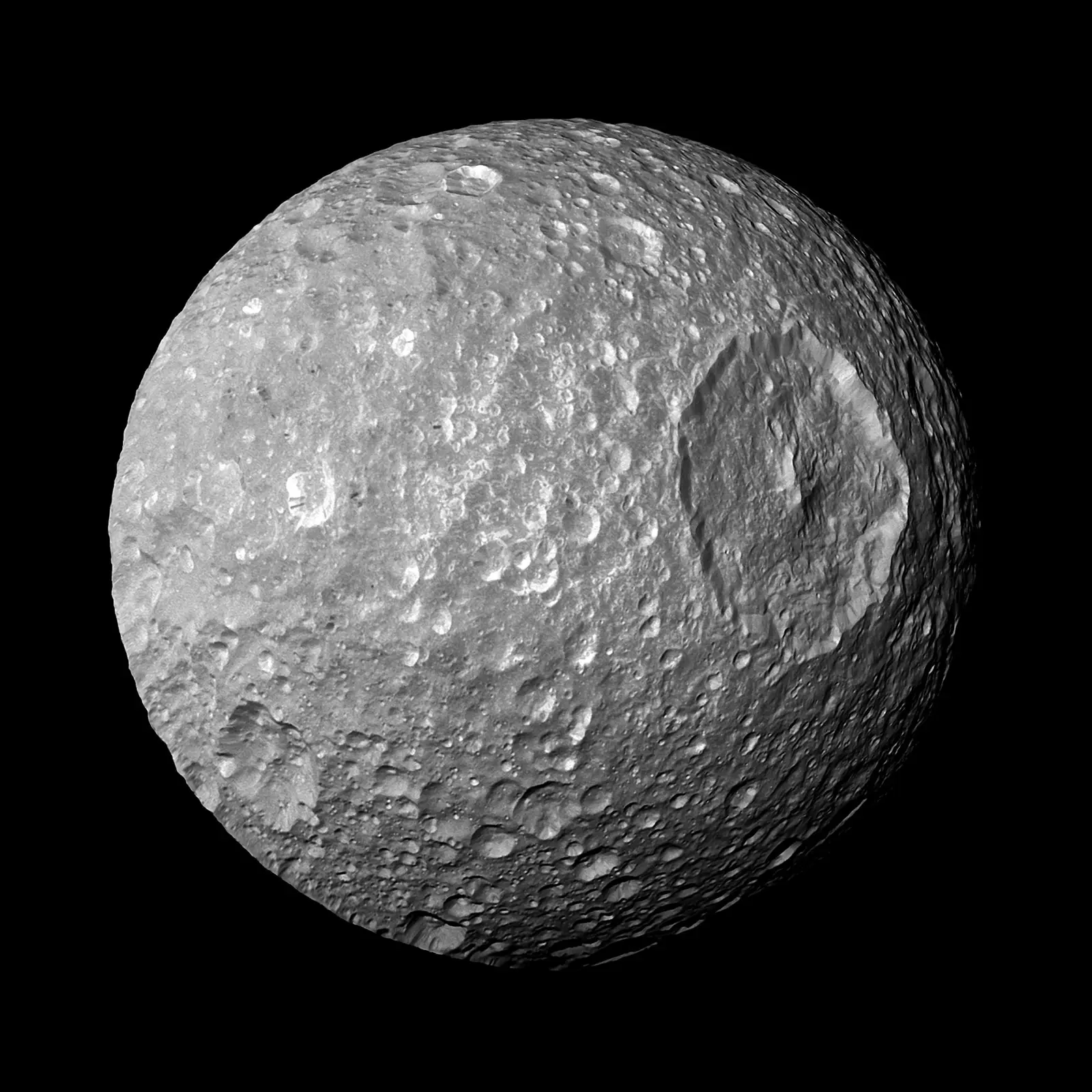
Mimas
Saturn's 'Death Star' moon — a small, icy world hiding a surprisingly young global ocean beneath its ancient, battered surface.
Mimas
Mimas is the smallest and innermost of Saturn's major moons — a battered, icy sphere just 394 km (about 245 miles) across, orbiting closer to the planet than any of its large siblings. Despite its modest size, Mimas has become one of the solar system's most scientifically surprising objects: its surface is dominated by the enormous Herschel impact crater, which gives it an uncanny resemblance to the Death Star from Star Wars, and its interior, long assumed to be a cold, inert ball of ice and rock, is now believed to harbour a global ocean of liquid water hidden 20–30 km beneath the surface.
Discovered by William Herschel on 17 September 1789 using his newly completed 40-foot reflecting telescope, Mimas spent nearly two centuries as little more than a faint point of light. The Voyager 1 flyby in 1980 first revealed its dramatic surface in detail, and the Cassini mission — which orbited Saturn from 2004 to 2017 — transformed understanding of the moon's interior by detecting an unexpectedly large rotational wobble that could not be explained by a simple solid body. A landmark 2024 study published in Nature closed the debate: Mimas carries a recently formed global subsurface ocean, probably less than 25 million years old, making it the youngest known ocean world in the solar system and a compelling target for future exploration.
Discovery and Naming
William Herschel, the German-born British astronomer celebrated for his discovery of Uranus, turned his extraordinary new 40-foot reflecting telescope toward Saturn in the summer of 1789. The instrument's primary mirror measured approximately 49 inches (1.25 m) in diameter and weighed roughly a ton — the largest telescope of its era. Herschel was systematically searching for additional satellites around Saturn, which at the time was known to have five moons. On 28 August 1789 he detected a sixth moon, later named Enceladus, and less than three weeks later, on 17 September 1789, he identified a seventh, interior moon: the object now known as Mimas.
Herschel himself did not name either of his discoveries. The name Mimas — taken from a Giant of Greek mythology, one of the sons of Gaia — was proposed by his son John Herschel in 1847 as part of a systematic scheme to name Saturn's moons after Titans and Giants. For more than a century after its discovery, Mimas remained only a point of light. Astronomers could determine its orbital period and estimate its brightness, but its surface was entirely unknown. The Herschel crater, ironically named in honour of the moon's discoverer, was not revealed until Voyager 1 passed through the Saturnian system in 1980.
Physical Characteristics
Mimas is a small, roughly spherical body with a mean diameter of approximately 394 km, though its true shape is slightly ovoid: its three principal axes measure about 207 × 197 × 191 km. It is not quite large enough to be perfectly spherical under its own gravity, yet it is considered one of the smallest known bodies to have achieved approximate hydrostatic equilibrium — a shape governed by self-gravity rather than by random collisional history. Its very low density, about 1.15 times that of water, demonstrates that water ice makes up the overwhelming bulk of its volume, with only a minor fraction of rocky material mixed in. NASA reports that water ice is the only substance ever conclusively detected on Mimas's surface, and its exterior can be described as water frost.
The surface is heavily cratered, preserving a record of intense bombardment from the early solar system. Mimas's low surface gravity — far weaker than Earth's — means that ejecta from impacts could not accumulate deeply, and bowl-shaped craters retain steep walls that would have slumped long ago on larger, warmer worlds. At temperatures averaging around 77 K (−320 °F), ice behaves like rock and deforms very slowly, so ancient craters remain sharp and well-defined across virtually the entire surface.
Mimas orbits Saturn at a mean distance of approximately 185,500 km from the planet's centre — closer than any of Saturn's other large moons — completing one orbit in roughly 22 hours and 37 minutes. Its orbit is nearly circular, with an eccentricity of about 0.02, and it lies close to Saturn's equatorial plane. A notable dynamical feature is its 2:1 mean-motion resonance with Tethys: for every orbit Tethys completes around Saturn, Mimas completes approximately two. Mimas also plays a role in sculpting Saturn's rings: its gravitational influence is responsible for the Cassini Division, the prominent gap in the ring system.
Herschel Crater: The Death Star Feature
The single most striking feature on Mimas is Herschel crater, an enormous impact basin approximately 130 km across — roughly one-third the diameter of the moon itself. The crater's outer walls rise about 5 km above the surrounding terrain, and its floor plunges 10–12 km below the rim. At the centre stands a pronounced central peak rising 6–8 km above the crater floor, a structure formed when the rock and ice beneath the impact point rebounded upward immediately after the collision. It is this combination — a vast circular depression on an otherwise spherical, icy body, with a prominent central mound — that gives Mimas its famous resemblance to the Death Star of the Star Wars franchise.
The resemblance is entirely coincidental. Star Wars: Episode IV – A New Hope was released in 1977, three years before Voyager 1 returned the first images of Mimas with sufficient resolution to reveal Herschel's true character. The crater's enormous size relative to its host body tells a sobering story: the impact that formed it was almost catastrophic. NASA has noted that the collision probably came close to breaking Mimas apart entirely. On the side of Mimas directly opposite Herschel, the surface is crossed by large fractures — chasmata — interpreted as stress cracks produced when shock waves from the impact focused on the antipodal point. To put the scale in perspective, if a crater with the same proportional size existed on Earth, it would span more than 4,000 km, larger than the continent of Canada, with walls over 200 km high.
Herschel is considered one of the largest craters relative to the size of its host body among the regular moons of the outer solar system. Age estimates derived from crater density in the surrounding terrain suggest Herschel dates to the early solar system, during the period of heavy bombardment roughly 4 billion years ago.
Cassini Observations: The Pac-Man Heat Map
In 2004 the Cassini spacecraft entered orbit around Saturn and began a detailed survey of the planet's moons that would continue for 13 years. Among its many observations of Mimas, one of the most visually memorable came on 13 February 2010, when Cassini made its closest flyby of the moon and its Composite Infrared Spectrometer captured a detailed thermal map of the surface.
The resulting image looked strikingly like the 1980s video game character Pac-Man. The leading hemisphere of Mimas — the side facing the direction of orbital motion — appeared as a roughly wedge-shaped warm region with temperatures reaching about 90–92 K (approximately −300 to −294 °F), while a concentrated warm spot near Herschel crater formed the 'dot' that Pac-Man appeared to be eating. The rest of the moon was significantly colder, around 77 K (−320 °F).
Scientists attributed the pattern to differences in surface texture and thermal inertia. Regions covered by harder, denser, more compacted ice respond differently to solar heating than regions blanketed by fluffier, more porous, insulating ice. Denser ice absorbs heat and re-radiates it more efficiently, producing warmer daytime temperatures even at the same distance from the Sun. The same Pac-Man thermal signature was later observed on Tethys in 2011, suggesting that the phenomenon reflects a general process shaping the surfaces of Saturnian icy moons — likely related to the bombardment of the moons by high-energy electrons trapped in Saturn's magnetosphere, which preferentially alter the texture of ice on the leading hemispheres.
Interior Mysteries: Cassini's Wobble Discovery
The most scientifically consequential Cassini findings about Mimas concerned not its surface but its interior. Using hundreds of high-resolution images from Cassini's Imaging Science Subsystem, Radwan Tajeddine and colleagues precisely tracked how much Mimas physically librates — that is, how much it wobbles back and forth as it orbits Saturn. For a synchronously rotating moon whose interior is rigid and uniform, the expected libration amplitude can be calculated from the moon's shape and orbital eccentricity. When the team carried out this analysis, published in Science in October 2014, they found that Mimas's measured libration amplitude was approximately twice what would be expected for a simple solid body.
This anomalous wobble is physically significant because it reveals that the moon's internal mass distribution is unusual. If the outer ice shell were rigidly coupled to the deep interior, the entire body would rotate as a unit and produce a predictable, small libration. A much larger wobble indicates that the outer shell is somehow decoupled from the interior — and there are two broad ways this can happen. The first is a global subsurface ocean: if liquid water separates the icy crust from the deeper rocky or icy core, the shell can slosh slightly relative to the interior, amplifying the libration signal. The second is a highly elongated, non-hydrostatic solid core — sometimes called a 'fossil' core — whose irregular shape, frozen in from an earlier epoch, could also produce a larger libration without requiring any liquid layer.
The 2014 analysis by Tajeddine's team found both classes of model consistent with Cassini's measured libration. If an ocean existed, it would lie roughly 24–31 km below the surface, beneath a thick shell of cold ice. Subsequent modelling work by researchers at the Planetary Science Institute and the Observatoire de Paris refined these constraints. Tidal heating models showed that shells of approximately 22–32 km thickness were compatible with a fluid subsurface layer when the libration forcing was taken into account. Later dynamical studies, incorporating not just the libration but also the detailed orbital precession of Mimas, found that the elongated fossil core model struggled to reproduce all the observed dynamical behaviour simultaneously, tipping the balance toward the ocean interpretation — even though Mimas's ancient, geologically quiescent surface, showing no plumes, fractures, or obvious thermal anomalies, remained puzzling if a liquid ocean were present.
The 2024 Confirmation: A Young Global Ocean
The debate over Mimas's interior was decisively resolved by a study published in Nature on 8 February 2024. The team, led by Valéry Lainey of the Observatoire de Paris/IMCCE, applied detailed analysis of Cassini orbital tracking data to study the drift of Mimas's periapsis — the point on its orbit closest to Saturn — with exceptional precision. Their key finding was that the fine details of Mimas's observed orbital motion cannot be reproduced by any solid-body interior model; only a moon harbouring a global internal ocean of liquid water matches the data.
The ocean inferred from this orbital analysis lies approximately 20–30 km beneath the heavily cratered ice surface, consistent with the shell thickness range previously estimated from the libration data. The research goes further, however, in constraining not just the ocean's existence but its age. Tidal evolution modelling shows that if Mimas had always possessed a global ocean, its current small orbital eccentricity would long since have been damped away by tidal dissipation in the liquid layer. The fact that the eccentricity is still measurable — about 0.02 — means the ocean must have formed recently, relative to the age of the solar system. The Nature paper concludes that the ocean is likely less than 25 million years old, with simulations suggesting the ice–ocean interface only reached shallower than 30 km depth within the past 2–3 million years. The Observatoire de Paris characterised it as a 'young' ocean, perhaps 5–15 million years old, whose formation was triggered by a tripling of Mimas's orbital eccentricity through gravitational interactions with other Saturnian moons.
The youthfulness of the ocean immediately explains what had long seemed paradoxical: why does Mimas's surface look so geologically old and inactive if it hides liquid water? On Enceladus, whose ocean has had much longer to operate, tidal heating drives vigorous cryovolcanism and the famous plumes that spray water vapour and ice into space. Mimas's ocean has been in existence for such a short time — a geological eyeblink — that it has not yet had sufficient time to warm the overlying ice shell, drive tectonic deformation, or produce any surface expression of the activity below. The heavily cratered terrain is therefore not evidence against an ocean; it is simply a record of the ancient bombardment that predates the ocean's formation by billions of years. A 2023 study by Southwest Research Institute researchers modelling the Herschel impact basin reached a complementary conclusion: the basin's structure, combined with the absence of tectonics, is consistent with a present-day ocean beneath a thinning ice shell less than 30 km thick — a scenario they described as Mimas being a 'stealth ocean world,' one whose hidden ocean leaves no betraying marks on the surface.
The 2024 result repositions Mimas in planetary science. Previously regarded as the most geologically dull of Saturn's moons, it is now recognised as harbouring one of the solar system's most recently formed bodies of liquid water. Because the ocean is young, its chemistry and heat budget may differ markedly from those of older ocean worlds like Enceladus or Jupiter's moon Europa, offering scientists a rare opportunity to study an ocean world at an early stage of its evolution.
Mimas Through Time
- 17 Sep 1789Discovery by William Herschel
Herschel detects Mimas using his 40-foot reflecting telescope, the largest in the world at the time, while systematically searching for new Saturnian satellites. He had found Enceladus just three weeks earlier.
- 1847Named by John Herschel
William Herschel's son John proposes naming the moon Mimas, after a Giant of Greek mythology, as part of a systematic scheme for Saturn's satellites.
- 12 Nov 1980Voyager 1 flyby
Voyager 1 passes through the Saturnian system and returns the first images of Mimas with sufficient resolution to reveal Herschel crater and the heavily cratered surface in detail, three years after Star Wars introduced the Death Star to cinema audiences.
- 13 Feb 2010Cassini thermal map — the Pac-Man
During its closest approach to Mimas, Cassini's Composite Infrared Spectrometer captures a thermal map showing a Pac-Man-shaped warm region on the leading hemisphere, with temperatures reaching 90–92 K. Scientists link the pattern to surface texture differences and thermal inertia.
- 17 Oct 2014Anomalous wobble published in Science
Tajeddine et al. publish Cassini-based measurements showing Mimas librates at roughly twice the amplitude expected for a solid body, pointing to either a global subsurface ocean 24–31 km deep or a highly elongated fossil core.
- 2023SwRI 'stealth ocean world' modelling
Southwest Research Institute researchers model the Herschel basin and conclude that Mimas's structure is consistent with a present-day ocean beneath a thinning ice shell less than 30 km thick, coining the term 'stealth ocean world.'
- 8 Feb 2024Nature paper confirms global ocean
Lainey et al. publish orbital-dynamics analysis of Cassini data in Nature, demonstrating that only a global subsurface ocean can reproduce Mimas's observed orbital motion. The ocean is estimated to be less than 25 million years old — the youngest known ocean in the solar system.
Key Findings About Mimas
Herschel crater, approximately 130 km wide and up to 12 km deep, covers roughly one-third of Mimas's diameter. The impact that formed it came close to disrupting the moon entirely, leaving fractures on the opposite hemisphere as shock waves focused at the antipodal point.
Cassini imaging revealed that Mimas librates at about twice the amplitude predicted for a rigid, homogeneous body — the first strong indication that its interior is structurally unusual, requiring either a global liquid ocean or an exotic elongated fossil core.
A 2024 Nature study led by Valéry Lainey used Cassini orbital data to show that only a global internal ocean, lying 20–30 km beneath the surface, can reproduce the observed drift of Mimas's periapsis. Alternative solid-body models were ruled out.
Tidal evolution modelling in the 2024 study showed that the ocean formed less than 25 million years ago — geologically very recent. Its youth explains why the surface shows no plumes, fractures, or tectonic features that might betray the presence of liquid water.
Cassini's infrared spectrometer mapped a Pac-Man-shaped warm region on the leading hemisphere in 2010, attributed to differences in ice compaction and thermal inertia, likely caused by charged-particle bombardment from Saturn's magnetosphere.
Unlike Enceladus, whose ocean reveals itself through geysers and thermal hot spots, Mimas hides its ocean entirely beneath an ancient, heavily cratered surface. This makes it the prototype of a new class of object: an ocean world with no visible surface signature of its hidden liquid layer.
Frequently Asked Questions
Sources
- Mimas — NASA Science
- Saturn's moon Mimas, a snowplough in the planet's rings — Observatoire de Paris
- Mimas | Definition, Features, & Facts — Britannica
- A recently formed ocean inside Saturn's moon Mimas — PubMed / Nature
- A 'young' ocean under the Mimas ice sheet — IMCCE
- Mimas: A middle-aged moon of Saturn? — ScienceDirect
- SwRI investigations reveal more evidence that Mimas is a stealth ocean world
- Saturn Moon May Hide a 'Fossil' Core or an Ocean — NASA JPL
- Wobbling of a Saturn moon hints at what lies beneath — Cornell University News
- Mimas Has A Young Ocean Beneath Its Icy Shell — Astrobiology Web
- 1980s video game icon glows on Saturn's moon Mimas — ScienceDaily
- A Pair of Pac-Men — NASA JPL
- 235 Years Ago: Herschel Discovers Saturn's Moon Enceladus — NASA
- Fun Facts About Mimas, Saturn's 'Death Star' Moon — KidsDiscover
- The evolution of a young ocean within Mimas — ScienceDirect
- Mimas: An Intriguing Interior — Centauri Dreams
- Herschel (Mimantean crater) — Wikipedia