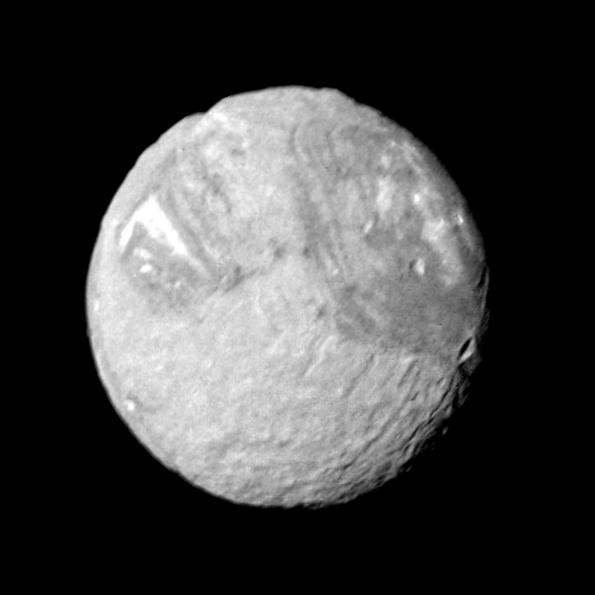
Miranda
Uranus's innermost major moon — a geologically bizarre world of towering cliffs, fractured coronae, and a possible hidden ocean.
Miranda
Miranda is the smallest and innermost of the five major moons of Uranus, and one of the most geologically bizarre objects in the Solar System. With a mean diameter of roughly 470 km — comparable to the surface area of the U.S. state of Texas — it is far smaller than its siblings Ariel, Umbriel, Titania, and Oberon, yet its surface displays a complexity that rivals bodies many times its size.
Discovered in 1948 by Dutch-American astronomer Gerard P. Kuiper, Miranda remained a faint speck until January 1986, when NASA's Voyager 2 spacecraft swept past Uranus and returned the only close-up images of the moon ever obtained. Those images revealed an extraordinary patchwork landscape: ancient cratered plains abruptly bordered by young, ridged terrains; enormous fault canyons plunging up to 20 km deep; and three large, roughly oval tectonic provinces called coronae, unlike any features known elsewhere in the Solar System.
Miranda's low density of about 1.15 g/cm³ indicates an interior dominated by water ice, and its very low surface gravity — less than one per cent of Earth's — means slopes that would collapse on a larger body can persist for billions of years, preserving features such as Verona Rupes, the tallest known cliff in the Solar System. Recent research published in 2024 has reframed Miranda as a candidate ocean world: geophysical modelling of its tectonic features suggests the moon harboured a global subsurface liquid-water ocean at least 100 km deep as recently as 100–500 million years ago, and may retain a thinner remnant ocean today.
Discovery and exploration
- 16 Feb 1948Discovery by Gerard P. Kuiper
Kuiper detected a 'close companion' to Uranus on photographic plates taken with the 82-inch telescope at McDonald Observatory in West Texas. It was the first new Uranian satellite in almost a century.
- 1 Mar 1948Motion confirmed
Comparison plates showed the object moving with Uranus rather than a fixed background star, confirming it was a satellite. Additional images established a nearly circular orbit of about 33 h 56 min.
- Jun 1949Formal announcement
Kuiper published the discovery in the Publications of the Astronomical Society of the Pacific, naming the moon Miranda after the character in Shakespeare's The Tempest, following the convention for Uranian moons.
- 20 Aug 1977Voyager 2 launched
NASA launched Voyager 2, which was extended beyond Jupiter and Saturn to conduct the first flyby of Uranus — and thus Miranda — in the outer Solar System.
- 24 Jan 1986Voyager 2 close approach to Miranda
Voyager 2 passed within approximately 29,000 km of Miranda's surface — closer than to any other major Uranian moon — returning high-resolution images that revealed the moon's extraordinary and varied terrain for the first time.
- Oct 2024Subsurface ocean study published
A study led by Tom Nordheim (Johns Hopkins APL), published in The Planetary Science Journal on 16 October 2024, concluded that Miranda likely harboured a global liquid-water ocean at least ~100 km deep beneath an icy crust ≤30 km thick, as recently as 100–500 million years ago, and may retain a thinner ocean today.
Discovery
Miranda was discovered by Dutch-American astronomer Gerard Peter Kuiper on the night of 16 February 1948, using the 82-inch (2.1 m) telescope at McDonald Observatory in West Texas. Kuiper was initially photographing Uranus to measure the magnitudes of the four then-known Uranian satellites when he noticed an additional, previously unrecorded point of light close to the planet. Its nature as a moon — rather than a background star — was confirmed on 1 March 1948, when control plates showed it moving with Uranus. Additional observations in March 1948 established that it followed a nearly circular orbit of about 33 hours 56 minutes. The discovery was formally announced by Kuiper in June 1949 in the Publications of the Astronomical Society of the Pacific.
Miranda was the first new Uranian satellite in almost a century and only the eighth planetary satellite or new planet discovered in the twentieth century at the time of announcement. Following the established convention of naming Uranian moons after Shakespearean or Alexander Pope characters, Kuiper chose Miranda, after the daughter of Prospero in Shakespeare's The Tempest. The choice proved apt: Miranda would turn out to be one of the most dramatically surprising worlds ever imaged.
Voyager 2 and the 1986 flyby
For nearly four decades after its discovery, Miranda was known only as a faint dot of light. Everything changed on 24 January 1986, when NASA's Voyager 2 spacecraft conducted the first — and so far only — close flyby of Uranus and its moons. To continue on toward Neptune, Voyager 2's trajectory was designed to pass through the inner Uranian system, and the geometry meant the spacecraft approached Miranda more closely than any other major moon, passing within approximately 29,000 km of its surface. As a consequence, Miranda received the highest-resolution imaging of any Uranian satellite during the encounter.
The images that returned were startling. Scientists had anticipated a small, unremarkable icy body — the sort of ancient, heavily cratered moon common in the outer Solar System. Instead Voyager 2 revealed a surface of extraordinary variety: ancient cratered plains sat immediately beside young, barely cratered terrains laced with ridges and grooves; vast canyons plunged to depths of up to 20 km; three large, geometrically distinctive tectonic provinces unlike anything seen on other worlds were identified. The moon's surface quickly earned comparisons to 'Frankenstein's monster,' sewn together from mismatched parts. During the same Uranus encounter, Voyager 2 also discovered 11 previously unknown small inner moons of Uranus, but Miranda dominated scientific attention.
No spacecraft has returned to Uranus or Miranda since 1986. All detailed knowledge of Miranda's surface comes from Voyager 2 data, and the images covered only the moon's southern hemisphere, which was turned toward the Sun at the time of the flyby. The northern hemisphere remains unimaged at close range.
Physical characteristics
Miranda is the smallest of Uranus's five major round moons, with a mean diameter of about 470 km and actual dimensions of roughly 480 × 468.4 × 465.8 km — making it slightly non-spherical, with an equatorial diameter approximately 3% larger than its polar diameter. Its total surface area is roughly 6.99 × 10⁵ km², comparable to the U.S. state of Texas.
Its mass of approximately (6.293 ± 0.300) × 10¹⁹ kg and mean density of about 1.15–1.2 g/cm³ are both the lowest among the five major Uranian moons. This low density directly indicates a composition dominated by water ice, with a smaller but significant fraction of silicate rock and possibly some organic compounds. Surface spectroscopy has firmly detected water ice; other volatiles such as methane, ammonia, carbon monoxide, or nitrogen have been proposed at trace levels but not definitively confirmed.
Miranda's surface gravity of about 0.076 m/s² — less than one per cent of Earth's — has a profound effect on the landscape. Slopes that would be unstable on a larger body can remain intact indefinitely, and an object dropped from the top of the moon's largest cliff would spend roughly 10–12 minutes falling before reaching the base. The escape velocity is only about 0.189 km/s. The surface has a geometric albedo of approximately 0.32, reflecting roughly a third of the sunlight that falls on it; brightness increases sharply at opposition, a pattern consistent with a porous, 'fluffy' regolith whose microscopic shadows vanish when the Sun is directly behind an observer. Surface darkening is attributed to the presence of carbonaceous material.
Geology and surface features
Miranda's surface is one of the most varied and tectonically disrupted terrains in the Solar System. Voyager 2 imaging revealed a patchwork of sharply bounded regions with very different ages, topographies, and likely compositions. Heavily cratered, darker regions of ancient, relatively undisturbed crust sit alongside lightly cratered zones of young terrain crosscut by ridges, valleys, grooves, and steep fault scarps. The boundaries between these regions are often nearly linear and strikingly abrupt, giving the moon an appearance sometimes described as 'stitched together.'
The most scientifically distinctive features of Miranda are three large, roughly oval tectonic provinces called coronae — Arden Corona, Elsinore Corona, and Inverness Corona. These are unlike any terrain type found on other known bodies. Each corona is a broad, trapezoidal or chevron-shaped region of closely spaced parallel ridges and grooves, fault scarps, valleys, and low-relief plains, bounded on all sides by older cratered crust. The patterns within each corona are internally consistent but differ from corona to corona, adding to the patchwork impression.
Two main hypotheses have been advanced for the coronae's origin. In one model, they formed through diapirism — upwelling of partially melted ices from Miranda's interior that punched through the colder outer crust, spreading laterally and deforming it into ridges and grooves. In a competing model, Miranda was catastrophically disrupted by one or more large impacts and then reassembled under self-gravity, mixing old and young crustal blocks in the process. More recent geophysical modelling, drawing on tidal stress analysis calibrated to Voyager 2 topography, favours the internal heating scenario, in which a past subsurface ocean played a central role in generating the tectonic stresses recorded at the surface.
Miranda is also cut by enormous fault canyons estimated to be up to approximately 20 km deep — roughly 10 to 12 times the depth of the Grand Canyon. These chasms appear to result from large-scale extensional tectonics, in which the icy crust was pulled apart, probably driven by internal heating and volume changes. The most prominent single tectonic feature is Verona Rupes, a cliff whose height is commonly cited at about 20 km, making it the tallest known cliff in the Solar System. Because Miranda's gravity is so weak, this immense scarp remains mechanically stable; the same structure on a larger, denser body would collapse under its own weight.
Notable surface features
A fault scarp on Miranda approximately 20 km tall — over ten times the depth of the Grand Canyon. Because of Miranda's very low gravity (~0.008 g), an object dropped from the top would take roughly 10–12 minutes to reach the base. Its exact height remains uncertain because all measurements derive from Voyager 2 images; no later spacecraft has imaged it.
Arden, Elsinore, and Inverness coronae are large, roughly oval regions of ridged and grooved terrain unlike any known elsewhere. Their abrupt boundaries with older cratered crust give Miranda its 'Frankenstein' appearance. They are thought to reflect either icy upwellings from the interior or the aftermath of catastrophic disruption and reassembly.
Extensive systems of cliffs and graben (rift valleys) cut Miranda's surface, indicating intense extensional tectonics. Their depth — far exceeding the Grand Canyon — points to large-scale stretching and fracturing of the icy crust, likely driven by internal heating during past orbital resonances.
Crater counts reveal a wide spread of surface ages: ancient, densely cratered highlands next to lightly cratered, geologically young zones with complex internal structure. This mixture implies multiple episodes of resurfacing and tectonic activity across Miranda's history, unusual for such a small icy body.
Interior structure and composition
Miranda's bulk composition is inferred from its mean density of about 1.15–1.2 g/cm³, which is the lowest among Uranus's five major moons and implies the highest water-ice fraction of the group. Current models treat Miranda as consisting of roughly equal parts water ice and silicate rock by mass, with a probable structure of a silicate-rich rocky core overlain by a thick icy mantle. The moon is considered likely differentiated, with the separation of rock and ice driven by heat from radioactive decay shortly after formation from the accretion disk surrounding Uranus.
The outermost layer visible to Voyager 2 is a heavily fractured, porous regolith of water ice darkened by carbonaceous material, which accounts for the relatively low albedo of the older terrain units. Beneath this lies the main icy shell, whose properties are the central question of recent research.
A study published in The Planetary Science Journal on 16 October 2024 and led by Tom Nordheim of Johns Hopkins APL presented the most detailed interior modelling of Miranda to date. By mapping Miranda's surface fractures, ridges, and coronae from Voyager 2 imagery and comparing them with tidal stress patterns predicted by interior models of varying structure, the team found that the configuration best matching the observed geology requires a global liquid-water ocean beneath the ice shell. The preferred model yields an ocean at least approximately 100 km deep, lying under an icy crust no thicker than about 30 km. Given Miranda's radius of only 235 km, such an ocean would have occupied nearly half the moon's total interior volume.
The modelling indicates this ocean existed about 100 to 500 million years ago — geologically recent. On whether any ocean persists today, the same study notes that if Miranda had frozen entirely, the volumetric expansion of water converting to ice would have produced characteristic global-expansion fractures at the surface; these have not been identified in existing imagery. The authors interpret this absence as evidence that the interior is still cooling and may retain a thinner subsurface ocean layer at present. This finding remains an inference, however: confirming or ruling out a current ocean would require future spacecraft measurements such as radar sounding, or gravity and magnetic field data collected during close flybys.
The heat source for any such ocean is tidal dissipation. Miranda's orbit is slightly inclined — about 4.2° — relative to Uranus's equatorial plane, and the moon has undergone past orbital resonances with other Uranian moons. During such resonances, the repeated gravitational tugging causes Miranda's shape to oscillate between slightly more spherical and more elongated, and the resulting internal friction generates heat. Combined with radiogenic heating from the rocky interior, this tidal heating appears capable of maintaining a liquid layer in a moon of Miranda's size, even at Uranus's great distance from the Sun.
Miranda in the Uranian system
Uranus is orbited by at least 27 to 28 known moons. Five of these — Miranda, Ariel, Umbriel, Titania, and Oberon — are large enough to be roughly spherical and are collectively called the major or classical moons. In order of distance from Uranus, Miranda is the innermost of this group, orbiting at a mean radius of about 129,900 km with a period of 1.413 Earth days. It is tidally locked, always presenting the same face to Uranus.
The four outer major moons — Ariel, Umbriel, Titania, and Oberon — have diameters ranging from roughly 1,200 to 1,600 km, making them all substantially larger than Miranda's 470 km. Their orbits lie very close to Uranus's equatorial plane, whereas Miranda's orbit is inclined by about 4.2°, the largest orbital tilt of any major Uranian moon, and a property that facilitates the tidal resonances thought to have shaped its interior. Miranda also has the lowest density of the five, consistent with its higher ice fraction.
Inside Miranda's orbit there are at least 13 smaller inner moons, with diameters from about 15 to 150 km, that interact with Uranus's ring system. Beyond the five major moons, nine or more irregular moons move on distant, often retrograde orbits. In 2025, a new tiny inner moon designated S/2025 U 1 was discovered using the James Webb Space Telescope, refining the overall architecture of the Uranian system, though it does not materially affect Miranda's known properties.
The emerging picture from 2023–2024 research is that Miranda may not be alone as an ocean world within the Uranian system. A 2023 analysis by Ian Cohen and colleagues at APL reexamined Voyager 2 particle and magnetic field data from the 1986 flyby and found indications that Miranda and Ariel may be actively releasing material into Uranus's magnetosphere, possibly via plumes or other venting analogous to the activity at Saturn's moon Enceladus. Separately, JWST observations of Ariel reported in 2024 suggested that its surface carbon dioxide ice is being replenished from a subsurface reservoir. Together, these results strengthen the view that multiple Uranian moons may harbour or have recently harboured liquid water, making the Uranian system a high-priority target for future exploration.
Frequently asked questions
Sources
- Miranda (moon) — Wikipedia
- Miranda | Uranus, Moon, Gravity, Size, Facts, Satellite, Cliff, & Coronae — Britannica
- Miranda — NASA Science
- Miranda: Uranus' moon — NOAA's Science On a Sphere
- Miranda (moon) — EBSCO Research Starters
- Uranus' Moon Miranda May Have an Ocean Beneath Its Surface — Johns Hopkins APL
- Torn Apart at Birth: 70 Years Since the Discovery of Miranda — AmericaSpace
- Jumping the Tallest Cliff in the Solar System — NASA Space Place
- Verona Rupes: Tallest Known Cliff in the Solar System — UCL APOD
- Is there an ocean lurking beneath one of Uranus' moons? — PSI
- Compositions and Interior Structures of the Large Moons of Uranus — AGU Journals
- UND astronomers help uncover mysteries of Miranda
- New Moon Discovered Orbiting Uranus Using NASA's Webb Telescope