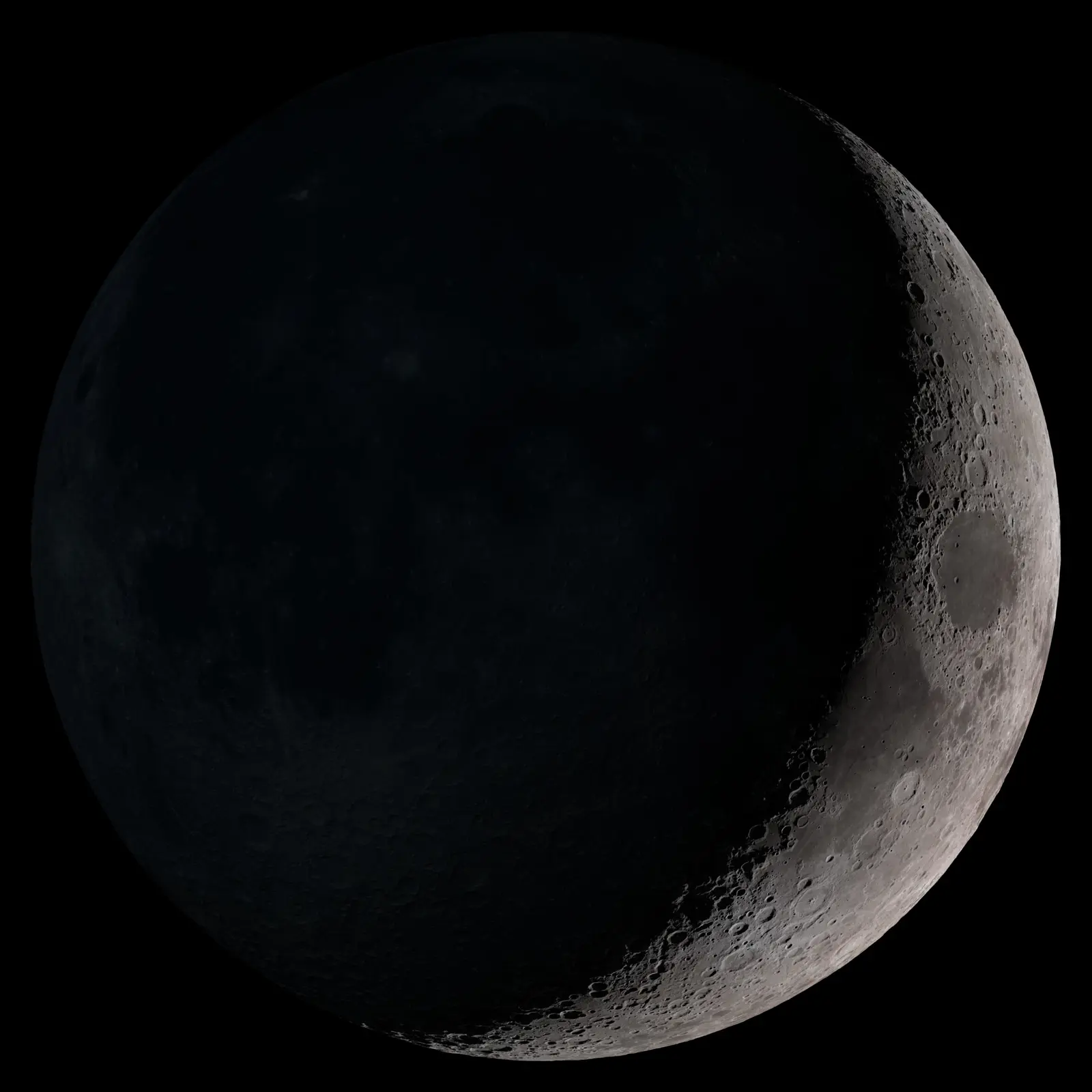
Moon Phases
The Moon's ever-changing face — a 29.5-day dance of sunlight, shadow, and geometry that has shaped calendars, guided tides, and inspired explorers for tens of thousands of years.
Moon Phases
The phases of the Moon are the regularly repeating changes in the Moon's illuminated appearance as seen from Earth. They arise from a straightforward geometric cause: the Sun illuminates one hemisphere of the Moon at all times, and as the Moon orbits Earth, observers on Earth see varying fractions of that sunlit hemisphere. The result is a continuous cycle — from an invisible new Moon, through swelling crescents and a fully lit full Moon, and back again — that takes an average of 29.53059 days to complete. This interval, called the synodic month, is slightly longer than the Moon's true orbital period of about 27.3 days because Earth itself is moving around the Sun, requiring the Moon to travel an extra arc before the Sun–Earth–Moon geometry repeats.
Moon phases are not caused by Earth's shadow falling on the Moon — that is a widespread misconception. Earth's shadow produces a lunar eclipse, a distinct and rare event requiring precise three-body alignment at full Moon. During a normal phase, the dark portion of the disk is simply the Moon's own night side, the half not currently facing the Sun.
The phase cycle has been one of humanity's most reliable natural clocks. Prehistoric people scratched tallies of lunar days into bone more than 20,000 years ago. Ancient Mesopotamian, Egyptian, Chinese, Hindu, and Roman civilizations built calendars around the Moon's rhythm. Two elegant long-period cycles — the 19-year Metonic cycle and the roughly 18-year Saros cycle — were discovered by ancient astronomers who noticed that phases and eclipses repeat with remarkable regularity. Today, phases continue to govern ocean tides, influence the behaviour of countless marine species, and set the operational windows for robotic and crewed spacecraft exploring the lunar surface.
What Causes the Phases: Geometry of Sunlight
The Moon produces no light of its own; it shines entirely by reflecting sunlight. At any moment, the Sun illuminates exactly half of the lunar sphere — the hemisphere directly facing the Sun — while the opposite hemisphere is dark. This arrangement is identical to night and day on Earth, and it never changes regardless of where the Moon is in its orbit.
What does change, continuously, is the angle between the Sun, Earth, and Moon — the elongation. When the Moon lies between Earth and the Sun (elongation 0°), its sunlit hemisphere faces entirely away from Earth and the disk appears dark: new Moon. As the Moon moves eastward in its orbit, observers begin to see a sliver of the lit side: the waxing crescent. At elongation 90° — when the Moon is one-quarter of the way around its orbit — exactly half of the sunlit face is visible from Earth: first quarter. Continuing to elongation 180°, the Moon is on the opposite side of Earth from the Sun, and the entire sunlit hemisphere faces Earth: full Moon. The sequence then reverses as the Moon completes the second half of its orbit — waning gibbous, last quarter, waning crescent — before returning to new Moon.
Because the Moon's orbit is tilted roughly 5° relative to Earth's orbital plane (the ecliptic), the Moon usually passes slightly above or below the Earth–Sun line at new and full Moon, which is why solar and lunar eclipses do not occur every month. Only when the Moon crosses the plane precisely at new Moon or full Moon do eclipses happen.
The synodic month averages 29.53059 days, but individual lunations can differ from this mean by up to about 7 hours, because the Moon's elliptical orbit causes it to move faster near perigee (closest approach) and slower near apogee (farthest point). This ellipticity also means that full Moons are not always the same apparent size or brightness.
The Eight Phases: Angles, Illumination, and Timing
Astronomers conventionally recognise eight named phases, four principal (new Moon, first quarter, full Moon, last quarter) and four intermediate (waxing crescent, waxing gibbous, waning gibbous, waning crescent). Using the mean synodic month of 29.53 days, the four quarter points fall approximately at days 0, 7.4, 14.8, and 22.1 after new Moon.
New Moon (elongation 0°, illumination ≈0%): The Moon is between Earth and the Sun. The dark side faces Earth, making the Moon nearly invisible in the daytime sky. Day 0 of the cycle.
Waxing Crescent (elongation 0°–90°, illumination roughly 1–49%): A growing crescent appears on the right side of the disk as seen from the Northern Hemisphere, between about day 0 and day 7.4.
First Quarter (elongation ≈90°, illumination ≈50%): The Sun–Earth–Moon angle is a right angle, with the Moon 90° east of the Sun. The right half of the disk (Northern Hemisphere view) is lit. Occurs roughly 7.4 days after new Moon.
Waxing Gibbous (elongation 90°–180°, illumination roughly 51–99%): More than half the disk is lit and growing toward full, between about day 7.4 and day 14.8.
Full Moon (elongation 180°, illumination ≈100%): Earth lies between the Sun and Moon. The entire sunlit hemisphere faces Earth. Occurs roughly 14.8 days after new Moon. Because the Moon's orbit is slightly inclined, the disk is usually not 100% illuminated — a true 100% full Moon requires the Moon to pass through Earth's shadow (a lunar eclipse), which is far rarer than a regular full Moon.
Waning Gibbous (elongation 180°–270°, illumination roughly 99–51%): The Moon begins to shrink from full, between about day 14.8 and day 22.1.
Last (Third) Quarter (elongation ≈270°, illumination ≈50%): The Moon is 90° west of the Sun; now the left half of the disk is lit (Northern Hemisphere). Roughly 22.1 days after new Moon.
Waning Crescent (elongation 270°–360°, illumination roughly 49–1%): A narrowing crescent on the left side, from about day 22.1 back to day 29.5 and the next new Moon.
The illumination values at the quarter phases are idealized. Because the Moon's orbit is elliptical, the actual illuminated fraction at first or last quarter can be slightly above or below 50%.
The Synodic vs. Sidereal Month: Why 29.5 Days Instead of 27.3
The Moon's true orbital period — the time it takes to circle Earth once relative to the distant stars — is the sidereal month, approximately 27.32 days. But the phase cycle takes about 29.53 days, nearly two days longer. The difference arises because Earth is itself moving around the Sun.
During the 27.32 days the Moon completes one orbit, Earth advances roughly 30° along its own orbit around the Sun. To return to the same Sun–Earth–Moon alignment (and thus the same phase), the Moon must travel an additional 30° — the extra arc takes roughly two more days. The result is the synodic month of 29.53059 days.
Humanity's Discovery and Study of Moon Phases
- ~25,000–35,000 BCEPrehistoric lunar tallies
Ice-Age hunters in Europe scratched lines and gouged holes in sticks and bones, apparently counting the days between phases of the Moon. Archaeological evidence from this period provides some of the earliest indications of structured human timekeeping.
- ~8000 BCEWarren Field lunisolar calendar, Scotland
A set of pits at Warren Field in Aberdeenshire, dated to around 10,000 years ago, has been interpreted as a lunisolar calendar marking both the lunar cycle and the midwinter solstice, suggesting its makers understood that a lunar year is shorter than a solar year and must be periodically corrected.
- ~3000–2500 BCESumerian and Babylonian lunar calendars
Sumerians used a structured calendar of 30-day months. Babylonians adopted a year of twelve lunar months of alternating 29 and 30 days (a 354-day year), explicitly tied to the synodic lunar month, with intercalary months added to keep the calendar aligned with the seasons.
- ~3100 BCEEgyptian solar calendar derived from lunar origins
The earliest Egyptian calendar was based on the Moon's cycles. Around 3100 BCE, Egyptians noticed that the heliacal rising of Sirius coincided with the annual Nile inundation every 365 days and devised one of the earliest solar calendars, though lunar phases continued to govern religious festivals.
- ~3000–2000 BCEStonehenge and lunar alignments
Stone Age peoples recorded the phases of the Moon in various ways. Stonehenge (c. 3000–2000 BCE) includes stones whose positions appear related to the lunar cycle, probably used for tracking eclipses and seasonal timing.
- ~8th–6th century BCEBabylonian recognition of the Saros cycle
Babylonian astronomers compiled long eclipse records and discovered that eclipses of similar geometry repeat after approximately 18 years 11⅓ days — a period corresponding to 223 synodic months, 242 draconic months, and 239 anomalistic months. Though the name 'Saros' is modern, the cycle itself was known empirically from Babylonian eclipse lists.
- 432 BCEMeton of Athens formalises the Metonic cycle
Meton of Athens introduced the observation that 19 tropical years are almost exactly equal to 235 synodic lunar months — an error of only a few hours. This Metonic cycle means that lunar phases recur on nearly the same calendar dates every 19 years. Babylonian astronomers had effectively used the same relation earlier for intercalation, but Meton systematised it for Greek calendar reform.
- ~150–100 BCEAntikythera mechanism encodes lunar cycles
The Antikythera mechanism, an ancient Greek analogue computing device, incorporated gearing to predict lunar phases and eclipses. Modern reconstructions show it includes a Metonic dial, demonstrating that sophisticated mechanical modelling of the phase cycle existed in the ancient world.
- 46 BCEJulian calendar decouples civil timekeeping from the Moon
Under Julius Caesar, Rome adopted the Julian calendar — a purely solar calendar of 12 months with fixed lengths and leap years. This largely ended the alignment of Roman civil timekeeping with the Moon's phases, though lunar cycles remained important for religious purposes.
Ancient Civilisations and Lunar Calendars
Across the ancient world, the Moon's phase cycle formed the foundation of the earliest calendars precisely because it provided a natural, repeating unit of time between the very short day and the much longer year. The problem every lunar calendar faced was the same: 12 synodic months add up to only about 354 days, roughly 11 days short of the solar year. Failing to correct for this gap causes the calendar to drift through the seasons, eventually putting midwinter festivals in summer. Different civilisations solved this in different ways.
The traditional Chinese calendar is lunisolar: months follow the lunar cycle, but the year is kept in step with the Sun by intercalating extra months when needed, with the year beginning on the second (or sometimes third) new Moon after the winter solstice. The Hindu lunisolar calendar divides each month into two fortnights — the waxing fortnight (shukla paksha) and the waning fortnight (krishna paksha) — directly institutionalising the phase cycle as the backbone of religious and civil life. The Maya maintained careful records of the Moon's phase alongside their 365-day solar calendar and 260-day ritual calendar, and lunar series inscribed on monuments show detailed tracking of lunar age and eclipse predictions.
The two great long-period cycles discovered through careful lunar observation — the Metonic cycle and the Saros cycle — represent the highest achievement of ancient mathematical astronomy. The Metonic cycle (19 years ≈ 235 synodic months) allows calendar makers to know exactly when to insert a 13th month to keep the lunar and solar years in sync. The Saros cycle (223 synodic months ≈ 18 years 11⅓ days) means that a solar or lunar eclipse is followed by a nearly identical one after that interval, enabling eclipse prediction without any understanding of celestial mechanics in the modern sense — just patient record-keeping and pattern recognition.
Moon Phases and Their Effects on Earth
The Moon's gravitational pull is the primary driver of Earth's ocean tides. The Moon creates tidal bulges on the side of Earth facing it and on the opposite side simultaneously. The Sun also exerts a tidal force, and the combined effect depends on the Sun–Earth–Moon alignment — which is itself a function of the lunar phase.
At new Moon and full Moon, when the Sun, Earth, and Moon are roughly aligned, the solar and lunar tidal forces reinforce each other, producing spring tides with larger-than-average tidal ranges. At first and last quarter, when the Sun and Moon are at right angles to each other as seen from Earth, the solar tide partially offsets the lunar tide, producing neap tides with smaller-than-average tidal ranges. This means tidal extremes are directly tied to the phase cycle, repeating roughly every 14.8 days.
Many marine and coastal organisms exploit this predictable rhythm. Corals, crabs, polychaete worms, grunion, and sea turtles are among the species documented to synchronise spawning, egg-laying, or hatching with the tidal or moonlight conditions associated with particular phases. Moonlight itself — at its brightest around full Moon — influences the nocturnal behaviour of predators and prey in open-water and intertidal ecosystems, altering visibility and thus hunting success.
In contrast, the idea that the full Moon triggers unusual human behaviour is not supported by careful statistical studies. Research reviewed by the Lunar and Planetary Institute found no correlation between the full Moon and elevated rates of unusual behaviour. The persistence of this belief likely reflects confirmation bias — incidents attributed to the full Moon on moonlit nights that would be forgotten on other nights.
Supermoons, Micromoons, Blue Moons and Black Moons
A supermoon is a full Moon (or sometimes a new Moon) that occurs when the Moon is at or near perigee — the closest point in its elliptical orbit. Because there is no single official definition, some sources restrict the term to the closest full Moon of a given year, while popular and NASA outreach usage applies it to any full Moon that falls near perigee. Under the looser definition, three or four supermoons typically occur each year, often in consecutive months. A supermoon appears slightly larger and brighter than an average full Moon, though the difference is often subtle to the naked eye.
The informal opposite of a supermoon: a full Moon or new Moon that occurs at or near apogee, the farthest point in the Moon's orbit. A micromoon appears somewhat smaller and dimmer than average. By symmetry with supermoons, three or four micromoons per year are typical under the 'near apogee' criterion. The term is not part of formal astronomical nomenclature.
The second full Moon in a single calendar month. Because the synodic month (29.53 days) is shorter than most calendar months, a month that begins with a full Moon will end with a second one. This definition became widespread following a 1946 misinterpretation in Sky & Telescope, but is now broadly accepted. February can never have a monthly blue Moon, as it is shorter than one lunation.
The traditional definition from older almanac usage: when a season (the period between a solstice and the next equinox, or vice versa) contains four full Moons instead of the usual three, the third of those four is called a blue Moon. Both definitions are now recognised by NASA and major observatories.
Blue moons of either calendrical type occur approximately every two to three years. More precisely, a monthly blue Moon occurs seven times in every 19-year Metonic cycle — about once every 2.7 years on average. The phrase 'once in a blue moon' overstates their rarity; they are not astronomical curiosities. A Moon that actually appears blue in colour is far rarer, occurring only when large volcanic eruptions or major wildfires scatter unusual atmospheric particles.
The most common modern definition is the second new Moon in a calendar month — the new-Moon analog of a monthly blue Moon. Some sources also apply the term to a February that contains no full Moon at all, which is possible because February can be shorter than one lunation. Black Moons, like blue Moons, recur roughly every two to three years. The term is not used in formal astronomy and is applied inconsistently across different popular sources.
Recent Missions and the Lunar Phase Cycle
Chandrayaan-3 (India, ISRO)
Aug 2023Soft-land a rover near the lunar south pole; study regolith composition, surface temperatures, and near-surface plasma in a region where illumination conditions are extreme and water-ice stability is tied to permanently shadowed craters.
Luna 25 (Russia, Roscosmos)
Aug 2023Land near the south pole to study polar volatiles and regolith.
SLIM — Smart Lander for Investigating Moon (Japan, JAXA)
Jan 2024Demonstrate sub-100-metre precision landing near Shioli Crater; deploy two mini-rovers (LEV-1 hopper and LEV-2 Sora-Q); image surface rocks to study local crustal composition.
Chang'e-6 (China, CNSA)
May–Jun 2024Return the first-ever samples from the lunar farside — specifically from Apollo crater within the South Pole–Aitken Basin — to shed light on farside volcanism, crustal differences from the nearside, and the early impact history of the inner Solar System.
Artemis Program (NASA)
OngoingReturn humans to the Moon; map and sample polar water-ice deposits in permanently shadowed regions; deploy geophysical instruments; prepare architecture (Gateway, commercial landers) for sustained lunar presence and eventual Mars missions.
Moon Phases and Spacecraft Operations
The lunar phase cycle has a direct and practical consequence for spacecraft operating on or near the Moon. Because the Moon rotates once on its axis in the same time it takes to orbit Earth (synchronous rotation), a fixed point on the lunar surface experiences roughly 14 consecutive Earth-days of sunlight followed by 14 days of darkness — a lunar day tied to the synodic month. For landers relying on solar power, this means a single lunar day is the operational window before a frigid, pitch-dark fortnight descends.
Chandrayaan-3's Vikram lander and Pragyan rover were designed for one lunar day, requiring landing shortly after local sunrise when both thermal conditions and lighting would be favourable. SLIM's experience extended this understanding: despite landing in an unfavourable orientation that left its solar panels shadowed, the spacecraft operated whenever the local Sun angle permitted light to reach the panels, and it survived multiple lunar nights — data relevant to future mission designs for longer-duration surface operations.
Chang'e-6's farside sampling required the entire sequence — descent, surface sampling by scoop and drill, and ascent — to be completed within a single local lunar day. The mission also depended on the Queqiao-2 relay satellite, whose orbital geometry relative to the farside was itself influenced by the evolving Earth–Moon–Sun configuration over the 53-day mission.
NASA's Artemis programme prioritises landing sites near the lunar south pole partly because certain elevated terrain there — so-called peaks of near-eternal light — receives sunlight for a large fraction of the year. These illuminated ridges sit adjacent to permanently shadowed craters believed to harbour water ice, meaning the lunar phase-driven illumination pattern is a primary factor in determining where humans will first set foot on the Moon again.
Moon Phases FAQ
Sources
- Length of the Synodic Month: 2001 to 2100 — AstroPixels
- Lunar Sidereal vs. Synodic — Durham University
- Lunar month — Wikipedia
- Sky Tellers — Moon Phases, Lunar and Planetary Institute
- Moon Phases — Las Cumbres Observatory
- Ancient humans used the moon as a calendar in the sky — Science News
- A History of Lunar Science — Lunar Reconnaissance Orbiter Camera
- A Walk Through Time — Ancient Calendars, NIST
- Lunar phase — Wikipedia
- Moon Phases — NASA Science
- The Moon's Influence on Us — Lunar and Planetary Institute
- Tidal Variations — NOAA Ocean Service
- Supermoon — EBSCO Research Starters
- Supermoon, Blood Moon, Blue Moon and Harvest Moon — NASA Space Place
- Blue moon — Wikipedia
- What is a blue moon and when will the next one occur? — Royal Museums Greenwich
- What is a Blue Moon — Space.com
- List of missions to the Moon — Wikipedia
- NASA's Artemis Program
- International fleet of spacecraft heading to the Moon in 2024 — New Scientist