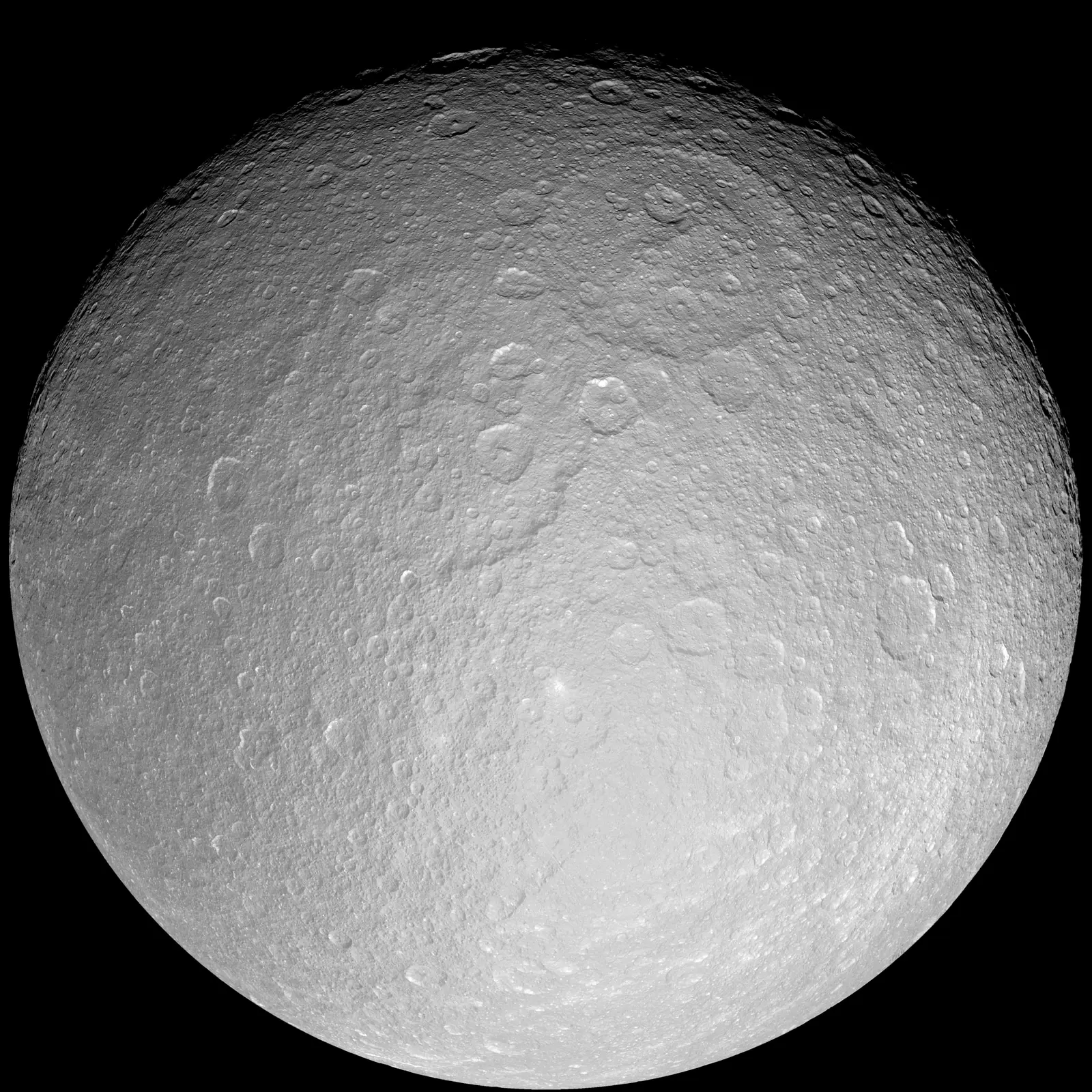
Rhea
Saturn's second-largest moon — an ancient, icy world of frozen cliffs, craters, and a whisper-thin oxygen atmosphere
Rhea
Rhea is the second-largest moon of Saturn and the ninth-largest moon in the Solar System. With a diameter of approximately 1,528 km, it is a medium-sized, ice-rich world that has preserved an ancient, heavily cratered surface largely unchanged for billions of years. Its mean density of about 1.236 g/cm³ — only slightly above that of liquid water — reveals a bulk composition of roughly 75% water ice and 25% silicate rock, earning it the informal description of a "frozen dirty snowball."
Discovered on 23 December 1672 by the Italian-born French astronomer Giovanni Domenico Cassini, Rhea was only the third Saturnian moon known to humanity at the time, after Titan and Iapetus. For nearly three centuries it remained a faint point of light in even the best telescopes, until the Voyager 1 and 2 flybys of 1980 and 1981 returned the first resolved images of its cratered, icy surface. The Cassini–Huygens orbiter, operating in the Saturn system from 2004 to 2017, conducted five dedicated close flybys of Rhea and transformed scientific understanding of the moon in virtually every dimension — its geology, interior, surface chemistry, and the extraordinary thinness of its exosphere.
Rhea is tidally locked to Saturn, keeping one hemisphere permanently facing the planet as it completes an orbit every 4.518 Earth days in a nearly circular path some 527,000 km from Saturn's centre. Its surface temperature ranges from around −174 °C on the sunlit side to −220 °C in shadow. Despite this frigid environment, Rhea has not been entirely passive: Cassini revealed a surprisingly complex geological history, including ancient tectonic fractures, possible early cryovolcanism, and an ongoing, albeit extraordinarily tenuous, oxygen–carbon dioxide exosphere generated by radiation striking the icy surface.
History of Rhea
- Dec 23, 1672Discovery by Giovanni Cassini
Giovanni Domenico Cassini observed Rhea from the Paris Observatory using a 10.4-metre focal-length refracting telescope made by optician Giuseppe Campani. It was the second Saturnian moon Cassini found (after Iapetus in 1671) and the third moon of Saturn known overall. Cassini grouped it with his other four discoveries under the collective name Sidera Lodoicea — the "Stars of Louis" — in honour of King Louis XIV.
- 1847Named "Rhea" by John Herschel
The astronomer John Herschel proposed the name Rhea — after the Titaness of Greek mythology, mother of the Olympian gods — in his work Results of Astronomical Observations made at the Cape of Good Hope. The name aligned with the convention of naming Saturn's moons after Titans and related figures from Greek myth.
- 1980Voyager 1 flyby
Voyager 1's encounter with the Saturn system yielded the first resolved images of Rhea, transforming it from a point of light into a cratered, icy world. The flyby provided the first data on Rhea's size, brightness, and basic surface geology.
- 1981Voyager 2 flyby
Voyager 2 followed up with additional observations during its own Saturn encounter, supplementing Voyager 1's data and refining early understanding of Rhea's surface morphology and global properties.
- Nov 26, 2005Cassini first close flyby (500 km)
Cassini made its first targeted close flyby of Rhea at approximately 500 km. Six instruments studying particles and fields investigated the environment around the moon. Analysis of electron depletion data from this flyby would eventually lead to the 2008 announcement of possible rings.
- Aug 30, 2007Cassini second flyby (5,750 km)
Cassini passed Rhea at a closest approach of about 5,750 km, contributing additional imaging and particle-environment data.
- Mar 6, 2008Rings of Rhea announced
NASA and Cassini scientists announced evidence for a broad debris disk and at least one ring orbiting Rhea, inferred from the pattern of electron depletion measured during the November 2005 flyby. It was described as the first possible detection of rings around a moon.
- Mar 2, 2010Cassini third flyby (100 km)
Cassini swept past Rhea at an extremely close 100 km, producing high-resolution mosaics of the leading hemisphere and anti-Saturn side. Targeted optical searches for the proposed ring system during this encounter found no evidence of ring material.
- 2010Oxygen exosphere confirmed
Analysis of Cassini data announced that Rhea possesses an extremely tenuous oxygen–carbon dioxide exosphere, with O₂ about five trillion times less dense than Earth's sea-level atmosphere. This made Rhea one of only a handful of bodies in the Solar System known to have a detectable oxygen-bearing atmosphere.
- Jan 11, 2011Cassini fourth flyby (69 km)
The closest-ever Cassini encounter with Rhea, at just 69 km. The Cosmic Dust Analyzer recorded dust impacts near the surface, and fields-and-particles instruments probed the interaction between Rhea's exosphere and Saturn's magnetosphere.
- Mar 9, 2013Cassini fifth (final) flyby (992 km)
Cassini's last targeted flyby of Rhea, at 992 km, was designed primarily as a gravity science experiment. Using the spacecraft's radio link to the Deep Space Network, scientists measured minute velocity changes to probe the distribution of mass inside Rhea and constrain its internal structure.
- 2020sPost-Cassini reanalysis: hydrazine and interior
Researchers re-examining Cassini ultraviolet spectra identified a persistent absorption feature near 184 nm on Rhea's surface, matched best by hydrazine monohydrate — a radiation-driven product of surface chemistry, and potentially the first detection of such a species on a moon's surface. Parallel work refined the interior model, strengthening evidence for a largely homogeneous, undifferentiated interior with no present-day subsurface ocean.
Physical characteristics and interior
With a mean radius of 763.8 km and a mass of 2.3065 × 10²¹ kg, Rhea is a substantial but not enormous world — about 0.031 times the mass of Earth's Moon. Its most diagnostic property is its low mean density of approximately 1.236 g/cm³, only slightly greater than that of liquid water. This figure immediately rules out a predominantly rocky interior and points to a composition dominated by water ice, with silicate rock making up around a quarter of the total mass.
Cassini gravity measurements taken during multiple flybys, and especially the final targeted encounter in March 2013, provided constraints on how that ice and rock are arranged inside the moon. The data yielded a moment of inertia higher than would be expected for a clearly differentiated body — one with a dense rock core surrounded by an ice mantle. Scientists therefore interpret Rhea as most likely a broadly homogeneous mixture of ice and rock throughout, rather than a layered structure. This picture is consistent with a history in which Rhea never generated enough internal heat to allow rock and ice to fully separate. Earlier speculation about a possible subsurface liquid-water ocean has been largely set aside by these findings; current models favour a cold, rigid interior with no present-day ocean.
At the pressures found deep within Rhea, models predict a transition to high-pressure Ice II at roughly 350–450 km below the surface. The surface itself is dominated by water ice that, at Rhea's temperatures, behaves mechanically like rock. Dayside surface temperatures reach approximately −174 °C, dropping to around −220 °C in permanently shadowed regions. The high geometric albedo of about 0.7 reflects the purity and prevalence of this water ice, making Rhea one of the brightest moons in the Saturnian system.
Surface geology: craters, cliffs, and frozen plains
Rhea's surface is one of the most densely cratered in the Solar System, resembling the ancient highlands of Earth's Moon. This saturation of craters indicates that the surface is very old and that Rhea has been geologically inert for most of its history. Voyager and Cassini images identified two broad terrain types: heavily cratered bright regions dominated by impact craters larger than 40 km across, and somewhat smoother areas — found mainly at certain polar and equatorial latitudes — where craters are predominantly smaller than 40 km. The second terrain type is interpreted as the product of at least one major resurfacing event early in Rhea's history, with the smoother plains estimated to be roughly 4 billion years old.
Several enormous impact basins scar the surface. The most prominent include Mamaldi, approximately 480 km across, and Tirawa, roughly 360 km across. These structures attest to a period of heavy bombardment shortly after the formation of the Solar System, impacts energetic enough to have momentarily melted or mobilized ice across large areas of the surface.
One of Voyager's most striking discoveries was a set of bright, wispy streaks stretching tens to hundreds of kilometres across Rhea's trailing hemisphere. For decades their origin was debated. High-resolution Cassini images obtained in 2006 resolved the mystery: the wisps are not frost deposits but cliffs — subsidence fractures and canyons with walls several hundred metres high. The cliff faces are bright because darker material has fallen away under gravity, continuously exposing fresh, clean water ice. These features place Rhea alongside Dione and Tethys as icy moons that experienced genuine tectonic activity early in their histories, even if that activity stopped long ago and never reached the sustained, dramatic scale seen today on Enceladus.
The smoother plains regions have been tentatively linked to a limited episode of cryovolcanism or impact-induced melting very early in Rhea's history. Under this model, liquid water reached the surface and flooded low-lying areas such as large crater floors, then refroze, obliterating pre-existing topography. Today no such activity continues; Rhea is considered a geologically dead world, its internal heat long since dissipated.
Exosphere: a breath of oxygen in the void
Rhea possesses an exosphere — a collisionless, extremely tenuous envelope of gas — composed primarily of molecular oxygen (O₂) with a significant fraction of carbon dioxide (CO₂). Cassini's Ion and Neutral Mass Spectrometer and plasma instruments detected and characterized this exosphere during close flybys, with results reported in 2010. The mixing ratio where sampled is approximately 70% O₂ and 30% CO₂. Peak oxygen densities measured near the surface are around 50 billion molecules per cubic metre — about five trillion times less dense than Earth's atmosphere at sea level, and roughly one hundred times thinner than the already-tenuous exospheres of the Jovian moons Europa and Ganymede.
The origin of the oxygen is well understood. Saturn's magnetosphere continuously bombards Rhea's surface with energetic charged particles. This radiation drives radiolysis — the chemical decomposition of water-ice molecules — splitting H₂O and liberating molecular oxygen, which then escapes into the exosphere. The process is ongoing, and Cassini observations of outflowing positive and negative ions near Rhea confirm that pickup ionisation is a major loss mechanism, continuously stripping gas away into Saturn's magnetosphere.
The source of the CO₂ component is less certain. Proposed explanations include radiolysis reactions between oxidants produced in the ice and organic or carbon-bearing material on or just below the surface, as well as sputtering or outgassing of CO₂ trapped within Rhea's ice since its formation. Cassini data alone could not definitively distinguish among these possibilities. Cassini also found no evidence of an intrinsic magnetic field at Rhea; the local plasma and field environment is controlled entirely by Saturn's magnetosphere rather than by any field generated inside the moon itself.
The ring controversy
In November 2005, six Cassini instruments studying particles and fields investigated the environment around Rhea during a close flyby. Two instruments measuring energetic electrons recorded a broad, symmetrical decrease in electron counts on both sides of the moon, plus three sharp, brief drops — "punctuations" — on each side at specific radial distances from Rhea's centre. The discovery team, led by Geraint Jones of the Cassini MIMI team, interpreted this pattern as most consistent with solid material orbiting Rhea in an equatorial disk containing several denser rings or arcs, with particle sizes up to decimetre–metre scale.
NASA and Cassini scientists announced the results on 6 March 2008, describing evidence for a broad debris disk extending to roughly 5,900 km from Rhea's centre, plus at least one narrow ring, with the densest inferred structures at orbital radii of approximately 1,615 km, 1,800 km, and 2,020 km from Rhea's centre. Published in Science, the announcement was widely reported as the first proposed detection of rings around a moon anywhere in the Solar System. Subsequent numerical simulations suggested that Rhea's gravitational environment and its particular orbit around Saturn could, in principle, allow rings to remain stable for extended periods, lending dynamical plausibility to the hypothesis.
However, targeted optical searches using Cassini's narrow-angle camera, including during the close 2010 flyby, found no visual evidence of ring material, down to very low optical depths. By August 2010, Cassini investigators reported that Rhea is unlikely to have rings, because any ring system massive enough to produce the observed electron depletions should have been detectable in the imaging data. A separate piece of circumstantial evidence emerged in 2009: ultraviolet observations revealed a chain of small UV-bright spots closely following Rhea's equator, lying within about two degrees of it and extending roughly three-quarters of the way around the moon. Some researchers interpreted these as impact scars left by ring debris that had spiralled inward and struck the surface, suggestive of a past ring system even if none persists today.
The current consensus treats the rings of Rhea as a tentative or disfavoured hypothesis. The original 2008 evidence was indirect, based solely on magnetospheric electron absorption signatures, and later optical searches found nothing. At the same time, the peculiar, symmetrical pattern of electron depletion and the equatorial UV spots remain unexplained if no material whatsoever orbits Rhea. A very low-density or transient debris environment below the threshold of optical detection cannot be completely excluded, and the question of a past or extremely tenuous ring environment remains open to further analysis of the Cassini dataset.
Key Scientific Findings
Cassini confirmed that Rhea is surrounded by an extremely tenuous O₂–CO₂ exosphere, roughly five trillion times less dense than Earth's atmosphere at sea level, generated by radiation-driven decomposition of surface water ice.
Gravity measurements across multiple flybys, including the final 2013 encounter, yielded a moment of inertia inconsistent with a rock-core–ice-mantle structure, supporting a broadly homogeneous mixture of ice and rock throughout Rhea's interior.
Cassini resolved the long-mysterious bright "wispy" features first seen by Voyager as subsidence fractures and canyons with cliff walls several hundred metres high, exposing fresh ice and confirming past tectonic activity.
High-resolution imaging identified the Mamaldi basin (~480 km across) and Tirawa basin (~360 km across) as among the largest impact structures on Rhea, recording the moon's early heavy bombardment history.
Electron depletion signatures measured during the 2005 flyby led to the 2008 announcement of possible rings or a debris disk around Rhea — the first such claim for any moon — though subsequent optical searches found no confirming visual evidence.
Cassini's Cosmic Dust Analyzer used Rhea as a natural detector to measure the rate of micrometeoroid impacts near the moon, yielding estimates of the flux of small external impactors into the Saturn system and their contribution to ring-particle contamination.
Recent research in the 2020s
Although the Cassini mission ended in September 2017, its archive of data continues to generate new discoveries. Research in the early 2020s has taken several notable directions.
One of the most striking findings concerns a persistent absorption feature near 184 nm recorded by Cassini's ultraviolet spectrometer in spectra of Rhea's surface. Laboratory UV spectroscopy matched this feature most closely to hydrazine monohydrate and certain chlorine-bearing compounds; authors of the study argued that hydrazine monohydrate is the most plausible explanation for the 184-nm band under Rhea-like radiation conditions. If confirmed, this would represent the first detection of a hydrazine-like species on the surface of any moon in the Solar System. In this context, hydrazine is understood as a radiation-driven product of surface chemistry — energetic particles interacting with water ice mixed with nitrogen-bearing compounds — not as any form of contamination.
Parallel work has continued to refine models of Rhea's exosphere by re-examining Cassini INMS and plasma data, improving estimates of O₂ and CO₂ production rates and their spatial distribution across the surface. These studies treat Rhea as a natural laboratory for understanding how icy bodies embedded in strong planetary magnetospheres develop and sustain thin gaseous envelopes through radiolysis and sputtering. Re-analysis of Cassini gravity data and shape measurements has further solidified the case for a largely homogeneous interior with no strong rocky core and no present-day subsurface ocean, strengthening earlier, more ambiguous interpretations. The ring or debris environment around Rhea has also been revisited, with some research attempting to reconcile the unexplained electron signatures with crater-statistics-derived impactor populations, though no new direct detections of orbiting material have been published.
Frequently Asked Questions
Sources
- Rhea (moon) — Wikipedia
- Rhea — Britannica
- Rhea: A guide to Saturn's 'rocky snowball' moon — Space.com
- Rhea — NASA Science
- Saturn's Moon Rhea — Universe Today
- Saturn's Moon Rhea Also May Have Rings — LPI/USRA
- Saturn's Moon Rhea Also May Have Rings — NASA JPL
- Cassini Makes Last Close Flyby of Saturnian Moon Rhea — NASA JPL
- Cassini completes Rhea flyby — Phys.org
- Saturn's Icy Moon Rhea Shines in New NASA Photos — Space.com
- Cassini reveals oxygen atmosphere of Saturn's moon Rhea — Astronomy.com
- Saturn Moon Rhea's Surprise: Oxygen-Rich Atmosphere — Space.com
- Cassini Finds an Oxygen–Carbon Dioxide Atmosphere at Saturn's Moon Rhea — Science
- Rings of Rhea — Wikipedia
- Saturn's moon Rhea may have rings, too — University College London
- Rings Detected Around Saturn's Moon Rhea — Universe Today
- Dec. 23, 1672: Saturn's moon Rhea is discovered — Astronomy.com
- Saturn's moon Rhea has a mysterious material on its surface — Inverse
- Puzzling signal on Saturn's moon Rhea may finally be explained — New Scientist
- Rhea: Saturn's Moon — NOAA Science On a Sphere