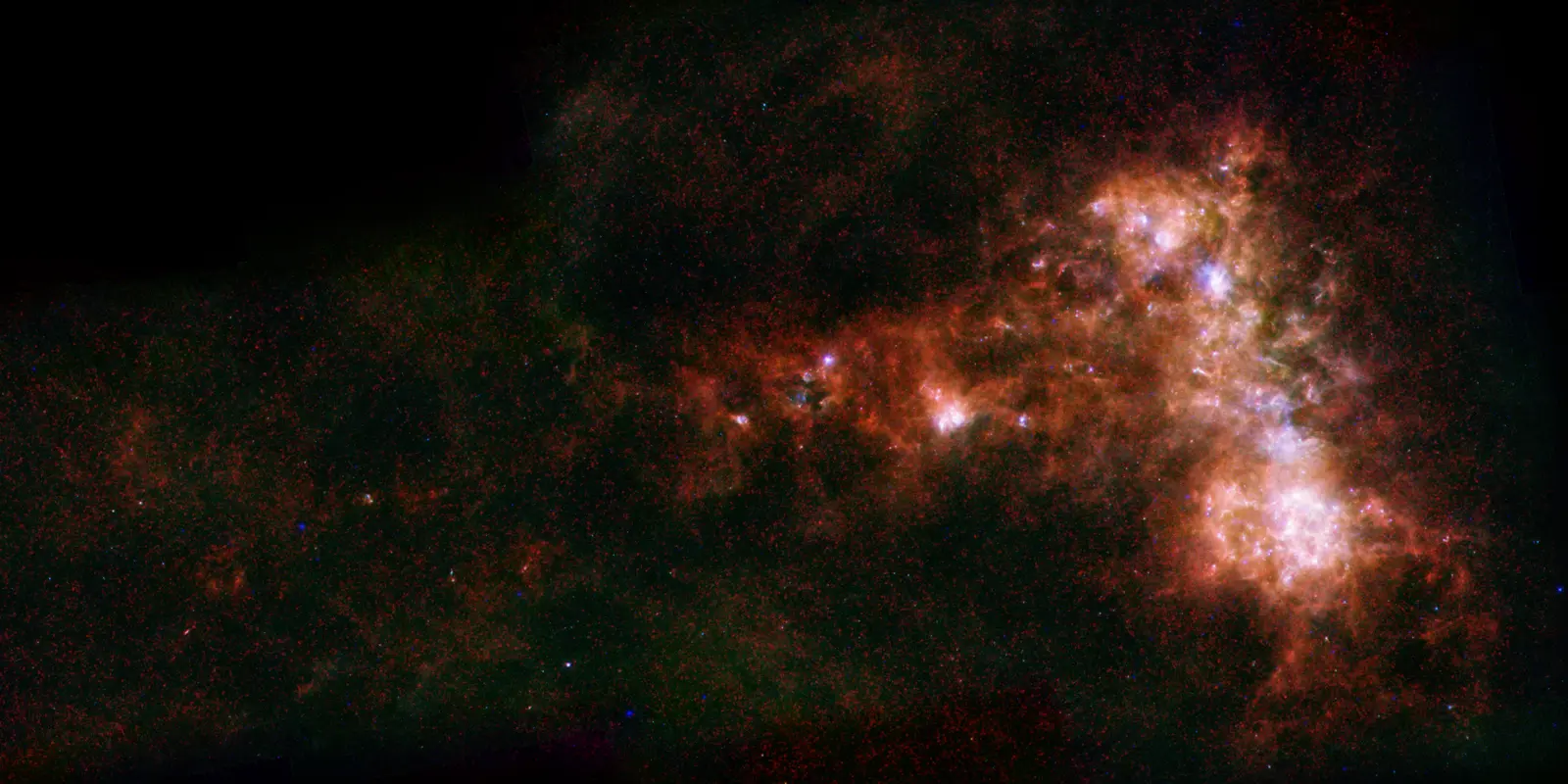
Small Magellanic Cloud
A dwarf irregular galaxy 200,000 light-years away — the Milky Way's disrupted companion and one of astronomy's most productive laboratories.
Small Magellanic Cloud
The Small Magellanic Cloud (SMC) is a dwarf irregular galaxy approximately 62.4 kiloparsecs — about 200,000 light-years — from the Milky Way, making it one of our galaxy's closest known companions. Visible to the naked eye from the Southern Hemisphere as a detached, hazy patch of sky, it has been part of human culture for millennia and a cornerstone of professional astronomy for more than a century.
With a diameter of roughly 18,900 light-years and a total mass estimated between 3 and 7 billion solar masses, the SMC is modest by galactic standards. Yet its proximity allows astronomers to resolve individual stars, star clusters, nebulae, and even molecular clouds in extraordinary detail — making it one of the most intensively studied galaxies beyond the Milky Way. Observations with instruments ranging from ground-based radio telescopes to the Hubble and Chandra space observatories have turned the SMC into a benchmark for understanding star formation, stellar evolution, galaxy interactions, and the physics of the interstellar medium.
Structurally, the SMC is far from a simple, undisturbed disk. Its stellar component shows little ordered rotation, its neutral gas is double-peaked and deeply fragmented, and it trails a vast stream of stripped material across the sky. All of this is the legacy of a turbulent dynamical history dominated by repeated gravitational encounters with its larger sibling, the Large Magellanic Cloud (LMC), and the tidal pull of the Milky Way itself.
History of Observation
- Before 1500sIndigenous and early southern-sky knowledge
The SMC and its larger companion were observed and incorporated into the cultures of peoples throughout the Southern Hemisphere long before European contact. The Clouds were known navigational and seasonal markers to many Indigenous traditions.
- 1501–1502Amerigo Vespucci's southern-sky descriptions
During his voyages to the southern Atlantic, Amerigo Vespucci described features of the southern sky that are believed to include the Magellanic Clouds, providing some of the earliest written European records.
- c. 1515Andrea Corsali's account
Italian explorer Andrea Corsali produced a clearer written description of the southern sky, including what are now identified as the Magellanic Clouds.
- 1519–1522Magellan's circumnavigation
Ferdinand Magellan's expedition used the southern Clouds as navigational aids during the first circumnavigation of Earth. His chronicler Antonio Pigafetta recorded them, and the Clouds subsequently took Magellan's name in European astronomical literature.
- 1834John Herschel's Cape of Good Hope observations
John Herschel conducted systematic telescopic observations of the southern sky from the Cape of Good Hope, producing detailed catalogs of the SMC's clusters, nebulae, and stellar features — foundational for later 19th- and 20th-century study.
- 1847The term 'Magellanic Clouds' enters scientific literature
John Herschel formally used the term 'Magellanic Clouds' in a scientific publication, cementing the name that astronomers use to this day.
- Early 1900sHenrietta Leavitt and the period-luminosity relation
Henrietta Swan Leavitt's study of variable stars in the SMC led directly to the discovery of the Cepheid period-luminosity relation — the foundational rung of the cosmic distance ladder. By establishing that all SMC Cepheids were at roughly the same distance, she could isolate the relationship between a Cepheid's pulsation period and its intrinsic brightness, transforming humanity's ability to measure distances across the universe.
- Early 20th centuryRecognition as a separate galaxy
Building on Leavitt's distance work and Hubble's broader research on galaxies, the Magellanic Clouds were established as companion galaxies to the Milky Way rather than internal nebulae — among the first confirmed external galaxies.
- 2000s–2010sMulti-wavelength observatory campaigns
Hubble, Chandra, Spitzer (SAGE-SMC), Herschel, Planck, IRAS, and COBE observations mapped the SMC's stars, dust, gas, and X-ray sources in unprecedented detail. Chandra recorded the first detection of X-ray emission from young, Sun-like stars located outside the Milky Way.
- 2025ALMA molecular cloud survey and possible two-component structure
ALMA observations of 17 SMC molecular clouds revealed both filamentary structures (about 60%, with widths around 0.3 light-years) and cooler, fluffier clouds — giving new insight into star-forming conditions at low metallicity. Separately, a study proposed that the SMC may consist of two distinct stellar components at different positions along the line of sight, with different chemical compositions and velocities, though this interpretation remains under active investigation.
Structure: Bar, Wing, and a Tidally Shredded Body
At first glance, the SMC appears as a roughly oval smudge of light, but detailed multi-wavelength mapping reveals a complex, multiply distorted structure. Its two most prominent features are the central bar — a denser, elongated concentration of stars and gas roughly aligned northeast–southwest on the sky — and the eastern Wing, an extension of gas and young stars stretching toward the LMC.
The bar is the kinematic hub of the SMC. High-resolution 21 cm neutral hydrogen (H I) mapping shows that the gas bar is more extended and fragmented than the stellar bar, broken into giant shells and supershells excavated by stellar winds and supernova explosions. From this bar, three prominent H I extensions fan out: one toward the north, one toward the southeastern Wing region, and one at higher velocities pointing toward the onset of the Magellanic Stream to the northeast. A clear H I bridge links the bar directly to the Wing, confirming that both are dynamically connected parts of the same disrupted gas system.
The stellar bar is more compact and smoother than its gas counterpart — an expected difference, since stars respond to tidal forces as a collisionless fluid while gas is collisional and more easily shocked and stripped. Farther out, the stellar body of the SMC shows very little ordered rotation: in simulations of the LMC collision, only stars near the SMC's center retain some rotation, while those at larger radii move predominantly radially outward, forming a tidal tail. The SMC's unusually large line-of-sight depth compared with its small angular size on the sky is direct evidence that material has been pulled out along our line of sight by tidal forces.
The neutral hydrogen gas distribution is double-peaked, consistent with a tidally distorted and partially stripped system. A recent study proposed interpreting this as two physically distinct SMC components — an 'SMC Main' closer to us and more spherical, and an 'SMC Wing' component that is more elongated and somewhat farther away along the line of sight, with different chemical compositions, masses, and velocities, both interacting with the LMC. While this two-component picture is still being refined, it is consistent with the broader dynamical picture of the SMC as a complex, multi-component, tidally shredded system rather than a simple undisturbed disk.
The Magellanic Bridge and Stream
The SMC does not exist in isolation. Together with the LMC and the Milky Way, it is part of a single dynamical system that is actively exchanging gas and stars on a vast scale. Two enormous gaseous structures trace this exchange across the sky.
The Magellanic Bridge is a gaseous — and partly stellar — connection between the SMC and the LMC, interpreted as material pulled out by tidal forces during close encounters or a direct collision between the two dwarf galaxies. It is not simply inert debris: the Bridge is actively forming stars in shocked and compressed gas, demonstrating that tidal debris can itself become a site of new stellar generations. On the SMC side, the Bridge originates from the Wing and bar region, where H I extensions toward the southeast and toward the LMC are observed.
The Magellanic Stream is far larger — a long trailing ribbon of gas (and some stars) that stretches over a substantial fraction of the entire sky behind the Magellanic Clouds. It is thought to consist largely of gas stripped from the SMC during repeated tidal interactions with the LMC and ram-pressure stripping by gas in the Milky Way's halo. H I mapping of the SMC directly links an extension from the bar toward the northeast, at a radial velocity of about 190 km/s, to the onset of the Stream — connecting the internal structure of the SMC to one of the largest gaseous structures in the Local Group.
A Galaxy Shaped by Collision
Modern simulations and observational evidence increasingly converge on a dramatic explanation for the SMC's current state: it passed directly through the disk of the LMC within the past 200 to 300 million years. This is not merely a close flyby; the evidence points to a genuine physical collision.
The distinction matters because flyby models and collision models make different predictions. Both can produce a bridge of gas between the SMC and LMC. However, only the collision scenario simultaneously explains the SMC's gas rotating while its stars largely do not, the galaxy's extreme line-of-sight depth, and the double-peaked neutral hydrogen density distribution. In the collision picture, pressure from the LMC's gas destroys most of the SMC's previous gas rotation, the stellar body is stretched into an elongated shape with a tidal tail, and the gas is stripped and shocked far more violently than in a simple tidal flyby.
The collision also left physical marks on the LMC itself: its central bar appears tilted out of the disk plane, and the degree of that tilt encodes information about the SMC's dark-matter content — making the LMC bar a novel probe of dark matter in the Magellanic system. Some researchers argue that the transformation currently underway in the SMC — from an irregular dwarf toward a more spheroidal or ellipsoidal shape — is a process that can be observed in real time, offering a rare window into how dwarf galaxy morphology is driven by environment.
Star Formation: A Turbulent History
The SMC's star-formation history is highly non-uniform across both time and space. Reconstruction of the resolved stellar populations using the VISTA Magellanic Cloud (VMC) survey found that the galaxy formed a total of approximately 5.31 × 10⁸ solar masses of stars over its lifetime. About 50% of that stellar mass formed before 6.3 billion years ago, and roughly 80% formed in the broad period between 8 and 3.5 billion years ago — a galaxy that was most productive in the ancient and intermediate-age universe.
Spatially, recent star formation is strongest in the central bar, while outer regions are less active. Localized enhancement of star formation in the Wing and other outer fields is likely triggered by the tidal interactions with the LMC and Milky Way that have shaped the whole system. Multiple studies note a common increase in star-formation activity around 5 to 7 billion years ago, though the metallicity record does not strongly support a major merger at that time — a minor merger remains possible but is not firmly established.
At the smallest scales, a 2025 ALMA survey of 17 molecular clouds in the SMC found two broad structural types: filamentary clouds (about 60% of the sample, with typical widths of about 0.3 light-years) and cooler, more diffuse 'fluffy' structures. The SMC's low metallicity — meaning its gas has fewer heavy elements than typical Milky Way molecular clouds — makes it a natural laboratory for understanding how star formation proceeds in conditions analogous to the early universe, when heavy-element enrichment was similarly limited.
Among the SMC's most studied individual star-forming regions is the area around NGC 346, one of the most active stellar nurseries in the Magellanic Clouds, which has been imaged in detail by Hubble. The SMC also hosts large numbers of massive stars and high-mass X-ray binaries concentrated in its central bar — compact remnants of earlier generations of heavy stars that lived fast and died in supernova explosions.
Key Telescopes and Instruments
- Hubble Space Telescope
Detailed optical and near-infrared imaging of SMC star-forming regions including NGC 346 and the Wing; stellar proper-motion measurements that revealed the highly disturbed kinematics of the SMC's stellar body and evidence of past collision with the LMC.
- Chandra X-ray Observatory
First detection of X-ray emission from young, Sun-like stars outside the Milky Way; surveys of high-mass X-ray binaries and massive stars in the SMC bar and Wing, exploiting the SMC's proximity to resolve phenomena invisible in more distant galaxies.
- Spitzer Space Telescope — SAGE-SMC Program
Infrared mapping of the full SMC to study the lifecycle of interstellar dust, the distribution of old stars versus young stellar objects, and the relative contributions of different stellar populations to the galaxy's infrared emission.
- Multi-mission far-infrared composite
Combined mapping of cold dust, warmer dust, and hydrogen gas across the SMC's interstellar medium; demonstrated that no single far-infrared observatory alone captures the full dust census and that multi-mission synthesis is necessary for a complete picture.
- Gaia (ESA astrometry mission)
High-precision proper motions of stars in the SMC; used together with Hubble data to constrain the galaxy's internal kinematics, bulk motion relative to the Milky Way, and interaction history with the LMC.
- Atacama Large Millimeter/submillimeter Array
High-resolution imaging of molecular clouds in the SMC (2025 results), revealing filamentary and diffuse 'fluffy' cloud structures at sub-parsec scales in a low-metallicity environment analogous to the early universe.
- VISTA Magellanic Cloud Survey
Near-infrared photometric survey used to reconstruct the spatially resolved star-formation history of the SMC across different regions; found that approximately 50% of stellar mass formed before 6.3 billion years ago.
What the SMC Has Taught Astronomy
Henrietta Leavitt's analysis of Cepheid variable stars in the SMC — where all targets are at essentially the same distance from Earth — revealed the period-luminosity relation that became the foundational tool for measuring distances across the universe. Without this discovery, made possible by the SMC's proximity and the separability of its variable stars, modern cosmology's distance scale would not exist.
Chandra observations of the SMC produced the first detection of X-ray emission from young stars with masses comparable to the Sun located outside our galaxy. The SMC's proximity made individual stars resolvable at X-ray energies where more distant galaxies appear only as unresolved sources.
The combination of the SMC's disordered stellar kinematics, extreme line-of-sight depth, double-peaked H I gas distribution, and tidal features is most consistently explained by a direct passage of the SMC through the LMC's disk within the past 200–300 million years — a finding with implications for how dwarf galaxies are transformed by their environments.
Because the SMC contains fewer heavy elements than the Milky Way, its star-forming regions provide conditions analogous to galaxies in the early universe. ALMA's 2025 survey of SMC molecular clouds — finding both narrow filamentary and diffuse 'fluffy' structures — is directly relevant to understanding how the first generations of stars formed in metal-poor gas.
The SMC's ongoing disruption by the LMC and the Milky Way offers a nearby, observable example of how repeated gravitational interactions can transform an irregular dwarf galaxy into a more spheroidal or ellipsoidal system — a process invoked to explain the morphology of many dwarf satellites around large galaxies throughout the universe.
The SMC's collision with the LMC tilted the LMC's central bar out of its disk plane. The degree of that tilt is sensitive to the SMC's dark-matter content, turning the LMC bar into an indirect probe of how dark matter is distributed in the SMC.
Future and Fate
The SMC is not heading toward a clean, isolated merger with the Milky Way on any near-term timescale. Its future is instead intertwined with that of the LMC: the two Magellanic Clouds are a gravitationally bound pair — though a disrupted one — and their combined dynamical fate within the Milky Way's gravitational field will determine how their material is eventually incorporated into our galaxy.
Ongoing tidal stripping is already redistributing SMC material into the Magellanic Stream and Bridge. The SMC's stellar body may continue to be transformed from its current irregular, disrupted state toward a more spheroidal shape as interaction-driven tidal heating removes kinetic energy from stellar orbits. Some models suggest this transformation — from dwarf irregular to dwarf spheroidal or ellipsoidal — is already measurably underway.
On the largest scales, the eventual fate of the Milky Way itself is also being revised. The classical picture of a guaranteed collision between the Milky Way and the Andromeda galaxy (M31) within about 4 to 5 billion years has been updated by newer Gaia- and Hubble-based analyses. A 2025 Nature Astronomy study found that, when the LMC and M33 are included in full simulations, a Milky Way–Andromeda merger within 10 billion years occurs in only about half of simulations. A 2026 preprint found a higher merger probability — about 90% — with a median merger time of 6.5 billion years, but stressed that the outcome remains highly sensitive to proper-motion measurement uncertainties. In any scenario, the SMC's material — already being stripped and redistributed — will be part of whatever larger galactic entity eventually forms.
Frequently Asked Questions
Sources
- A distance determination to the Small Magellanic Cloud (arXiv:2010.08754)
- Small Magellanic Cloud — Wikipedia
- Magellanic Clouds — Wikipedia
- The Nearest Galaxies — NASA Imagine the Universe
- Small Magellanic Cloud — COSMOS (Swinburne)
- Small Magellanic Cloud (ground-based image) — ESA/Hubble
- Small Magellanic Cloud revealed as 2 objects — EarthSky
- Observational History of the SMC — OzSky
- The (not so) Sordid History of the Small Magellanic Cloud — Astrobites
- A History of the Magellanic Clouds — Universe Today
- Disrupted Dwarf Galaxy: Investigating the History of the SMC — AAS Nova
- Something is Changing the Small Magellanic Cloud — Universe Today
- Large-scale H I structure of the SMC (MNRAS)
- Taken Under the 'Wing' of the Small Magellanic Cloud — NASA
- The VMC Survey XXXI: Spatially resolved star-formation history (arXiv:1805.04516)
- Small Magellanic Cloud observations provide insight into early universe — Phys.org
- Small Magellanic Cloud imaged by Herschel, Planck, IRAS, COBE — NASA/JPL
- Hubble Captures a Neighbor's Colorful Clouds — NASA Science
- Magellanic Clouds — NASA
- The Fate of the Milky Way–Andromeda System: To Merge or Not? (arXiv:2603.22863)
- No certainty of a Milky Way–Andromeda collision — Nature Astronomy