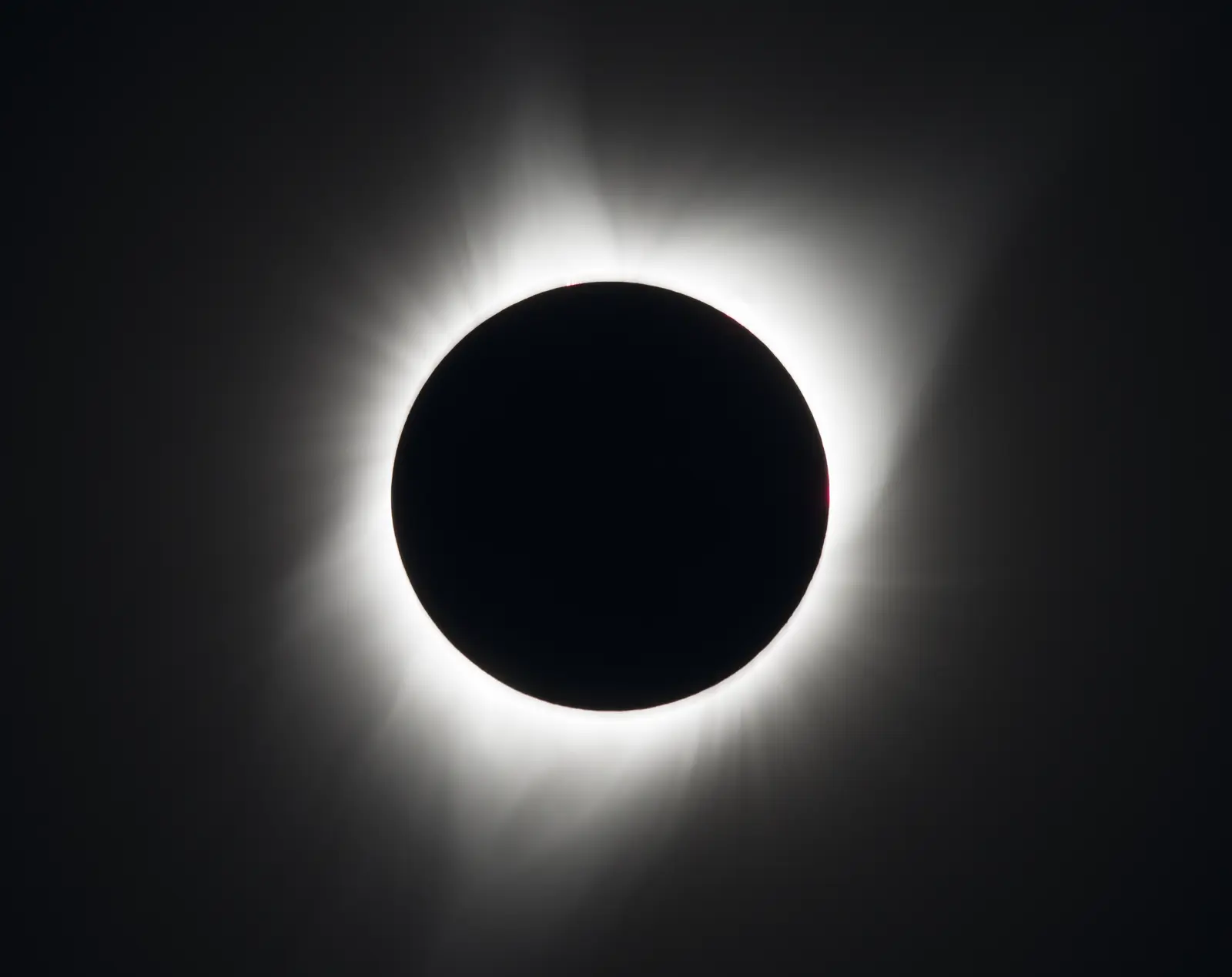
Solar Eclipse
When the Moon blots out the Sun — the geometry, science, and history of Earth's most dramatic astronomical event.
Solar Eclipse
A solar eclipse occurs when the Moon passes between the Sun and Earth at new Moon, so that the Moon's shadow falls on Earth and sunlight is fully or partially blocked for observers in that shadow. The event is governed by the precise three-body geometry of Sun, Moon, and Earth: all three must be nearly collinear, and the Moon must be close to one of the two nodes where its orbit crosses the plane of Earth's orbit around the Sun — a condition that defines the roughly two eclipse seasons each year.
Because the Moon's orbital plane is tilted about 5° relative to Earth's orbital plane (the ecliptic), most new Moons pass north or south of the Sun as seen from Earth, and no eclipse occurs. Only when the node condition is met does the Moon's shadow actually strike Earth.
What an observer sees depends on which part of the Moon's three-part shadow cone they stand in: the umbra (complete blockage), the antumbra (Moon appears smaller than the Sun), or the penumbra (partial blockage). This determines whether a given location experiences a total, annular, hybrid, or partial solar eclipse. The four types differ dramatically in appearance and in the scientific opportunities they offer.
The Shadow Geometry: Umbra, Penumbra, and Antumbra
The Moon is an opaque body that casts a three-zone shadow into space. The umbra is the innermost cone where the Sun is completely hidden; no direct sunlight penetrates. Beyond the tip of the umbral cone the shadow flares outward into the antumbra, a region from which an observer would see the Moon centred on the Sun but too small to cover it fully. Surrounding both is the broad penumbra, where the Sun is only partially blocked.
Which zone sweeps across a given location on Earth determines the eclipse type. Because both Earth's orbit around the Sun and the Moon's orbit around Earth are elliptical rather than circular, the apparent angular sizes of Sun and Moon vary. The Moon ranges from slightly larger (near perigee) to slightly smaller (near apogee) than the Sun in the sky. When the Moon is near perigee and geometry is central, its disk can fully cover the Sun's photosphere and the umbral cone reaches Earth's surface — a total eclipse. When the Moon is near apogee it is too small even in perfect alignment, the umbral tip falls short of Earth, and the antumbra sweeps the surface instead — an annular eclipse.
Eclipse magnitude formalises this: it is the fraction of the Sun's diameter covered by the Moon at maximum eclipse. A magnitude of 1.000 or greater means the Moon is at least as large as the Sun in apparent size, and a total eclipse is geometrically possible. A magnitude below 1.000 means the best central alignment can produce is an annular eclipse.
The Four Types of Solar Eclipse
Total solar eclipse. When the Moon completely covers the Sun's bright disk (the photosphere), observers within the narrow umbral path experience totality. The path of totality is typically 100–160 km wide and races across Earth's surface at more than 1,700 km/h. During totality — which lasts at most about 7 minutes 32 seconds in the current era — daylight drops to deep twilight, stars and planets may become visible, and the solar corona (the Sun's outer atmosphere), prominences, and the chromosphere are revealed because the brilliant photosphere is blocked. Outside the umbral path but within the broad penumbra, observers see only a partial eclipse. A total eclipse begins at first contact (C1), when the Moon's limb first touches the Sun's disk; second contact (C2) marks the start of totality and is accompanied by the dramatic Baily's beads and diamond-ring effects as the last slivers of photosphere vanish. Third contact (C3) ends totality as the photosphere reappears, and fourth contact (C4) ends the eclipse entirely.
Annular solar eclipse. When Sun, Moon, and Earth are well aligned but the Moon is near apogee — and therefore angularly smaller than the Sun — the umbral cone falls short of Earth. Observers along the central track lie in the antumbra and see the Moon centred on the Sun surrounded by a bright ring (annulus) of unblocked sunlight. The sky darkens noticeably less than during totality, and the corona is not visible because the Sun's photosphere is never fully obscured.
Hybrid (annular-total) solar eclipse. A hybrid eclipse is comparatively rare and occurs when the eclipse magnitude is so close to 1.000 that Earth's curvature makes the difference. Near the midpoint of the track, where Earth's surface is closest to the Moon, the umbral cone just reaches the ground and observers see totality. Near the beginning and end of the track, where curvature places the surface slightly farther from the Moon, the umbra falls short and those observers see an annular eclipse instead. The path of totality in a hybrid is typically extremely narrow and totality is brief.
Partial solar eclipse. A partial eclipse occurs whenever an observer is in the Moon's penumbra but not in the umbra or antumbra. The Sun appears as a crescent or a disk with a curved bite taken out of it. A purely partial eclipse — one in which the umbra and antumbra miss Earth entirely — is also possible. Partial phases always surround the central tracks of total, annular, and hybrid eclipses, extending the partial-eclipse zone hundreds or thousands of kilometres on either side. Statistical work finds that partial eclipses (including partial phases of other types) occur at a given location roughly once every 2.59 ± 0.02 years on average.
The Saros Cycle and Eclipse Prediction
The most important periodicity in solar eclipse prediction is the Saros, a cycle of 6,585.3 days — approximately 18 years, 11 days, and 8 hours — after which the Sun, Moon, and Earth return to nearly the same geometric alignment because 6,585.3 days corresponds to 223 synodic months (new-Moon-to-new-Moon intervals) and nearly equals 239 anomalistic months (perigee to perigee) and 242 draconic months (node to node). An eclipse separated by exactly one Saros is therefore very similar in character to its predecessor — same type, similar duration and path width.
However, because of the extra 8 hours, Earth rotates approximately 120° during that fraction of a day. Each successive eclipse in a Saros series therefore falls roughly 120° west in longitude compared with its predecessor. A complete geographic return requires three Saros periods — about 54 years and 34 days — a sub-cycle known as the Exeligmos.
A single Saros series lasts between roughly 1,226 and 1,551 years and contains between 69 and 87 individual eclipses, of which 39–59 are central (total, annular, or hybrid). Most series contain around 70–73 eclipses in total. As a concrete example, Saros series 145 runs from 1639 to 3009 — about 1,370 years — and includes 77 eclipses, of which 41 are total. The longest totality in that series is 7 minutes 12 seconds, calculated for 25 June 2522 north of Madagascar, while the shortest was 50 seconds on 29 June 1927.
Ancient Babylonian and Assyrian astronomers kept careful eclipse records over many centuries and identified repeating patterns that modern historians connect to the Saros cycle. Herodotus' account of the Greek philosopher Thales predicting a solar eclipse — traditionally dated to 585 BCE — is often cited as the earliest recorded prediction of a solar eclipse, though historians note that the evidence for the precise prediction method is weak and may reflect pattern recognition rather than detailed geometric computation.
The transition toward modern eclipse prediction came with Newtonian mechanics. In 1715 Edmond Halley used Newtonian principles to predict a total solar eclipse over England, a landmark step toward the precise forecasting now possible. Contemporary eclipse predictions are accurate to within a second in time and to within a few kilometres in path location.
Major Scientific Discoveries
During the chromospheric flash spectrum just before totality, Jules Janssen and J. Norman Lockyer independently identified an unknown yellow spectral line in the solar chromosphere. Named helium from Helios (the Greek Sun god), the element was only identified on Earth in 1895 — nearly three decades later.
Observers of the 1869 total eclipse detected a mysterious green coronal emission line and proposed a new element, 'coronium.' Later work revealed the line came from highly ionised iron, implying the corona is far hotter than the solar surface — a discovery central to the still-active coronal heating problem.
Arthur Eddington's measurements of star positions near the eclipsed Sun on 29 May 1919 showed that starlight was deflected by roughly 1.7–2 arcseconds as it grazed the solar limb — consistent with Einstein's predicted ~1.75 arcseconds and approximately double the Newtonian prediction, providing the first experimental support for general relativity.
Bright points of light that flare around the Moon's edge just before and after totality result from sunlight shining through valleys in the Moon's irregular terrain. First carefully recorded by Edmund Halley in 1715, Baily's beads have since been used to refine measurements of the solar diameter.
Modern eclipse campaigns have mapped coronal streamers, plumes, prominences, and coronal mass ejections (CMEs) — the drivers of space weather affecting satellites and power grids. Eclipses fill a critical 'missing height' gap between space coronagraphs and EUV imagers, allowing direct imaging of the low corona in white light.
Eclipse passages cause measurable drops in total electron content in the ionosphere, temporary temperature changes in the lower atmosphere, and alterations to boundary-layer dynamics. These effects, studied systematically since the 20th century, inform models of solar-terrestrial coupling.
Key Moments in Solar Eclipse Science
- ~585 BCEEclipse of Thales
Herodotus records that the Greek philosopher Thales predicted a solar eclipse that halted a battle between the Lydians and Medes. Historians debate the prediction method; it may have relied on Babylonian eclipse records and pattern recognition rather than geometric computation.
- Antiquity–medievalBabylonian eclipse records and the Saros
Babylonian and Assyrian astronomers maintained systematic eclipse records over centuries and identified repeating patterns later associated with the 18-year Saros cycle, providing the empirical foundation for early eclipse prediction.
- 1715Halley's prediction and Baily's beads
Edmond Halley applied Newtonian mechanics to predict a total solar eclipse over England, a key step toward modern eclipse forecasting. Halley also made an early careful record of the bright beads of light at the Moon's limb (later named Baily's beads).
- 1868Discovery of helium
Jules Janssen and J. Norman Lockyer independently identified an unknown yellow spectral line in the solar chromosphere during eclipse observations. The element was named helium and confirmed on Earth only in 1895.
- 1869Coronium mystery and the hot corona
Observers detected a green emission line in the corona during the 7 August 1869 total eclipse. Initially attributed to a new element 'coronium,' the line was eventually identified as coming from highly ionised iron — revealing that the corona reaches millions of degrees.
- 29 May 1919Eddington confirms general relativity
British expeditions to Sobral, Brazil and Príncipe, West Africa photographed stars near the eclipsed Sun. Measured deflections of roughly 1.7–2 arcseconds matched Einstein's prediction of ~1.75 arcseconds, providing the first experimental test of general relativity. Results were announced in London on 8 November 1919.
- 21 Aug 2017Great American Eclipse
A total solar eclipse crossed the continental United States from Oregon to South Carolina with up to 2 minutes 40 seconds of totality. Large-scale corona studies were conducted, and an amateur astronomer repeated the Eddington light-deflection experiment with a ~$4,000 telescope, confirming general relativity to greater precision than in 1919.
- 8 Apr 2024Great North American Eclipse
A total solar eclipse with up to 4 minutes 28 seconds of totality crossed Mexico, 15 U.S. states, and 6 Canadian provinces. Occurring near Solar Cycle 25 maximum, it provided the most complex coronal morphology observable from North America in generations, with extensive NASA and citizen-science campaigns studying the corona, CMEs, ionospheric response, and Earth's atmospheric dynamics.
- 2 Aug 2027Longest 21st-century eclipse to date
A total eclipse crossing North Africa and the Middle East will offer about 6 minutes 23 seconds of totality — the longest totality of any eclipse for roughly a century — making it especially valuable for extended corona and space-weather studies.
- 16 Jul 2186Longest computed eclipse (3000 BCE–8000 CE)
Calculations indicate this future eclipse over northern Guyana will reach 7 minutes 29 seconds of totality — the longest in the computed range from 3000 BCE to at least AD 8000.
The Eclipse of 29 May 1919: Science's Most Important Eclipse
The total solar eclipse of 29 May 1919 is often described as probably the most important eclipse in the history of science. Its path of totality passed across northern South America and West Africa, and the maximum duration of totality reached approximately 6 minutes 50.75 seconds — the longest total eclipse since 27 May 1416. But its significance lay not in its duration, nor even in what it revealed about the Sun, but in what it revealed about the nature of gravity itself.
In 1915, Albert Einstein published his general theory of relativity, which predicted that massive bodies warp spacetime and that light passing close to the Sun would be deflected by approximately 1.75 arcseconds — roughly double the deflection that Newtonian gravity alone would produce. In 1919, the Royal Astronomical Society and the Royal Observatory, Greenwich organised two expeditions to test this prediction using the eclipse. One team went to Sobral, Brazil; the other, led by Arthur Eddington, to the island of Príncipe off the West African coast.
During totality both teams photographed stars in the Hyades cluster whose light grazed the solar limb, then compared the apparent star positions with reference plates taken when the Sun was elsewhere in the sky. The measured deflection of roughly 1.7–2 arcseconds aligned closely with Einstein's prediction and was approximately double the Newtonian value. When the results were announced in London on 8 November 1919, newspaper headlines around the world declared a scientific revolution: the Times of London ran 'Revolution in Science / New Theory of the Universe / Newtonian Ideas Overthrown,' and the New York Times reported 'Lights All Askew in the Heavens.'
The 1919 eclipse effectively cemented general relativity, laying the empirical groundwork for concepts that later shaped astronomy and technology: gravitational lensing, black holes, gravitational waves, and gravitational time dilation. The episode also became a symbol of international scientific cooperation, with British astronomers providing the first major experimental test of a theory developed by a German physicist just four years after the end of World War I.
The 8 April 2024 Eclipse: Science at Solar Maximum
The total solar eclipse of 8 April 2024 — widely called the Great North American Eclipse — produced a path of totality approximately 185 km (115 miles) wide that swept from Mexico's Pacific coast near Mazatlán, Sinaloa, northeast through six Mexican states, across fifteen U.S. states including Texas, Indiana, Ohio, New York, and Vermont, then through six Canadian provinces before ending over the North Atlantic some 700 km southwest of Ireland. An estimated 44 million people were within the path across all three countries. Maximum totality reached about 4 minutes 28 seconds. The path intersected the August 2017 eclipse track in southern Illinois near Makanda, south of Carbondale.
Scientifically, the 2024 eclipse was timed close to Solar Cycle 25 maximum, making the corona far more complex and active than during the 2017 solar minimum. NASA and partner institutions deployed aircraft, high-altitude balloons, and ground-based instrument arrays to observe the corona in visible and infrared wavelengths, targeting forbidden emission lines such as Fe XI and Fe XIV to diagnose coronal temperature, density, and magnetic field structure. Early results included improved mapping of the large-scale coronal magnetic field during solar maximum and detections of fine-scale coronal streamers and plumes whose evolution could be tracked over the minutes of totality.
Simultaneously, spacecraft including SOHO, SDO, Parker Solar Probe, and Solar Orbiter monitored the Sun from space, enabling researchers to track coronal mass ejections from their origin in the low corona outward through the heliosphere and to compare inner-corona brightness measured during totality with larger-radius coronagraph data. GPS receiver networks and ionosondes recorded a measurable drop in total electron content along the path as the shadow moved overhead, with recovery rates informing models of ionospheric cooling under rapid irradiance changes. Ground weather stations documented lower-atmospheric temperature drops and boundary-layer changes through totality.
Building on the citizen-science 'Megamovie' concept used in 2017, 2024 also saw coordinated observers along the full path capture overlapping coronal image sequences. Because totality lasted different amounts of time at each site and the shadow took roughly an hour to cross the continent, the combined data effectively extended continuous coronal coverage far beyond what any single location's few minutes of totality could provide. These combined data sets are still being fully analysed and are expected to refine models of the global coronal magnetic field, CME initiation, and how abrupt solar irradiance changes propagate through Earth's atmosphere and ionosphere.
Notable Upcoming Total Solar Eclipses
- 12 Aug 2026Arctic, Iceland, and northern Spain
Path of totality crosses the Arctic, Greenland, Iceland, and northern Spain; maximum totality approximately 1 minute 43 seconds.
- 2 Aug 2027North Africa and the Middle East — longest this century
Path crosses North Africa and the Middle East including Egypt and Saudi Arabia. With approximately 6 minutes 23 seconds of maximum totality, this will be the longest total eclipse for roughly a century — highly prized for extended corona and space-weather observations.
- 22 Jul 2028Australia and the South Pacific
Path of totality sweeps across Australia and parts of the South Pacific.
- 25 Nov 2030Southern Africa and Australia
Totality visible from parts of southern Africa and Australia.
- 20 Mar 2034North Africa and Eurasia
Path crosses parts of North Africa and Eurasia.
- 25 Jun 2150Next eclipse exceeding 7 minutes of totality
The next total eclipse with more than 7 minutes of totality, preceding the record-setting eclipse of 2186.
- 16 Jul 2186Longest total eclipse between 3000 BCE and 8000 CE
Calculated maximum totality of 7 minutes 29 seconds over northern Guyana — the longest total solar eclipse in the computed range spanning roughly 11,000 years.
Solar Eclipse FAQ
Sources
- Solar eclipse — Wikipedia
- Geometry of a Total Solar Eclipse | Clifftop Alliance
- Solar Eclipse Geometry | Discover Magazine
- Solar eclipse | Definition, Meaning, Diagram, & Types — Britannica
- Types of Solar Eclipses — NASA Science
- Eclipses and solar system geometry — IU Blogs
- Periodicity of Solar Eclipses — NASA Eclipse
- The Frequency of Solar Eclipses for a Given Place — arXiv
- The August 2027 Total Solar Eclipse, Longest For a Century — SYFY
- Solar eclipse of May 29, 1919 — Wikipedia
- Relativity and the 1919 eclipse — ESA
- 1919 solar eclipse — Royal Museums Greenwich
- How the 1919 Solar Eclipse Made Einstein the World's Most Famous Scientist — Discover Magazine
- The science of solar eclipses — ESA
- NASA Eclipse Science
- Eclipse of Thales — Wikipedia
- Solar eclipse of April 8, 2024 — Wikipedia
- 2024 Total Eclipse: Where & When — NASA Science
- Guide for the Total Solar Eclipse of 2027 — EclipseWise