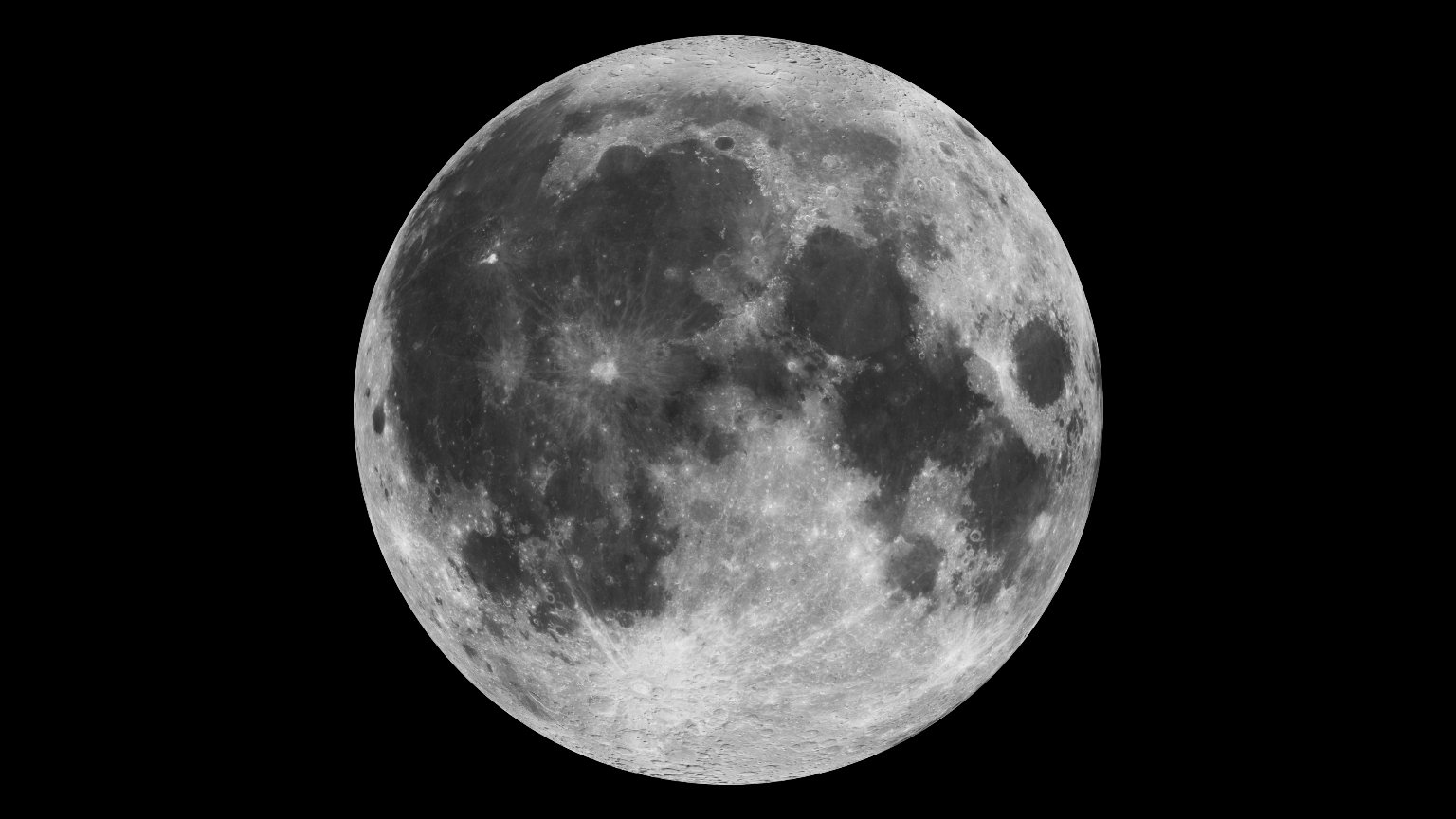
The Moon
Earth's only natural satellite — a world of craters, ancient volcanoes, and frozen water that shapes our tides, steadies our seasons, and beckons a new generation of explorers.

The Moon
The Moon is Earth's only natural satellite and the fifth-largest moon in the Solar System. With a diameter of roughly 3,474 km — just over one-quarter of Earth's — and a mass of 7.346×10²² kg (about 1/81 of Earth's mass), it is a substantial rocky body in its own right, comparable in size to a small planet. It orbits at a mean distance of approximately 384,400 km, a span equivalent to about 30 Earth diameters, completing one circuit every 27.3 days.
The Moon is in synchronous rotation with Earth, meaning it rotates once on its axis in the same time it takes to orbit — so the same hemisphere always faces Earth. The far side, invisible from the ground, was first imaged by spacecraft in 1959. Surface gravity is approximately 1.62 m/s², roughly one-sixth of Earth's, a figure that defined the physical experience of the twelve astronauts who walked there between 1969 and 1972.
Beyond its immediate physical presence, the Moon plays a central role in Earth's habitability: its gravitational pull drives most of the planet's ocean tides and damps chaotic swings in Earth's axial tilt, helping to stabilise the seasons over geological timescales. It is also the only extraterrestrial body on which humans have stood, and it is once again the focus of intense exploration by space agencies and commercial operators worldwide.
Origin: the giant-impact hypothesis
The Moon formed approximately 4.5 billion years ago, roughly 60 million years after the Solar System itself coalesced from a collapsing cloud of gas and dust. The dominant explanation for its origin is the giant-impact hypothesis, sometimes called the Theia impact. In this model, a Mars-sized body — given the name Theia — collided with the proto-Earth at high speed during the chaotic early phase of planetary accretion. The catastrophic collision melted and partially vaporised large fractions of both bodies, ejecting an enormous cloud of silicate-rich debris into orbit around the young Earth. That debris rapidly accreted to form the Moon.
Several independent lines of evidence support this scenario. Oxygen isotopes and many other chemical signatures in lunar rocks match those of Earth's mantle with a precision that strongly points to a common origin. Lunar samples are also strikingly depleted in volatile elements — zinc, cadmium, indium, tin, thallium — that would have evaporated in the searing heat of the impact plume and not fully recondensed, a clear fingerprint of a high-temperature birth. Meanwhile, the Moon's internal iron core is tiny, representing only about 1.6–1.8 % of its mass, compared with roughly 30 % for Earth; this asymmetry is consistent with most of the metallic iron having remained with Earth during and after the collision, leaving the Moon to form predominantly from silicate material.
Geological and remote-sensing data indicate that shortly after its formation, the Moon was covered by a deep global magma ocean — possibly hundreds to thousands of kilometres deep. As this ocean slowly cooled, lighter plagioclase feldspar crystals floated to the surface and solidified into a pale anorthositic crust, while denser minerals sank, eventually producing a layered interior of crust, mantle, and metallic core. Recent high-resolution supercomputer simulations suggest that a significant portion of the Moon may have been assembled within hours of the initial impact, rather than over a lengthy period from a slowly dispersing debris disk — but these models operate firmly within the giant-impact framework.
Before Apollo returned samples, three rival theories competed for acceptance: the capture hypothesis (the Moon formed elsewhere and was gravitationally caught by Earth), the co-accretion hypothesis (Earth and Moon grew side by side from the same material), and the fission hypothesis (a fast-spinning early Earth flung off material that became the Moon). Each fails on one or more key constraints — the close isotopic match rules out simple capture; co-accretion cannot explain the Moon's tiny core and volatile depletion; fission cannot satisfy angular-momentum requirements. High-precision isotopic analysis of Apollo samples effectively settled the debate in favour of giant impact, though the precise mass, angle, and velocity of Theia remain active areas of research.
Surface geology: craters, maria, and regolith
The Moon's surface is a record of Solar System history, preserved in exceptional detail because the body lacks an atmosphere, liquid water, and active plate tectonics — the three processes that erase or bury Earth's ancient terrain within hundreds of millions of years. On the Moon, craters billions of years old remain sharply defined.
Impact cratering is the dominant geological process. A lunar crater forms when an asteroid or comet strikes at hypervelocity, producing an explosion that excavates material in all directions. Small impacts produce simple, bowl-shaped depressions; larger events create complex craters with terraced walls, central peaks, and flat floors. The largest structures are impact basins, exceeding 300 km across. More than 40 major impact basins scar the Moon, most of them formed around 3.9 billion years ago during the Late Heavy Bombardment — a period when the rate of large impacts throughout the inner Solar System was dramatically elevated.
The grandest basin of all is the South Pole–Aitken Basin, spanning approximately 2,500 km in diameter and descending up to 8–12 km below the surrounding terrain. It is both the largest and oldest recognised impact structure on the Moon, and the energy of the impact that created it dwarfs the event that ended the dinosaurs on Earth. This basin's interior hosts some of the Moon's most permanently shadowed regions, making it a prime target for water-ice prospecting.
Volcanism shaped the other great class of lunar terrain: the maria (singular mare, from the Latin for 'sea'). Ancient astronomers mistook these dark, relatively flat plains for actual bodies of water; they are in fact vast sheets of basaltic lava that flooded large impact basins as magma rose through fractures in the crust. Mare basalts are iron-rich and often titanium-rich, giving them their characteristic low reflectivity. Most eruptions occurred between roughly 3.0 and 3.5 billion years ago, though some samples have ages approaching 4.2 billion years. High-resolution imagery has revealed small, irregular mare patches with crater counts suggesting ages younger than 50 million years, raising the possibility that minor volcanic activity persisted into geologically recent times. Mare Tranquillitatis, the 'Sea of Tranquillity', was the destination of Apollo 11 in 1969.
Virtually the entire lunar surface is blanketed by regolith: a layer of pulverised rock, glass beads, and dust produced by billions of years of micrometeorite bombardment. Unlike terrestrial soil, it contains no organic material and was created entirely by physical processes. Grains are sharp and angular, making the regolith highly abrasive — a challenge for both equipment and spacesuits. Depth varies with terrain age: about 2 m over relatively young maria, up to 20 m over the oldest highland surfaces. Apollo and Soviet Luna missions returned approximately 382 kg of rocks and soil, which remain the primary physical archive of lunar history.
The bright, heavily cratered highlands represent the Moon's ancient anorthositic crust — the solidified rind of the primordial magma ocean. Many of the mountain ranges that rim the maria are not the product of tectonic compression (as on Earth) but are uplifted walls of enormous impact basins. Linear features called rilles cut the surface: sinuous rilles are channels carved by ancient lava flows, while straight rilles are fault structures associated with basin formation and crustal cooling.
Water, ice, and volatiles
Deep craters near the lunar poles, especially around the South Pole–Aitken Basin, never receive direct sunlight. Temperatures in these permanently shadowed regions (PSRs) remain far below the sublimation point of water ice, allowing ice delivered by comets and asteroids to accumulate over billions of years.
Data from Chandrayaan-1's Moon Mineralogy Mapper instrument provided the first clear spectroscopic confirmation of water ice exposed at the lunar surface, concentrated in permanently shadowed regions near both poles.
NASA's Stratospheric Observatory for Infrared Astronomy detected molecular H₂O (not just hydroxyl) in sunlit areas, including near Clavius crater, at concentrations roughly comparable to a 12-ounce bottle of water within a cubic metre of soil — far lower than polar PSRs but significant for understanding surface water migration.
Using SOFIA infrared data, NASA produced the first large-scale map of water distribution across the lunar surface extending to the south pole, providing clues that water molecules may migrate across the surface and helping refine expectations for near-surface water availability in Artemis landing zones.
Multi-mission analyses — drawing on LRO, LCROSS, Chandrayaan, and Chang'e data — estimate hundreds of billions of kilograms of accessible water ice in polar PSRs, with one synthesis placing the figure at roughly 600 billion kilograms, concentrated primarily at the south pole.
Analysis of samples returned by China's Chang'e-6 mission from the far-side of the Moon indicated that the far-side mantle contains less water than the near-side mantle, supporting hypotheses that the Moon lost most of its interior water during early formation and differentiation.
Chandrayaan-3's thermal probe measurements at high southern latitudes suggested that conditions favourable for stable subsurface ice may extend beyond the immediate polar PSRs. Separately, rover data revealed excess sulfur at the landing site, interpreted as mantle-derived material delivered by the ancient South Pole–Aitken basin impact.
The Moon's influence on Earth
The Moon's relationship with Earth extends far beyond the visual spectacle of moonrise and lunar phases. Two effects in particular have shaped Earth's environment profoundly: tidal forcing and axial-tilt stabilisation.
Tides arise because the Moon's gravity pulls more strongly on the side of Earth facing it than on the opposite side. This differential force stretches the oceans into two bulges — one pointing toward the Moon, one pointing away — and as Earth rotates beneath them, coastlines experience roughly two high tides and two low tides every 24 hours. The Moon is the dominant driver of this cycle; the Sun also exerts a tidal pull, but it is less than half as strong as the Moon's. Without the Moon, only the weaker solar tides would remain, drastically reducing tidal ranges and transforming the intertidal ecosystems that depend on strong, regular tidal cycles. Over geological time, tidal dissipation has been gradually slowing Earth's rotation and pushing the Moon slowly further away.
Earth's rotation axis is currently tilted at approximately 23.4° relative to its orbital plane, an angle that produces the seasons. The Moon's gravitational torque on Earth's equatorial bulge acts as a stabiliser: it restricts the axial tilt to a slow, gentle wobble of about 2–3° over a roughly 26,000-year precession cycle. Models and comparisons with other planets — most notably Mars, whose axial tilt has varied chaotically over millions of years in the absence of a large moon — suggest that without the Moon, Earth's obliquity could range from near 0° to very large angles. Such extremes would produce dramatic, rapidly shifting climate regimes: periods with virtually no seasons giving way to periods where the poles seasonally overheat and equatorial regions cool. The Moon's stabilising presence is therefore widely regarded as one of the factors that has helped sustain relatively moderate, predictable climates over the billions of years during which life evolved on Earth.
Milestones in lunar exploration
- 1959Soviet Luna programme — first images of the far side
Early Luna probes achieved the first spacecraft contact with the Moon, and Luna 3 returned the first photographs of the lunar far side, which is permanently turned away from Earth.
- Feb 1966Luna 9 — first soft landing
The Soviet Luna 9 spacecraft achieved the first successful soft landing on the Moon, demonstrating that the surface could support a spacecraft and returning the first surface-level panoramic images.
- 20 Jul 1969Apollo 11 — first crewed landing
Neil Armstrong and Buzz Aldrin landed in Mare Tranquillitatis at 20:17 UTC. Armstrong stepped onto the surface at 02:56:15 UTC on 21 July 1969, becoming the first human to walk on another world. Michael Collins remained in lunar orbit.
- 19 Nov 1969Apollo 12 — first precision landing
Landed in Oceanus Procellarum near the Surveyor 3 robotic lander, demonstrating the ability to target a specific point on the surface. Returned additional samples and hardware for analysis.
- Apr 1970Apollo 13 — aborted landing
An oxygen tank explosion en route to the Moon forced the crew to abort the landing and use the lunar module as a lifeboat, looping around the Moon and returning safely to Earth.
- 5 Feb 1971Apollo 14 — first highlands landing
Commanded by Alan Shepard, Apollo 14 landed in the Fra Mauro highlands — the first landing outside the mare plains — returning scientifically valuable samples of ancient highland crust.
- 30 Jul 1971Apollo 15 — first use of the Lunar Roving Vehicle
The first of the extended 'J-missions', Apollo 15 landed at Hadley–Apennine, deploying the Lunar Roving Vehicle for the first time and greatly expanding the range and quantity of samples collected.
- 21 Apr 1972Apollo 16 — Descartes highlands
The first landing in a rugged, heavily cratered highland area at Descartes, allowing direct sampling of material once thought to be ancient volcanic rock but found to be impact breccias.
- 11 Dec 1972Apollo 17 — last crewed landing (to date)
Eugene Cernan and geologist-astronaut Harrison Schmitt landed in the Taurus–Littrow valley. They left the surface on 14 December 1972, ending the Apollo programme's surface operations. No humans have returned to the Moon since.
- Aug 1976Luna 24 — last Soviet sample return
The Soviet Luna 24 mission returned the final samples of the pre-modern era of lunar exploration. After this mission, there were no further soft landings on the Moon until 2013.
- Dec 2013Chang'e 3 — first soft landing since 1976
China's Chang'e 3 lander and Yutu rover touched down on the near side, ending a 37-year gap in soft landings and marking China's arrival as a major lunar exploration power.
- Jan 2019Chang'e 4 — first ever far-side landing
China's Chang'e 4 spacecraft achieved the first soft landing on the far side of the Moon, a feat requiring a relay satellite since direct radio contact with Earth is impossible from that hemisphere.
- Dec 2020Chang'e 5 — first sample return since 1976
Chang'e 5 landed, collected surface material, and returned lunar samples to Earth — the first robotic sample return since Luna 24 in 1976 and the first Chinese lunar sample return mission.
- Nov 2021Artemis I — first integrated test of SLS and Orion (launched Nov 2022)
NASA's Artemis programme, designed to return humans to the Moon for the first time since Apollo, conducted the Artemis I uncrewed test flight of the Space Launch System and Orion capsule around the Moon, validating the architecture for future crewed missions.
- 23 Aug 2023Chandrayaan-3 — first landing near the lunar south pole
India's Chandrayaan-3 lander touched down near the Moon's southern high latitudes, becoming the first mission to achieve a soft landing in the south polar region. Rover data revealed excess sulfur and provided thermal measurements with implications for subsurface ice stability.
- Aug 2023Luna-25 — crash landing
Russia's Luna-25, intended as a south-polar lander to study regolith and volatiles, crashed during its descent, ending the mission before any scientific measurements could be made at the surface.
- 19 Jan 2024SLIM — Japan's precision lunar lander
JAXA's Smart Lander for Investigating Moon touched down at approximately 15:20 UTC, landing within 100 m of its target and meeting the mission's primary precision-landing objective, though an incorrect attitude initially prevented solar power generation until lighting conditions changed.
- 2024Chang'e-6 — first far-side sample return
China's Chang'e-6 mission landed in the South Pole–Aitken Basin on the far side of the Moon, collected samples, and returned them to Earth. Analysis indicated that the far-side mantle contains less water than the near-side mantle, providing new constraints on the Moon's early volatile history.
All six crewed lunar landings
Apollo 11
Jul 1969First crewed lunar landing — Mare Tranquillitatis
Apollo 12
Nov 1969Precision landing near Surveyor 3 — Oceanus Procellarum
Apollo 13
Apr 1970Intended Fra Mauro landing — aborted after oxygen tank explosion
Apollo 14
Feb 1971First highlands landing — Fra Mauro
Apollo 15
Jul–Aug 1971Extended J-mission with Lunar Rover — Hadley–Apennine
Apollo 16
Apr 1972Cratered highlands landing — Descartes
Apollo 17
Dec 1972Final Apollo landing with scientist-astronaut — Taurus–Littrow valley
The new lunar race: programmes and ambitions in the 2020s
After a prolonged lull following the Apollo era, the 2020s have become the busiest decade in lunar exploration since the 1960s and 1970s. Multiple space agencies and commercial operators are pursuing an overlapping set of goals: mapping and characterising water ice for potential in-situ resource use, demonstrating precision landing technologies, returning samples from previously unvisited terrain, and laying the groundwork for sustained human presence.
NASA's Artemis programme is the centrepiece of the United States' return to crewed lunar exploration. Its long-term objective is to land the first woman and the next man on the Moon, targeting the south polar region because of its concentration of water ice in permanently shadowed craters. The 2022 Artemis I uncrewed test flight successfully demonstrated the Space Launch System rocket and the Orion capsule on a trajectory around the Moon. Artemis II is designed to carry a crew on a lunar flyby, and Artemis III aims to deliver astronauts to the surface — the first crewed lunar landing since Apollo 17 in 1972.
China has mounted the most consistently successful robotic programme of the modern era, with Chang'e 3 (2013), Chang'e 4 (2019, far side), Chang'e 5 (2020, sample return), and Chang'e 6 (2024, far-side sample return) each achieving their primary objectives. China and Russia have announced plans for a joint International Lunar Research Station. Russia's own Luna-25, the first Russian lunar mission since 1976, crashed in August 2023, but subsequent Luna missions remain part of long-term planning, including Luna-26 as a polar-mapping orbiter.
India joined the small club of successful south-polar landers with Chandrayaan-3 in August 2023. Japan demonstrated pinpoint landing capability with SLIM in January 2024. Looking further ahead, a joint ISRO–JAXA mission called LUPEX (also referred to as Chandrayaan-5) is approved to drill and directly characterise subsurface water ice at the south pole, targeting the kind of in-situ resource assessment that could support future crewed outposts.
Frequently asked questions about the Moon
Sources
- Moon - Wikipedia
- Moon Facts - NASA Science
- Earth's Moon - NASA Science
- Moon | Britannica
- The moon — A complete guide to Earth's companion | Space.com
- Moon Formation - NASA Science
- Giant-impact hypothesis - Wikipedia
- How did the Moon form? | Natural History Museum
- Research Advances in the Giant Impact Hypothesis of Moon Formation
- Surface features of the Moon | Institute of Physics
- Geology of the Moon - Wikipedia
- Shaping the Planets: Impact Cratering - Lunar and Planetary Institute
- The Moon's Influence — Lunar and Planetary Institute
- How does the Moon affect the Earth? | Institute of Physics
- Long-Term Earth–Moon Evolution — PMC
- Moon Water and Ices - NASA Science
- Lunar Mission Summaries — Lunar and Planetary Institute
- Every Mission to the Moon, Ever | The Planetary Society
- List of missions to the Moon - Wikipedia
- Apollo 11 Mission Overview - NASA
- Moon landing - Wikipedia