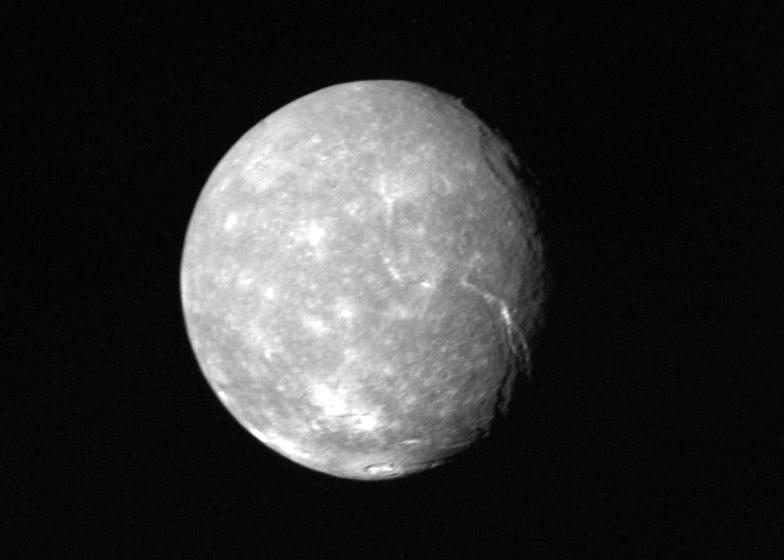
Titania
Uranus's largest moon — a fractured ice-and-rock world of vast canyons, ancient craters, and a possible hidden ocean.
Titania — Uranus's largest moon
Titania is the largest moon of Uranus and the eighth-largest moon in the entire Solar System. With a diameter of approximately 1,578 km, it is a mid-sized icy world — smaller than Earth's Moon but substantially larger than any of the other Uranian satellites. Its relatively high mean density of about 1.68 g/cm³ points to an interior composed of roughly equal parts water ice and rock, setting it apart from more ice-rich moons elsewhere in the outer Solar System.
The moon was discovered on 11 January 1787 by William Herschel, making it one of the earliest known satellites beyond the Jupiter and Saturn systems. It was not named until the mid-19th century, when John Herschel — William's son — proposed the name Titania from Shakespeare's A Midsummer Night's Dream, a tradition extended to all Uranian moons.
Titania's surface is a dark, moderately cratered icy crust dissected by enormous tectonic canyons and fault scarps. The most dramatic of these is Messina Chasma, a graben system stretching roughly 1,500 km from near the equator almost to the south pole. Voyager 2's brief January 1986 flyby remains the only close-up look humanity has achieved, imaging less than half the moon's surface. Much of what is known about Titania's geology, composition, and interior therefore rests on that single encounter, supplemented by Earth- and space-telescope spectroscopy and theoretical modelling.
Recent modelling work suggests that Titania may harbour a briny liquid ocean at its core–mantle boundary, sustained by residual radiogenic heat. Whether that ocean exists remains unconfirmed; answering the question is among the primary science goals of the proposed Uranus Orbiter and Probe flagship mission, ranked the top outer-planet priority by the U.S. Planetary Science Decadal Survey for 2023–2032.
Discovery and naming
William Herschel discovered Titania — along with Oberon — on the night of 11 January 1787. The discovery came six years after his celebrated identification of Uranus itself on 13 March 1781, and it made Titania and Oberon the first moons of Uranus known to science. At the time, Herschel referred to Uranus by the name he had proposed, Georgium Sidus (the 'Georgian star'), in honour of King George III, whose patronage had supported his work.
The technical key to the discovery was Herschel's deliberate choice of instrument. Rather than his usual Newtonian reflector, he employed a newly built 'front-view' reflecting telescope — a design in which light from the primary mirror travels directly to the eyepiece without bouncing off a secondary mirror. By eliminating that intermediate reflection, the telescope lost less light, increasing the brightness of extremely faint, small objects near a relatively bright planet. Herschel credited this design as the crucial factor that allowed him to detect the two tiny, star-like points moving in concert with Uranus.
Herschel did not assign names to his discoveries; he described them as satellites of the Georgian star. It was his son John Herschel who, in naming work carried out in 1847–1852, proposed the names Titania and Oberon — both drawn from characters in Shakespeare's A Midsummer Night's Dream. This Shakespearean convention was later extended to all subsequently discovered moons of Uranus. In modern planetary catalogues, Titania is designated Uranus III.
Physical characteristics and composition
With a diameter of 1,578 km, Titania occupies the upper tier of mid-sized icy moons — larger than any of the other four Uranian major moons (Miranda, Ariel, Umbriel, and Oberon), but smaller than the large moons of Jupiter and Saturn. Its mass of approximately 3.527 × 10²¹ kg yields a mean density in the range of 1.68–1.71 g/cm³. That density is meaningfully higher than pure water ice (about 0.92 g/cm³) and sits well above the density of ice-rich bodies, indicating that a substantial fraction of the interior is rocky material.
Current models estimate the bulk composition as roughly half water ice and half rock. The rock component is thought to include carbonaceous material and organic compounds. Spectroscopic observations from Earth and space have confirmed the presence of crystalline water ice on the surface, and carbon dioxide has also been detected — a finding with implications for surface chemistry and possibly internal processes.
The interior is believed to be differentiated: a dense rocky core surrounded by an icy mantle. The relatively high overall density for a Uranian satellite supports this layered picture and reinforces that Titania is not simply a loosely consolidated snowball but rather a geologically complex body whose rocky fraction contributes significantly to its mass and structure.
Surface geology — craters, canyons, and fault scarps
Titania's surface presents a dark, slightly reddish icy crust shaped by two overlapping processes: impact cratering from external projectiles, and endogenic (internally driven) tectonic activity. Fresh impact ejecta appear bluer than average terrain, while some graben floors and smooth plains are somewhat redder, hinting at compositional variation across the surface.
The moon is heavily cratered, but its crater density is lower than that of Oberon and Umbriel — its two neighbouring large moons. This comparative scarcity of craters implies that Titania's visible surface is geologically younger than theirs, because early resurfacing or tectonic activity obliterated a portion of the primordial impact record. The largest confirmed impact crater is Gertrude, approximately 326 km across. An unnamed, highly degraded impact basin west of Gertrude measures roughly 330 km across and is among the most ancient recognisable structures on the moon. Other notable craters include Ursula, which is unusual among large Titanian craters for having a central pit rather than the more common central peak, and Jessica, which along with Ursula displays bright ray systems of freshly excavated icy ejecta.
The most visually and geologically striking features of Titania, however, are its enormous tectonic structures. The moon is laced with grabens — long, down-dropped crustal blocks bounded on either side by parallel fault scarps — that give the surface the appearance of having been pulled apart. These grabens are typically 20–50 km wide and carry depth relief of about 2–5 km. They are interpreted as giant extensional fractures formed as Titania's interior expanded and cooled, causing the outer ice shell to crack under tension.
The most prominent of these features is Messina Chasma, a major graben system extending roughly 1,500 km from near the equator almost to the south pole — one of the longest known tectonic features on any Uranian moon. Messina Chasma cuts across older craters and plains, demonstrating that it formed late in the moon's geological history and is among the youngest major surface structures. In addition to fully formed grabens like Messina, Titania also shows rupes — individual high cliff-like scarps produced by tectonic faulting — which in some regions stand as isolated features and in others form the bounding walls of graben systems.
Taken together, Titania's geology tells a story of early resurfacing that erased much of its most ancient cratered terrain, followed by a long period of continued impact bombardment and episodic tectonic activity. The large extensional features suggest that the interior expanded — possibly as a subsurface ocean or water-rich layer froze and increased in volume — driving the icy crust outward and generating the fractures still visible today.
Voyager 2 flyby — humanity's only close look
On 24 January 1986, Voyager 2 completed its flyby of the Uranian system — the only spacecraft encounter with Uranus ever conducted. The mission transformed understanding of the entire system, revealing new moons and rings, mapping the planet's magnetic field, and obtaining the first resolved images of the major moons, including the first full-disk view of Titania.
Voyager 2's closest approach to Titania was approximately 365,200 km, which was closer than its approaches to Umbriel or Oberon, allowing a more extended colour imaging sequence during Titania's apparent rotation. The best images achieved a resolution of roughly 3.4 km per pixel. Even so, only about 40% of Titania's surface was imaged at all, and merely about 24% at a resolution sufficient for geological mapping — and that coverage was concentrated entirely in the southern hemisphere, since the northern hemisphere was in polar night during the encounter's geometry.
The images revealed the craters, chasmata, and fault scarps described above, but the geometry and brevity of the flyby imposed fundamental limits. No orbital mechanics allowed Voyager 2 to slow down, enter orbit, or return for a second pass. Every scientific inference about more than half of Titania's surface, and essentially the entire northern hemisphere, remains extrapolation from that single partial glimpse nearly four decades ago.
Interior structure and the case for a subsurface ocean
The question of whether Titania conceals a liquid ocean beneath its icy surface has moved from speculation to a scientifically substantive debate, driven by modelling advances in the 2020s. The standard interior model places a dense rocky core at the centre, enveloped by an icy mantle. If radiogenic decay within the rocky core generates enough heat, and if the ice contains dissolved salts or ammonia that lower its melting point, a liquid layer could persist at the core–mantle boundary — insulated from space by the thick ice above.
A 2023 study of the Uranian moon system concluded that Titania and three other large Uranian moons likely retained sufficient internal heat to prevent subsurface oceans from freezing to the present day. This finding places Titania in the growing category of potential ocean worlds in the outer Solar System, alongside more celebrated candidates such as Europa, Enceladus, and Ganymede.
A 2025 conference study examined how precision measurements of Titania's gravitational field and forced librations — tiny wobbles in its rotation — could discriminate between ocean-present and ocean-absent interior models. The analysis found the predicted difference in the tidal Love number k₂ between the two scenarios large enough that a sufficiently sensitive spacecraft measurement could confirm or rule out an ocean. A 2024 gravity and radio science paper similarly identified the large Uranian moons as high-priority targets because they may host liquid-water oceans beneath icy shells.
The principal uncertainty remains Titania's thermal history, which is poorly constrained without in-situ measurements. No spacecraft has yet measured Titania's gravity field precisely, detected any induced magnetic signal, or sampled surface materials that might indicate subsurface chemistry. The ocean, if it exists, has not yet been confirmed by direct observation.
Key moments in Titania's story
- 11 Jan 1787Discovery by William Herschel
Herschel detects Titania and Oberon orbiting Uranus using a custom front-view reflecting telescope, the first known moons of Uranus.
- 1847–1852Named by John Herschel
William Herschel's son John proposes the name Titania — from Shakespeare's A Midsummer Night's Dream — along with the name Oberon, establishing the Shakespearean naming tradition for Uranian moons.
- 24 Jan 1986Voyager 2 flyby
Voyager 2 flies through the Uranian system and obtains the first resolved images of Titania from a closest approach of ~365,200 km, imaging roughly 40% of the surface at up to 3.4 km/pixel resolution.
- 2023Ocean-world modelling study
A study concludes that Titania and three other large Uranian moons likely retained enough internal heat to maintain subsurface liquid-water layers to the present day.
- 2023–2024Decadal Survey flagship priority confirmed
The U.S. Planetary Science Decadal Survey for 2023–2032 designates the Uranus Orbiter and Probe as the top-priority outer-planet flagship mission, with study of the large moons — including Titania — as a core science goal.
- 2025Gravity and libration ocean-detection study
Modelling presented at a 2025 conference shows that precision k₂ and libration measurements during Uranus-orbiter flybys could confirm or rule out a subsurface ocean on Titania.
Key findings
Titania's mean density of 1.68–1.71 g/cm³ — far above that of pure water ice — demonstrates that it contains a substantial rocky component, distinguishing it from more ice-dominated moons elsewhere in the outer Solar System.
Infrared spectroscopy has confirmed crystalline water ice on Titania's surface, along with the presence of carbon dioxide — a finding with implications for surface chemistry and the possibility of ongoing internal processes releasing volatiles.
Its comparatively low crater density relative to Oberon and Umbriel implies that endogenic resurfacing erased part of the early impact record, making Titania's visible surface geologically younger.
The ~1,500 km graben system of Messina Chasma stretches from near the equator toward the south pole and is among the most extensive known tectonic features on any icy moon, recording a period of dramatic crustal extension.
The network of grabens and fault scarps across Titania's surface is best explained by internal expansion — likely the freezing of a subsurface liquid layer — which stretched the ice shell and fractured it, producing the chasmata and rupes visible today.
2023 modelling indicates that Titania may retain a liquid-water layer at its core–mantle boundary sustained by radiogenic heat, placing it among the Solar System's candidate ocean worlds — a conclusion testable by a future orbiter mission.
Future exploration — the Uranus Orbiter and Probe
No dedicated mission to Titania has ever been approved, and no spacecraft beyond Voyager 2 has visited the Uranian system at all. The principal vehicle for future Titania science is the proposed Uranus Orbiter and Probe (UOP), identified by the U.S. National Academies' Planetary Science Decadal Survey for 2023–2032 as the highest-priority large (flagship) mission for the coming decade. Understanding the bulk properties, internal structure, and geologic history of the Uranian satellites — with Titania as the largest and most massive — is an explicit science objective of that mission concept.
A Uranus orbiter would approach Titania through repeated close flybys rather than dedicated orbital insertion around the moon itself. Each flyby would provide opportunities for precision gravity tracking to constrain the interior mass distribution, magnetometer measurements to search for an induced magnetic field indicative of a conductive (salty) subsurface ocean, high-resolution imaging of terrain never seen by Voyager 2 — especially the entirely unimaged northern hemisphere — and visible and infrared spectroscopy to map water ice, dark carbonaceous material, organics, and volatiles across the surface.
As of the information available from community discussions and Decadal Survey materials, launch is conceptually discussed for the early-to-mid 2030s, with arrival at Uranus in the late 2040s. These dates remain subject to funding decisions and mission formulation. No payload has been finalised, and no dedicated Titania lander, rover, or Titania-only orbiter has advanced to a formal selection stage at any space agency.
Titania — frequently asked questions
Sources
- Uranus' Moon Titania — Universe Today
- Titania (moon) — Wikipedia
- Titania — NASA Science
- Titania: Uranus' moon — NOAA Science On a Sphere
- Titania — The Solar System Wiki, Fandom
- Jan. 11, 1787: William Herschel discovers two moons of Uranus — Astronomy.com
- William Herschel — Wikipedia
- Uncertain Journey: 30 Years Since Voyager 2's Encounter With Uranus — AmericaSpace
- Voyager 2's Titania image catalog — The Planetary Society
- A New Study of Uranus' Large Moons Shows That Four May Hold Water — Astrobiology.com
- Gravity and Radio Science Investigation at the Moons of Uranus — AGU Journals
- Gravity and Radio Science Investigation at the Moons of Uranus to Detect Subsurface Oceans (LPSC 2025 PDF)
- Uranus' Moons Could Have Cryovolcanism from Potential Interior Oceans — Universe Today