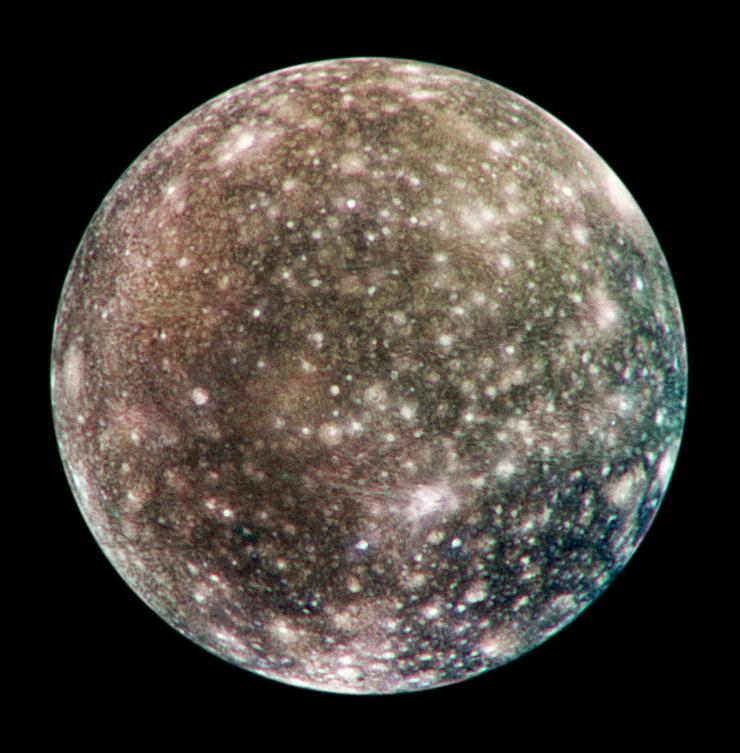
Callisto
Jupiter's ancient, battered moon — a geologically frozen world that may hide a global ocean beneath its cratered face.
Callisto
Callisto is the outermost of the four large moons of Jupiter discovered by Galileo Galilei in 1610, and the third-largest moon in the entire Solar System. With a mean radius of about 2,410 km — nearly the diameter of Mercury — it is a world of startling contradictions: physically imposing yet geologically silent, ancient yet increasingly recognised as dynamically alive beneath the surface.
Callisto's surface is among the oldest and most heavily cratered in the Solar System, preserving a near-unbroken record of bombardment stretching back roughly 4 billion years. No volcanoes erupt, no tectonic plates shift, and no fresh terrain resurfaces the battered landscape — earning Callisto its informal reputation as a geologically "dead" world. Yet appearances deceive. Data from NASA's Galileo spacecraft, and reanalysis published as recently as 2024–2025, increasingly point to a global ocean of salty liquid water hidden beneath the ice, making Callisto one of the Solar System's most compelling — and most underappreciated — ocean worlds.
Because it sits well outside Jupiter's main radiation belts, Callisto also experiences radiation doses far lower than its siblings Io and Europa, and has been studied as a possible staging point for future human exploration of the Jovian system.
Discovery and historical significance
Callisto was first observed on 7 January 1610 by Galileo Galilei, who used one of the earliest astronomical telescopes to record four points of light orbiting Jupiter over successive nights. He had discovered what are now called the Galilean satellites — Io, Europa, Ganymede, and Callisto. The German astronomer Simon Marius also observed the moons in 1610 and later claimed independent discovery; modern historians generally credit Galileo because his observations and publication came first. It was Marius, however, who proposed the name "Callisto," drawn from Greek mythology: Callisto was a nymph, a companion of the goddess Artemis, who was transformed and placed among the stars.
The discovery of these four satellites carried profound implications for the history of science. Here were bodies clearly orbiting something other than Earth, providing direct observational evidence against the geocentric model that had dominated Western astronomy and directly supporting the Copernican heliocentric system. Of the four, Callisto is the outermost, orbiting Jupiter at a mean distance of roughly 1,883,000 km — about 4.5 times farther from Jupiter than Io.
For more than three centuries after its discovery, Callisto remained little more than a point of light. The first close-up views came in 1979, when NASA's Voyager 1 and Voyager 2 spacecraft flew past Jupiter and returned images covering more than half of Callisto's surface at roughly 1–2 km resolution. Those images confirmed an ancient, heavily cratered world and established its basic character as an icy–rocky body. The transformative era came with NASA's Galileo orbiter, which operated in the Jovian system from 1995 to 2003 and conducted eight dedicated close flybys of Callisto between 1996 and 2001.
Callisto through time
- 7 Jan 1610Discovery by Galileo Galilei
Galileo records Callisto — along with Io, Europa, and Ganymede — as a point of light orbiting Jupiter, marking the first telescopic discovery of a moon around another planet.
- 1610Independent observation by Simon Marius
Simon Marius observes the Jovian moons and later proposes the name "Callisto" from Greek mythology, though credit for the discovery is generally given to Galileo.
- Mar–Jul 1979Voyager 1 and 2 flybys
The twin Voyager spacecraft return the first close-up images of Callisto, revealing a heavily cratered, ancient surface and measuring basic physical properties. More than half the surface is mapped at 1–2 km resolution.
- 18 Oct 1989Galileo spacecraft launched
NASA's Galileo probe is deployed from Space Shuttle Atlantis and begins its multi-year journey to Jupiter.
- 7 Dec 1995Galileo arrives at Jupiter
Galileo enters orbit around Jupiter, beginning an extended mission that will include eight close flybys of Callisto.
- 1996–2001Eight Galileo flybys of Callisto
Galileo conducts eight dedicated Callisto encounters, achieving a closest approach of about 138 km during the C30 flyby in 2001. The mission returns global imaging, high-resolution regional coverage, gravity data, magnetometer readings, and infrared spectra that revolutionise understanding of Callisto's interior, surface, and environment.
- 1999CO₂ exosphere announced
Scientists announce that 1997 Galileo observations detected a very tenuous carbon dioxide exosphere around Callisto — the first detection of an atmosphere at this moon.
- 2000Cassini flyby (Jupiter gravity assist)
On its way to Saturn, Cassini acquires high-quality infrared spectra of Callisto's surface, refining knowledge of its surface ice and non-ice materials.
- 2003Galileo deorbited into Jupiter
After eight years of operations, Galileo is deliberately commanded into Jupiter's atmosphere, ending the mission while leaving behind a wealth of Callisto data.
- 2007New Horizons flyby (Jupiter gravity assist)
On its way to Pluto, New Horizons obtains additional images and spectra of Callisto, improving compositional constraints.
- 14 Apr 2023JUICE launched
ESA's Jupiter Icy Moons Explorer (JUICE) launches on an Ariane 5 from Kourou, beginning a multi-year journey to Jupiter with Callisto as one of its key targets.
- Jul 2031JUICE arrives at Jupiter (planned)
JUICE is expected to enter the Jovian system and begin its tour of the icy moons.
- 2032–203421 JUICE flybys of Callisto (planned)
JUICE plans to conduct 21 close flybys of Callisto — with closest approaches down to approximately 200 km — to study its exosphere, magnetic environment, surface, and interior before the spacecraft is captured into orbit around Ganymede.
Physical characteristics and composition
Callisto is a large, low-density world. Its mean radius of approximately 2,410 km makes it the third-largest moon in the Solar System, exceeded only by Ganymede and Titan, and the second-largest of Jupiter's moons. Its diameter of roughly 4,820 km is about 99% that of Mercury — yet its mass is only about one-third of the innermost planet's, a reflection of Callisto's very different bulk composition. Where Mercury is a dense, iron-rich rocky body, Callisto is built primarily from a mixture of water ice and rock, with its mean density of 1.83 g/cm³ (compared to Mercury's roughly 5.4 g/cm³) telling the story clearly.
Surface gravity at Callisto's equator is about 1.24 m/s², or roughly 13% of Earth's, and the escape velocity is 2.44 km/s. A person standing on Callisto would weigh about as much as an infant on Earth. The moon's axial tilt is essentially zero degrees relative to its orbital plane, meaning it experiences virtually no seasons.
Spectral observations have identified magnesium and iron silicates, sulfur dioxide (SO₂), and carbon dioxide (CO₂) among the surface materials. The surface also shows only weak water-ice spectral signatures compared with Ganymede, because much of it is blanketed by dark, non-icy material — a mixture of hydrated minerals similar to clays, organic compounds, and other rocky and dusty components. Bright regions, by contrast, are dominated by relatively clean water ice, especially on crater rims, central peaks, and the inner zones of large impact basins.
Callisto's surface area is approximately 7.3 × 10⁷ km² — slightly larger than the total land area of Earth's continents — and is almost entirely covered by ancient impact craters, rendering it one of the most crater-saturated surfaces known.
Interior structure: an incompletely differentiated world
One of the most striking findings of the Galileo mission was that Callisto's interior is only weakly differentiated — meaning that rock and ice are not cleanly separated into distinct layers the way they are on Ganymede, or the way iron and silicates are separated in terrestrial planets. Gravity measurements during Galileo's flybys showed that Callisto's moment-of-inertia factor is consistent with an interior in which rock and ice remain broadly mixed throughout, rather than a structure with a dense metallic core, a rocky mantle, and an outer ice shell.
Britannica describes this as a "raisin pudding" interior — rocky "raisins" dispersed through an icy "pudding" — and this image captures the essential point well. If a small rock-rich core exists at all, models constrain it to less than 25% of Callisto's radius. Otherwise, the interior grades from a rock-rich deep region to increasingly ice-rich material toward the surface, with an outer ice-dominated shell atop whatever conducting layer lies beneath.
This state of incomplete differentiation is thought to reflect Callisto's accretion history. Unlike Io, Europa, and Ganymede — which participate in the Laplace orbital resonance and experience strong tidal heating — Callisto is not in any resonance with its siblings and has experienced much weaker tidal forces over its history. Without a large internal heat source, Callisto apparently never fully melted and separated its rock from its ice, preserving a primordial mixed structure. This is in sharp contrast to Ganymede, which is similar in size and bulk composition but has a differentiated iron core and rocky mantle.
The subsurface ocean: evidence and current understanding
Despite its geologically frozen exterior, Callisto almost certainly harbours a global ocean of liquid salty water somewhere beneath its icy crust. The primary evidence comes not from surface geology — which is utterly devoid of signs of internal activity — but from Callisto's magnetic behaviour.
Jupiter's magnetic field at Callisto's distance varies in both direction and magnitude over time. During Galileo's multiple flybys, the spacecraft's magnetometer detected a secondary magnetic field emanating from Callisto that changes in synchrony with Jupiter's field — the hallmark of electromagnetic induction. A fixed, internally generated magnetic field (like Earth's or Ganymede's) would not behave this way. The time-varying induced field instead requires a globally distributed, electrically conductive layer inside Callisto. The most natural candidate for such a layer is a briny (salty) liquid water ocean, since dissolved salts dramatically increase water's electrical conductivity.
Early Galileo-era analyses already strongly suggested this interpretation, but an alternative explanation lingered: Callisto has an unusually strong, conductive ionosphere — the ionised upper layer of its thin exosphere — which can also induce magnetic fields. For years, researchers debated whether the observed signal came primarily from the ionosphere, a subsurface ocean, or both.
Recent work has largely resolved this ambiguity. A study published in AGU Advances in 2024 (Cochrane et al.) reanalysed all eight close Galileo flybys using plasma interaction simulations and both forward and inverse magnetic-field modelling. The team built a four-layer model — rocky mantle, conductive ocean, non-conductive ice shell, and conductive ionosphere — and tested whether ionospheric induction alone could reproduce the data. It could not. The best fits consistently required a conductive subsurface ocean in addition to the ionosphere, with the ocean at least tens of kilometres thick beneath an ice shell that could range from tens to hundreds of kilometres in depth.
A separate Bayesian inference study presented at the 2024 Lunar and Planetary Science Conference reached similar conclusions. Using data from the C3 and C9 Galileo flybys, that analysis directly inverted for ocean thickness, conductivity, ionospheric properties, and ice-shell thickness. It found an induced amplitude response of 0.90 ± 0.02 — a value that cannot be reproduced by ionospheric induction alone at greater than 99.99% confidence. The conclusion: a subsurface ocean is required, with a salinity within roughly an order of magnitude of Earth's oceans. A 2025 synthesis summarised these results by characterising Callisto as "very likely an ocean world."
NASA estimates that the ocean, if present, may lie approximately 250 km (155 miles) below the surface. At such depths, the base of the ocean would be in contact with the rocky interior beneath — a detail of potential significance for habitability, since rock–water interfaces are exactly the settings on Earth where hydrothermal systems support chemosynthetic ecosystems independent of sunlight. Because Callisto lacks strong tidal heating, models require antifreeze components — dissolved salts, possibly ammonia — and sluggish convection within the ice shell to prevent the ocean from freezing over geological timescales.
Surface geology: a frozen record of ancient bombardment
Callisto's surface is one of the oldest and most heavily cratered in the Solar System. The cratered plains that cover the majority of the globe are estimated to be approximately 4–4.5 billion years old, dating essentially from the formation of the Solar System itself. Crater densities are so high that the surface is near saturation — meaning new impacts mostly erase older craters rather than adding net new ones. Crucially, there is no evidence of large-scale tectonics, volcanism, or any other form of endogenic resurfacing that has modified the terrain since its formation.
This preservation makes Callisto a scientific time capsule — a "witness of the early Solar System," as some researchers describe it — recording the flux of comets and asteroids that bombarded the outer Jovian system over billions of years. Because the other Galilean moons have been extensively resurfaced (Io by volcanism, Europa and Ganymede by tidal tectonics), Callisto alone preserves this early record, providing a reference chronology for impact processes across the Jupiter system.
At finer scales, Callisto's surface shows a characteristic landscape of dark cratered plains interspersed with bright regions rich in water ice — particularly on crater rims, central peaks, and ejecta blankets. Many craters show signs of viscous relaxation and softening, reflecting the tendency of the icy crust to flow slowly over geological time and reduce topographic relief. The surface also hosts abundant small knobs, interpreted as eroded remnants of crater rims, central peaks, and impact ejecta. Small craters, expected in large numbers from the steady trickle of impactors over billions of years, appear relatively scarce at small sizes, probably because sublimation of surface ice gradually degrades small features below the detection threshold.
Crater chains called catenae are also prominent, thought to arise from tidally disrupted comets or asteroid trains striking along a common trajectory — analogous to the Shoemaker–Levy 9 impact sequence that struck Jupiter itself in 1994.
Valhalla and the great basins
Valhalla is the largest impact structure on Callisto and one of the largest in the Solar System. Its bright central region spans roughly 600 km in diameter, while concentric rings of ridges and graben extend outward to approximately 1,800–1,900 km from the centre. The structure formed when a giant impactor struck the icy lithosphere, which then collapsed and rebounded, generating outward-spreading extensional faults. The bright material in the central zone and ring troughs represents excavated and emplaced fresh water ice. Crater counts suggest Valhalla is younger than the surrounding plains but still billions of years old.
Asgard is the second-largest multi-ring structure on Callisto, about 1,600 km in diameter. Like Valhalla, it features a bright, structurally complex central zone and multiple concentric rings, though its morphology is somewhat less regular. Both basins are surrounded by distinctive light plains and bright smooth terrain associated with their ring-and-trough systems.
The ancient cratered plains make up the dominant terrain type. Scattered across them are palimpsests — flattened, ghost-like remnants of ancient large craters whose topography has been largely erased by viscous relaxation of the icy crust over billions of years, leaving only faint circular outlines and bright patches.
Galileo's near-infrared spectrometer revealed that much of Callisto's surface is blanketed by dark, non-icy material — a mixture of hydrated minerals, organic compounds, and other rocky components — which has in some regions buried or obliterated smaller craters. This material is thought to be a lag deposit left behind as surface ice has been lost to sublimation and radiation processing over geological time.
Galileo spectroscopic studies found solid CO₂ ice and traces of hydrogen peroxide on Callisto's surface. The hydrogen peroxide is probably produced by radiation-driven splitting of water ice (radiolysis), while traces of sulfur compounds are likely delivered from volcanically active Io via Jupiter's magnetosphere.
Atmosphere and exosphere
Callisto does not possess a dense, bound atmosphere in any conventional sense. Instead it has an extremely tenuous exosphere — a surface-bounded atmosphere in which gas molecules travel on ballistic trajectories and rarely collide with one another. In 1997, instruments aboard Galileo detected a very thin carbon dioxide (CO₂) exosphere around Callisto, a discovery that was announced in 1999. This was the first identification of any atmospheric constituent at this moon.
Subsequent analyses and later research have also indicated the presence of molecular oxygen (O₂) and hydrogen in the exosphere, albeit at extremely low densities — far thinner than the best laboratory vacuums achievable on Earth. The oxygen is thought to be produced by radiolysis: high-energy particles from Jupiter's magnetosphere split water molecules in surface ice, releasing oxygen that slowly escapes into space. Surface pressures across the exosphere are estimated to be on the order of 10⁻¹¹ to 10⁻⁹ bar.
The upper, ionised portion of the exosphere forms a conductive ionosphere. This ionosphere is notably strong for a body its size, and — as described in the context of the subsurface ocean debate — it can also induce secondary magnetic fields in response to Jupiter's varying field, complicating the interpretation of Galileo's magnetic measurements. The precise balance between ionospheric and ocean contributions to Callisto's observed induced magnetic field remains an active research topic, and one that ESA's JUICE mission is designed in part to resolve.
Habitability and astrobiology
NASA lists Callisto as one of a small number of places beyond Earth where life could in principle exist, citing the likely presence of a salty subsurface ocean, rock–water interaction at depth, and the detection of oxygen in the exosphere. If the ocean's base is in contact with the rocky interior some 250 km below the surface, as models suggest, this creates exactly the kind of water–rock chemical interface that on Earth supports hydrothermal ecosystems harbouring chemosynthetic organisms independent of sunlight.
Nevertheless, Callisto ranks below Europa and Enceladus in most comparative habitability assessments. The principal reasons are its very weak tidal heating — Callisto is not in any orbital resonance — and the corresponding lack of active geology at the surface. On Europa, tidal flexing generates internal heat that drives geochemical cycling between the ocean and the surface, creating chemical disequilibrium that could sustain biological activity. On Callisto, those processes appear largely absent. The ocean, if present, is likely deeply buried, with little exchange of material between the ocean and the icy surface. No plume activity or surface expressions of a sub-surface ocean have been detected.
Callisto's radiation environment, however, is far gentler than that of the other Galilean moons. Orbiting at about 1,883,000 km from Jupiter — well outside the planet's main radiation belts — its surface receives an estimated radiation dose roughly twelve times Earth's natural background level, or about 0.01 rem per day. By comparison, Europa, deep within the belts, receives doses millions of times higher. This makes Callisto uniquely attractive as a potential location for a crewed or robotic outpost in the Jovian system — a staging base from which human explorers or robotic probes could operate missions to the harsher but more astrobiologically promising moons. NASA studies in the early 2000s specifically identified Callisto as a candidate site for a future human base in the Jovian system. The moon's abundant water ice could also serve as a resource for fuel production and life support.
ESA's JUICE mission and future exploration
The next major chapter in Callisto's exploration will be written by ESA's Jupiter Icy Moons Explorer — JUICE — which launched on 14 April 2023 on an Ariane 5 rocket from the Guiana Space Centre in Kourou, French Guiana. The spacecraft is expected to arrive at Jupiter in July 2031 and enter an extended tour of the Jovian system before ultimately being captured into orbit around Ganymede.
Callisto plays a central role in JUICE's tour design. The mission plans to conduct 21 close flybys of Callisto between 2032 and 2034, with closest approaches of approximately 200 km. These encounters serve a dual purpose: scientifically, they provide repeated opportunities to probe Callisto's exosphere, magnetic environment, surface composition, and interior; operationally, Callisto flybys are used as gravity assists to gradually reshape JUICE's orbit as it approaches final capture by Ganymede.
JUICE carries a suite of 10 instruments — including ultraviolet and visible–infrared spectrometers, a submillimetre sounder, a magnetometer, plasma and particle detectors, a laser altimeter, and a radio science package — that together can characterise Callisto's exosphere composition and structure, map the magnetic and plasma environment, and help distinguish whether Callisto's induced magnetic field originates in a subsurface ocean, the ionosphere, or both. This last question is among the most significant outstanding puzzles about Callisto, and resolving it definitively would either confirm or challenge the ocean-world status supported by recent Galileo data reanalyses.
Beyond JUICE, there is reported interest in China planning a mission to Jupiter's moons with a leading proposal involving a dedicated Callisto orbiter and lander. Such a mission would allow long-term monitoring of Callisto's space environment and in-situ surface and near-surface measurements that could link exosphere chemistry directly to surface ice and rock composition. As of the available research, however, JUICE remains the only approved mission that will directly investigate Callisto in the near future.
Frequently asked questions
Sources
- Callisto Facts — NASA Science
- Callisto — NASA Science
- Callisto (moon) — Wikipedia
- Callisto | Facts & Exploration — Britannica
- Callisto Moon of Jupiter | Definition, Facts & Atmosphere — Study.com
- Callisto moon of Jupiter — Weebau
- Callisto: Jupiter's Moon — NOAA Science On a Sphere
- Stronger Evidence of a Subsurface Ocean Within Callisto — AGU Advances (Cochrane et al. 2024)
- Confirmation of a Callisto Subsurface Ocean Using Bayesian Inference — LPSC 2024
- Jupiter's Moon Callisto Is Very Likely an Ocean World — Eos.org
- Callisto Is Very Likely an Ocean World — Astrobiology Web
- Does Jupiter's Moon Callisto Have an Ocean? — Universe Today
- Viability of Inhabiting the Galilean Moons — Astrobites
- Jupiter's cratered moon, Callisto — ESA Science & Technology
- JUICE: To Jupiter's icy moons — Science in School
- Juice, exploring Jupiter's icy moons — The Planetary Society
- Jupiter Icy Moons Explorer — Wikipedia
- Callisto's Atmosphere and Its Space Environment — AGU Earth and Space Science
- What are Jupiter's Galilean moons? — The Planetary Society