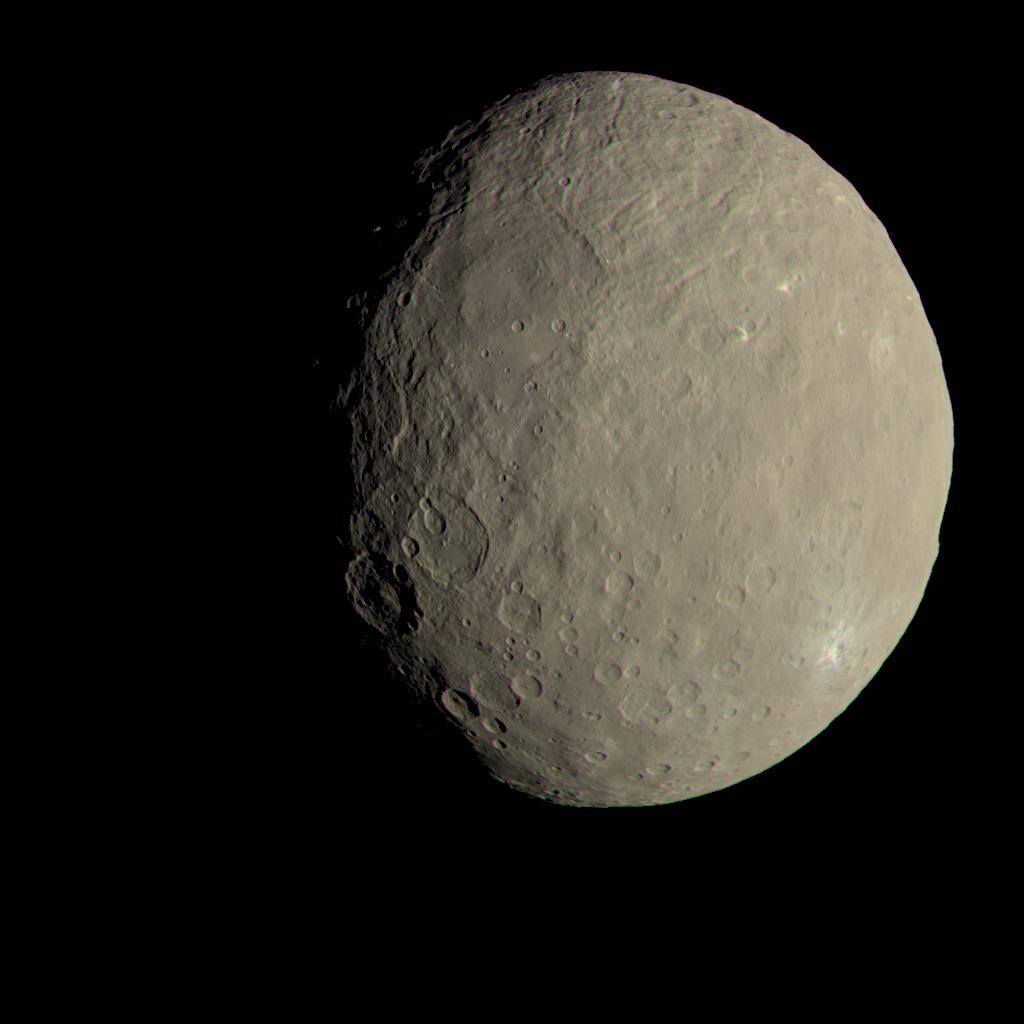
Ceres
The largest body in the asteroid belt and the only dwarf planet in the inner solar system — a former ocean world hiding briny secrets beneath its cratered surface.
Ceres
Ceres is the largest body in the main asteroid belt, orbiting the Sun between Mars and Jupiter at an average distance of about 2.77 AU (approximately 414 million km). With a mean diameter of roughly 940 km, it is massive enough to have pulled itself into a nearly spherical shape under its own gravity — the hallmark of a dwarf planet under the International Astronomical Union's 2006 definition. It is the only confirmed dwarf planet located in the inner solar system, and the smallest known dwarf planet overall.
Discovered on 1 January 1801 by Italian astronomer Giuseppe Piazzi at Palermo, Ceres was first celebrated as a new planet filling the orbital gap predicted between Mars and Jupiter, then demoted to asteroid status as dozens of similar small bodies were found, and finally recognized as a dwarf planet more than two centuries after its discovery. Its scientific importance, however, has only grown. NASA's Dawn spacecraft — which entered orbit around Ceres on 6 March 2015, making Ceres the first dwarf planet and first asteroid-belt object visited by a spacecraft in orbit — revealed a world far more geologically complex and water-rich than anyone had anticipated.
Dawn's findings transformed the prevailing image of Ceres from an inert, rocky relic into a geologically active former ocean world. Its surface is peppered with more than 300 bright patches of sodium carbonate salts deposited by brines rising from a deep subsurface reservoir. A 2024 study published in Nature Astronomy argues that the crust of Ceres is the frozen remnant of an ancient, muddy, briny ocean — making Ceres a kin, in some respects, to the icy ocean moons of the outer solar system, but positioned much closer to the Sun.
From new planet to dwarf planet: a 200-year journey
- 1 Jan 1801Discovery by Piazzi
Italian astronomer Giuseppe Piazzi at the Palermo Astronomical Observatory detects a faint, slowly moving object while compiling a star catalogue. He initially suspects a comet, but its nearly circular orbit between Mars and Jupiter hints at something different. This is the first object discovered in what is now called the asteroid belt.
- 24 Jan 1801First announcement
Piazzi writes to Barnaba Oriani in Milan and Johann Elert Bode in Berlin, cautiously describing the find as a possible comet but suggesting it may be something new.
- 7 May 1801Named Ceres Ferdinandea
Piazzi declares his intention to name the object Cerere Ferdinandea — Ceres after the Roman goddess of agriculture associated with Sicily, and Ferdinandea in honour of King Ferdinand of Naples and Sicily. International usage eventually drops the political epithet, and the body becomes simply Ceres.
- Sep 1801Observations published; object lost in solar glare
Piazzi's full positional data appear in Franz Xaver von Zach's journal. By this point Ceres has moved too close to the Sun's glare to be followed, and it is temporarily lost.
- 31 Dec 1801Recovery using Gauss's orbit method
Carl Friedrich Gauss, then 24 years old, develops a new method of orbit determination and predicts where Ceres should reappear. Von Zach recovers it on 31 December 1801, almost exactly where Gauss predicted. Piazzi himself reacquires it on 23 February 1802.
- 1802–1807Similar bodies found; new class proposed
Heinrich Olbers discovers Pallas (1802), followed by Juno (1804) and Vesta (1807). The accumulation of small bodies in the same orbital region leads William Herschel to propose a new class of objects. Herschel coins the term 'asteroid' (star-like) because these bodies appear point-like in telescopes, unlike the disk-shaped major planets.
- 19th–20th centuriesReclassified as an asteroid
As the asteroid belt population swells with new discoveries, Ceres is gradually demoted from planet to largest asteroid. In the minor planet catalogue it receives the designation (1) Ceres, reflecting its status as the first minor planet ever discovered.
- 24 Aug 2006IAU creates 'dwarf planet' category
The International Astronomical Union formally defines 'planet' and introduces the category 'dwarf planet' — a body that orbits the Sun and is massive enough to be roughly spherical, but has not cleared its orbital neighbourhood. Ceres meets the first two criteria but not the third, and is reclassified as a dwarf planet while retaining its minor planet status. It becomes the only confirmed dwarf planet in the asteroid belt and the smallest known dwarf planet.
- 6 Mar 2015Dawn enters orbit around Ceres
NASA's Dawn spacecraft becomes the first probe to orbit a dwarf planet and the first to orbit any object in the asteroid belt. It begins systematic mapping of Ceres's surface, gravity field, and composition — a mission that will run until October 2018.
- 2015–2018Dawn's major discoveries
Dawn reveals more than 300 bright salt deposits, confirms a geologically young surface with evidence of brine activity, characterises Occator crater's spectacular faculae, and builds a detailed gravity model pointing to a differentiated interior with ice-rich crust and a probable deep brine reservoir.
- Sep 2024Nature Astronomy: Ceres as a frozen ocean world
A study from Purdue University and JPL, published in Nature Astronomy, argues that Ceres's crust is the frozen remnant of an ancient muddy, briny ocean — proposing that the near-surface may be up to ~90% ice by volume in places, and characterising Ceres as a former ocean world whose ocean has largely solidified over billions of years.
Physical characteristics
Ceres is a roughly spherical body with mean dimensions of 966.2 × 962.0 × 891.8 km — slightly flattened at the poles — and a mean diameter of about 940 km, making it roughly one-quarter the diameter of Earth's Moon. Its near-spherical shape is directly tied to its dwarf planet designation: the body is massive enough for self-gravity to have overcome the material strength of rock and ice, pulling it into hydrostatic equilibrium. Its mass is approximately 9.384 × 10²⁰ kg, equivalent to about one-third of the total mass of the entire asteroid belt.
Despite this dominance of the belt, Ceres is much less dense than Earth or even the Moon. Its bulk density of 2.162 g/cm³ sits roughly midway between pure rock (~3.0 g/cm³) and water ice (~1.0 g/cm³), immediately signalling a large internal fraction of water in some form. Models based on Dawn's gravity and shape data estimate that water — as ice, hydrated minerals, and brines — makes up roughly 17–27% of Ceres's mass. In volume terms, a 100 km-thick water-rich mantle could hold up to roughly 200 million km³ of water, exceeding Earth's entire freshwater inventory.
Surface gravity at Ceres is only 0.284 m/s², about 2.9% of Earth's, with an escape velocity of 0.516 km/s — low enough for water vapour to escape to space over geological time, yet sufficient for Ceres to retain a transient, ultra-thin exosphere of water molecules produced by sublimation and possible cryovolcanic venting. The surface albedo is 0.090, making Ceres quite dark overall, although bright salt deposits in certain craters can be dramatically reflective. Surface temperatures range from roughly −140 °C in the coldest polar regions to about −38 °C in the warmest equatorial areas near perihelion.
Interior: a frozen ocean world
Dawn's gravity measurements, combined with topographic and flexure analysis, reveal that Ceres is at least partially differentiated — that is, its materials have separated into layers of different density rather than remaining a homogeneous mixture. The best-fitting interior model includes a dense rocky mantle at depth, overlain by a crust averaging about 40 km thick (ranging from ~25 to 55 km) with a much lower density of approximately 1,200–1,300 kg/m³. This low crustal density is consistent with a mixture of rock, water ice, salts, and clathrate hydrates — not pure ice, but an impure, mechanically strong composite. Crucially, the crust is estimated to be 100 to 1,000 times stronger than pure water ice, which explains why large impact basins have not fully relaxed and erased themselves over billions of years.
Beneath the strong crust, gravity modelling requires a more deformable layer — interpreted as rock saturated with brines in pore spaces, the residue of Ceres's ancient interior ocean. Thermal evolution models show that after Ceres formed and accreted its rocky and icy components, radiogenic heating could have melted the outer layers and sustained a global or near-global subsurface ocean for hundreds of millions of years. The pervasive distribution of ammoniated phyllosilicates, carbonates, and other hydrated minerals across the entire surface — detected by Dawn's VIR spectrometer — is consistent with planet-wide reaction between liquid water and silicate rock on this timescale.
A 2024 study published in Nature Astronomy pushes this interpretation further, arguing that Ceres's outer crust is best understood as an 'ancient and impure frozen ocean' — the solidified product of a once-global briny, muddy sea. Near-surface ice content may reach as high as ~90% by volume in places, decreasing with depth. The same study, along with earlier Dawn-era work, finds that gravity anomalies associated with several large craters and Ahuna Mons (a prominent dome likely formed by cryovolcanism) are consistent with residual brine pockets or low-density, volatile-rich materials lurking at depth. Most of the ancient ocean may be frozen into the crust as ice, clathrates, and salt-bearing phases, but pockets of liquid brine likely still persist today.
Dawn's Gamma Ray and Neutron Detector (GRaND) mapped the hydrogen content of the shallow subsurface, finding the highest water-equivalent concentrations at the poles — up to ~29 wt% H₂O equivalent in the upper metre — and lower but still significant values toward the equator. Local exposures of nearly pure water ice have been identified in association with fresh craters such as Oxo crater, where mass-wasting events appear to have excavated and exposed ice from the near subsurface. These exposures are expected to be short-lived, as water ice is not stable on Ceres's surface at most latitudes over geological time.
Occator crater and the bright spots
Among Dawn's most striking and consequential discoveries were the bright patches — formally called faculae — that dot Ceres's surface. Dawn's global mapping ultimately catalogued more than 300 such bright spots. The most prominent cluster sits inside Occator crater, an impact basin roughly 92 km across and about 4 km deep, formed approximately 20 million years ago. Two zones dominate: Cerealia Facula, a central bright dome on the crater floor, and Vinalia Faculae, a looser cluster of bright patches to its east.
Dawn's visible and infrared spectrometer identified the bright material as dominated by sodium carbonate (Na₂CO₃), one of the most reflective naturally occurring mineral deposits known. The brightest central portions of Cerealia Facula also contain hydrated sodium chloride (NaCl·nH₂O) and ammonium chloride, while Vinalia Faculae are composed of very thin layers — typically less than 10 metres thick — of sodium carbonate coating the crater floor over wide areas. These mineral assemblages are unambiguously aqueous in origin: they cannot have formed without liquid water.
The current consensus explanation is that the Occator impact melted volatile-rich crustal material and opened deep fracture systems connecting the crater floor to a long-lived brine reservoir inferred from gravity data to lie approximately 40 km beneath the surface and extend hundreds of kilometres laterally. Salty water rose along these fractures, reached the surface, and then either seeped out gently — forming Vinalia's thin coatings through hundreds to thousands of small hot-spring-like vents — or erupted more vigorously at Cerealia, where repeated brine fountaining built the bright dome. In both cases, the brines flash-froze on contact with the near-vacuum environment, and the ice then sublimated away, leaving behind the highly reflective carbonate and chloride crusts observed today.
The geological youth of these deposits is particularly telling. Crater-count dating indicates some of the Occator faculae are younger than 2 million years. More strikingly, the hydrated salt phases present — such as NaCl·nH₂O — lose their water of crystallisation within hundreds of years under current surface conditions. The fact that they remain hydrated is powerful evidence that brine reached the surface extremely recently in geological terms, and possibly continues to do so episodically. During Dawn's final, close-approach phase (imaging at resolutions around 140 m per pixel), observations also revealed transient haze inside Occator crater, interpreted as sublimating vapour from volatile material, lending further support to ongoing or very recent activity. Ceres, therefore, is not an inert fossil of the early solar system but a geologically living world.
Key instruments at Ceres
- Framing Camera
Produced high-resolution visible-light images of the entire surface, mapping craters, bright spots, and geological features including Occator crater's faculae at resolutions down to ~140 m per pixel.
- Visible and Infrared Spectrometer
Identified the mineral composition of the surface, detecting sodium carbonate, ammoniated phyllosilicates, hydrated silicates, and other salts that reveal the history of water–rock interaction and brine activity.
- Gamma Ray and Neutron Detector
Mapped the abundance of hydrogen and other elements in the upper ~1 m of the surface, revealing elevated water-equivalent content at the poles and providing global constraints on near-surface ice distribution.
- Radio Science Experiment
Used Doppler tracking of Dawn's radio signals to model Ceres's gravity field, revealing its internal density structure, degree of differentiation, and the presence of low-density material beneath the crust consistent with brines or ice.
What Dawn and subsequent research revealed
Gravity and shape data confirm Ceres is partially differentiated, with a dense rocky mantle beneath a ~40 km thick crust of mixed rock, ice, salts, and clathrates. Its bulk density of 2.162 g/cm³ implies water makes up roughly 17–27% of its mass, comparable to some icy moons of the outer solar system.
Dawn mapped more than 300 bright spots (faculae) across Ceres, all composed of highly reflective salts — primarily sodium carbonate — deposited by brines rising from within the crust. Their widespread distribution indicates salty water is a pervasive component of Ceres's interior, not a local anomaly.
The faculae in Occator crater are younger than ~2 million years, and some hydrated salt phases must have been emplaced within the past few hundred years to remain chemically intact. A deep brine reservoir ~40 km below the crater floor, opened by the impact ~20 million years ago, continues to supply material to the surface.
Thermal evolution models, pervasive aqueous mineral alteration, and the 2024 Nature Astronomy study all support that Ceres harboured a global or near-global subsurface ocean early in its history. That ocean has largely frozen into an impure, ice-rich crust, but relic brines may persist at depth today.
Despite being heavily cratered, Ceres lacks impact craters larger than roughly 280–300 km across, far fewer than expected. This suggests that its ice-rich, mobile crust has erased or relaxed the largest impact scars over time — a form of geological erasure driven by the presence of subsurface volatiles.
Dawn's VIR spectrometer detected ammoniated phyllosilicates distributed globally across Ceres's surface. Ammonia is not stable close to the Sun, suggesting Ceres either formed in the colder outer solar system and migrated inward, or accreted material delivered from beyond the snow line during the early solar system's turbulent dynamical history.
Orbit, rotation, and surface environment
Ceres follows a nearly circular orbit (eccentricity 0.079) around the Sun with a semi-major axis of 2.766 AU, placing it squarely in the middle of the main asteroid belt between Mars and Jupiter. At perihelion it comes as close as 2.55 AU to the Sun; at aphelion it reaches 2.99 AU. One full orbit takes 4.60 years (approximately 1,680 Earth days). The orbital inclination is 10.6° to the ecliptic, high enough to carry Ceres well above and below the mean plane of the belt during each orbit.
Ceres rotates quickly: one Cerean day lasts just 9.074 hours. Its axial tilt is only about 4°, meaning seasons are minimal and the poles receive little or no direct sunlight year-round. This low obliquity is directly responsible for permanently shadowed regions inside high-latitude craters, where temperatures plunge well below the global average and water ice can be preserved in cold traps for billions of years — a feature Ceres shares with Mercury and the Moon despite being a very different kind of body.
Surface temperatures vary considerably across the body. The warmest equatorial areas near local noon, especially around perihelion, can reach approximately −38 °C (235 K); the global representative average is closer to −100 °C, while permanently shadowed polar regions are far colder still. The combination of low gravity (0.284 m/s²), low escape velocity (0.516 km/s), and these surface temperatures means that water molecules escaping from the surface or from cryovolcanic activity can either drift away to space or, near the poles, settle out and accumulate in cold traps.
Frequently asked questions
Sources
- Ceres: Facts — NASA Science
- Ceres: Dwarf Planet — NOAA Science On a Sphere
- Asteroid Ceres is a former ocean world that slowly formed into a ball of ice — Purdue EAPS
- Dwarf Planet (1) Ceres — ASU summary (PDF)
- Dwarf planet Ceres: Origin in the asteroid belt? — Max Planck Institute
- Mystery Solved: Bright Areas on Ceres Come From Salty Water Below — NASA JPL
- Bright Hydrothermal Deposits on Dwarf Planet Ceres Have a Style All Their Own — USRA Newsroom
- Ceres' Bright Spots Seen in Striking New Detail — NASA JPL
- Ceres (dwarf planet) — Wikipedia
- Giuseppe Piazzi and the Discovery of Ceres — Vatican Observatory
- An ancient and impure frozen ocean on Ceres implied by its ice-rich crust — Nature Astronomy
- Dawn finds possible ancient ocean remnants at Ceres — AGU
- Introduction to the Special Issue: Ice on Ceres — AGU Journals / Wiley
- Bright carbonate surfaces on Ceres as remnants of salt-rich water volcanism — USGS
- Asteroid Ceres — Space Reference
- 1 Ceres Small-Body Database Lookup — NASA JPL
- Ceres: Astrobiological Target and Possible Ocean World — UCLA faculty reprint (PDF)