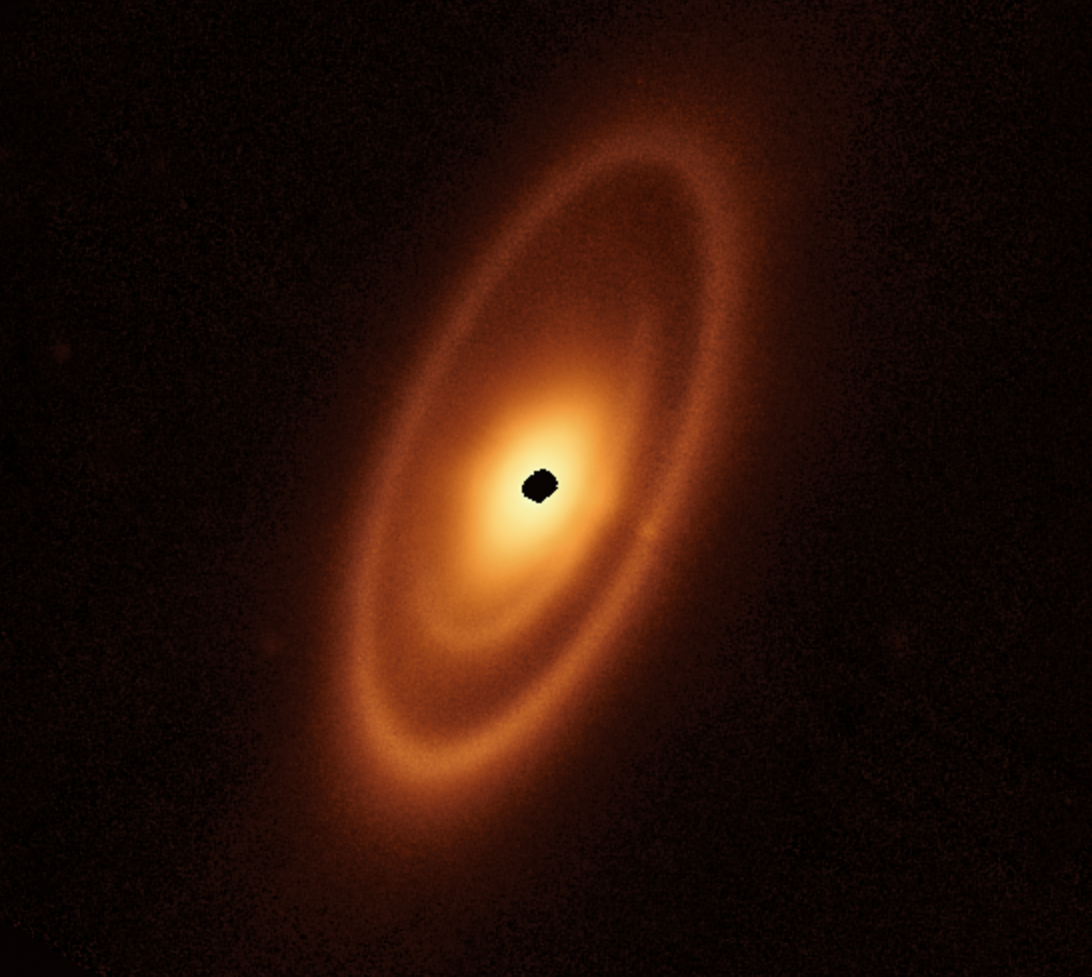
Fomalhaut
The Loneliest Star — a brilliant white sun 25 light-years away, ringed by nested debris belts and at the centre of one of astronomy's most dramatic planet controversies.
Fomalhaut
Fomalhaut (α Piscis Austrini) is a brilliant white, A-type main-sequence star located approximately 25 light-years from Earth in the southern constellation Piscis Austrinus. With an apparent visual magnitude of about 1.16, it ranks as the 18th brightest star in the night sky and the brightest in its constellation. Shining roughly 15 to 17 times more luminously than the Sun and burning at a surface temperature near 8,500 K, Fomalhaut is significantly hotter, more massive, and more radiant than our own star, yet at only around 440 million years old it is also considerably younger.
What elevates Fomalhaut from a merely prominent nearby star to one of the most intensively studied objects in modern astrophysics is the extraordinary debris-disk system encircling it. A narrow, eccentric ring of dust and planetesimals — a Kuiper Belt analogue lying roughly 140 AU from the star — was the first debris disk ever resolved in optical light, and it has since been found to be just the outermost component of a nested, multi-belt architecture shaped by unseen planets. JWST images from 2023 revealed two additional inner dust belts, a broad inner disk, and a mysterious compact feature dubbed the 'Great Dust Cloud.'
The star is also the setting of one of astronomy's most dramatic controversies. In 2008 the Hubble Space Telescope announced the first direct image of an exoplanet around Fomalhaut. That object, designated Fomalhaut b, was later found to be fading and expanding — and had vanished entirely by 2014 — forcing the conclusion that it was never a planet at all, but a transient dust cloud produced by the catastrophic collision of two icy planetesimals. JWST subsequently confirmed the non-detection at infrared wavelengths where any genuine giant planet would have been unmissable.
Fomalhaut is additionally part of a very wide triple star system, accompanied by the K-dwarf TW Piscis Austrini (Fomalhaut B) about 0.91 light-years away, and the M-dwarf LP 876-10 (Fomalhaut C) roughly 2.5 light-years distant, both confirmed as physically bound companions. Its relative proximity, young age, and rich debris environment make Fomalhaut a benchmark laboratory for studying the formation and evolution of planetary systems.
Physical Characteristics
Fomalhaut A belongs to the A-type stellar class, appearing white to bluish-white in color. Its effective surface temperature of approximately 8,500 K is substantially higher than the Sun's ~5,800 K, and its total luminosity of 15–17 times the Sun's reflects both that higher temperature and a radius of roughly twice the Sun's. Mass estimates cluster between about 1.9 and 2.5 solar masses, placing it in a regime where main-sequence lifetimes are measured in the low billions of years — far shorter than the Sun's — and where the star has not yet exhausted its core hydrogen.
The star's age of approximately 440 to 450 million years is well-established by modern isochrone fitting, though earlier literature cited younger values around 200 million years or even less. At 440–450 Myr, Fomalhaut is younger than the oldest complex animal life on Earth, and its debris disk system reflects a planetary architecture still in a relatively early, dynamically active phase of evolution. Precise parallax measurements place Fomalhaut at 7.607 parsecs (approximately 25 light-years), making it one of the nearest A-type stars and one of the nearest systems known to harbour a prominent circumstellar debris structure.
In terms of sky visibility, Fomalhaut rises conspicuously in autumn skies for observers in the Northern Hemisphere, where it appears as the solitary bright star in a sparse region sometimes called the 'Celestial Sea.' Its isolation against a relatively empty field has earned it the informal nickname 'the Loneliest Star.' From southern latitudes it is a prominent year-round fixture. Its proper motion of approximately 366 milliarcseconds per year is one of the larger values among bright naked-eye stars, consistent with its proximity and reflecting its relative motion through the local stellar neighbourhood.
The Triple Star System
Fomalhaut is not a solitary star. It is now recognised as the primary component of a gravitationally bound triple star system, alongside TW Piscis Austrini (Fomalhaut B) and LP 876-10 (Fomalhaut C). The system is remarkable for the extraordinary separations involved: even though all three stars share consistent proper motions and radial velocities, they lie so far apart that the entire system spans a region of space several light-years across.
Fomalhaut B (TW Piscis Austrini) is a K4–K5 main-sequence orange dwarf lying approximately 0.28 parsecs — roughly 0.91 light-years — from Fomalhaut A in three-dimensional space. It shares Fomalhaut A's space velocity to within 0.1 ± 0.5 km/s, a level of agreement that is essentially impossible to attribute to chance alignment and constitutes strong evidence for a bound orbit. The possibility of a physical connection between the two was first raised as long ago as 1897 by the astronomer T. J. J. See, and spectroscopic work in 1998 and further analysis in 2012 progressively strengthened the case. TW PsA's age — 400 ± 70 million years — is consistent with Fomalhaut A's 450 ± 40 Myr, as expected for coeval companions formed from the same molecular cloud.
Fomalhaut C (LP 876-10) is an M4-class red dwarf located roughly 0.77 parsecs — about 2.5 light-years, or approximately 159,000 AU — from Fomalhaut A. Its status as a genuine physical companion, rather than a chance nearby field star, was only demonstrated in 2013, when Eric Mamajek and colleagues combined precise astrometry and spectroscopy to show that its proper motion and radial velocity match those of the other two stars within measurement uncertainties. All three components lie well within the system's estimated tidal radius of about 1.9 parsecs (6.2 light-years), meaning stellar perturbations from the broader Galactic environment have not yet stripped them apart. Intriguingly, Fomalhaut C appears in the constellation Aquarius, some 6–8 degrees away on the sky from Fomalhaut A, reflecting the system's vast physical extent. Herschel observations from 2013 also revealed that Fomalhaut C hosts its own cold circumstellar debris disk, raising the prospect that comets and other small bodies could potentially be exchanged between the disks of A and C over geological timescales.
The Fomalhaut triple is sometimes cited as one of the widest known gravitationally bound multiple star systems: its outer companions are separated by hundreds of thousands of AU while still remaining bound to the primary. The three components are formally designated Fomalhaut A, B, and C under IAU naming conventions, corresponding respectively to α Piscis Austrini, TW Piscis Austrini, and LP 876-10.
The Debris Disk System
Fomalhaut A is surrounded by a gas-poor debris disk — a structure maintained not by primordial leftover material from the star's formation, but by an ongoing collisional cascade in which planetesimals continually grind themselves into ever-finer dust. No significant carbon or oxygen emission lines diagnostic of a gas-rich protoplanetary disk have been detected; sensitive Herschel/PACS spectroscopy yielded only upper limits inconsistent with substantial gas. Instead, the system behaves like an older, evolved planetary system whose major gas reservoir has long since dispersed, leaving behind the rocky and icy debris of planet-building.
The outermost component of this debris system is a narrow, eccentric ring — the celebrated 'Kuiper Belt analogue' — whose inner edge lies at approximately 136 AU from the star, with a width of roughly 13.5 AU and an outer edge near 150 AU. This places it at roughly twice the distance of the Solar System's Kuiper Belt from its own star. ALMA millimetre-continuum imaging characterises the ring as having a coherent eccentricity of about e ≈ 0.12 and an offset geometric centre — the ring is not centred precisely on Fomalhaut A. This offset and the ring's sharp edges are the hallmarks of gravitational sculpting by one or more interior planets. ALMA also detected the so-called 'apocenter glow' effect: because particles orbit more slowly at the farthest point (apocenter) of an eccentric ring, they accumulate there, producing brighter millimetre emission at apocenter than at pericenter. Fomalhaut's outer ring provided the first clear observational confirmation of this theoretically predicted phenomenon in any debris disk.
Higher-resolution ALMA studies reveal additional complexity. The ring is warped and asymmetric: it appears closer to the star in the south, where it is wider and fainter, and farther from the star in the north, where it is narrower and brighter. The eccentricity also appears to vary with radius — a 'negative eccentricity gradient' in which the ring's inner parts are more eccentric than its outer parts — a signature consistent with ongoing gravitational perturbation by a massive interior planet whose influence weakens with distance. The total dust mass in the outer ring, constrained by ALMA modelling of millimetre-sized grains, is approximately 0.015 Earth masses.
Prior to JWST, the inner regions of the Fomalhaut system showed only indirect evidence — primarily from infrared excess in the star's spectral energy distribution — of additional warmer dust analogous to an asteroid belt. JWST's MIRI instrument changed this picture dramatically. Its 2023 imaging at wavelengths around 23–25.5 micrometres resolved a multi-component inner disk system that had been entirely invisible to previous observatories. An extended 'broad inner disk' close to the star, previously only inferred rather than resolved, was directly imaged and found to be more spatially extended than expected. Between this inner disk and the outer Kuiper-belt ring, MIRI revealed a distinct 'intermediate belt' separated from the inner disk by a clear gap — a structure never seen in any previous observation of this system. The outer ring itself, approximately 240 AU in diameter as measured across its full extent, was also imaged with new precision. The sharpness and emptiness of the gaps between the three belt components strongly imply the presence of one or more unseen planets keeping those regions clear, in close analogy to how giant planets in the Solar System maintain the asteroid belt and Kuiper Belt as distinct, bounded structures.
MIRI also detected a compact, localised brightness enhancement embedded within the outer ring, tentatively dubbed the 'Great Dust Cloud.' Initially interpreted as the aftermath of a giant planetesimal collision within the belt, the feature attracted considerable attention. However, subsequent analysis combining ALMA and Keck ground-based data with the JWST detections concluded that this clump and other compact sources in the field are most likely background objects — distant galaxies coincidentally projected along the line of sight through the ring — rather than transient in-disk features.
Unseen Planets and Dynamical Architecture
No planet in the Fomalhaut system has been directly and unambiguously confirmed as of 2024, yet the circumstantial case for one or more unseen giant planets is compelling. The eccentric, offset outer ring with its coherent eccentricity gradient; the sharp inner and outer edges of the ring that persist over hundreds of millions of years; the warped morphology and north–south brightness asymmetry; the newly discovered inner gap and intermediate belt: all of these features are difficult or impossible to maintain without the sustained gravitational influence of planets. In the Solar System, analogous structures — the sharp outer edge of the Kuiper Belt, the cleared gaps in the asteroid belt — are maintained by Neptune and Jupiter respectively. Current dynamical models for Fomalhaut favour one or more massive planets interior to the outer ring, with a planet massive enough to force and maintain the ring's eccentricity and warp.
JWST NIRCam coronagraphic observations have added a tantalising clue. While searching for planets across the disk system, the NIRCam team identified 10 point sources in and around the rings; nine were matched to background objects in archival Hubble and Keck data. One object, located at the edge of the inner dust ring, has no counterpart in any previous observation. If it is genuinely a member of the Fomalhaut system rather than a background galaxy or brown dwarf, its properties would be broadly compatible with a Jupiter-mass planet. The authors were careful to stress that the current data cannot discriminate between these possibilities, and that follow-up JWST observations in Cycle 2 are required to determine whether this object moves with the star — the definitive test of system membership. As of 2024, it remains a candidate only.
The Fomalhaut b Controversy
For several years, Fomalhaut held a special place in the history of exoplanet science as the host of what was reported to be the first planet directly imaged in visible light around another star. In 2008, the Hubble Space Telescope detected a bright, point-like source — designated Fomalhaut b — just inside the sharp inner edge of the outer debris ring. Early mass estimates placed it below 3 Jupiter masses, and the visual detection appeared to show orbital motion consistent with a planet circling inside the belt's inner edge. The discovery was heralded as a landmark: a planet imaged not at infrared wavelengths, as all prior candidates had been, but in reflected visible light.
Doubts emerged quickly. A genuine giant planet of a few Jupiter masses, warm from its recent formation, should have been readily detectable at infrared wavelengths; Fomalhaut b was not. Re-analysis of the full archive of HST observations over multiple epochs told a damning story: instead of maintaining the fixed brightness expected of a planet, the source was fading over time — and in HST images taken in 2014, it had completely disappeared. A University of Arizona team concluded that the behaviour was entirely consistent with an expanding cloud of fine (~1 μm) dust produced by the catastrophic collision of two icy planetesimals in the outer ring shortly before the first HST detection in 2004. Such a cloud would scatter light efficiently at optical wavelengths — which is why HST saw it — while being almost invisible at infrared wavelengths and would gradually disperse below detectability as it expanded. Modelling suggested that collisions of this magnitude in Fomalhaut's ring might occur only roughly once every 200,000 years, making the timing of the original detection an unusually fortunate observation of an intrinsically rare event.
JWST delivered the final verdict. NIRCam coronagraphic imaging searched for any object at the former position of Fomalhaut b at near-infrared wavelengths — precisely the wavelength range where a surviving Jupiter-mass planet would appear brightly — and found nothing. The team explicitly described this non-detection as putting 'the nail in the coffin' for the planetary interpretation. The non-detection is fully consistent with the dust cloud hypothesis, which predicts no persistent source at those wavelengths. NASA's own page for the original Fomalhaut b announcement carries an editor's note explicitly stating that later Hubble observations indicate the object was 'an immense, transient cloud of dust and ice from a collision,' not a planet. The Fomalhaut b episode stands as a cautionary tale in exoplanet science about the dangers of interpreting a single detection epoch without multi-wavelength corroboration, and equally as a reminder of how dynamic and collision-prone young debris disk systems can be.
Milestones
- 1897Companion first suggested
Astronomer T. J. J. See proposed that TW Piscis Austrini might be a physical companion to Fomalhaut, based on their proximity and apparent common motion.
- 1983Infrared excess discovered
NASA's IRAS satellite detected an unexpected infrared excess around Fomalhaut, the first hint that the star is surrounded by cool dust — marking the discovery of its debris disk.
- 1998Companion status strengthened
Spectroscopic and kinematic analysis supported TW PsA (Fomalhaut B) as a genuine physical companion rather than a line-of-sight coincidence.
- 2004Outer ring resolved by Hubble
HST's Advanced Camera for Surveys produced the first optical-wavelength image resolving Fomalhaut's outer dust ring — a narrow, eccentric belt at ~140 AU — as a distinct structure, one of the sharpest debris rings ever imaged.
- 2008Fomalhaut b announced
HST reported the first directly imaged exoplanet in visible light, designated Fomalhaut b, seen just inside the inner edge of the outer ring. Early estimates placed its mass below 3 Jupiter masses.
- 2012Age and binarity refined
Mamajek's analysis revised the age of the Fomalhaut system to ~440–450 Myr and further confirmed TW PsA as a gravitationally bound companion with matching kinematics.
- 2013Fomalhaut confirmed as a triple system
Mamajek et al. demonstrated via astrometry and spectroscopy that LP 876-10 (Fomalhaut C) is physically associated, establishing Fomalhaut as a triple star system. Herschel data also revealed that Fomalhaut C hosts its own debris disk.
- 2017ALMA reveals apocenter glow
ALMA millimetre-continuum imaging provided the first detection of 'apocenter glow' in any debris disk, confirming the outer ring's eccentricity of ~0.12 and its geometric offset from the star.
- 2020Fomalhaut b revealed as dust cloud
Re-analysis of archival HST data showed that Fomalhaut b had been fading since detection and disappeared in 2014 images, consistent with an expanding dust cloud from a planetesimal collision rather than a genuine planet.
- 2023JWST/MIRI reveals nested belt system
JWST's MIRI instrument imaged Fomalhaut's disk in mid-infrared, resolving three nested belts — outer ring, intermediate belt, and broad inner disk — separated by clear gaps, together with the compact 'Great Dust Cloud' feature in the outer ring.
- 2023–2024JWST/NIRCam rules out Fomalhaut b as planet
NIRCam coronagraphic observations found no object at the former position of Fomalhaut b at infrared wavelengths where a giant planet would be bright, definitively confirming the dust cloud interpretation. The same study identified one new point source near the inner belt as a candidate planet requiring follow-up.
Key Discoveries
The Hubble Space Telescope's 2004 images of Fomalhaut's outer ring were the first to resolve a circumstellar debris disk in visible scattered light, setting the template for all subsequent optical debris-disk imaging.
ALMA millimetre-continuum observations of the outer ring provided the first observational confirmation of 'apocenter glow' — the brightness enhancement at the farthest point of an eccentric ring predicted by celestial mechanics — in any known debris disk.
The Fomalhaut b controversy produced a fundamental lesson for exoplanet science: an object detected in a single wavelength band and a limited number of epochs can mimic a planetary signature. Its disappearance and JWST's non-detection demonstrated that the object was a transient cloud from a rare planetesimal collision.
JWST's MIRI imaging transformed Fomalhaut from a single-ring system into a three-belt, two-gap architecture analogous in structure to the combined asteroid-belt and Kuiper-belt zones of the Solar System, strongly implying multiple embedded planets.
The confirmation of LP 876-10 as Fomalhaut C revealed that the Fomalhaut system spans roughly 2.5 light-years while remaining gravitationally bound — one of the widest triple stellar systems known. Fomalhaut C also hosts its own debris disk, making this a multi-star, multi-disk system.
High-resolution ALMA modelling found that the outer ring's eccentricity decreases with distance from the star — a 'negative eccentricity gradient' — matching predictions for a ring shaped by the gravity of a massive interior planet whose influence weakens outward.
Frequently Asked Questions
Sources
- Fomalhaut is the Loneliest Star — EarthSky
- Meet Fomalhaut, the Autumn Star — Sky & Telescope
- Fomalhaut and Piscis Austrinus — ESA/Hubble
- Fomalhaut | Location, Astrology & Facts — Britannica
- Fomalhaut Overview — NASA Exoplanet Archive
- On the Age and Binarity of Fomalhaut — arXiv
- Neighboring Star's Warped Ring Could Be Shaped by Hidden Planet — CfA Harvard
- Neighboring Star's Warped Ring Shaped by Evolving Planets — ALMA Observatory
- Planets or Giant Collisions in the Fomalhaut Debris Disk System — STScI (JWST Phase 2)
- ALMA imaging of the M-dwarf Fomalhaut C's debris disc — MNRAS
- ALMA and Keck analysis of Fomalhaut field sources — MNRAS
- Astronomers Discover Planet that Never Was — University of Arizona
- Hubble Directly Observes Planet Orbiting Fomalhaut — NASA Science
- JWST Searches for Planets in the Fomalhaut System — Universe Today
- The James Webb Space Telescope Reveals Fomalhaut's Disk in Unprecedented Detail — Sky & Telescope
- Webb inspects dusty debris disc around Fomalhaut (annotated) — ESA Webb
- JWST Spies a Debris Disk (Fomalhaut C) — AAS Nova
- Fomalhaut C = LP 876-10 — Mamajek Research Page, University of Rochester
- Researchers Find Fomalhaut Is Actually a Triple Star System — RECONS/Georgia State
- A New Glow in the Eye of Sauron — Astrobites