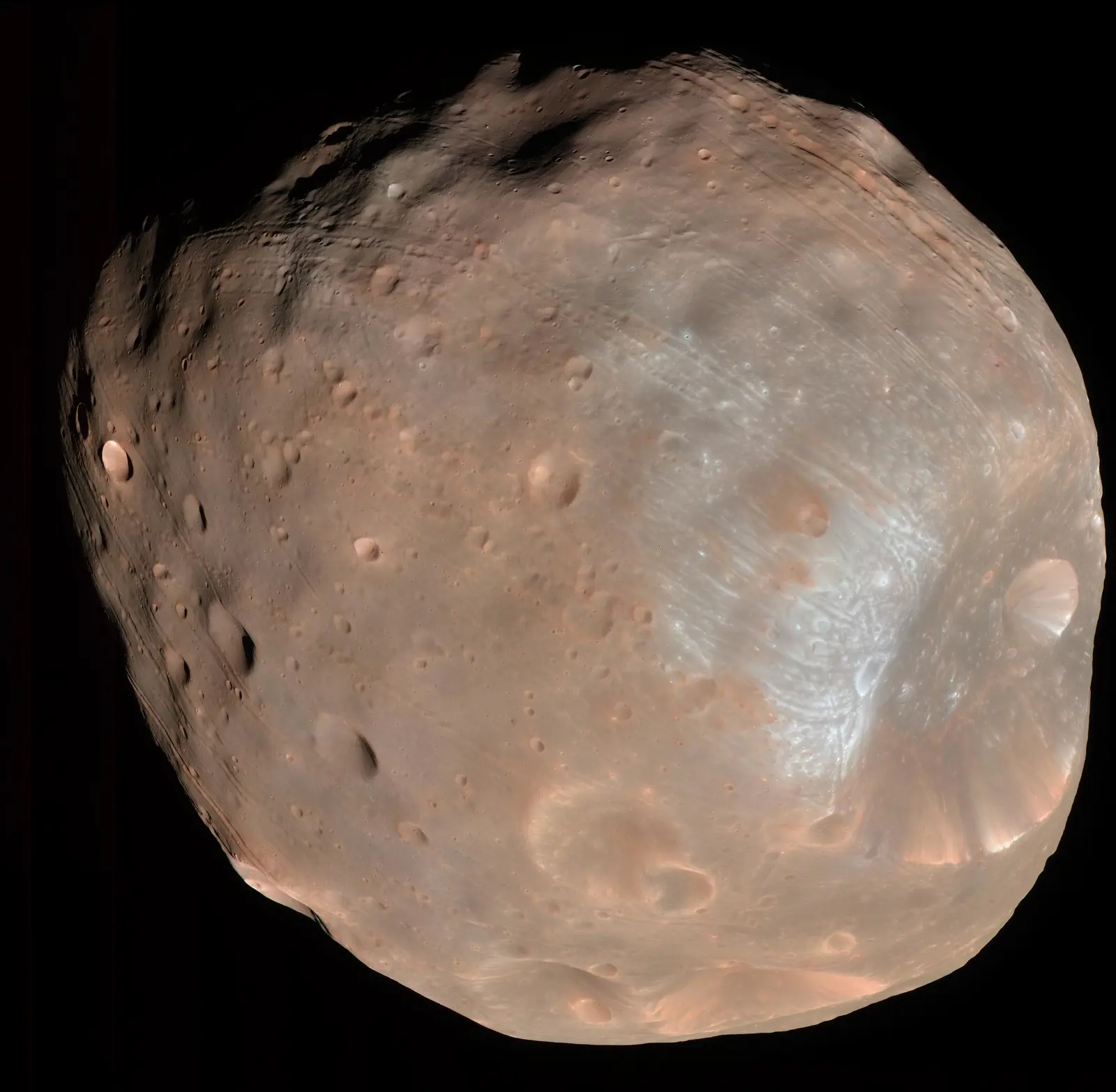
Phobos
Phobos is the larger and innermost of the two moons of Mars, orbiting the planet at an average altitude of just 5,989 km above its surface — the closest orbital distance of any known moon to its parent planet in the Solar System. Irregular and heavily cratered, it measures roughly 27 × 22 × 18 km, far too small for its own gravity to pull it into a sphere. Its dark, carbon-rich surface, porous interior, and unusually fast orbit make it one of the most scientifically compelling objects in the inner Solar System.
Phobos completes an orbit of Mars in just 7 hours and 39 minutes — less than a third of a Martian day. Because it moves so quickly, a surface observer on Mars would see it rise in the west and set in the east, crossing the sky roughly twice per sol. This behaviour, a direct consequence of orbiting inside Mars's synchronous orbit radius, also drives a steady tidal interaction that is slowly pulling Phobos inward at about 1.8 metres per century. In tens of millions of years, the moon will either disintegrate into a temporary ring or scatter its fragments across the Martian surface.
The moon was discovered on 17–18 August 1877 by American astronomer Asaph Hall and named, along with the smaller Deimos, after the sons of the Greek war god Ares. Its largest surface feature — the crater Stickney, spanning some 9–10 km — carries the maiden name of Hall's wife, who encouraged him to continue searching on the night of the discovery. Today, Phobos is studied by a fleet of Mars-orbiting spacecraft and is the primary target of JAXA's forthcoming Martian Moons eXploration (MMX) sample-return mission.
Discovery and naming
Phobos was discovered by American astronomer Asaph Hall on the night of 17–18 August 1877 at the U.S. Naval Observatory in Washington, D.C. Hall was working with the observatory's 26-inch Clark refractor, then the largest refracting telescope in the world, taking advantage of the close opposition of Mars that year to search for any undiscovered satellites. He had already detected the smaller moon Deimos a few nights earlier, but had temporarily suspended his search, doubting his results. His wife, Angeline Stickney Hall, urged him to persevere; he resumed observations and confirmed Phobos on the following night. Hall later credited her encouragement as decisive to the discovery.
Hall named the two moons after the twin sons of Ares, the Greek counterpart of the Roman war god Mars. Phobos means "fear" and Deimos means "terror" — fitting companions for the god of war. The largest impact crater on Phobos was subsequently named Stickney in honour of Chloe Angeline Stickney Hall, acknowledging the role she played in the night that changed planetary astronomy.
Prior to Hall's discovery, the existence of Martian moons had been a topic of lively speculation. Jonathan Swift's 1726 novel Gulliver's Travels famously described two Martian moons with orbital periods of 10 and 21.5 hours — a remarkable coincidence given that Phobos orbits in 7 h 39 min and Deimos in about 30 hours, though the resemblance is generally attributed to chance rather than prescience.
Physical characteristics
Phobos is an irregular, "potato-shaped" body with principal dimensions of approximately 27 × 22 × 18 km. Its mean radius is about 11 km. It is far too small and insufficiently massive — at 1.06 × 10¹⁶ kg — for self-gravity to overcome the material strength of rock and draw it into a sphere. The surface is dark and heavily cratered, with a reflectance and composition broadly resembling carbonaceous (C-type) asteroid material: dark, carbon-rich, and primitive in character.
The bulk density of Phobos, measured by tracking the orbits of successive spacecraft with high precision, is approximately 1.88–1.90 g/cm³. This is significantly lower than solid rock, which typically ranges from 2.7–3.3 g/cm³, and implies that the interior contains substantial void space. Depending on the assumed grain composition, internal macroporosity is estimated at roughly 25–35%, meaning up to a third of Phobos's volume is empty. This is consistent with a rubble-pile or highly fractured interior — an aggregate of loosely bound blocks and dust rather than a solid monolith.
The surface is blanketed by a fine regolith of dust and broken rock. Infrared thermal measurements, first made by Mariner and Viking instruments, showed that the surface cools and heats very rapidly, a property of fine, loose material with low thermal inertia. This produces extreme day–night temperature swings: the sunlit surface can reach approximately −4 °C (25 °F), while the night side plunges to around −112 °C (−170 °F). The regolith layer may extend to depths of roughly 100 metres in places and has very low cohesion — far less cohesive than lunar regolith.
Spectral observations from spacecraft including Mars Express reveal a compositionally heterogeneous surface. Two broad terrain types have been identified: "blue" units dominated by phyllosilicates (hydrated clay minerals) and "red" units interpreted as relatively feldspar-rich material. The interior of Stickney crater exposes at least three distinct spectral units, suggesting complex layering or mixing in the upper tens to hundreds of metres. Early analyses compared Phobos to type 1 and 2 carbonaceous chondrites, but more recent spacecraft data show that its spectrum does not match any standard chondrite class well, and in several infrared bands the composition more closely resembles Martian surface materials than typical asteroid types.
Phobos has no detectable atmosphere. Because it is tidally locked to Mars — rotating once per orbit, just as Earth's Moon always presents the same face to Earth — its leading and trailing hemispheres experience very different cratering histories and surface processing.
Stickney crater and surface grooves
The dominant topographic feature on Phobos is Stickney, an impact crater approximately 9–10 km in diameter — large enough to occupy a substantial fraction of an entire hemisphere of the moon. The energy required to excavate Stickney must have come close to shattering Phobos entirely, and the impact is thought to have been one of the most violent events in the moon's history. The crater's interior exposes compositionally distinct layers, offering a window into Phobos's subsurface structure.
Across almost the entire surface of Phobos — absent only in one region roughly antipodal to Stickney — runs a network of hundreds of linear grooves. These features are typically 80–200 metres wide, up to 30 metres deep, and can extend for up to about 20 km. They occur in families of nearly parallel members, giving the moon a globally coherent banded texture visible in spacecraft images. High-resolution imaging by Viking showed the grooves have smooth cross-sections, lack large boulders along their floors, and can approach depths near 100 metres in places — all properties consistent with formation in loose, low-cohesion regolith.
The origin of the grooves has been debated for decades. The classical interpretation linked them to deep radial fractures caused by the Stickney impact, which then drained loose regolith downward, producing the trench-like forms. More recent work, notably a 2016 study led by Arizona State University researchers, argues that the majority of the grooves are instead produced by boulders and debris ejected from Stickney and other craters. In this model, ejecta blocks roll and bounce across the surface, carving long parallel tracks, and chains of small secondary craters form where streams of impact debris re-impact the surface. The alignment of many groove families with trajectories expected for Stickney ejecta supports this interpretation.
A separate subset of grooves may owe their origin to tidal stress exerted by Mars. A 2015 NASA-led study found that several groove families are oriented in a way consistent with tidal stress fractures, and lead author Terry Hurford described the grooves as early indications that Phobos has "already started to fail" under tidal deformation. Current consensus holds that the groove population is probably the product of multiple overlapping processes — Stickney-related fracturing and regolith drainage, rolling ejecta boulders and secondary crater chains, and tidal stress — rather than any single mechanism.
Orbit and tidal dynamics
Phobos orbits Mars at a mean distance of 9,375 km from the planet's centre, which corresponds to just 5,989 km above the Martian surface. This is not only the closest of any known moon to its primary in the Solar System, but also well inside the synchronous orbit radius of Mars — the distance at which an orbiting body would complete one orbit in the same time Mars takes to rotate. Phobos circles the planet in only 7 hours and 39 minutes, roughly one-third of a Martian day (sol). Its orbit is nearly circular, with an eccentricity of just 0.015, and nearly equatorial, inclined only 1.1° to the Martian equator.
Because Phobos orbits faster than Mars rotates, tidal interactions between the planet and the moon act as a brake on the moon's orbit rather than pushing it outward (as Earth's tides push the Moon away from Earth). The result is a slow but relentless inward spiral. Current measurements place the rate of orbital decay at approximately 1.8 metres per century — about 1.8 cm per year. While imperceptible on human timescales, this has profound long-term consequences.
Models of Phobos's interior structure, combined with calculations of tidal forces as the orbit shrinks, suggest that Phobos will reach its Roche limit — the distance at which tidal forces exceed the self-gravity holding a body together — at roughly 2.1 Mars radii from the planet's centre. At that point, expected in approximately 30–50 million years (with many analyses converging on around 40–43 million years), tidal forces are predicted to tear the moon apart. Whether the outcome is a diffuse ring of debris lasting 1–100 million years or coherent fragments that fall to the Martian surface depends on the mechanical properties of the interior. Because Phobos appears to be a rubble pile with a weaker interior covered by a somewhat stronger outer layer, gradual tidal breakup into a temporary ring is considered somewhat more likely than a clean, intact impact.
The fast, low orbit of Phobos produces a striking observational consequence for any hypothetical observer standing on Mars. Unlike Earth's Moon, which rises in the east and sets in the west, Phobos rises in the west and sets in the east — the opposite direction from the Sun and stars. It completes approximately two apparent crossings of the Martian sky per sol, and during each crossing, its disc is visibly smaller than Earth's full Moon appears from Earth. Phobos is also large enough that, from the equatorial regions of Mars, it subtends an angular diameter roughly one-third that of Earth's Moon.
Origin: captured asteroid or child of Mars?
The origin of Phobos has been debated since shortly after its discovery and remains unresolved. Two main hypotheses dominate current discussion: that Phobos is a captured asteroid, and that it formed from debris thrown into Martian orbit by a giant impact on Mars, which subsequently reaccreted — analogously to the prevailing model for the formation of Earth's Moon.
The captured-asteroid hypothesis draws support from Phobos's dark, carbon-rich surface and its spectral resemblance to primitive, volatile-rich asteroids. If Phobos were a captured body, it would likely be compositionally similar to the carbonaceous asteroids of the outer main belt, which share these general properties. Early spectral comparisons to type 1 and 2 carbonaceous chondrites were consistent with this picture.
However, several lines of evidence argue against a simple captured origin. First, Phobos's orbit is nearly circular and nearly equatorial — properties that are difficult to produce through gravitational capture, which typically yields eccentric and inclined orbits. Second, the bulk density of approximately 1.88–1.90 g/cm³ and estimated macroporosity of 25–35% are difficult to reconcile with a compact asteroidal body. Third, modern spacecraft spectroscopy shows that Phobos's surface composition does not match any known chondrite class well, and in several infrared bands resembles Martian crustal material more closely than typical asteroid spectra. These observations are more naturally explained if Phobos formed from material originally derived from Mars itself, ejected by a large impact and reaccreted in orbit.
The giant-impact reaccretion hypothesis — sometimes called the "co-formation" or "impact debris" model — accounts for the near-circular, near-equatorial orbit as a natural product of assembly from a debris disk in the Martian equatorial plane. It can also accommodate the high porosity, as a loosely packed rubble pile reaccreted from ejecta would be expected to have large void fractions. The question is not fully settled, however, and active research continues. The JAXA MMX mission is specifically designed to address this question by returning a sample of Phobos material to Earth for isotopic and geochemical analysis, which should distinguish between a Martian-derived and an asteroidal composition.
Phobos through the ages
- 17–18 Aug 1877Discovery by Asaph Hall
Hall discovers Phobos at the U.S. Naval Observatory using the 26-inch Clark refractor, days after finding Deimos. He names it after the Greek personification of fear, son of Ares.
- 1977Viking 1 Orbiter close imaging
NASA's Viking 1 Orbiter becomes the first spacecraft to image Phobos in detail, revealing its heavily cratered surface, Stickney crater, and the network of linear grooves.
- 1997–2006Mars Global Surveyor observations
Mars Global Surveyor obtains high-resolution images of Phobos, refines understanding of its shape and cratering, and provides thermal data used to characterise the depth and properties of the surface regolith.
- 2004–presentESA Mars Express extended study
Mars Express conducts repeated close flybys of Phobos, producing the most precise measurements to date of its mass, volume, and bulk density (≈1.88 g/cm³), confirming a porous interior. In 2009 it captures the first combined images of Phobos and Deimos together.
- 2015NASA tidal stress study published
A NASA-led study interprets many of Phobos's surface grooves as early tidal stress fractures, with lead author Terry Hurford concluding that Phobos has "already started to fail" under Mars's gravitational pull.
- 2016Arizona State University impact-ejecta study
Researchers publish evidence that the majority of Phobos's grooves are produced not by tidal fractures but by boulders and debris ejected from Stickney and other craters, rolling and bouncing across the surface.
- FY2026 (planned)JAXA MMX launch
Japan's Martian Moons eXploration spacecraft is scheduled to launch aboard an H3 rocket from Tanegashima Space Center, with Mars arrival in 2027, surface operations and sample collection at Phobos through 2030, and sample return to Earth in FY2031.
The MMX mission: humanity's next step
The most ambitious dedicated mission to Phobos is the Martian Moons eXploration (MMX) spacecraft, developed by the Japan Aerospace Exploration Agency (JAXA). MMX is designed to address the fundamental open question of Phobos's origin by returning a sample from the moon's surface to Earth for laboratory analysis. Isotopic and geochemical measurements of a returned sample are expected to definitively distinguish between a Martian-derived composition and an asteroidal one — a question that remote spectral observations from orbit have not been able to resolve.
According to JAXA's current mission timeline, MMX is scheduled for launch in Japanese fiscal year 2026 aboard an H3 rocket from the Tanegashima Space Center. The spacecraft is expected to arrive in the Martian system in 2027 and will spend approximately 2027–2030 conducting observations of both Phobos and Deimos. During its time at Phobos, MMX will deploy the IDEFIX rover — a small surface rover contributed by European partners — to traverse the surface and characterise surface conditions at ground level. The main spacecraft will collect samples and then depart for Earth, with capsule recovery in Australia targeted for fiscal year 2031.
Earlier planning had targeted a September 2024 launch, but the schedule was revised, and the FY2026 launch date reflects JAXA's current mission page. The scientific payload includes instruments to study surface composition, internal structure, and the broader Martian dust and plasma environment. MMX would represent the first sample return from a Martian moon and only the third sample return from a small solar system body following JAXA's own Hayabusa and Hayabusa2 missions.
What we have learned about Phobos
Orbiting just 5,989 km above Mars's surface, Phobos holds the record for the smallest moon-to-planet distance of any known natural satellite, a consequence of its formation or capture in a very low orbit around a relatively small planet.
Spacecraft gravity measurements give a bulk density of ~1.88–1.90 g/cm³ and imply 25–35% internal void space, confirming Phobos is a loosely bound aggregate rather than a cohesive rocky body — making it structurally vulnerable to tidal disruption.
Modern infrared spectroscopy shows Phobos's surface matches neither standard carbonaceous chondrites nor any other meteorite group well. Several spectral features resemble Martian crustal material more closely than typical asteroid spectra, lending support to an impact-reaccretion origin.
The hundreds of linear grooves criss-crossing Phobos's surface appear to result from multiple processes: boulders and ejecta rolling from the giant Stickney impact, chains of secondary craters from debris re-impacts, and early tidal stress fractures as the orbit tightens — a surface visibly shaped by its doom.
Phobos is losing 1.8 metres of orbital altitude per century. Within 30–50 million years, tidal forces will tear it apart at the Roche limit (approximately 2.1 Mars radii), likely producing a temporary debris ring around Mars before the material falls to the surface.
The 9–10 km Stickney crater, named for the astronomer's wife whose encouragement led to Phobos's discovery, is large enough that the impact that formed it came close to shattering the entire moon. It exposes compositionally distinct subsurface layers and anchors the global groove pattern.
Phobos FAQ
Sources
- Martian moons: Phobos — ESA Mars Express
- Phobos — NASA Science
- Mars Moons — NASA Science
- Phobos (Moon) Facts — Space Facts
- Aug. 17, 1877: Asaph Hall discovers Phobos — Astronomy Magazine
- Asaph Hall — Wikipedia
- Phobos (moon) — Wikipedia
- Phobos: Facts About the Doomed Martian Moon — Space.com
- Martian Moons eXploration — JAXA
- MMX — NASA Science
- Phobos sample return mission enters development for 2024 launch — Spaceflight Now
- Surface features of Phobos and Deimos — ScienceDirect
- A Moon Falling Apart: Grooves on Phobos — AmericaSpace
- Mysterious grooves on Martian moon Phobos explained by impacts — ASU News
- Phobos Grooves from Rolling Boulders — Planetary Geomorphology