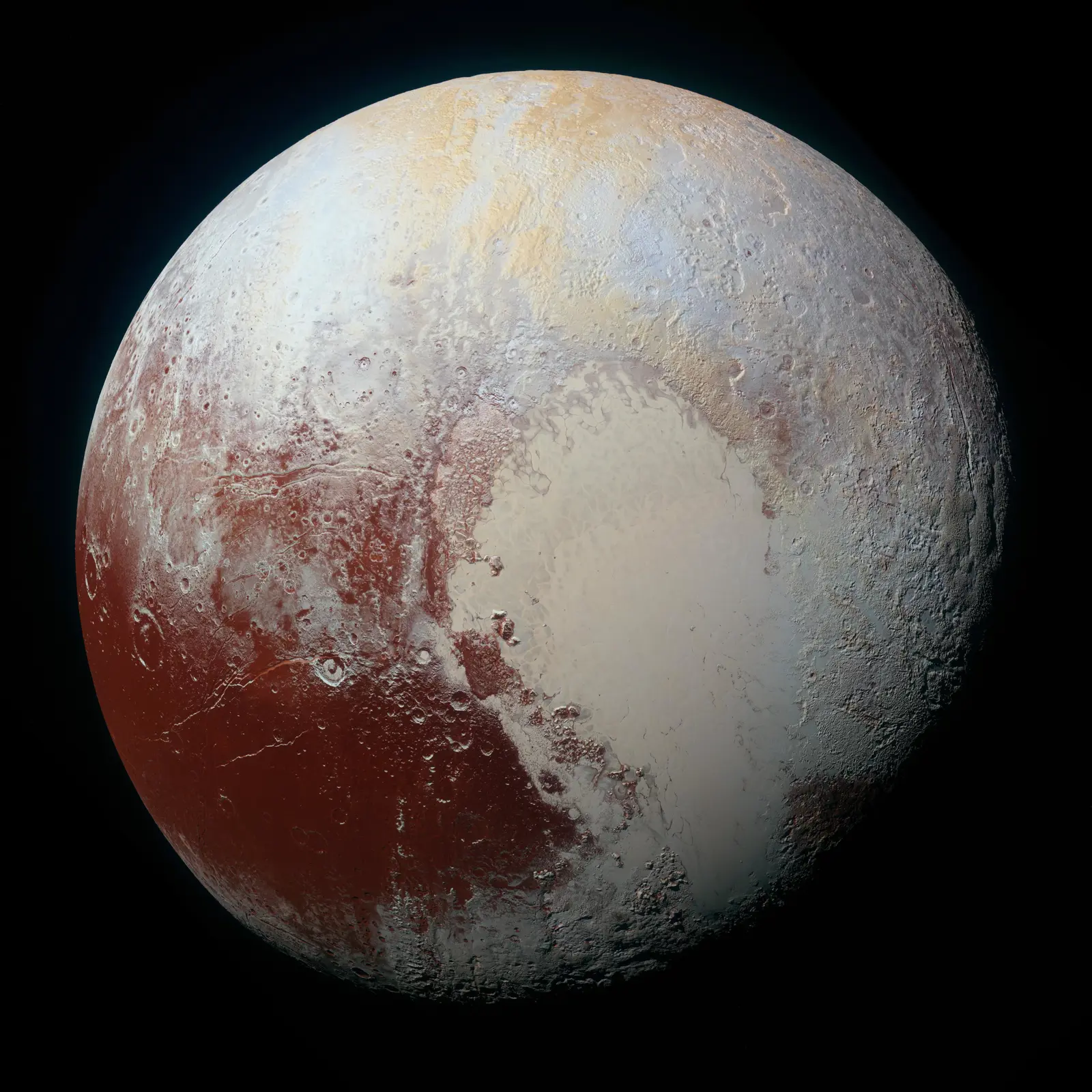
Pluto
The largest known Kuiper Belt object — a geologically active dwarf planet with towering ice mountains, a nitrogen-ice heart, a possible subsurface ocean, and five moons.
Pluto
Pluto is a dwarf planet located in the Kuiper Belt, the vast ring of icy bodies beyond Neptune. With a diameter of approximately 2,377 km, it is the largest known object in the Kuiper Belt. At an average distance of 39.48 AU (about 5.9 billion kilometres) from the Sun, Pluto follows a highly elliptical, 248-year orbit tilted significantly to the ecliptic plane. Sunlight takes roughly 5.5 hours to travel from the Sun to Pluto at its average distance.
Discovered in 1930 by American astronomer Clyde Tombaugh at Lowell Observatory, Pluto was considered the ninth planet of the Solar System for more than seven decades. In 2006, the International Astronomical Union (IAU) formally reclassified it as a "dwarf planet" — a new category for bodies that orbit the Sun and have achieved a nearly round shape through self-gravity, but have not cleared other bodies from their orbital neighbourhood. Pluto shares its orbital zone with other Kuiper Belt objects, a fact that ultimately drove its reclassification.
Despite its small size, Pluto proved to be a world of remarkable complexity when NASA's New Horizons spacecraft conducted a close flyby on 14 July 2015 — the first and, to date, only spacecraft visit to Pluto. The encounter revealed towering water-ice mountains, an enormous nitrogen-ice plain showing active geological processes, a layered atmospheric haze, evidence consistent with a subsurface liquid ocean, and a chaotic family of five moons. These findings fundamentally revised scientific understanding of small, distant icy bodies in the outer Solar System.
Discovery, exploration, and reclassification
- 1906Clyde Tombaugh born
Clyde William Tombaugh is born on 4 February near Streator, Illinois. He would become the astronomer credited with discovering Pluto.
- 1929Search for Planet X begins
Tombaugh is hired at Lowell Observatory in Flagstaff, Arizona to lead a photographic search for a hypothetical trans-Neptunian planet — 'Planet X' — proposed by Percival Lowell. He uses a 13-inch astrograph to photograph star fields on successive nights.
- January 1930Discovery plates taken
Tombaugh photographs the critical sky fields in January 1930, capturing a faint, slowly moving point of light on plates taken six days apart.
- 18 February 1930Pluto identified
Tombaugh detects the moving object by blinking the two plates in a blink comparator and noticing its shift against the fixed star background. This date is recorded as the official discovery date.
- 13 March 1930Discovery announced
Lowell Observatory announces the discovery of a new planet to the world.
- 1 May 1930Named 'Pluto'
The name 'Pluto' — suggested by 11-year-old Venetia Burney of Oxford, England, after the Roman god of the underworld — is officially adopted following approval by the American and Royal Astronomical Societies.
- 22 June 1978Charon discovered
Astronomer James W. Christy discovers Charon, Pluto's large moon, revealing that Pluto is part of a close binary system.
- 1990sKuiper Belt objects discovered
Astronomers begin finding many icy bodies beyond Neptune with sizes comparable to Pluto, raising questions about its status as a unique ninth planet.
- 2005Nix and Hydra discovered
The Pluto Companion Search Team discovers two additional small moons — Nix and Hydra — using the Hubble Space Telescope.
- 19 January 2006New Horizons launched
NASA's New Horizons spacecraft launches from Cape Canaveral, beginning a nine-year journey to Pluto.
- 24 August 2006IAU reclassification
The International Astronomical Union votes to adopt a formal definition of 'planet' and creates the category 'dwarf planet.' Pluto is reclassified as a dwarf planet because it has not cleared other bodies from its orbital neighbourhood, reducing the Solar System's official planet count to eight.
- 2011–2012Kerberos and Styx discovered
Mark R. Showalter and colleagues discover Kerberos (2011) and Styx (2012) using Hubble, bringing Pluto's known moon count to five.
- 14 July 2015New Horizons flyby
New Horizons makes its closest approach at 11:49 UTC, passing about 12,500 km above Pluto's surface at a distance of ~34 AU from the Sun. It is the first spacecraft to visit Pluto, returning the first high-resolution images and data of Pluto and its moons.
- 25 October 2016Full data downlink complete
New Horizons finishes transmitting its full ~6.25 GB Pluto–Charon encounter dataset to Earth, allowing scientists to complete their initial analysis of all flyby data.
- 2019–2024Continued Kuiper Belt exploration and Pluto science
New Horizons flies past Kuiper Belt object Arrokoth (2014 MU69) in January 2019. Through the 2020s, scientists continue to reanalyse New Horizons Pluto data, refining models of Pluto's subsurface ocean, volatile cycles, and atmospheric evolution.
Physical characteristics
Pluto is a small, dense world composed primarily of rock and water ice. Its diameter of 2,376.6 km makes it somewhat larger than earlier estimates suggested — a fact confirmed by New Horizons, which also determined a bulk density of about 1,879 kg/m³. This density implies Pluto is somewhat more icy and less rocky than some pre-flyby models predicted. Pluto's surface area of roughly 1.77 × 10⁷ km² is approximately 3.5% of Earth's — slightly larger than the area of Russia.
Its internal structure consists of a rocky core surrounded by a mantle of water ice. Above the water-ice mantle, the surface is coated with layers of volatile ices: nitrogen (N₂), methane (CH₄), and carbon monoxide (CO). The nitrogen ice in the brightest regions, particularly Sputnik Planitia, exceeds 98% purity. Surface temperatures average around −232 °C, with a range of approximately −228 to −238 °C.
Pluto rotates slowly, completing a day in about 153 hours (roughly 6.4 Earth days). Its rotational axis is tilted approximately 57° relative to its orbital plane, meaning Pluto spins nearly on its side — a tilt more extreme than even Uranus. This axial tilt, combined with its eccentric orbit, produces extreme seasonal variations over its 248-year year. As Pluto approaches perihelion (its closest point to the Sun, at 29.66 AU), its thin atmosphere expands as volatile ices sublimate; as it recedes toward aphelion (49.31 AU), the atmosphere cools and condenses back onto the surface in a cycle sometimes compared to a comet's behaviour.
The atmosphere, dominated by nitrogen with minor quantities of methane and carbon monoxide, exerts a surface pressure of only about 1 Pascal — roughly 1/100,000 of Earth's sea-level pressure as measured in 2015. New Horizons revealed multiple distinct layers of atmospheric haze, composed of photochemically produced aerosols (tholins) derived from methane and nitrogen. These tholins contribute both to the blue atmospheric haze seen in backlit images and to the reddish coloration of many surface regions.
Tombaugh Regio and Sputnik Planitia
The most prominent feature on Pluto's surface is Tombaugh Regio, a vast, bright, heart-shaped province spanning much of one hemisphere just north of the equator. Named after Pluto's discoverer, it is divided into two geologically distinct lobes. The western lobe is Sputnik Planitia, a nitrogen-ice-filled basin roughly 1,000 to 1,600 km across and approximately 2.5 to 4 km lower than typical Pluto terrain. The eastern lobe is a rougher, more cratered highland mantled by a thinner layer of volatile ices.
Sputnik Planitia is the geological centrepiece of Pluto. Its surface displays hundreds of polygonal cells, typically tens of kilometres wide, separated by shallow troughs. These polygons are the tops of convection cells within the nitrogen-ice layer, where warm ice slowly rises in each cell's centre and cooler ice sinks at the margins — a process of solid-state convection. Models suggest the visible surface could be as young as approximately 180,000 years, and certainly less than 10 million years old, making it among the youngest terrain in the Solar System. The basin covers an area of about 8.7 × 10⁵ km² and is almost entirely devoid of impact craters, confirming its geologically recent age.
Around the margins of Sputnik Planitia, towering water-ice mountains rise several kilometres above the plain. Some peaks reach approximately 3,400 metres in height. Unlike the nitrogen ice of the basin floor, these mountains are composed of water ice — which at Pluto's temperatures behaves as rigid bedrock. Scientists describe them as floating like icebergs in the softer nitrogen-ice substrate. Glaciers of nitrogen ice flow from the eastern highlands into the basin, feeding an active volatile cycle.
The origin of Sputnik Planitia is widely interpreted as a giant impact: a large object, estimated at roughly 700 km in diameter with a modest rock fraction, struck Pluto at a low angle, excavating the deep basin. Volatile ices subsequently accumulated in this topographic depression, which acts as a cold trap. The enormous mass of ice concentrated in the basin created a gravitational anomaly that drove true polar wander — a reorientation of Pluto's entire outer shell — causing Sputnik Planitia to migrate to its current position near the equator, roughly opposite the sub-Charon point. This process appears to have been aided by the presence of a subsurface liquid-water ocean, which allowed mass redistribution within the body.
The eastern lobe of Tombaugh Regio presents a striking contrast. Crater counts indicate it is approximately one billion years old — ancient compared with Sputnik Planitia's near-pristine surface. Water-ice mountains and chaotic blocks of uplifted crust characterise its terrain, and valleys host nitrogen-rich glaciers that drain westward into the basin. The entire Tombaugh Regio region is compositionally dominated by nitrogen, carbon monoxide, and methane ices sitting atop a water-ice crust, and its high reflectivity gives Pluto its distinctive bright "heart" when viewed from afar.
Key discoveries from the Pluto flyby
New Horizons measured Pluto's diameter as 2,370 km — somewhat larger than pre-flyby estimates — confirming it as the largest known body in the Kuiper Belt by diameter. The bulk density of ~1,879 kg/m³ indicated a more icy and slightly less rocky composition than expected.
Sputnik Planitia, the western lobe of the heart-shaped Tombaugh Regio, is a vast nitrogen-ice plain showing solid-state convection, glacial flow, and an almost complete absence of impact craters. Its surface may be as young as 180,000 years. Towering water-ice mountains several kilometres high surround the basin.
The pattern of extensional fractures (but absence of compressional features) across Pluto's crust, combined with the mass anomaly beneath Sputnik Planitia and thermal modelling, is most consistent with Pluto harbouring a subsurface liquid-water ocean beneath its outer ice shell — possibly persisting to the present day.
Analysis of New Horizons imagery linked the reorientation of Pluto's entire outer shell — true polar wander — to the formation of Sputnik Planitia. The massive ice-filled basin migrated toward the equatorial, anti-Charon position as Pluto's body reoriented around its internal mass distribution.
New Horizons observed multiple distinct haze layers in Pluto's cold nitrogen atmosphere. The atmospheric escape rate was far lower than models had predicted, forcing a major revision of understanding of Pluto's atmospheric loss and volatile inventory over time.
New Horizons identified massive methane-ice deposits near Pluto's equator forming sharp, blade-like ridges (penitente-like landforms) comparable in height to multi-storey buildings. Subsequent analysis suggests these may be widespread across the hemisphere New Horizons did not image in detail.
Charon (diameter ~1,212 km) was found to have a vast equatorial belt of chasms and cliffs indicating past global expansion, likely caused by the freezing of a former internal ocean. Its north pole bears a reddish deposit of tholins derived from gases that escaped Pluto's atmosphere and were chemically processed on Charon's cold surface.
Styx, Nix, Kerberos, and Hydra were imaged and characterised for the first time. All four spin rapidly and in non-tidally-locked, chaotic rotation states, influenced by the complex gravitational field of the close Pluto–Charon binary. Their high albedos are consistent with water-ice-rich surfaces.
Pluto's moon system
Pluto has five known moons: Charon, Styx, Nix, Kerberos, and Hydra. All are thought to have originated in a single giant impact early in the Solar System's history, which also created the Pluto–Charon binary. Compositional and dynamical evidence — including the water-ice-rich surfaces of all five moons and their arrangement in a chain of orbital resonances with Charon — supports this common origin.
Charon, discovered in 1978 by astronomer James W. Christy, is by far the largest of the five. With a diameter of approximately 1,212 km — roughly half of Pluto's own diameter — Charon is so large relative to Pluto that the two bodies orbit a common centre of mass (barycenter) that lies outside Pluto's surface, making them effectively a double dwarf-planet system. Pluto and Charon are mutually tidally locked: each permanently faces the same hemisphere toward the other, completing a mutual orbit in about 6.4 Earth days at a mean separation of roughly 19,596 km. Charon bears an extensive equatorial system of chasms and cliffs, testimony to a past internal ocean that froze and caused global expansion. Its north pole is stained with reddish tholins captured from Pluto's escaping atmosphere.
The four smaller moons — Styx, Nix, Kerberos, and Hydra — orbit the Pluto–Charon barycenter in nearly circular, equatorial paths, from Styx closest in to Hydra farthest out. Their orbital periods are approximately 20, 25, 32, and 38 days respectively, and they sit near integer resonances with Charon's period (roughly 3:1, 4:1, 5:1, and 6:1), helping stabilise the system dynamically. Nix and Hydra were discovered in 2005 using the Hubble Space Telescope; Kerberos followed in 2011 and Styx in 2012, both also found with Hubble.
All four small moons spin rapidly and in chaotic, non-synchronous rotation states — they are not tidally locked and their spin axes point in varied directions. Hydra holds the record for the fastest spin among them, completing a rotation in only about 10.3 hours while taking 38 days to complete an orbit — nearly 89 rotations per orbit. Nix's spin axis is tilted approximately 132° relative to Pluto's equatorial plane, meaning it effectively rotates retrograde. These wacky rotation states arise from the chaotic gravitational environment created by the nearby Pluto–Charon binary, which constantly tugs the small moons' spin axes. All four display high albedos consistent with water-ice compositions — notably bright for outer Solar System objects, suggesting relatively fresh surfaces.
Science payload that studied Pluto
- Long Range Reconnaissance Imager
High-resolution panchromatic camera; provided the iconic close-up images of Pluto's surface, including Tombaugh Regio, Sputnik Planitia, and mountain ranges.
- Multispectral Visible Imaging Camera / Linear Etalon Imaging Spectral Array
Combined colour imager and infrared imaging spectrometer; mapped compositional variations of ices (nitrogen, methane, carbon monoxide, water ice) across Pluto and Charon.
- Ultraviolet Imaging Spectrograph
Studied Pluto's upper atmosphere composition and measured atmospheric escape rates; observed solar and stellar occultations by Pluto's atmosphere.
- Radio Science Experiment
Used radio signals from Earth to probe Pluto's atmosphere density and temperature profiles, and contributed to measurements of Pluto's and Charon's radii and bulk properties.
- Linear Etalon Imaging Spectral Array (part of Ralph)
Near-infrared spectrometer that identified the distribution of N₂, CH₄, CO, and H₂O ices on Pluto's and Charon's surfaces.
- Solar Wind Around Pluto
Measured the interaction between Pluto's escaping atmosphere and the solar wind, characterising the rate of atmospheric loss.
- Pluto Energetic Particle Spectrometer Science Investigation
Detected ions escaping from Pluto's atmosphere and measured their composition and flux.
- Student Dust Counter
Measured dust particle impacts throughout the New Horizons journey, including in the Pluto–Kuiper Belt environment.
Interior structure and the subsurface ocean
Pluto's likely internal structure consists of three broad layers: a dense rocky core containing most of the body's mass, an overlying mantle of water ice, and a thin outer shell of volatile ices (primarily nitrogen, with methane and carbon monoxide). This picture emerged from the combination of Pluto's measured bulk density (~1,879 kg/m³) and models of solar system icy body formation.
One of the most significant implications of New Horizons data is that Pluto may still harbour a liquid-water ocean beneath its outer ice shell. Several lines of geological evidence point in this direction. New Horizons found an abundance of extensional fractures — faults, graben, and rifts — but a notable absence of compressional features on Pluto's surface. A fully frozen interior would contract over time and produce compressional tectonics; instead, the pattern observed is more consistent with gradual global expansion, which would occur as an internal liquid ocean slowly freezes and water expands. Thermal models incorporating radiogenic heating from the rocky core, the insulating properties of the ice shell, and possible antifreeze agents such as ammonia or dissolved salts support the persistence of a subsurface liquid layer for much of Pluto's history.
The placement and stability of Sputnik Planitia near the equator further reinforces this hypothesis. Simulations show that if the Sputnik Planitia impact thinned the outer ice shell, the underlying ocean could bulge upward at that location, creating a density anomaly beneath the basin that would drive the true polar wander — the wholesale reorientation of Pluto's shell — observed in the geological record. The basin's current position, roughly facing away from Charon along the tidal axis, is exactly where such a mass anomaly would naturally stabilise.
Possible cryovolcanic features on Pluto — including large constructs such as Wright Mons and Piccard Mons, which have morphologies suggestive of volcanic edifices — indicate that internal heat may have driven ice-volcanic activity relatively recently in Pluto's geological history. Continued analysis of New Horizons data through the early 2020s has refined estimates of the age of these features and strengthened the case for Pluto as a geologically active world.
Atmosphere, volatile cycles, and recent evolution
Pluto's atmosphere is thin, cold, and highly variable. At the time of the New Horizons flyby in 2015, surface pressure was approximately 1 Pascal — comparable to Earth's atmosphere at an altitude of about 80 km above the surface. The atmosphere is dominated by nitrogen gas, with minor components of methane and carbon monoxide. At around 70 K, it is far colder than Earth's atmosphere but exhibits complex structure, including multiple layers of photochemical haze.
The atmosphere is intrinsically tied to the volatile ice cycle driven by Sputnik Planitia. As sunlight warms nitrogen ice on the surface, it sublimes and enters the atmosphere; as the planet moves farther from the Sun and temperatures drop, nitrogen gas condenses and freezes back onto the surface. Sputnik Planitia acts as the primary reservoir and cold trap for nitrogen — the basin's enormous inventory of nitrogen ice controls global atmospheric pressure over timescales ranging from decades to millions of years as Pluto's orbit and obliquity evolve.
Ground-based stellar occultation observations conducted between 2018 and 2022 found evidence that Pluto's atmospheric pressure had decreased significantly compared to the 2015 peak, suggesting the atmosphere may be entering a phase of partial collapse as Pluto moves away from its 1989 perihelion. Debate continues among modellers about the rate and extent of this collapse, but there is broad agreement that Pluto's atmosphere is among the most seasonally variable in the Solar System.
The photochemical processing of methane and nitrogen in Pluto's atmosphere produces complex organic aerosols called tholins, which give much of Pluto's surface its reddish tint and are responsible for the blue atmospheric haze detected by New Horizons. The dark equatorial region known as Cthulhu Macula is particularly rich in these complex organics, forming a striking contrast with the brilliant white and orange of Tombaugh Regio.
Reclassification and scientific legacy
For 76 years after its discovery, Pluto held the status of the Solar System's ninth planet. That status came under sustained pressure from the 1990s onward as astronomers discovered an ever-growing population of Kuiper Belt Objects (KBOs) — icy bodies orbiting beyond Neptune with sizes approaching Pluto's. The critical moment came with the discovery of Eris, a trans-Neptunian object that proved to be more massive than Pluto. Treating Pluto as a unique ninth planet while excluding Eris would have been arbitrary; conversely, accepting Eris as a tenth planet would open the door to dozens of additional planetary candidates.
The International Astronomical Union addressed the issue at its General Assembly on 24 August 2006, adopting a formal three-part definition of 'planet.' Under this definition, a planet must orbit the Sun, have sufficient mass for self-gravity to achieve a nearly round shape (hydrostatic equilibrium), and have cleared the neighbourhood of its orbit of other bodies. Pluto satisfies the first two criteria but shares its orbital zone with other Kuiper Belt objects. It was accordingly placed in the new IAU category of 'dwarf planet,' and the Solar System's official planet count was set at eight.
Clyde Tombaugh, who resisted efforts during his lifetime to question Pluto's planetary status, died in January 1997 — nine years before the IAU decision. His widow Patricia Tombaugh acknowledged that while he would likely have been disappointed, "he was a scientist" and would have understood the need to address the expanding population of Pluto-like objects. Planetary dynamicist Hal Levison offered an enduring reassessment of Tombaugh's legacy: by finding Pluto, Tombaugh in effect discovered the Kuiper Belt — a realisation modern astronomers regard as more significant than the identification of a single ninth planet.
Pluto's scientific legacy extends well beyond the reclassification debate. The New Horizons flyby demonstrated that even a small, distant, icy body far from the Sun can support active geology, a layered atmosphere, a possible liquid ocean, and a complex family of moons. These findings have reshaped models of Kuiper Belt objects, informed the search for ocean worlds beyond the ice giants, and raised new questions about the sources of Earth's own volatiles. Pluto now serves as a prototype for understanding how small icy bodies can remain geologically active over billions of years.
Frequently asked questions about Pluto
Sources
- Pluto: Facts – NASA Science
- Pluto – Wikipedia
- Pluto – NASA Science
- New Horizons – NASA Science
- New Horizons – Wikipedia
- New Horizons Pluto probe notches 3 new discoveries far from Earth – Space.com
- Clyde Tombaugh – Wikipedia
- Clyde Tombaugh – New Mexico Museum of Space History
- March 13, 1930: Clyde Tombaugh's discovery of Pluto announced – APS News
- Why is Pluto no longer a planet? – Library of Congress
- Tombaugh Regio – Wikipedia
- How Pluto got its 'heart' – University of Arizona News
- Splat or subsurface ocean? The mysterious positioning of Pluto's heart – The Planetary Society
- Geological mapping of Sputnik Planitia on Pluto – ScienceDirect
- Pluto's icy, slushy heart – MIT News
- Pluto Moons – NASA Science
- Hubble Reveals Fascinating and Chaotic Properties of Pluto's Moons – AmericaSpace
- 10 cool things we learned about Pluto from New Horizons – Phys.org
- New Horizons – eoPortal
- DPS 2015: Pluto's small moons Styx, Nix, Kerberos, Hydra – The Planetary Society