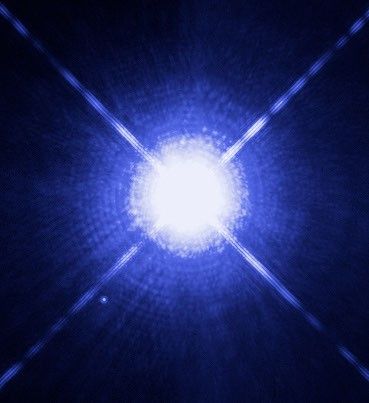
Sirius
The brightest star in the night sky — a dazzling blue-white giant paired with the closest known white dwarf, revered by ancient civilisations for millennia.
Sirius
Sirius is the brightest star in Earth's night sky, with an apparent visual magnitude of −1.46 — nearly twice as bright as its nearest rival, Canopus. Located in the constellation Canis Major (the Greater Dog), it has been called the Dog Star since antiquity. The name Sirius derives from the ancient Greek Seirios, meaning "glowing" or "scorching," a fitting description for the blue-white beacon that blazes above the winter sky in the northern hemisphere.
What appears to the naked eye as a single brilliant star is in fact a binary system: Sirius A, a hot, young main-sequence star roughly twice the mass of the Sun, and Sirius B, a compact white dwarf that was once a more massive star in its own right. The two orbit each other over a period of about 50 years in a markedly eccentric path, their separation varying from roughly 8 AU at closest approach to more than 31 AU at maximum distance — a range spanning from inside the orbit of Saturn to well beyond Neptune.
At a distance of 8.61 light-years (2.64 parsecs), the Sirius system is one of the Sun's nearest stellar neighbours — the fifth-closest stellar system known — and its proximity is a large part of why it dominates the night sky. Its intrinsic luminosity, some 25 times that of the Sun, does the rest. Sirius B holds a special place in the history of science: it was the first white dwarf ever discovered and has since served as a benchmark for testing theories of stellar evolution, stellar masses, and even general relativity.
For thousands of years before telescopes existed, Sirius was one of humanity's most important stars — a calendar anchor, a flood oracle, and a goddess incarnate in ancient Egypt. Its annual reappearance in the dawn sky heralded the flooding of the Nile and marked the Egyptian New Year. Across the ancient world, from Mesopotamia to Greece to India, the Dog Star's seasonal appearances shaped calendars, religious observance, and everyday life.
Sirius A: A Hot, Young Giant
Sirius A is classified as an A0–A1 V star — an early-type main-sequence star burning hydrogen in its core. Its surface temperature of approximately 9,940 K makes it more than 4,000 K hotter than the Sun and gives it the characteristic blue-white colour visible to the naked eye. With a mass of 2.063 ± 0.023 solar masses and a radius of about 1.71 solar radii, Sirius A is considerably larger and more energetic than the Sun, releasing roughly 25 times as much energy. Its absolute visual magnitude is approximately +1.4.
Because more massive stars burn through their hydrogen reserves faster, Sirius A is a relatively young star by cosmic standards. The Sirius system is estimated to be between 200 and 300 million years old — young enough that Sirius A is still on the main sequence, but old enough that its initially more massive companion has already lived and died, leaving behind the white dwarf Sirius B. Models suggest that Sirius A will eventually exhaust its own hydrogen, swell into a giant, and ultimately leave its own white dwarf remnant far in the future.
Despite its brilliance, Sirius A's apparent dominance of the night sky owes as much to proximity as to intrinsic power. At 8.61 light-years, it is simply nearby. Stars with far greater absolute luminosities exist throughout the galaxy but are too distant to rival Sirius on the sky. This combination of modest-by-cosmic-standards luminosity and very short distance places it permanently atop the brightness rankings as seen from Earth.
Sirius B: The First White Dwarf
Sirius B is the faint companion locked in orbit around the bright primary. Although it cannot be seen without a telescope — its apparent magnitude of around 8.4 to 8.6 is lost in the glare of Sirius A under most observing conditions — it is one of the most scientifically significant stars known. Sirius B is a white dwarf of spectral type DA2, with a mass of 1.018 ± 0.011 solar masses compressed into a volume comparable to Earth. Its surface temperature of approximately 25,200 K is even higher than that of Sirius A, yet it appears dim because its tiny size means its total luminosity is very low.
The story of how Sirius B came to be known is one of the great detective stories of 19th-century astronomy. In 1844, German mathematician and astronomer Friedrich Bessel was studying the precise positions of stars accumulated over many decades and noticed that Sirius was not travelling across the sky in a straight line. Instead, it followed a gentle undulating path — the signature of a gravitational tug from an unseen companion. Bessel announced his inference that Sirius must be a binary system, but no companion was visible through any telescope of the era.
The mystery was resolved on 31 January 1862, when American telescope maker and astronomer Alvan Graham Clark was testing a new 18.5-inch refractor — at the time one of the largest in the world — and spotted a faint point of light close to Sirius. The object was Sirius B, the invisible companion Bessel had predicted nearly two decades earlier. When its properties were eventually understood, Sirius B became recognised as the first white dwarf ever discovered and the prototype of an entire class of stellar remnant.
Sirius B has continued to reward science long after its discovery. Because it is the nearest known white dwarf to Earth, its light has been used to measure gravitational redshift — the stretching of light climbing out of a strong gravitational field — providing an important test of general relativity. The precise mass of Sirius B, constrained by the binary orbit to 1.018 ± 0.011 solar masses, also helps calibrate the relationship between a white dwarf's mass and the mass of the progenitor star that produced it, feeding into broader models of stellar evolution for intermediate-mass stars.
The Binary Orbit: An Eccentric Dance
The two stars of the Sirius system orbit their common centre of mass in a highly eccentric ellipse. The most precise orbital solution, derived from a combination of roughly 150 years of ground-based visual measurements and dedicated Hubble Space Telescope imaging campaigns (including five additional WFC3 epochs between 2010 and 2016, published by Bond et al. in 2017), gives an orbital period of 50.1284 ± 0.0043 years and an eccentricity of 0.59142 ± 0.00037. The relative semimajor axis of the orbit is 19.783 ± 0.073 AU, with the orbit inclined 136.336 ± 0.040° to the plane of the sky — meaning it runs retrograde as seen from Earth.
That eccentricity has dramatic consequences for the separation between the two stars. At periastron — closest approach, last reached in mid-1994 — the pair are separated by only about 8.2 AU, roughly the Sun–Saturn distance. At apoastron they pull apart to more than 31 AU. Because of projection effects, the maximum apparent angular separation as seen from Earth (11.333 arcseconds) was reached in 2023, making recent years one of the best epochs for amateur astronomers to attempt to observe Sirius B through a telescope. The pair will slowly draw closer again over the coming decades as they head toward the next periastron.
The same Hubble dataset that refined the orbit also addressed a long-standing question about a possible third body. Since 1894, occasional reports of small residuals in the orbital motion had suggested a "Sirius C" with a proposed period of around six years. The Bond et al. analysis found no evidence for such a body. Using more than 2,300 data points spanning 150 years, the team could rule out any bound companion more massive than roughly 15 to 25 Jupiter masses across a wide range of orbital periods. The Sirius system is, within current observational limits, a simple two-body system.
Sirius in the Ancient World
No star played a more practical or more sacred role in the ancient world than Sirius. Across many cultures its conspicuous brightness and its reliable annual behaviour made it a clock, a calendar, and a manifestation of divine power. The civilisation for which it mattered most was ancient Egypt, where Sirius — known as Sopdet (also rendered Sepdet; Greek: Sothis) — occupied a position at the very heart of religion, timekeeping, and agriculture.
The key event was the heliacal rising of Sirius: its first reappearance in the dawn sky after approximately 70 days of invisibility in the Sun's glare. At Egyptian latitudes, this occurred around 19 July (Julian calendar) during the era of classical Egyptian civilisation, and it coincided with the onset of the annual Nile inundation — the flood that deposited the rich silt on which Egyptian agriculture depended. The Egyptians understood this correspondence and made Sirius's reappearance the anchor of their New Year festival, Wep Renpet ("Opening of the Year"). Priests stationed on the eastern horizon would watch for the first faint glimmer of the star just before sunrise, knowing that the river's rising was imminent.
Sopdet was personified as a goddess, depicted in art as a woman wearing a tall crown topped with a star. She was regarded as a bringer of the New Year and of the Nile flood, and therefore as a fertility goddess of the fields. Her consort in the sky was Sah, the personified constellation Orion, identified with the god Osiris; their mythic child was Sopdu, a hawk god associated with Venus. In mythology, a story explained the flood as the tears of Isis (identified with Sopdet) mourning the death of Osiris at the hands of Seth — the Nile's overflow onto the land was her grief, made fertile.
Sopdet's 70-day disappearance before the heliacal rising was also given symbolic meaning: it mirrored the roughly 70 days of the mummification process, so Isis and Osiris were understood to be passing through the Duat — the underworld — before their annual rebirth. The heliacal rising was therefore simultaneously a practical signal, a New Year celebration, a promise of agricultural renewal, and a cosmic re-enactment of one of Egypt's most important myths.
The 365-day Egyptian civil calendar was probably established at a moment when the civil New Year coincided with the heliacal rising of Sirius. The calendar had 12 months of 30 days plus five epagomenal festival days, but contained no leap-year correction. As a result it drifted by one day every four years relative to the solar year and to the Sothic year (the year defined by Sirius's heliacal risings, approximately 365.25 days long). After 1,460 civil years — the Sothic cycle — the two calendars realigned. Egyptologists use dated records of Sothic risings found in ancient texts as powerful anchors for reconstructing absolute pharaonic chronology.
Beyond Egypt, Sirius left its mark across the ancient world. In Greek and Roman tradition, its heliacal rising in mid-summer gave rise to the concept of the "dog days" — the hottest, most oppressive weeks of the year, when the Dog Star rose alongside the Sun and was thought (incorrectly but vividly) to add its heat to the sky. The Greek name Seirios, meaning "scorching," captures this association. In Vedic and later Hindu sources, Sirius appears as a "Chieftain's star" and in some texts as a rain-bringing star tied to seasonal weather. In Mesopotamia, Sumerians and Babylonians tracked the heliacal risings of prominent stars — including Sirius — as seasonal markers for agricultural activities. Across all these cultures, the underlying mechanism was the same: a bright star, reliably appearing at the same time of year, providing a free and universal clock in a world without written calendars.
The Dogon and the Sirius Controversy
In 1976, the writer Robert Temple published a book titled The Sirius Mystery, arguing that the Dogon people of Mali possessed ancient knowledge of Sirius as a binary system — including detailed awareness of the white dwarf companion Sirius B — and that this knowledge could only have come from an extraterrestrial civilisation associated with the star. The book attracted enormous popular attention and has remained in print.
Temple's argument rested largely on ethnographic reports by Marcel Griaule and Germaine Dieterlen, French anthropologists who conducted fieldwork among the Dogon in the mid-20th century and recorded cosmological traditions that appeared to reference a small, dense companion star to Sirius. The Dogon do have a rich cosmological tradition in which Sirius features prominently.
However, mainstream scholarship strongly rejects Temple's interpretation. Critics point out that Temple's reading of the ethnographic material was selective and in places inaccurate, and that far more parsimonious explanations are available. Chief among these is cultural diffusion: knowledge of Sirius B, which had been widely publicised by the time Griaule began his fieldwork, may have reached Dogon communities through contact with Western missionaries, traders, or travellers before the interviews took place. Scholars also note that complex symbolic traditions can be misread when interpreted through the lens of modern astronomical categories that their originators did not share. There is no independently documented pre-contact evidence that the Dogon possessed telescopic-level knowledge of Sirius B's existence, mass, or orbital properties. The astronomical detail in their traditions, while intriguing, does not constitute evidence of ancient advanced science or extraterrestrial contact.
Key Moments in the Story of Sirius
- ~3rd millennium BCEEgyptian civil calendar established
Ancient Egyptians appear to have fixed their 365-day civil calendar at a time when the New Year's Day coincided with the heliacal rising of Sirius (Sopdet/Sothis), anchoring timekeeping to the star for millennia.
- c. 19 July (Julian), classical eraAnnual heliacal rising at Egyptian latitudes
Each year, the reappearance of Sirius in the dawn sky after roughly 70 days of invisibility heralded the Nile flood and the New Year festival Wep Renpet, making it the most important astronomical event in the Egyptian calendar.
- 1844Bessel predicts an unseen companion
Friedrich Bessel, analysing decades of precise positional measurements, announced that the irregular motion of Sirius across the sky could only be explained by gravitational influence from an invisible companion star.
- 31 January 1862Alvan Graham Clark discovers Sirius B
While testing a new 18.5-inch refractor, American telescope maker Alvan Graham Clark spotted the faint companion predicted by Bessel. Sirius B was later recognised as the first white dwarf ever discovered.
- 1868First stellar radial velocity measured
Sir William Huggins used spectroscopy to detect a shift in Sirius's spectral lines, producing the first estimate of a star's radial velocity — a pioneering moment in stellar astrophysics, even though the magnitude and sign of his result were later corrected.
- 1976Robert Temple publishes The Sirius Mystery
Temple argued that the Dogon people of Mali possessed ancient knowledge of Sirius B derived from extraterrestrial contact. The claim attracted wide public interest but was rejected by mainstream historians of astronomy and anthropologists.
- 1990s–2016Hubble Space Telescope imaging campaigns
A series of HST observations using WFPC2 and WFC3 — combined with re-reduced historical measurements stretching back to the 19th century — produced the most precise orbital solution for the Sirius system to date.
- 2017Bond et al. publish definitive orbital analysis
Using more than 2,300 data points spanning 150 years, Bond and colleagues determined the orbital period (50.1284 ± 0.0043 yr), eccentricity (0.591), and dynamical masses of both stars, and ruled out a third body more massive than ~15–25 Jupiter masses.
- 2019Sirius A–B reach apoastron
The two stars reached their maximum physical separation, with the greatest apparent angular separation on the sky (11.333 arcseconds) following in 2023 — providing optimal conditions for observers to resolve Sirius B.
Motion, Neighbourhood, and Future Brightness
The Sirius system sits at a distance of 8.61 ± 0.03 light-years (2.639 ± 0.010 parsecs), placing it among the very nearest neighbours of the Sun. It is the fifth-closest stellar system known, and Sirius A and B together account for two of the eight individual stars nearest to Earth. Its proximity is the primary reason it appears so dramatically brighter than any other star in the night sky: there are intrinsically far more luminous stars in the galaxy, but none combines significant intrinsic brightness with such a small distance.
Sirius is currently approaching the Sun. Its radial velocity is approximately −5.5 km/s (the negative sign indicating motion toward us), and calculations based on Hipparcos astrometry indicate that it will continue to close the distance for tens of thousands of years. The closest approach is estimated to occur in roughly 46,000 years, when Sirius will be about 8.18 light-years away — only marginally closer than today, but sufficient to make it very slightly brighter. After that minimum, it will gradually recede. Over the same timescale, its large proper motion will cause its position in the sky to shift noticeably relative to the background stars that define the constellation Canis Major today.
One striking long-term prediction: models combining proper motion and the precession of Earth's rotation axis suggest that around the 7th millennium CE, Sirius will lie very close to the south celestial pole, effectively serving as a southern pole star for civilisations on Earth at that time — a role it could not currently play.
What Sirius Has Taught Astronomy
Sirius B was the first white dwarf ever discovered, following Bessel's 1844 dynamical prediction and Clark's 1862 telescopic confirmation. It established that stars could leave behind extremely dense remnants far smaller than any star known at the time, opening an entirely new chapter in stellar astrophysics.
In 1868, Sir William Huggins used spectroscopy on Sirius to produce the first estimate of a star's motion toward or away from Earth — a pioneering technique that would eventually map the motions of the entire galaxy and contribute to the discovery of the expanding universe.
Because Sirius B is the nearest white dwarf, its compactness and proximity make it an ideal target for measuring gravitational redshift — the lengthening of light wavelengths as photons climb out of a strong gravitational field — providing an observational test of general relativity.
The precise dynamical masses of Sirius A (2.063 ± 0.023 M☉) and Sirius B (1.018 ± 0.011 M☉), derived from HST astrometry, provide tight constraints on stellar evolution models for intermediate-mass stars and on the initial-final mass relationship for white dwarf progenitors.
A century of claims about a possible 'Sirius C' companion were definitively tested by the Bond et al. 2017 study, which used 150 years of data to exclude any companion more massive than ~15–25 Jupiter masses — demonstrating the power of long-baseline astrometry.
As one of the nearest, brightest, and best-studied A-type stars, Sirius A serves as a standard reference for calibrating models of hot stellar atmospheres, luminosity–temperature relations, and stellar colour indices used throughout observational astronomy.
Frequently Asked Questions
Sources
- Sirius | Facts & Location | Britannica
- The Dog Star, Sirius, and its Tiny Companion — NASA Science
- Sirius — Wikipedia
- Sirius | The Brightest Star in the Sky — AstroBackyard
- Meet Sirius, the Brightest Star — Sky & Telescope
- New Hubble Observations of the Sirius System — Drew Ex Machina
- Measuring Sirius: An Exercise in Patience — AAS Nova
- Friedrich Bessel: Discoverer of White Dwarf Sirius B — AMNH
- The life and times of Sirius B — Astronomy.com
- Sopdet — Wikipedia
- What Makes Sirius, the Dog Star, So Special? — Ancient Origins
- The star Sirius in ancient Egypt and Babylonia — gautschy.ch
- The Heliacal Rising of Sirius (2006) — Academia.edu
- Heliacal rising — Wikipedia
- Astrophysical Properties of the Sirius Binary System Modeled with… — arXiv
- Weighing the Dog Star's companion — ESA